
Not everyone wants to buy from Amazon. That might seem obvious, but the search data makes it concrete: queries like “buy X not on Amazon” or “Amazon alternatives for X” have meaningful volume across thousands of product categories. These searches represent consumers actively looking for somewhere else to shop.
For retailers, this is an opportunity hiding in plain sight. Someone searching for Amazon alternatives has already decided to buy—they're just deciding where. If you can capture that search at the moment they're looking for options, you've acquired a customer with high purchase intent and demonstrated preference for shopping elsewhere.
But capturing this traffic requires understanding the motivations behind it. People don't leave Amazon randomly; they have specific reasons. Your content needs to address those reasons authentically while positioning your store as the solution. This guide covers how to build pages that capture Amazon alternative searches effectively. For the broader strategy, see our E-commerce Comparison Playbook.
Why People Search for Amazon Alternatives
Understanding why shoppers seek alternatives helps you create content that resonates. The motivations vary significantly, and different messaging works for different segments.
Ethical and political concerns drive a substantial portion of these searches. Some consumers object to Amazon's labor practices, environmental impact, or market dominance. They're actively choosing to redirect their spending. For these shoppers, your content should acknowledge their concerns and highlight your own practices—without preaching or excessive virtue signaling.
Desire for specialized expertise motivates another segment. Amazon is a generalist; specialty retailers are experts. Someone buying climbing gear might want advice from people who actually climb, not an algorithm optimizing for sales. Your expertise—product knowledge, curated selection, knowledgeable staff—is a genuine advantage here.
Better selection in specific categories drives searches in niches where Amazon's selection is weak or generic. Specialty foods, niche hobbies, professional equipment—categories where depth matters more than breadth. These shoppers often can't find what they need on Amazon or don't trust the options available.
Concerns about counterfeit products are increasingly common. Amazon's third-party marketplace has well-documented issues with fake goods, particularly in categories like cosmetics, electronics, and branded goods. Shoppers willing to pay more for authenticity guarantees actively seek authorized retailers. According to reporting from The Wall Street Journal, counterfeit concerns have driven significant traffic away from marketplace platforms.
Supporting small or local businesses motivates consumers who prefer their money go to independent retailers rather than the world's largest corporation. This motivation spiked during pandemic years and has remained elevated since.
Keyword Strategy for Amazon Alternative Content
The search patterns for Amazon alternatives follow predictable formats. Understanding these patterns helps you target the right queries.
Direct alternative queries are the most explicit: “buy [product] not on Amazon,” “Amazon alternatives for [product],” “where to buy [product] besides Amazon.” These have clear intent and often good conversion rates, though volumes vary by category.
General Amazon alternative queries target shoppers looking for platform alternatives: “online stores like Amazon,” “Amazon alternatives 2026,” “best Amazon alternatives.” These are competitive but valuable for brand discovery.
Problem-specific queries target particular Amazon pain points: “avoid Amazon counterfeits [product],” “authentic [product] online,” “authorized [brand] retailers.” These queries reveal specific motivations you can address directly.
Research which patterns have volume in your categories. Tools like Ahrefs or Semrush can reveal search volumes for various Amazon alternative query formats. You might find that “buy [your category] not on Amazon” has surprising volume—or that your category's Amazon alternative searches are minimal. Let data guide your investment.
Don't overlook branded Amazon alternative queries. Searches like “Amazon vs [Your Brand]” or “[Your Brand] vs Amazon” give you permission to create direct comparison content. These queries specifically involve your brand, making comparison content natural.
Types of Amazon Alternative Pages
Different page types serve different purposes. Most retailers benefit from a combination.
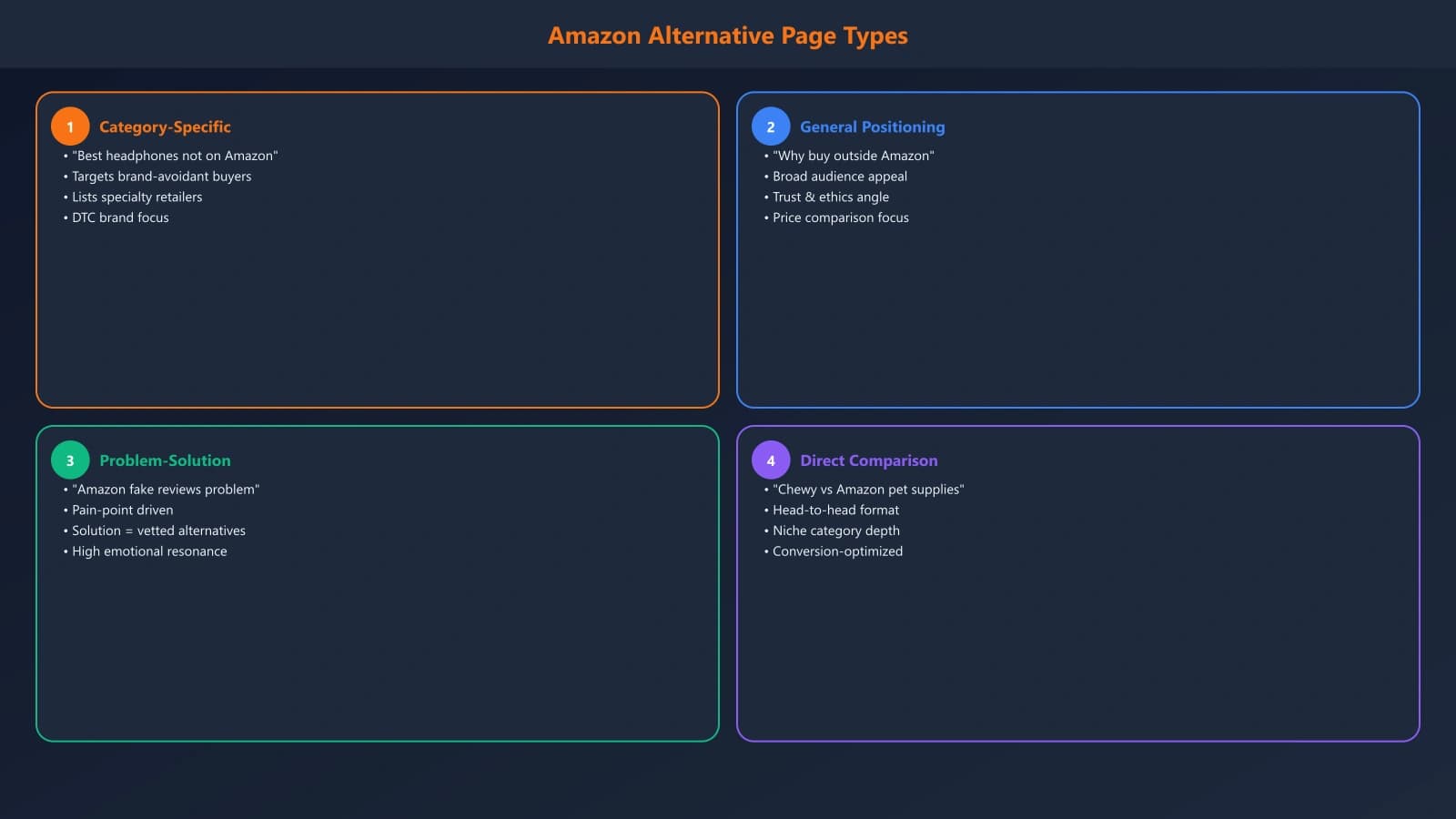
Category-specific alternative pages focus on individual product categories. “Buy Running Shoes Not on Amazon: 7 Better Options” targets a specific search while showcasing your category depth. These pages can rank for long-tail queries and serve high-intent traffic ready to buy in that category.
General “Why Shop With Us Instead of Amazon” pages make the case for your store overall. They're less likely to rank for specific queries but valuable for users who land elsewhere on your site and want to understand your differentiation. Include these in site navigation for easy discovery.
Problem-solution pages address specific Amazon concerns. “How to Guarantee Authentic [Product] (Why We're Safer Than Amazon)” targets shoppers motivated by counterfeit concerns. “Expert Advice That Amazon Can't Offer” targets those seeking specialized guidance.
Direct comparison pages work when you have branded query volume. “Shopping at [Your Store] vs Amazon: What's Different?” provides the comparison content these searchers want. Be honest—Amazon has advantages too—while highlighting where you genuinely win.
Capture Amazon Alternative Traffic
Generate comparison content that positions your store against Amazon authentically. Target shoppers actively looking for alternatives.
Try for Free
Content Approach That Converts
The content itself needs to acknowledge the elephant in the room: Amazon is convenient, cheap, and ubiquitous. You're not going to win by pretending those advantages don't exist. Instead, your content should honestly address the trade-offs.
Lead with understanding. Show that you get why someone might default to Amazon. “We know Amazon is the easy choice—Prime shipping, familiar checkout, seemingly every product available. There are good reasons it's the default.” This acknowledgment builds trust; dismissing Amazon's advantages feels defensive.
Then introduce the case for alternatives. Not “Amazon is bad” but “here's what you might be missing.” Present your advantages as positive reasons to choose differently, not negative attacks on Amazon. “When you buy from us, you get X, Y, and Z” is stronger than “Amazon doesn't offer X, Y, and Z.”
Be specific about your advantages. “Better service” is vague; “real humans answer the phone within 30 seconds, and they actually know our products” is concrete. “Quality selection” is generic; “we test every product ourselves and reject 40% of what vendors send us” is memorable.
Include social proof from customers who made the switch. Testimonials specifically mentioning the comparison—“I used to buy on Amazon but switched after discovering [Store]...”—are powerful because they narrate the exact journey you want readers to take.
Address the pricing question directly. If you're more expensive than Amazon (likely), explain the value proposition. “Yes, our prices are slightly higher. Here's what that difference gets you...” Hiding from the price comparison makes readers suspicious.
Highlighting Genuine Competitive Advantages
Different retailers have different advantages over Amazon. Identify yours and build content around them.
Expertise and curation matter for specialty categories. Amazon's algorithm optimizes for sales; your buyers curate for quality. If you have genuine product expertise—staff who use the products, formal training programs, relationships with manufacturers—that expertise is a differentiator worth emphasizing.
Customer service quality often exceeds Amazon in specialty retail. Real human support from knowledgeable staff, liberal return policies, product advice, after-purchase support—these are things Amazon's scale makes difficult. Quantify where you can: response times, satisfaction scores, return rates.
Authenticity guarantees address the counterfeit concern directly. If you're an authorized retailer, manufacturer, or have supply chain transparency Amazon's marketplace cannot match, make that explicit. “Every product ships directly from the manufacturer or our verified warehouse—zero third-party sellers.”
Community and values resonate with segments of shoppers. Supporting independent business, environmental practices, local employment, charitable giving—these factors matter to some consumers enough to outweigh Amazon's convenience. But be authentic; performative values backfire.
Specialized selection in your niche beats Amazon's breadth when depth matters. A fishing retailer carries products Amazon doesn't know exist. A specialty food store offers varieties Amazon can't source. If your selection advantage is real, make it visible.
SEO Implementation
Ranking for Amazon alternative queries requires typical SEO fundamentals plus some specific considerations.
Include target phrases naturally in titles and headings. “Buy [Product] Without Amazon: 10 Better Options” clearly targets the query while promising value. Avoid keyword stuffing—write for humans first, then ensure key phrases appear.
Build internal links from relevant product and category pages. When discussing products on your site, link to your Amazon alternative content where relevant: “Looking for more options? See our guide to the best places to buy [category] outside Amazon.”
Create content at multiple specificity levels. A general “Amazon alternatives” page captures broad queries; category-specific pages capture long-tail. Internal linking between these pages creates topical authority.
Update content regularly with fresh signals. Amazon's policies, pricing, and issues change; your content should reflect current reality. Outdated criticism or stale comparisons hurt credibility.
Consider featuring in industry roundups. Journalists and bloggers regularly write “Amazon alternatives” content. Having your own strong content makes you more likely to be included in these listicles, earning backlinks that improve domain authority.
Measuring Success
Track specific metrics to understand whether your Amazon alternative strategy is working.
Organic traffic to alternative-focused pages shows whether you're capturing search demand. Segment this traffic by query type—branded vs. generic, specific vs. general—to understand which content resonates.
Conversion rate from these pages indicates content effectiveness. High traffic with low conversion suggests a disconnect between what users expected and what they found. Low traffic with high conversion suggests you've found a valuable niche worth expanding.
Customer acquisition cost via this channel helps you evaluate ROI. If Amazon alternative content acquires customers more efficiently than paid advertising, that justifies continued investment.
Customer quality metrics matter too. Are customers acquired through Amazon alternative content higher-value? More loyal? Better fits for your ideal customer profile? Sometimes niche traffic outperforms volume traffic significantly.
Brand search lift can indicate whether alternative content is building awareness. If searches for your brand name increase alongside alternative content publication, you're achieving broader visibility.
Capturing the Amazon Skeptic
The market of consumers actively seeking Amazon alternatives is larger than most retailers realize. These aren't just price-sensitive shoppers looking for deals—they're often premium customers willing to pay more for values, expertise, or authenticity that Amazon can't provide.
Capturing this traffic requires content that meets these shoppers where they are. Acknowledge why Amazon is the default. Explain—specifically and credibly—why you're a better choice for their needs. Make the case honestly, including where Amazon might actually be the better option for some shoppers.
Start with one page targeting your strongest differentiation. If you're a specialty retailer with deep expertise, build content around that. If you're an authorized dealer solving counterfeit concerns, lead with authenticity. Let your genuine strengths drive the strategy.
The shoppers searching for Amazon alternatives have already done half the work—they've decided to look elsewhere. Your job is to be there when they look, with content that earns their click and their business.
For the complete e-commerce comparison strategy, see our E-commerce Comparison Playbook. And for category-level comparison content, explore our guide on e-commerce category listicles.

Product Manager at BestPage. Pioneer in AEO research since 2024, exploring the convergence of SEO and GEO (Generative Engine Optimization). Led multiple AI-powered content optimization projects that achieved 300%+ citation increases in ChatGPT and Perplexity.