

When someone searches “best running shoes for flat feet” or “iPhone 16 vs Samsung Galaxy S25,” they're ready to buy. These comparison-intent searches represent some of the highest-value organic traffic in e-commerce—users who have already decided to purchase and just need help picking the right product.
Yet most e-commerce sites either ignore comparison content entirely (focusing only on product pages) or execute it poorly with thin, SEO-stuffed content that doesn't actually help buyers. The result: affiliate sites and publishers capture traffic that could be going to retailers directly.
This playbook is for retailers and publishers who want to own comparison traffic in their categories. We'll cover everything from keyword research to page structure to the specific trust signals that convert e-commerce comparison visitors. Whether you're a DTC brand, a multi-brand retailer, or a publishing company with affiliate revenue, you'll find actionable tactics here.
For the SaaS perspective on comparison content, see our SaaS Comparison Page Playbook. Many principles overlap, but the execution details differ significantly.
The E-commerce Comparison Opportunity
Before diving into tactics, let's understand why comparison content deserves investment from e-commerce businesses.
The Traffic Value Reality
Comparison searches signal purchase intent. According to Google research, users who conduct comparison searches are 2.5x more likely to complete a purchase within 24 hours compared to general browsing behavior. They're past the “what should I buy?” phase and into “which one should I buy?”
The query patterns tell the story:
- “Best [product category] for [use case]” — Discovery with intent
- “[Product A] vs [Product B]” — Active comparison shopping
- “[Product] review 2026” — Final validation before purchase
- “[Product] worth it” — Overcoming last objections
Who Owns This Traffic Today
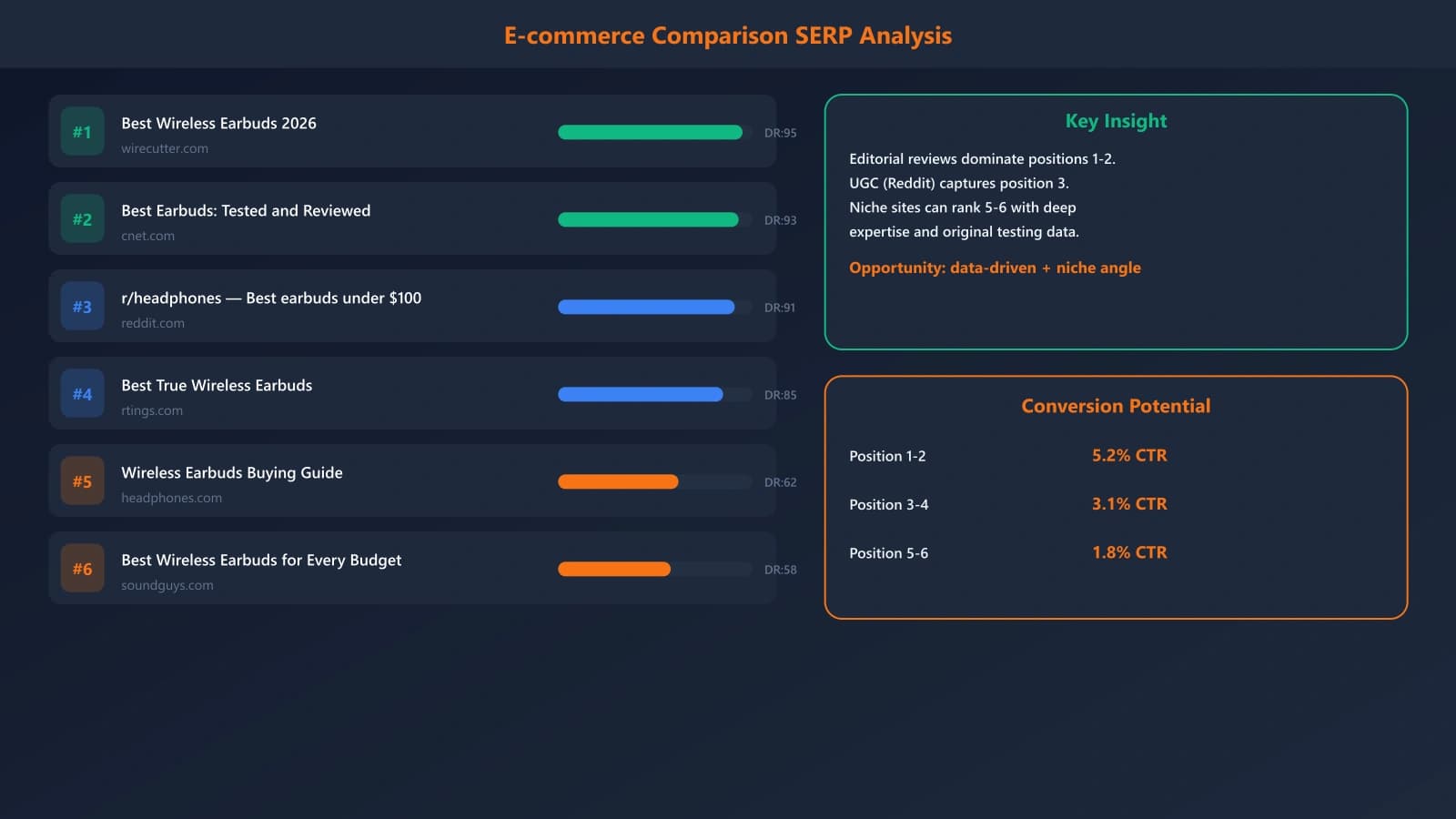
If you search most e-commerce comparison queries right now, you'll see:
- Publishers: Wirecutter, CNET, Tom's Guide, niche review sites
- Affiliate sites: Content built specifically to capture comparison traffic
- YouTube: Video comparisons increasingly appearing in web SERPs
- Reddit: User discussions ranking for “best X” queries
- Retailer buying guides: Best Buy, Amazon, category specialists
The opportunity: most retailers don't compete here. When they do, they often win because they have unique advantages—real inventory data, customer reviews, and the ability to sell directly.
Retailer Advantages in Comparison Content
Retailers have assets that publishers and affiliates can't match:
- Real inventory: “In stock now” is a powerful conversion signal
- Authentic reviews: Verified purchase reviews from real customers
- Current pricing: Accurate prices, not affiliate estimates
- Direct purchase: No redirect to another site to complete the transaction
- Return policies: Trust signals affiliates can't offer
E-commerce Comparison Query Research
Finding the right comparison queries to target requires understanding e-commerce-specific search patterns.
Query Type Taxonomy
E-commerce comparison queries fall into distinct categories, each requiring different page approaches:
| Query Type | Example | Page Format | Commercial Intent |
|---|---|---|---|
| Best-of category | “Best wireless earbuds 2026” | Ranked listicle | High |
| Best-for use case | “Best running shoes for beginners” | Filtered listicle | Very high |
| Head-to-head | “AirPods Pro 3 vs Sony WF-1000XM6” | Comparison page | Very high |
| Product review | “Dyson V15 review 2026” | Review page | High |
| Worth it queries | “Is Apple Watch Ultra 3 worth it” | Analysis page | Very high |
| Budget queries | “Best laptops under $500” | Price-filtered listicle | Very high |
Finding Comparison Opportunities
Use these methods to build your comparison keyword list:
- Internal search data: What comparisons are customers searching on your site?
- Review request patterns: What products do customers ask about before buying?
- Competitor analysis: What comparison content do Wirecutter and category specialists rank for?
- Keyword tools: Filter for “best,” “vs,” “review,” and “compare” modifiers
- Google Suggest: Auto-complete reveals real user patterns
- YouTube search: Video comparison queries often indicate web opportunities
Prioritization Framework
Not all comparison queries are worth pursuing. Prioritize based on:
- Inventory alignment: Do you actually carry these products?
- Search volume: Enough traffic to justify the effort
- Margin potential: Are these high-margin or commoditized products?
- Competition: Can you realistically rank against established players?
- Seasonal relevance: Gift guides, back-to-school, seasonal needs
Page Architecture for E-commerce Comparisons
The structure of e-commerce comparison pages differs from SaaS in key ways. Here's the architecture that works.
Above-the-Fold Essentials
E-commerce comparison visitors want immediate orientation:
- Clear H1: Matches search query exactly
- Quick picks summary: Top 3 recommendations with one-line reasons
- Visual product images: Hero shots of featured products
- Update timestamp: “Updated January 2026” signals freshness
- Jump links: Navigate to specific products or sections
Product Card Design
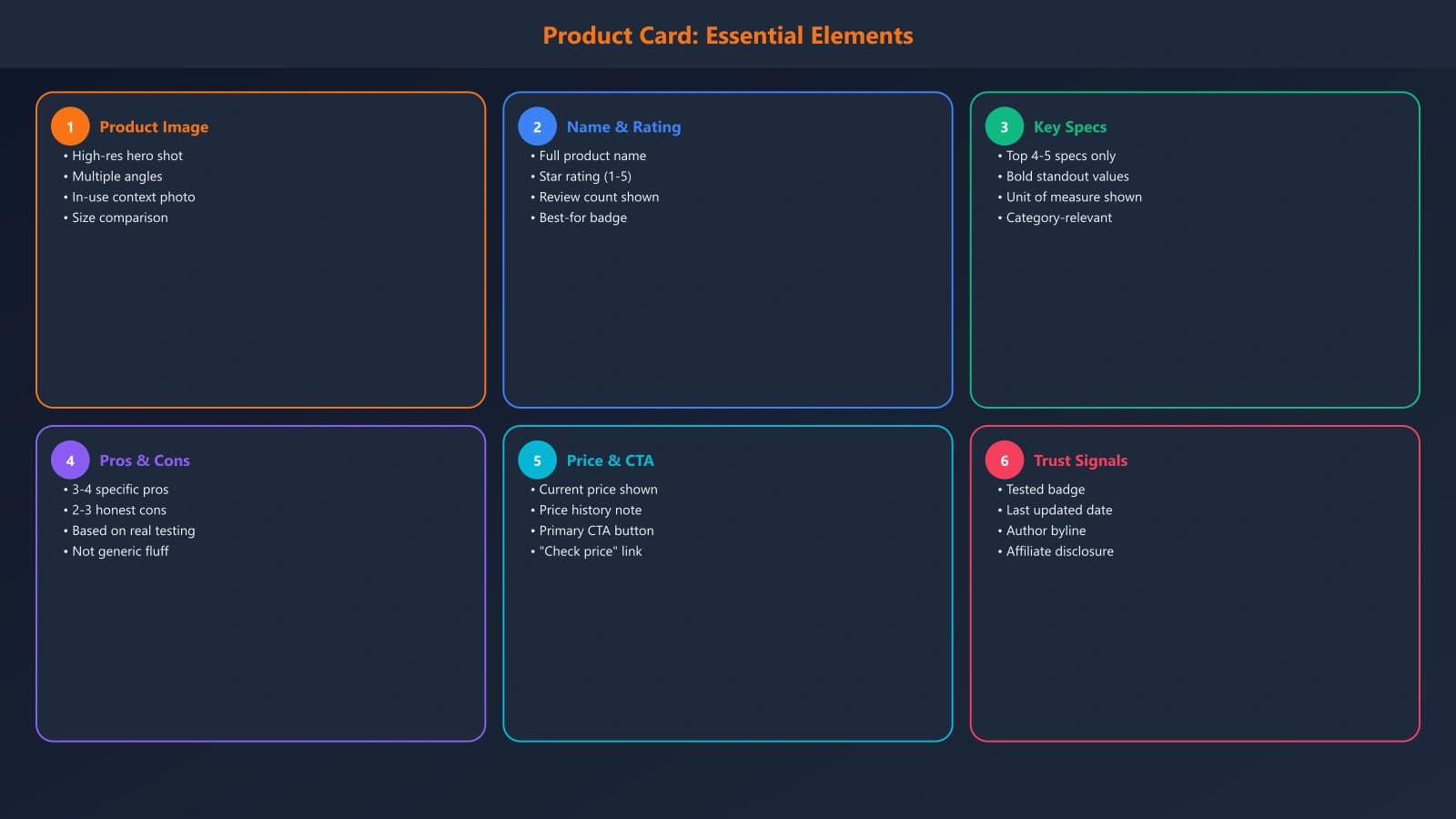
Each product in your comparison needs a structured presentation:
- Product image: High-quality hero shot
- Name and brand: Clear identification
- Price: Current, accurate pricing with sale indicators
- Rating: Star rating with review count
- Key specs: 3-5 most important specifications
- Best-for callout: Who this product is ideal for
- Pros/cons: Quick summary of strengths and weaknesses
- CTA: Clear path to product page or cart
Comparison Table Best Practices
Scannable comparison tables help users make decisions:
| Element | Best Practice | Why It Matters |
|---|---|---|
| Column limit | Maximum 5 products side-by-side | Prevents cognitive overload |
| Row organization | Most important specs first | Scannable without scrolling |
| Visual indicators | Icons for yes/no, color for best-in-class | Faster comprehension |
| Mobile design | Horizontal scroll or stacked cards | 50%+ traffic is mobile |
| Sticky header | Product names visible while scrolling | Maintains context |
Supporting Content Sections
Beyond the core comparison, include:
- How we tested/selected: Methodology builds credibility
- Buying guide: What to look for when shopping this category
- FAQ section: Common buyer questions (schema-optimized)
- Price tracking note: When prices were verified
- Related comparisons: Links to similar content
Build E-commerce Comparisons at Scale
Generate product comparison pages with built-in schema, conversion elements, and SEO optimization.
Try for Free
Schema Markup for E-commerce Comparisons
Proper schema implementation is essential for e-commerce comparison pages—it enables rich results that dramatically increase click-through rates.
Essential Schema Types
- Product schema: For each product mentioned with offers, ratings, and availability
- AggregateRating schema: Review scores from your product pages
- ItemList schema: For ranked listicles
- FAQPage schema: For FAQ sections
- Article schema: For the page itself
- BreadcrumbList: Navigation context
Product Schema Implementation
For each product in your comparison, include:
- name: Official product name
- image: Product image URL
- description: Brief product description
- brand: Manufacturer/brand name
- offers: Price, availability, URL to purchase
- aggregateRating: Your customer review data
- sku: Product identifier
ItemList for Ranked Comparisons
For “best of” listicles, ItemList schema enables carousel-style rich results:
- Wrap your ranked products in ItemList
- Include itemListElement for each product
- Use position property for rankings
- Link each item to its detailed section on the page
Trust Signals for E-commerce Comparisons
E-commerce comparison visitors need different trust signals than B2B buyers. Here's what works.
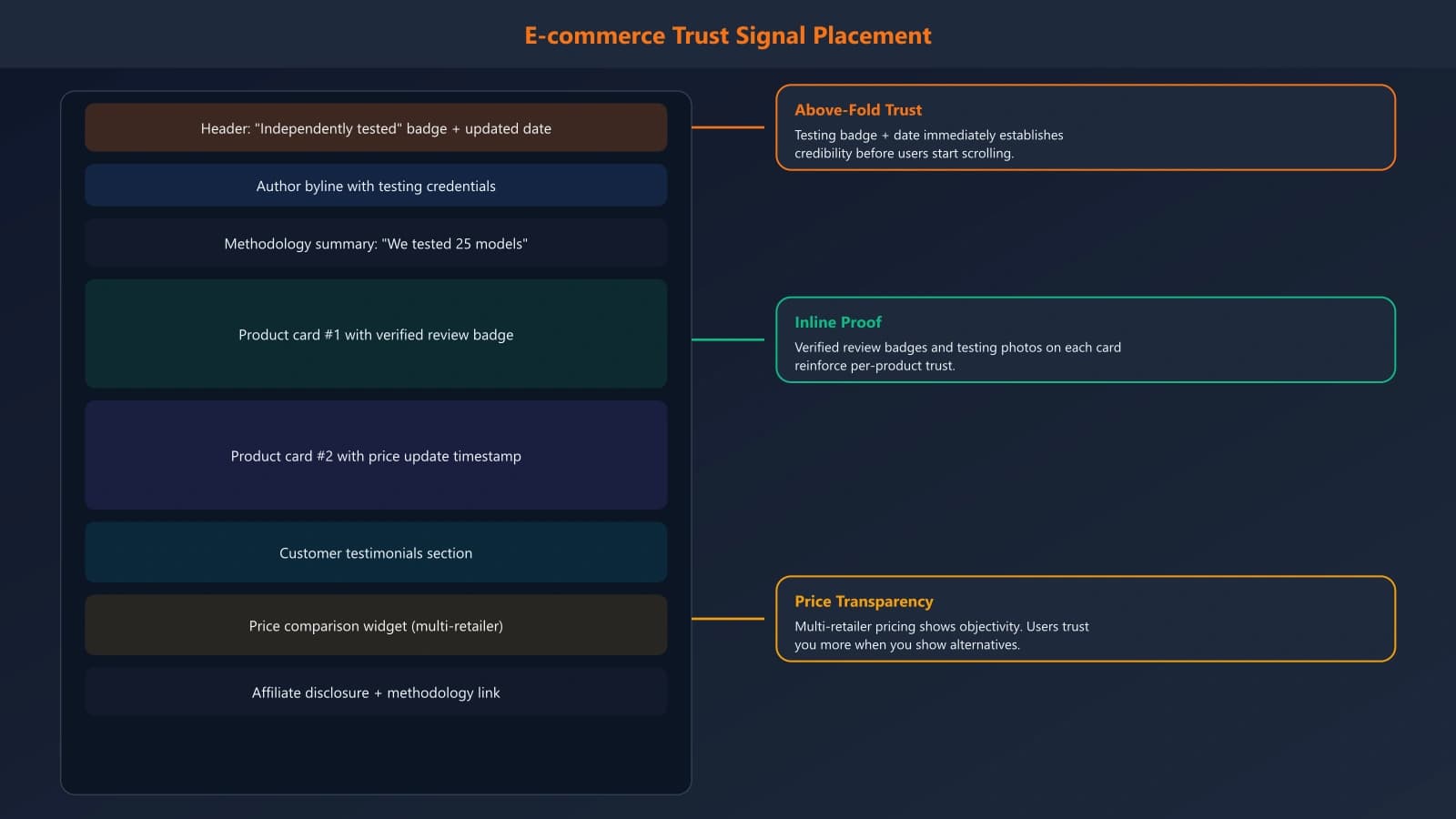
Authentic Review Integration
Your biggest asset is real customer reviews:
- Pull verified purchase reviews from your product pages
- Feature review quotes that address comparison concerns
- Show aggregate ratings with review counts
- Include “Verified Purchase” badges
- Display recent review dates for freshness signals
Testing Methodology
Explain how you evaluated products:
- If you tested directly: Describe your testing process and criteria
- If based on data: Cite sources—sales data, return rates, customer feedback
- Expert input: Feature quotes from category buyers or product experts
- Update frequency: How often you re-evaluate recommendations
Price Accuracy and Updates
Nothing destroys trust faster than wrong prices:
- Implement dynamic pricing from your product catalog
- Show price update timestamps
- Include sale/discount indicators
- Note when prices were last verified
Conversion Optimization
The goal isn't just traffic—it's purchases. Here's how to optimize comparison pages for conversion.
CTA Strategy
Balance helpfulness with clear purchase paths:
- Primary CTAs: “View Details,” “Check Price,” “Add to Cart”
- Placement: On each product card and at page end
- Mobile optimization: Thumb-friendly tap targets
- Urgency signals: Stock levels, sale deadlines (only if real)
Quick Picks Section
Many visitors want a fast answer. A “Quick Picks” section near the top captures impatient shoppers:
- Best Overall: Your top recommendation
- Best Value: Best performance for the price
- Best Budget: Best option under [price point]
- Best Premium: Best regardless of price
For more on quick picks optimization, see our guide on quick picks section design.
Managing Exit Paths
Control how users leave the comparison page:
- Product page links should open the path to purchase
- External links (if any) should be minimal and open in new tabs
- Related comparison links keep users in your ecosystem
- Category links for users not finding what they need
SEO Strategy for E-commerce Comparisons
Ranking e-commerce comparison content requires specific optimization tactics.
Title and URL Patterns
Effective patterns for e-commerce:
- Best-of: “7 Best [Category] of 2026 (Tested & Reviewed)”
- Comparison: “[Product A] vs [Product B]: Which Should You Buy?”
- Budget: “Best [Category] Under $[Price] (2026 Picks)”
- URLs: /compare/[category]-buying-guide or /best/[category]
Internal Linking Strategy
Build an interconnected comparison ecosystem:
- Comparison pages link to individual product pages
- Product pages link back to relevant comparisons
- Category pages link to comparison content
- Related comparisons cross-link
- Navigation includes comparison/buying guide sections
Freshness Optimization
E-commerce comparisons require regular updates:
- Price updates: Ideally dynamic, at minimum monthly
- Product launches: Add new products as they release
- Discontinuations: Remove or note discontinued products
- Seasonal refresh: Update for gift guides, back-to-school, etc.
- Annual major update: Full content review yearly
Affiliate Revenue Considerations
For publishers and retailers with affiliate programs, comparison content offers significant revenue potential.
Disclosure Requirements
FTC guidelines require clear disclosure:
- Affiliate disclosure visible before any affiliate links
- Clear language: “We may earn commission from purchases made through our links”
- Disclosure in proximity to affiliate links, not just footer
- Consistent disclosure across all comparison content
Balancing Revenue and Trust
Affiliate incentives can create bias. Maintain credibility by:
- Including products that don't pay affiliate commissions
- Recommending the best products, not the highest-paying
- Acknowledging when a competitor is genuinely better
- Transparent about testing methodology
AI Search Visibility
E-commerce comparison content increasingly appears in AI Overviews and LLM responses. Here's how to optimize.
What AI Systems Extract
AI systems favor e-commerce content with:
- Clear recommendations: “The best [category] is [product] because...”
- Structured specifications: Tables and lists with specific data
- Price information: Specific prices and value comparisons
- Use case matching: “Best for [specific need]” statements
- Recent dates: 2026 in titles and content
Entity Optimization
Help AI systems understand your product coverage:
- Use canonical product names consistently
- Include brand names alongside product names
- Reference official product pages/specs
- Implement complete Product schema
For more on AI visibility for comparison content, see our guide on how listicles get cited by AI Overviews.
Implementation Roadmap
Here's a phased approach to launching e-commerce comparison content.
Phase 1: Foundation (Weeks 1-2)
- Audit existing comparison content (if any)
- Research top 20 comparison queries in your categories
- Define page templates and component designs
- Set up schema markup framework
- Establish content update processes
Phase 2: Build (Weeks 3-6)
- Create 5-10 priority comparison pages
- Implement product data integration
- Set up review pull from product pages
- Build internal linking structure
- Launch initial pages and monitor performance
Phase 3: Scale (Ongoing)
- Expand to additional categories and queries
- Implement programmatic generation for long-tail
- Establish seasonal content calendar
- Build competitive monitoring for SERP changes
- Optimize based on performance data
Winning E-commerce Comparison Traffic
E-commerce comparison content represents a significant, often underexploited opportunity for retailers and publishers. The users searching these queries are ready to buy—they just need help deciding what.
The key principles:
- Own your categories: Build comparison content for products you sell
- Leverage your assets: Real prices, real reviews, real inventory
- Structure for scanners: Quick picks, comparison tables, visual products
- Implement proper schema: Rich results drive significantly higher CTR
- Maintain freshness: Stale e-commerce content loses trust and rankings
- Optimize for conversion: Clear paths from comparison to purchase
- Think AI-first: Structure content for AI citation alongside traditional SEO
Start with your highest-margin, highest-volume categories. Build comparison content that genuinely helps shoppers make decisions. The traffic and revenue will follow.
For supporting content on specific aspects of comparison strategy, explore:
- Product Roundups That Drive Traffic and Revenue
- Quick Picks: Capture Impatient Visitors Instantly
- Trust Signals That Actually Lift Conversions
- Keyword to Page Type Mapping Framework

Product Manager at BestPage. Pioneer in AEO research since 2024, exploring the convergence of SEO and GEO (Generative Engine Optimization). Led multiple AI-powered content optimization projects that achieved 300%+ citation increases in ChatGPT and Perplexity.