

The product roundup is perhaps the most crowded content format on the internet. Search “best wireless headphones” and you'll find dozens of publications, from Wirecutter to random affiliate blogs, all competing for the same traffic with similar lists.
Yet despite the competition, product roundups remain one of the highest-ROI content investments for publishers and retailers. The math is simple: comparison-intent traffic converts at 2-5x the rate of informational content, and a single well-ranking roundup can generate revenue for years with periodic updates.
The challenge is execution. Google's helpful content updates have raised the bar significantly—thin roundups built from manufacturer specs and affiliate links no longer perform. What works now is demonstrable expertise, structured content that earns rich results, and layouts optimized for both search and conversion.
This guide covers how to build product roundups that perform in 2026. For the broader strategic context, see our E-commerce Comparison Playbook.
The Economics of Product Roundups
Understanding the business case helps prioritize effort. Here's how roundup economics work.
Traffic Value by Category
Not all product roundups are equal. Traffic value varies dramatically by category:
| Category | Typical CPM | Affiliate Potential | Competition Level |
|---|---|---|---|
| Consumer electronics | $15-25 | High (3-8% commission) | Very high |
| Home goods | $10-20 | Medium (4-8% commission) | High |
| Fashion/accessories | $8-15 | Medium (5-10% commission) | High |
| B2B software | $25-50 | Very high (10-30% commission) | Medium |
| Niche hobbies | $5-15 | Variable (3-15%) | Low-Medium |
Content Longevity
Product roundups have exceptional longevity compared to news content:
- Initial ramp: 3-6 months to reach stable rankings
- Peak performance: 12-24 months with proper maintenance
- Maintenance burden: Quarterly updates to maintain rankings
- Evergreen potential: “Best [category]” queries persist year after year
A well-executed roundup can drive consistent traffic for 3-5+ years with regular updates, making the initial investment highly worthwhile.
Content Differentiation That Matters
With hundreds of competing roundups, differentiation is survival. Here's what separates performers from also-rans.
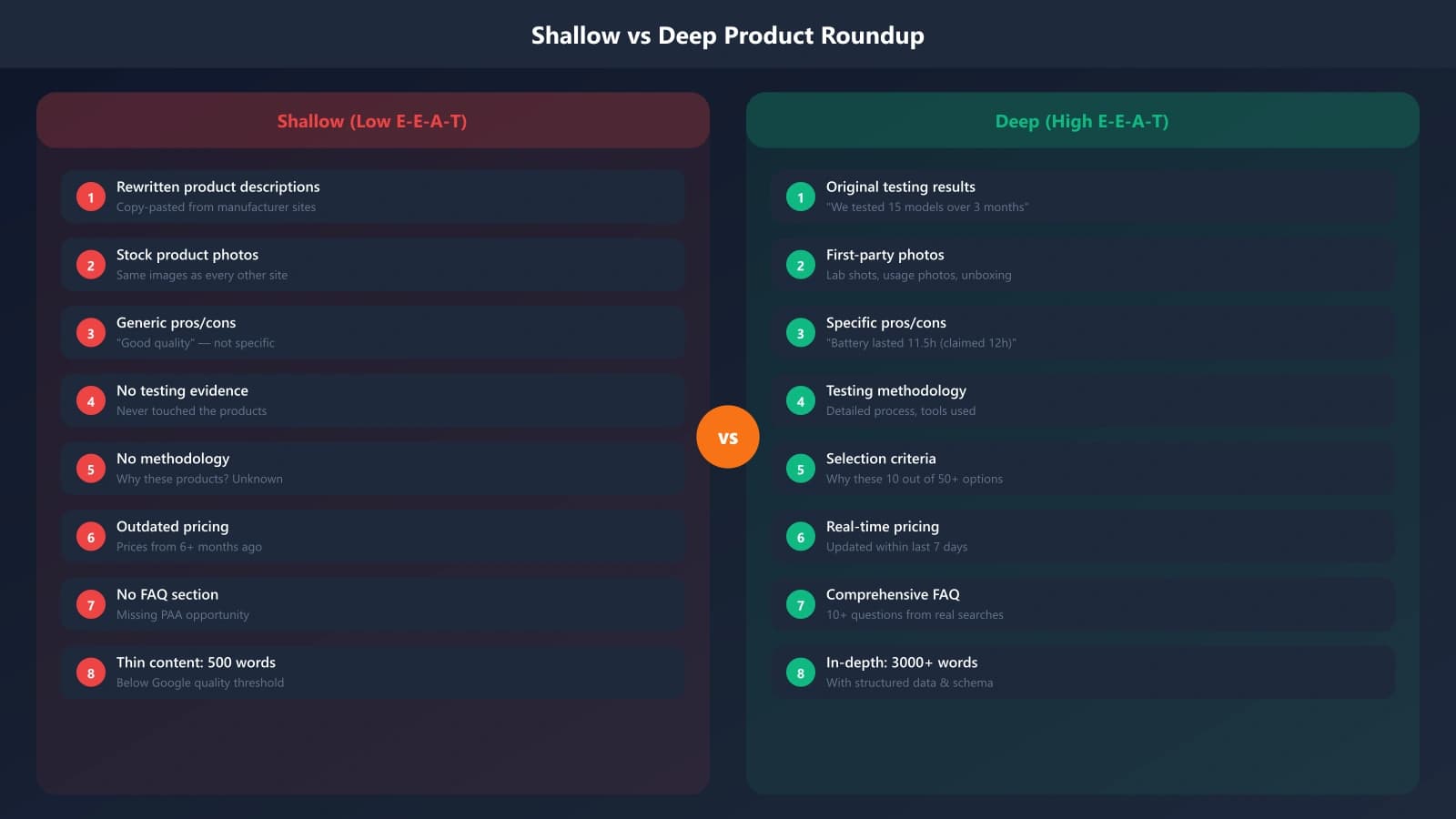
Genuine Expertise Signals
Google's helpful content guidelines emphasize expertise. Show yours through:
- Hands-on testing: “We tested 15 headphones over 3 weeks”
- Unique data: Performance measurements, comparison charts from actual testing
- Expert credentials: Author bios that establish category expertise
- Specific observations: Details only someone who used the product would know
- Honest limitations: Acknowledging products you couldn't test
Original Visual Content
Stock photos and manufacturer images are table stakes. Differentiate with:
- Original photography from testing
- Comparison images (products side-by-side)
- Custom infographics summarizing findings
- Video content (increasingly important for AI Overviews)
- Charts and data visualizations from testing
Content Depth Markers
Signals that indicate comprehensive coverage:
- How-we-tested methodology section
- Detailed pros/cons for each product
- Use case matching (“best for [specific need]”)
- FAQ section addressing real buyer questions
- Buying guide explaining selection criteria
Structure for Rankings and Conversions
The structure of your roundup affects both search performance and affiliate revenue. Here's the optimal architecture.
Page Structure Blueprint
- Hero section — Title, update date, author credentials
- Quick picks — Top 3 recommendations with one-line summaries
- Jump navigation — Links to each product and major sections
- Testing methodology — Brief explanation of evaluation process
- Product entries — Individual product sections with consistent format
- Comparison table — Side-by-side specs for all products
- Buying guide — What to consider when choosing
- FAQ section — Common questions (schema-marked)
- Update log — History of content updates
Product Entry Format
Each product in your roundup needs consistent coverage:
- Product name and brand (H3 heading)
- Best-for callout: “Best for: [specific use case]”
- Hero image: Original if possible, high-quality if not
- Key specs: 4-6 most important specifications
- Pricing: Current price with retailer
- What we like: 2-4 specific positives
- What we don't: 1-2 honest drawbacks
- Verdict: 2-3 sentence summary of who should buy
- CTA: Check price / View at [retailer]
Quick Picks Optimization
The quick picks section captures impatient visitors and improves time-on-page:
- Position immediately after introduction
- Include 3-4 picks maximum
- Use clear differentiation (Best Overall, Best Value, Best Budget, etc.)
- Include price and primary CTA
- Link to full review section below
For detailed quick picks strategy, see our guide on quick picks section optimization.
SEO Implementation
Technical SEO execution makes the difference between page 1 and page 5.
Schema Markup Requirements
Implement these schema types for maximum rich result eligibility:
- ItemList schema: For the ranked list of products
- Product schema: For each individual product with offers
- Review schema: If you provide ratings/scores
- FAQPage schema: For FAQ section
- Article schema: For the page itself
Title and Meta Optimization
Effective patterns for roundup titles:
- “[Number] Best [Category] of 2026 (Tested & Reviewed)” — Establishes expertise
- “Best [Category]: [Number] Top Picks for [Use Case]” — Targets specific intent
- “[Number] Best [Category] Under $[Price] (2026)” — Price-focused queries
Meta descriptions should include:
- Number of products reviewed
- Top pick mention
- Update recency
- Expertise signal (“tested,” “expert picks”)
URL Structure
Keep URLs clean and keyword-focused:
- Good: /best-wireless-headphones/
- Good: /reviews/best-running-shoes-2026/
- Avoid: /blog/2026/01/15-best-wireless-headphones-for-working-out/
Generate Product Roundups at Scale
Build SEO-optimized product roundups with proper schema, conversion elements, and content depth built in.
Try for Free
Conversion Optimization
Traffic without conversion is just expense. Here's how to maximize affiliate and commerce revenue.
CTA Placement Strategy
- Quick picks: High-visibility CTAs for each top pick
- Product sections: CTA at end of each product entry
- Comparison table: CTAs in table for each product
- Sticky element: Consider sticky CTA for top pick on long pages
- Page conclusion: Final recommendation with strong CTA
Affiliate Link Optimization
- Multiple retailers: Offer links to multiple stores when possible
- Price visibility: Show current prices (dynamically updated if possible)
- Clear labeling: Users should know where the link takes them
- Mobile optimization: Ensure CTAs are tap-friendly
Trust Elements That Convert
- Testing photos: Real photos from your testing process
- Expert author: Photo and credentials of writer
- Update timestamps: Show when content was last verified
- Methodology transparency: Explain how you selected products
- Disclosure visibility: Clear affiliate disclosure builds trust
Maintenance and Update Strategy
Product roundups require ongoing maintenance to maintain rankings and revenue.
Update Schedule
| Update Type | Frequency | What to Check |
|---|---|---|
| Price verification | Monthly | Prices, availability, link validity |
| Product refresh | Quarterly | New releases, discontinued products |
| Content update | Semi-annually | Rankings, recommendations, methodology |
| Full refresh | Annually | Complete re-evaluation, new testing |
Freshness Signals
- Update timestamps visible in content
- Year in title (update annually)
- Update log section showing revision history
- “Newly added” labels for recent product additions
- Price accuracy notes (“Prices verified [date]”)
AI Search Optimization
Product roundups increasingly appear in AI Overviews and LLM responses. Optimize for these channels.
Elements AI Systems Extract
- Clear recommendations: “The best [category] is [product] because...”
- Structured comparisons: Tables with specific data points
- Price information: Specific pricing with context
- Use case matching: Explicit “best for [need]” statements
- Expert rationale: Reasoning behind recommendations
AI-Friendly Content Structure
- Clear hierarchy with descriptive headings
- Summary statements at section starts
- Bullet points for key comparisons
- Tables for specification data
- FAQ format for common questions
For comprehensive AI visibility strategy, see our guide on how listicles get cited by AI Overviews.
Building Sustainable Roundup Success
Product roundups remain one of the most valuable content formats for publishers and retailers—when executed properly. The days of thin, affiliate-stuffed content are over. What works now requires genuine investment in expertise, original content, and ongoing maintenance.
Key takeaways:
- Differentiate through expertise: Testing, original photography, unique data
- Structure for both search and conversion: Quick picks, consistent format, strategic CTAs
- Implement proper schema: Rich results significantly increase CTR
- Maintain actively: Quarterly updates minimum to retain rankings
- Optimize for AI: Structure content for extraction by LLMs
- Balance revenue and trust: Short-term affiliate optimization destroys long-term authority
The investment in quality pays compound returns. A well-executed roundup can drive traffic and revenue for years, making it one of the highest-ROI content investments available.
For the broader e-commerce content strategy, see our E-commerce Comparison Playbook. And for specific optimization tactics, explore our guides on quick picks optimization and trust signals for comparison pages.

Product Manager at BestPage. Pioneer in AEO research since 2024, exploring the convergence of SEO and GEO (Generative Engine Optimization). Led multiple AI-powered content optimization projects that achieved 300%+ citation increases in ChatGPT and Perplexity.