
Search “best running shoes” and count how many e-commerce sites appear on page one. Usually? Zero. Maybe one. The results are dominated by publishers, review sites, and aggregators. Yet the user searching that query almost certainly intends to buy running shoes—they're just getting funneled through intermediaries first.
This is a massive missed opportunity for retailers. The “best [product]” search represents high-intent traffic at the top of the purchase funnel. Winning even a portion of that traffic means acquiring customers earlier in their journey, before they've been influenced by affiliate-driven recommendations.
The conventional wisdom says retailers can't compete for this traffic because Google prefers “editorial” content over product listings. That's partially true but misses the bigger picture. Retailers lose because they don't create the right kind of content—not because Google is biased against commerce.
This guide shows how e-commerce sites can create category listicles that genuinely compete with aggregators. For the complete e-commerce comparison strategy, see our E-commerce Comparison Playbook.
Advantages Retailers Have Over Aggregators
Before we talk strategy, let's acknowledge what retailers bring to the table that aggregators simply cannot match.
You have real sales data. You know which products actually sell well, which ones get returned, and which ones customers reorder. This is ground truth that no amount of editorial research can replicate. When Wirecutter says a product is the “best overall,” they're guessing based on limited testing. When you have data on 50,000 purchases, you actually know.
You have authentic customer reviews at scale. Not three reviews from staff testers—hundreds or thousands of reviews from actual buyers who used the product in real life. This review corpus is enormously valuable for both understanding product quality and for SEO purposes. According to Bazaarvoice research, pages with user-generated reviews convert 3.5x better than those without.
You have current inventory and pricing. Aggregators recommend products that might be out of stock or whose prices have changed. You can show what's actually available right now, at the actual current price. This real-time accuracy is something publishers fundamentally cannot offer.
You can fulfill the purchase immediately. The user journey from discovery to purchase can happen entirely on your site. No clicking through affiliate links, no searching for the product on another site—just add to cart and check out. That frictionless path has real value.
The question isn't whether retailers have advantages—they clearly do. The question is how to structure content that communicates those advantages to both users and search engines.
Content Structure That Competes
The typical e-commerce category page is a product grid with filters. That's not what ranks for “best [product]” queries. To compete with aggregators, you need content that looks and feels like editorial guidance while leveraging your commerce capabilities.
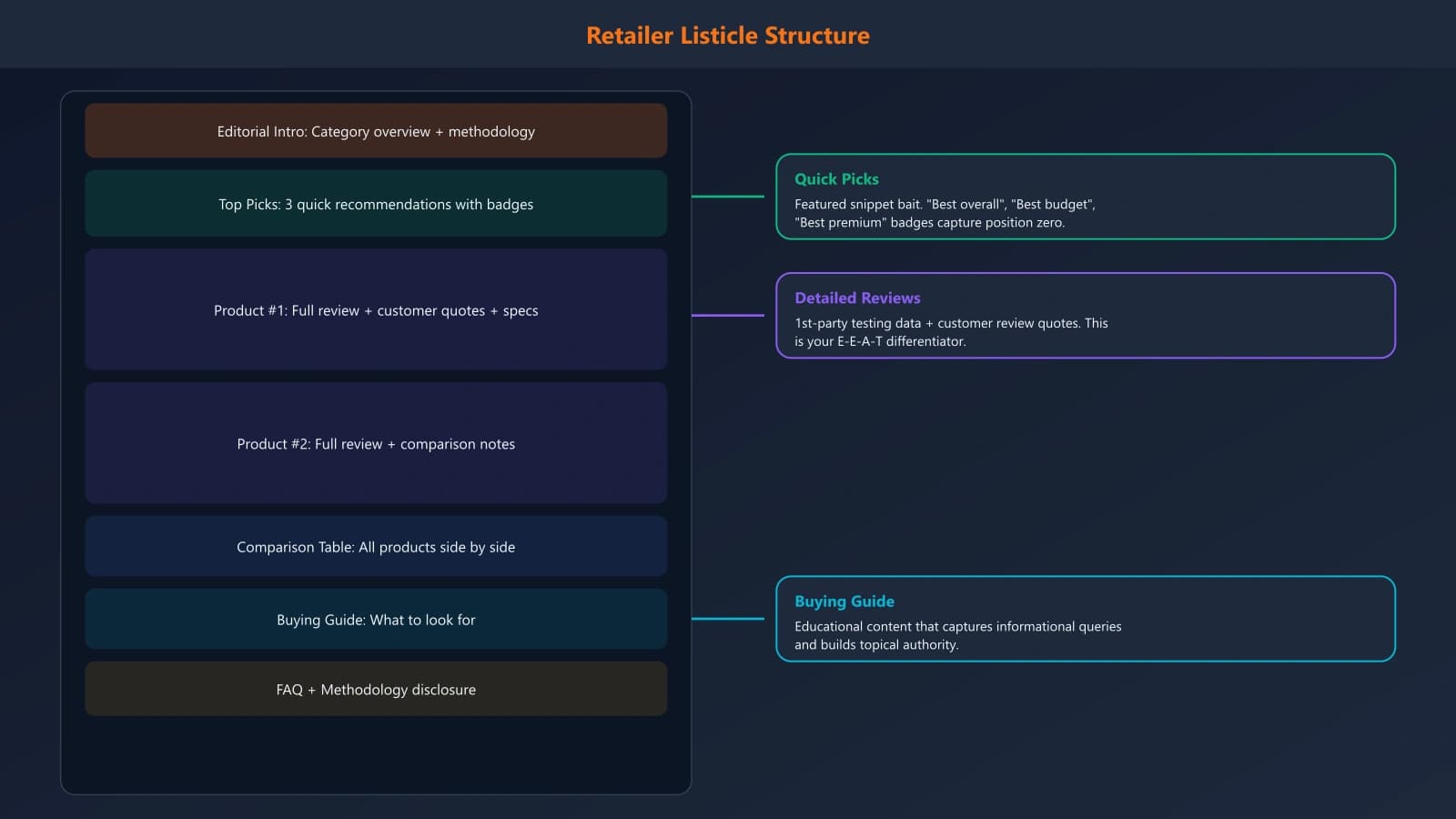
Start with an editorial introduction that demonstrates expertise. Don't just list products—explain how you evaluated them. What makes a great running shoe? What factors should buyers prioritize? This establishes your authority and signals to Google that this isn't just a product listing page.
Include a clear “top picks” section near the top. This answers the user's core question quickly: what should I buy? Three to five recommendations with brief explanations of why each is best for different needs. Users who want quick answers get them; users who want deeper research can keep scrolling.
Follow with detailed coverage of each recommended product. Not just specs—actual editorial perspective on who the product is best for, what users love about it, and honest discussion of limitations. Pull from your customer reviews to add authentic voices: “Customers consistently mention the exceptional cushioning, with one calling it ‘like running on clouds.’”
Include a comparison section that helps users differentiate. This could be a table comparing key specs across your top picks, or prose that explains the trade-offs between different options. Make the comparison specific and actionable.
End with buying guidance that addresses common questions. How should runners choose between stability and neutral shoes? What's the right price range for different commitment levels? This educational content both helps users and signals expertise to search engines.
Leveraging Your Data Advantages
Here's where retailers can truly differentiate: using proprietary data that aggregators simply don't have access to.
Sales velocity is a powerful signal. When you say “our bestselling running shoe for the third consecutive quarter,” that's a claim no aggregator can make. It's credible because it's based on actual purchase behavior, not editorial opinion. Incorporate sales-based signals into your recommendations—bestsellers, trending products, most-wished-for items.
Return rate data tells you about quality in a way that brief testing cannot. Products with exceptionally low return rates are doing something right. Products with high returns have issues that might not show up in a two-week test. You can use this data to inform recommendations without necessarily publishing the specific numbers.
Customer reviews provide both quantitative signals (average rating, rating distribution) and qualitative insights (what do customers consistently praise or criticize?). Mine your reviews for patterns that inform your editorial perspective. When 40% of reviews mention exceptional durability, that's worth highlighting.
Repeat purchase data reveals products that satisfy customers enough that they buy again. For consumables or products with limited lifespans, high repeat rates are a strong quality signal. “60% of customers who buy this product order it again within six months” is compelling evidence of quality.
Present this data credibly. Phrases like “based on X thousand customer reviews” or “analyzing two years of sales data” establish that your recommendations have empirical foundations that opinion-based reviews cannot match.
Generate Category Listicles That Beat Aggregators
Build best-of pages that leverage your retailer advantages—real sales data, authentic reviews, immediate fulfillment—to outrank publishers.
Try for Free
Integrating Commerce Without Killing UX
One reason retailers struggle with comparison content is the tension between editorial helpfulness and commercial intent. Users sense when they're being sold to rather than helped, and it undermines trust.
The key is letting editorial value lead while making commerce seamlessly available. Don't interrupt product descriptions with aggressive buy buttons. Instead, make purchase options natural and convenient—visible but not pushy.
Consider a product card format that shows the product image, a brief editorial summary, the price, and a subtle “View Product” link. The focus is on the editorial content; the commerce functionality is there when wanted. Compare this to aggressive “BUY NOW” buttons after every sentence—one builds trust, the other destroys it.
Include real-time inventory status. “In stock” or “Ships tomorrow” signals are genuinely helpful to users making purchase decisions. They're also signals of commerce capability that aggregators can't match. But present them as helpful information, not sales pressure.
Enable quick add-to-cart for users ready to buy without making it the visual focus. Some users will know exactly what they want after reading your recommendation—let them add to cart efficiently. Others are still researching—don't make them feel pressured.
The test is whether the page would still be valuable if you removed all commerce functionality. If it would still help users make a decision, you've got the balance right. If it would feel empty without the buy buttons, you've prioritized commerce over content.
SEO Strategy for Retailer Listicles
Competing with established aggregators requires smart SEO strategy, not just good content. You're typically facing domains with significant authority advantages.
Start with long-tail targeting. You're unlikely to immediately rank for “best running shoes”—but “best running shoes for flat feet” or “best running shoes under $100” are more achievable. Build authority through these specific variations before tackling head terms. According to analysis from Ahrefs, long-tail keywords often have higher conversion rates despite lower volume.
Create topical clusters around your category pages. A main “best running shoes” page supported by specific pages for different audiences (beginners, marathoners, trail runners) creates topical depth that signals expertise. Internal linking between these pages passes authority and helps users navigate to the most relevant content.
Optimize for featured snippets and AI citations. Structure your content with clear summaries, bulleted recommendations, and direct answers to common questions. These formats are more likely to be extracted for featured snippets in traditional search and citations in AI-powered search. For more on this, see our guide on getting cited by AI.
Update content regularly with fresh signals. Aggregators often let content age between major refreshes. You can update with new products, current pricing, recent review insights, and seasonal relevance. Regular updates signal freshness to search engines and keep content accurate for users.
Build internal links from your product pages to your listicles. Every product page in the category should link to the relevant listicle with anchor text like “See how this compares to our top picks.” This passes authority from your (presumably strong) product pages to your (newer) editorial content.
Building Credibility and Trust
Users are naturally skeptical of retailers recommending products. They know you have commercial incentives. Your content needs to overcome this skepticism through demonstrated expertise and honesty.
Acknowledge products you don't carry when relevant. If you're recommending the best running shoes but don't stock certain popular options, say so. “We don't currently carry Brand X, but if you're specifically looking for [feature], it's worth considering.” This honesty increases trust in your other recommendations.
Be transparent about your selection process. Explain how products make it onto your list. Is it purely sales-based? Editorial curation? A combination? Users appreciate understanding your methodology, and it differentiates you from aggregators who rarely explain their criteria.
Include critical perspectives, not just praise. Every product has trade-offs. When you mention that the best overall running shoe “runs slightly narrow—consider sizing up if you have wide feet,” you demonstrate honesty that pure promotional content lacks.
Attribute claims to sources. “Based on analysis of 12,847 customer reviews” or “according to our in-house product experts” gives claims credibility that unsourced assertions lack. Users can evaluate the authority of your claims when they know where they come from.
Measuring Listicle Performance
Category listicles need different success metrics than typical e-commerce pages. You're measuring both content performance and commerce contribution.
Track organic traffic specifically to listicle pages. Are you capturing search traffic that would otherwise go to aggregators? Growth in this metric indicates your content is becoming competitive.
Measure assisted conversions, not just direct conversions. Listicle pages often introduce products to users who then navigate elsewhere to purchase. Attribution modeling should capture when the listicle was part of a customer's path to purchase, even if not the last click.
Monitor engagement metrics as content quality signals. Time on page, scroll depth, and click-through to product pages indicate whether users are finding your content valuable. High bounce rates might suggest content doesn't match user expectations.
Compare conversion paths. Are users who visit your listicle before purchasing higher-value customers? Do they return more often? Buy more items? Understanding the long-term value of listicle-acquired customers helps justify content investment.
Track ranking progress for target keywords. It takes time to build authority, so month-over-month ranking improvements are a leading indicator that your strategy is working, even before traffic materializes.
Competing on Your Terms
Retailers have been ceding “best [product]” traffic to aggregators for too long. The conventional wisdom that Google prefers publishers is a half-truth—Google prefers helpful content, and retailers can create content that's genuinely more helpful than what aggregators offer.
Your advantages are substantial: real sales data, authentic customer reviews, current inventory, and frictionless purchase paths. The challenge is packaging these advantages into content that reads as editorial guidance rather than product promotion.
Start with one category where you have deep expertise and rich data. Create a single listicle that demonstrates what's possible when retailer data meets editorial execution. Learn from its performance, refine your approach, then expand to additional categories.
The goal isn't to replace your category pages with listicles—it's to add a content layer that captures search intent your current pages miss. Users searching “best running shoes” want guidance; users searching “Nike Pegasus 41” want a product page. Serve both needs with the right content types.
For the complete e-commerce comparison strategy, see our E-commerce Comparison Playbook. And for competing specifically on Amazon alternative searches, explore our Amazon alternatives strategy guide.

Product Manager at BestPage. Pioneer in AEO research since 2024, exploring the convergence of SEO and GEO (Generative Engine Optimization). Led multiple AI-powered content optimization projects that achieved 300%+ citation increases in ChatGPT and Perplexity.