
Put yourself in the shoes of a VP of Sales evaluating CRM software. You've got a budget to justify, a team to onboard, and a boss who will remember if this decision goes sideways. You land on a vendor's comparison page. What do you see? “Trusted by 10,000+ companies!” and a grid of logos you half-recognize. Does that make you feel confident? Probably not.
B2B software buyers are different from consumer buyers—and their trust requirements are different too. They're spending company money, often with multiple stakeholders watching. They need to justify their decisions in meetings and reports. Vague claims and impressive-sounding numbers aren't enough. They need proof that holds up to scrutiny.
In our SaaS Comparison Page Playbook, we covered the overall framework for building comparison content that converts. This article goes deep on one critical layer: the specific trust signals that convince skeptical enterprise evaluators to take the next step. These aren't the same trust signals that work on landing pages or product pages—they're tailored for the comparison context where buyers are actively weighing alternatives.
Why B2B Buyers Don't Trust Your Comparison Page
Let's be honest about the fundamental problem: when a prospect lands on your comparison page, they know you're not neutral. You're a vendor with an obvious interest in making yourself look good. Every claim you make gets filtered through that lens.
According to Gartner research, 75% of B2B buyers describe the purchasing process as “very complex or difficult.” Part of that complexity is separating legitimate information from vendor spin. Your comparison page starts at a credibility disadvantage—you have to earn trust actively.
Common Trust Signal Failures
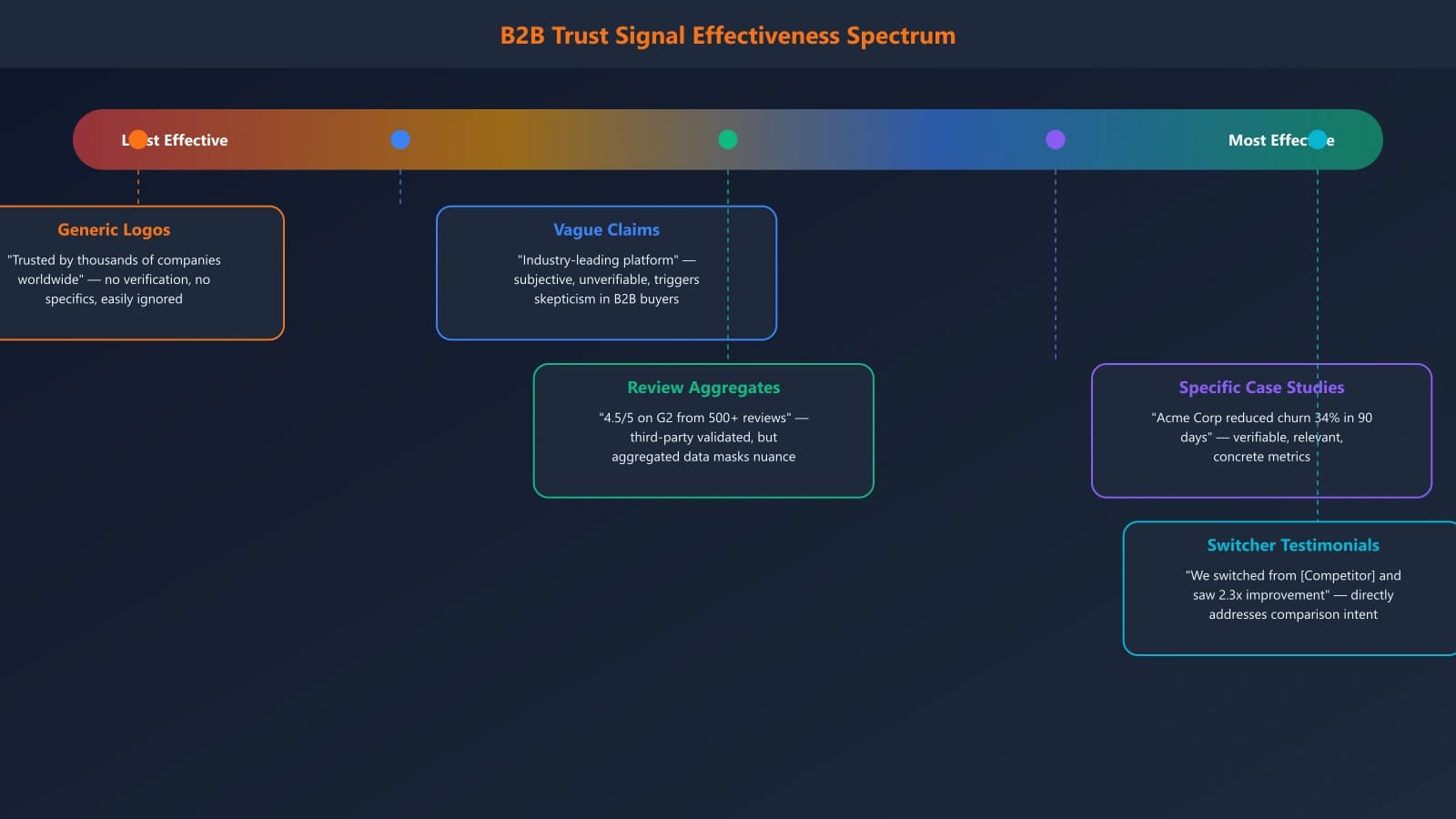
Most comparison pages try to build trust, but they use signals that sophisticated buyers immediately discount:
- “Trusted by X companies” — What kind of companies? Doing what? This is too vague to verify or relate to.
- Logo grids — Unless those logos are deeply relevant to the reader's industry and company size, they're wallpaper.
- Star ratings without context — 4.7 stars means nothing without knowing how many reviews, from what type of customers, compared to what alternatives.
- Generic testimonial quotes — “Great product, love it!” tells evaluators nothing useful.
- Internal awards — “Voted Best Product by Our Marketing Team” isn't credible.
The 7 Trust Signals That Actually Convert
Based on analyzing high-converting B2B comparison pages and interviewing enterprise buyers, I've identified seven trust signals that consistently influence evaluation decisions. These aren't hypothetical best practices—they're the elements that show up again and again in pages that drive demo requests and trials.
Signal 1: Switcher Testimonials
The single most powerful trust signal for comparison pages is a testimonial from someone who switched from the exact competitor you're comparing against. These directly address the question on every reader's mind: “What happened when someone else made this exact decision?”
Effective switcher testimonial structure:
- Previous solution used and duration
- Specific reason for switching
- Migration experience (timeline, difficulty)
- Quantified outcome or improvement
- Name, title, company, and ideally company size/industry
“After four years on Salesforce, we migrated to HubSpot in six weeks. Our sales team was fully productive within two weeks of go-live, and we're now saving $62,000 annually while actually having features we use.”
— Sarah Chen, VP of Revenue Operations, TechScale (220 employees, B2B SaaS)
Notice the specificity: timeline (four years, six weeks, two weeks), outcome ($62,000), and context (company size and industry). This is verifiable. An evaluator could theoretically check LinkedIn to confirm Sarah Chen exists at TechScale.
Signal 2: Verifiable Comparative Metrics
Don't just claim you're faster or better—provide specific, comparative metrics with clear methodology.
| Weak Signal | Strong Signal |
|---|---|
| “Faster implementation” | “Average implementation: 18 days vs. industry average of 45 days (based on 200+ enterprise deployments in 2025)” |
| “Higher ROI” | “Customers report 340% average ROI in year one (Forrester TEI Study, 2025)” |
| “Better support” | “Average response time: 12 minutes vs. competitor's 4-hour SLA” |
The strong signals share common elements: specific numbers, timeframes, sample sizes, and either methodology notes or third-party attribution. They invite verification rather than asking for blind trust.
Signal 3: Third-Party Validation
External validation from sources without a financial stake in your success carries significant weight. The most effective sources for B2B software:
- Analyst reports: Gartner Magic Quadrant, Forrester Wave, IDC rankings
- Review platforms: G2, Capterra, TrustRadius scores with sample sizes
- Industry certifications: SOC 2, ISO 27001, HIPAA compliance, industry-specific standards
- Press coverage: Coverage from respected industry publications (not sponsored content)
When citing these sources, link directly to them. Don't just claim “Leader in Gartner Magic Quadrant”—link to the report or at least the Gartner page about it.
Build Trust Into Your Comparison Pages
Generate comparison content with the right trust signals baked in. Stop losing deals to skepticism.
Try for Free
Signal 4: Transparent Methodology
When you make claims—especially comparative claims—explain exactly how you arrived at them. This transparency is itself a trust signal.
Examples of transparent methodology:
- “Pricing information verified against public pricing pages as of January 2026”
- “Feature comparison based on hands-on testing by our product team, December 2025”
- “Customer satisfaction scores aggregated from G2 reviews (n=847) and Capterra reviews (n=312)”
- “Migration timeline data from our last 50 enterprise customers (500+ employees)”
This approach inverts the typical vendor credibility problem. Instead of asking readers to trust you, you're providing the tools for them to verify independently.
Signal 5: Relevant Case Studies
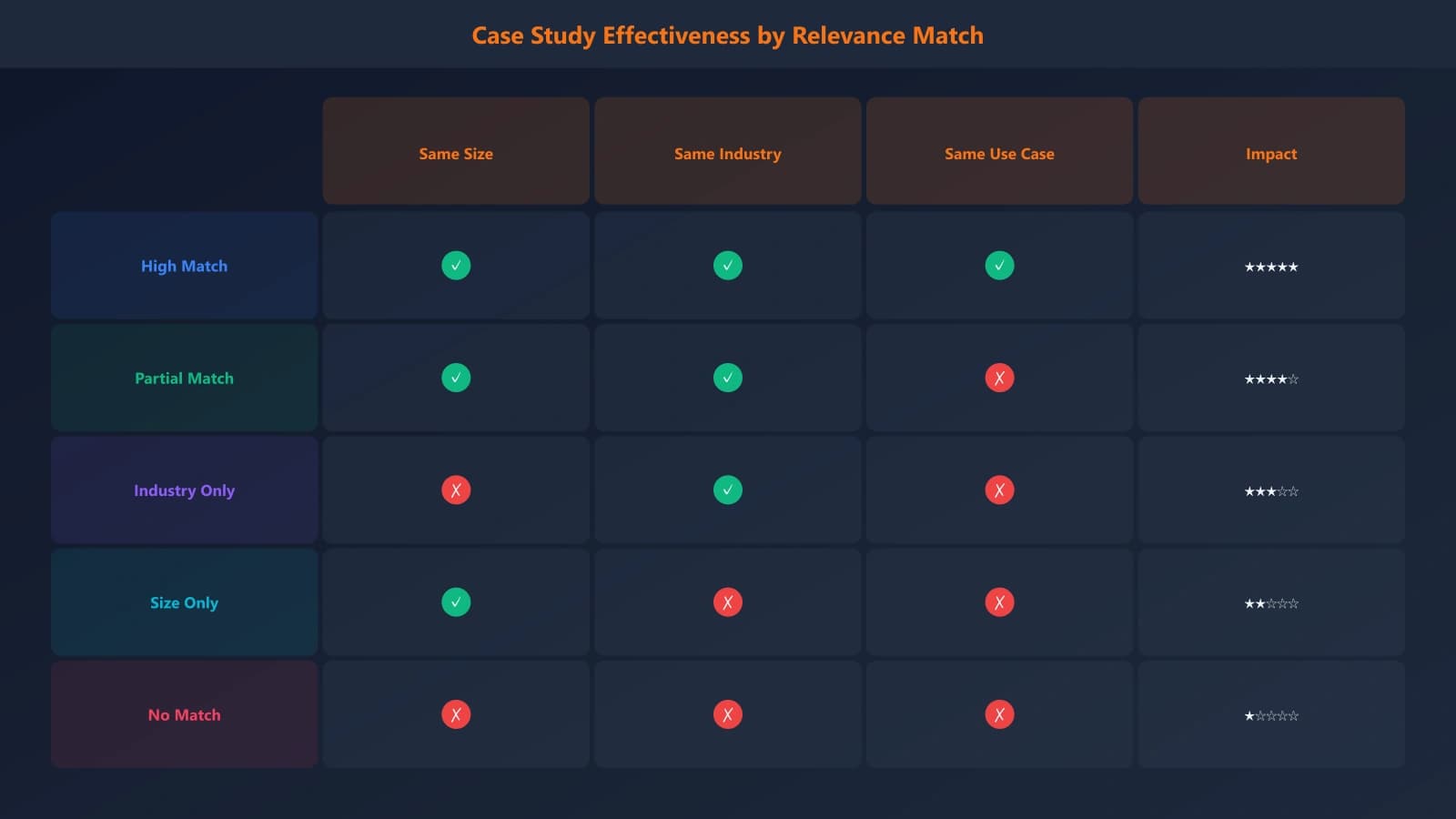
Case studies work, but only when they're relevant to the reader's context. A case study about an enterprise implementation doesn't help a startup evaluator, and vice versa.
What makes a case study relevant for comparison pages:
- Similar company size to target reader
- Same or similar industry
- Similar use case or deployment
- Ideally, a switch from a known alternative
Consider segmenting case study links by industry or company size on your comparison pages. “See how other mid-market SaaS companies made this switch” is much more compelling than a generic case study carousel.
Signal 6: Honest Limitations
Here's a counterintuitive trust signal: admitting what you're not good at. When you acknowledge genuine limitations or scenarios where a competitor might be a better fit, you dramatically increase credibility for everything else you say.
Examples:
- “If you need deep customization at the database level, [Competitor] offers more flexibility here”
- “Our product is built for teams of 10-200. For enterprise deployments above 1,000 users, you may find [Competitor] has more robust administrative controls”
- “We integrate with 150+ tools, but if Obscure Legacy System X is critical to your workflow, check our integration directory before committing”
This honesty feels risky, but it works because it signals confidence and customer-first thinking. If you're willing to acknowledge trade-offs, your positive claims feel more trustworthy.
Signal 7: Risk Reducers
B2B buyers aren't just worried about making the wrong choice—they're worried about the consequences of making the wrong choice. Risk reducers address this directly.
- Free trials with meaningful scope — Not a 7-day glimpse, but enough time to actually evaluate
- Migration support — Help with data transfer, training, and change management
- Money-back guarantees — Rare in B2B but powerful when offered
- Flexible contracts — Month-to-month options or easy exit clauses
- Implementation guarantees — “Go live in 30 days or extended free support”
These signals work because they shift risk from the buyer to you. If you're confident in your product, you can afford to be generous with risk reducers.
Implementing Trust Signals: Practical Guide
Knowing which trust signals work is one thing. Actually gathering and implementing them is another. Here's how to build a trust signal library for your comparison content.
Collecting Switcher Testimonials
Switcher testimonials don't appear magically—you have to actively collect them:
- Flag switchers in your CRM. When a deal closes, note what they switched from.
- Build a testimonial trigger into your onboarding flow—ask for feedback at the 90-day mark when migration success is fresh.
- Create competitor-specific testimonial requests. Instead of “Can you give us a testimonial?”, ask “Can you share your experience switching from [Competitor]?”
- Offer incentives strategically. Discounts or credits in exchange for detailed testimonials can accelerate collection.
- Make it easy. Provide a template: “Just fill in the blanks: We used [X] for [time]. We switched because [reason]. The result: [outcome].”
Trust Signal Placement
Where you place trust signals matters as much as which ones you use:
| Page Section | Best Trust Signals |
|---|---|
| Above the fold | Third-party badges (G2 scores), key differentiating metrics |
| Feature comparison | Methodology notes, source links for claims |
| Mid-page | Switcher testimonials, relevant case studies |
| Near verdict/CTA | Risk reducers, honest limitations |
| Footer area | Security certifications, compliance badges |
Mistakes That Kill Credibility
Even good trust signals can backfire if implemented poorly. Watch for these credibility killers:
Using Outdated Information
Nothing destroys trust faster than obviously outdated claims. If your page says “Competitor X doesn't have feature Y” and they shipped it six months ago, your entire comparison loses credibility. Set quarterly review reminders for all comparison content.
Misrepresenting Competitors
If buyers catch you misrepresenting a competitor—even slightly—they'll assume everything else you say is biased too. Be scrupulously accurate about competitor capabilities, even when it hurts your positioning.
Over-Engineering Social Proof
A page drowning in logos, badges, and testimonials feels desperate. Curate ruthlessly. Three highly relevant trust signals beat fifteen generic ones.
Hiding Attribution
“One study found...” without linking to the study reads as made-up. Always attribute and link. If you can't find a source, don't make the claim.
Trust Is the Deciding Factor
Here's the reality: most B2B software in any given category has reached feature parity on the basics. The deciding factor often isn't which product is objectively better—it's which vendor the buyer trusts more. Your comparison page is a trust-building opportunity, but only if you use the right signals.
The seven signals we covered—switcher testimonials, verifiable metrics, third-party validation, transparent methodology, relevant case studies, honest limitations, and risk reducers—work because they're inherently verifiable. They invite scrutiny rather than asking for blind faith.
Start by auditing your existing comparison content against this framework. Identify which trust signals you have, which you're missing, and which you're using ineffectively. Then build a collection system for the signals you need—especially switcher testimonials, which are the hardest to gather but the most impactful.
The companies winning enterprise deals in competitive markets aren't necessarily those with the best products. They're the ones who've mastered the art of building trust with professional skeptics. These trust signals are how you do it.
Want the complete picture? This guide is part of our comprehensive SaaS Comparison Page Playbook. For related strategies, see Enterprise Software Listicles That Actually Convert.

Product Manager at BestPage. Pioneer in AEO research since 2024, exploring the convergence of SEO and GEO (Generative Engine Optimization). Led multiple AI-powered content optimization projects that achieved 300%+ citation increases in ChatGPT and Perplexity.