
Here's what happens when an enterprise IT director finds your “Best ERP Solutions” listicle: they skim it, maybe bookmark it, and then... nothing. The page sits in their browser for months while the actual evaluation unfolds through RFP processes, committee meetings, and internal politics. Your listicle was fine for initial discovery, but it wasn't built to support a complex enterprise buying process.
Enterprise software purchases are fundamentally different from SMB or self-serve deals. According to Gartner, the average enterprise buying group includes 6-10 decision-makers, each bringing their own priorities and concerns. Your listicle needs to give an internal champion ammunition for conversations you'll never be part of.
This guide adapts the comparison page framework from our SaaS Comparison Page Playbook specifically for enterprise software contexts—where sales cycles are long, stakeholders are many, and the criteria for success go far beyond features and pricing.
The Enterprise Comparison Challenge
Standard comparison content fails in enterprise contexts because it's built for individual decision-makers making quick decisions. Enterprise reality looks nothing like that.
Understanding Enterprise Buying Dynamics
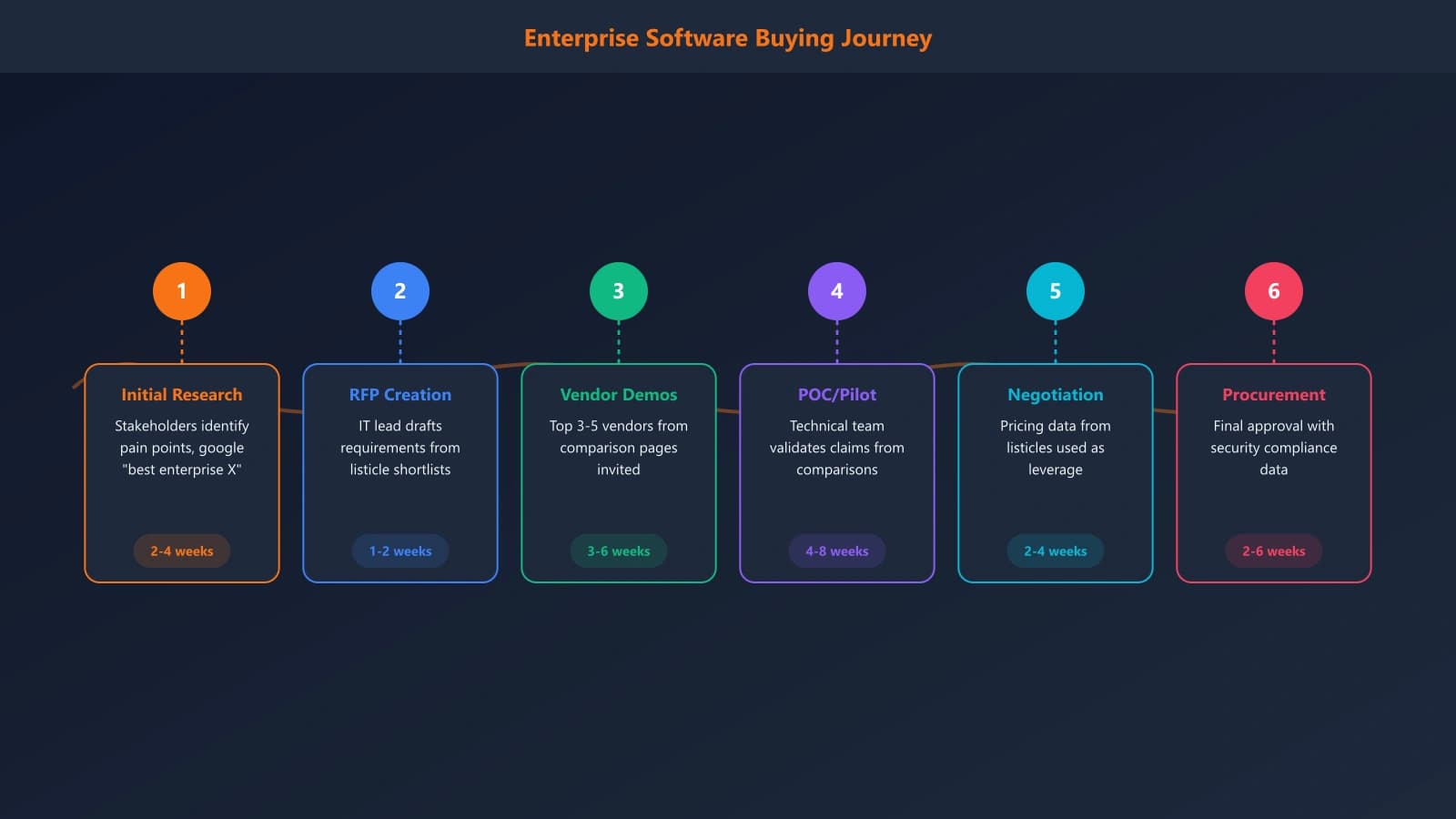
Let's map the typical enterprise software purchase:
- Timeline: 6-12 months from initial research to signed contract
- Stakeholders: IT, Finance, Operations, Legal, Security, end-user departments
- Process: Discovery → RFP → Demos → POC → Negotiation → Procurement → Legal
- Internal selling: Your champion needs to sell the decision internally before you close
Your listicle content will be accessed at multiple points throughout this journey, by different stakeholders with different questions. A page optimized only for the initial discovery phase fails everywhere else.
Where Standard Listicles Fall Short
Most comparison content has these gaps for enterprise audiences:
- Missing stakeholder-specific views — CFO cares about different things than CTO
- No security/compliance section — Often a deal-breaker, rarely covered well
- Implementation glossed over — Enterprise buyers need to understand the real commitment
- Scale not addressed — Can it handle 10,000 users? 100,000? What changes?
- No internal selling assets — No way to share evaluation with committee
- Missing enterprise pricing reality — Custom pricing requires different approach
The Enterprise Listicle Framework
Here's how to adapt comparison content for enterprise buying contexts. We're adding layers specific to enterprise requirements while keeping the core comparison structure.
Stakeholder-Specific Sections
Create clear sections addressing different stakeholder concerns. Label them explicitly so readers can find what's relevant to their role:
| Stakeholder | Primary Concerns | Section Content |
|---|---|---|
| IT/Technical | Integration, security, maintenance | Architecture, APIs, security certifications, SLAs |
| Finance/CFO | TCO, ROI, budget predictability | Pricing models, hidden costs, ROI calculation |
| Operations | Implementation, training, change management | Rollout timeline, training resources, support |
| Legal/Procurement | Contracts, compliance, data governance | Compliance certifications, data residency, DPA |
| End Users | Usability, daily workflow impact | UX comparison, learning curve, mobile access |
You don't need separate pages—just clearly labeled sections that each stakeholder can jump to directly. Use anchor links and a detailed table of contents.
Security and Compliance Coverage
For enterprise buyers, security and compliance isn't optional—it's often the first filter. Cover it comprehensively:
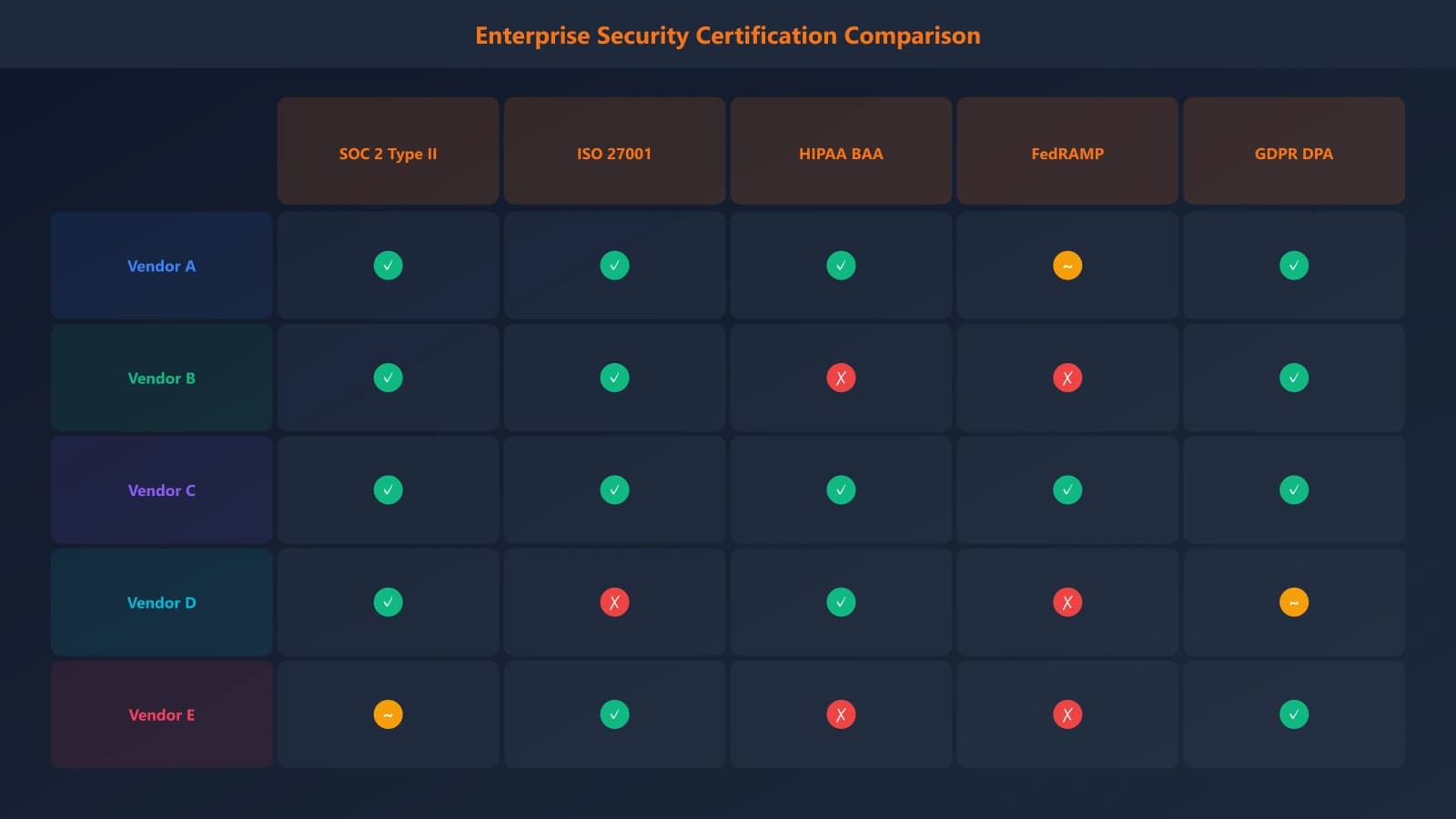
- Certifications: SOC 2 Type II, ISO 27001, HIPAA, FedRAMP, etc.
- Data residency: Where is data stored? EU options? Single-tenant available?
- Access controls: SSO, RBAC, audit logging capabilities
- Encryption: At rest, in transit, key management
- Vendor security posture: Pentesting frequency, bug bounty, incident history
Create a security comparison table. For enterprise buyers, this might be the most-referenced section on your entire page.
Implementation Reality Check
Enterprise implementations are projects unto themselves. Address them honestly:
- Timeline ranges: “Typical enterprise deployment: 3-6 months depending on complexity”
- Resource requirements: Internal team allocation needed
- Professional services: What's included vs. additional cost
- Migration support: Data migration, training, change management
- Phased rollout options: Can you pilot before enterprise-wide?
Underestimating implementation complexity burns trust. Enterprise buyers have been burned before—they appreciate honesty about what it actually takes.
Generate Enterprise-Ready Comparison Content
Build listicles that support complex buying processes with the right sections for every stakeholder.
Try for Free
Scale Considerations
Enterprise buyers need to know how your recommendations hold up at scale. Address explicitly:
- User count tiers: How does the product behave at 1K, 10K, 100K users?
- Pricing at scale: Do discounts kick in? How does TCO change?
- Performance at scale: Any known limitations or considerations?
- Support at scale: Dedicated CSM? Premium support tiers?
- Administration at scale: Multi-tenant management, organizational hierarchy
Internal Selling Assets
Here's what most listicles miss entirely: your champion needs to sell this decision internally. Give them tools:
- Downloadable comparison PDF — Formatted for printing and sharing in meetings
- Executive summary — One-page version for leadership presentations
- ROI calculator — Customizable model they can present to finance
- Vendor evaluation scorecard — Template for structured evaluation
- RFP question bank — Questions to include in their RFP process
These assets extend your listicle's influence into rooms you'll never be in. They're the difference between content that supports discovery and content that supports deals.
Handling Enterprise Pricing
Enterprise pricing is complicated. Most vendors don't publish it. Comparisons become difficult. Here's how to handle it:
What You Can Include
- Pricing model types: Per-user, per-seat, consumption-based, flat fee
- Typical ranges: “Enterprise contracts typically range from $X to $Y annually”
- Cost factors: What drives price up or down (users, features, support tier)
- Hidden costs: Implementation, training, integrations, overages
- Contract terms: Typical commitment lengths, payment terms
Total Cost of Ownership Focus
For enterprise, sticker price matters less than TCO. Help buyers calculate:
- License/subscription costs over 3-5 years
- Implementation and migration
- Training and change management
- Ongoing administration and support
- Integration development and maintenance
- Scaling costs as organization grows
Providing a TCO framework—even without exact numbers—positions you as genuinely helpful rather than just promoting the cheapest option.
Enterprise Listicle Structure Template
Here's the complete page structure for an enterprise-focused comparison listicle:
- Executive TL;DR (150 words) — Strategic summary for time-pressed executives
- Evaluation methodology — How you assessed and what criteria you used
- Quick comparison table — High-level matrix covering all vendors
- Ranked vendor profiles (400-600 words each)
- Overview and positioning
- Enterprise strengths
- Enterprise considerations/limitations
- Best for (specific enterprise contexts)
- Notable enterprise customers
- Stakeholder-specific sections
- For IT: Architecture, security, integration
- For Finance: TCO, ROI, pricing models
- For Operations: Implementation, training
- Security and compliance comparison — Detailed table
- Implementation comparison — Timeline, resources, support
- Scale considerations — Performance and pricing at enterprise scale
- Downloadable assets — PDF, scorecard, ROI calculator links
- Selection guidance — Decision framework based on enterprise context
- FAQ — Enterprise-specific questions
Enterprise Listicle Mistakes to Avoid
Beyond general comparison page mistakes, watch for these enterprise-specific errors:
Treating Enterprise Like SMB+
Enterprise isn't just SMB with more users. The buying process, stakeholders, criteria, and timeline are fundamentally different. Content that works for 50-person companies doesn't translate to 5,000-person organizations.
Ignoring the Buying Committee
Writing only for one persona (usually the technical evaluator) ignores 5-9 other stakeholders who influence the decision. Each needs their concerns addressed.
Oversimplifying Pricing
“Starting at $X/user/month” is meaningless for enterprise where pricing is negotiated, bundled, and customized. Acknowledge complexity rather than pretending it doesn't exist.
Skipping Security/Compliance
Security sections aren't optional for enterprise content. They're often the first thing IT and security stakeholders look for—and if they don't find it, they move on.
No Internal Sharing Support
If your content can't be easily shared, printed, or presented internally, it's dead on arrival for enterprise. Provide assets designed for internal circulation.
Building Content for Complex Buying
Enterprise software listicles require a mindset shift. You're not just helping someone pick a tool—you're equipping a champion to navigate a 6-12 month buying process involving a committee of stakeholders with different priorities.
The framework we covered—stakeholder-specific sections, comprehensive security coverage, honest implementation expectations, scale considerations, and internal selling assets—transforms listicles from discovery content into evaluation enablement.
Start by identifying which stakeholders your current content serves versus which it ignores. Then build out the missing sections systematically. The additional depth takes more effort, but enterprise deals justify the investment—and buyers will notice when your content actually addresses their reality.
The companies winning enterprise deals through content marketing aren't just those with the best products. They're the ones providing tools that help buyers do their jobs—including the internal selling job that happens long before contracts are signed.
For the foundational framework, see our SaaS Comparison Page Playbook. For trust-building specifics, read Trust Signals That Convert B2B Software Buyers.

Product Manager at BestPage. Pioneer in AEO research since 2024, exploring the convergence of SEO and GEO (Generative Engine Optimization). Led multiple AI-powered content optimization projects that achieved 300%+ citation increases in ChatGPT and Perplexity.