
Security professionals are trained to be skeptical. Their job is to question claims, verify sources, and assume threats. This makes them among the most demanding audiences for comparison content. A listicle that works for project management software will fail for security tools.
The challenge is compounded by the stakes involved. Recommending the wrong security tool can have serious consequences—data breaches, compliance failures, business disruption. Buyers know this and evaluate sources accordingly. They're looking for reasons not to trust you.
This guide provides strategies for creating cybersecurity comparison content that builds trust quickly. We'll cover the unique trust requirements of security buyers, category-specific approaches, and the credibility signals that matter most.
Trust Requirements for Security Content
Security buyers evaluate content differently. Understanding their trust criteria is essential.
What Security Buyers Look For
Before trusting comparison content, security professionals typically check:
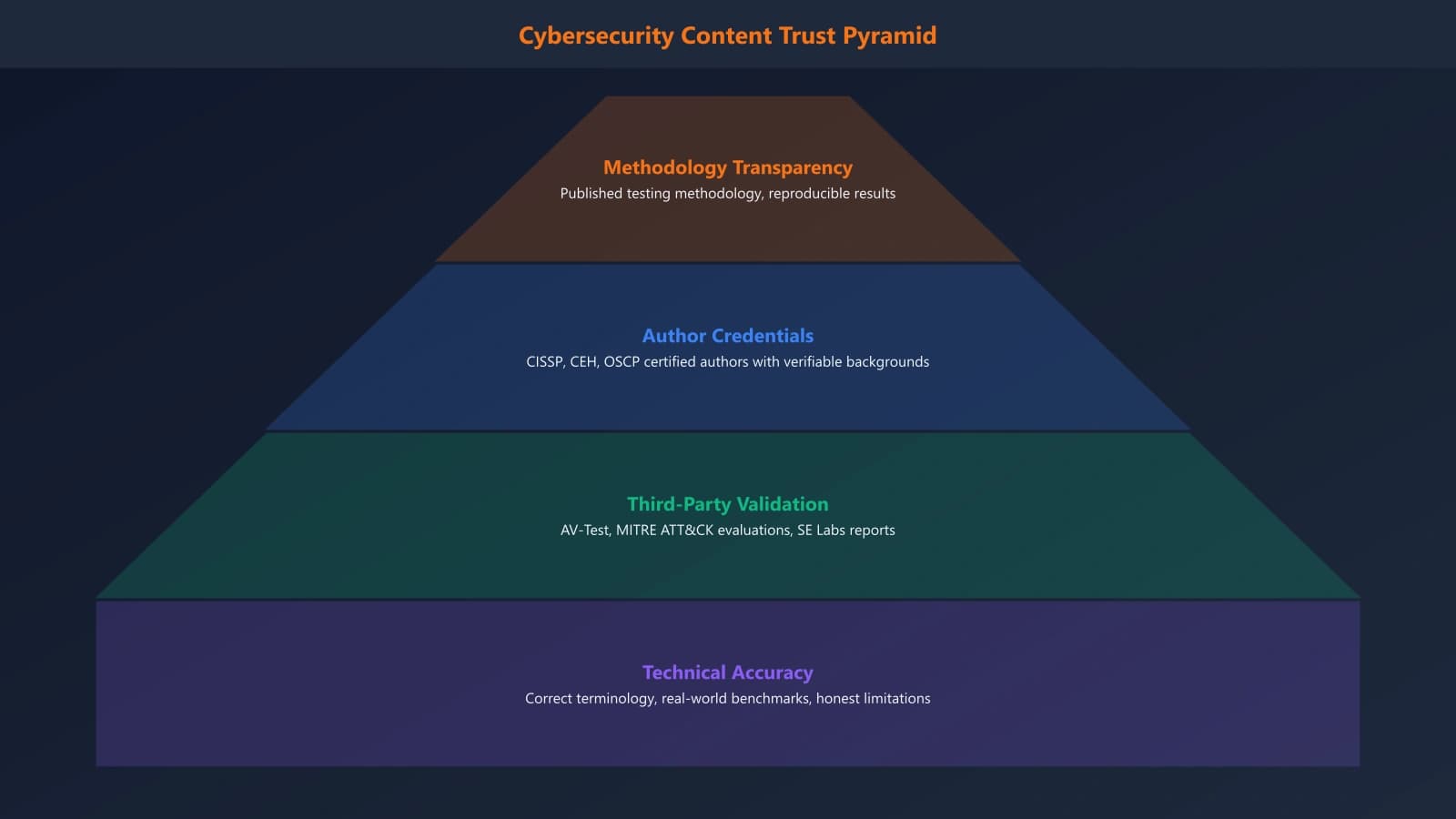
- Author credentials: Does the author have security experience? Certifications?
- Technical accuracy: Are product descriptions technically correct?
- Testing methodology: How were products actually evaluated?
- Third-party references: Are independent test results cited?
- Conflicts of interest: Is the comparison sponsored? Affiliate-driven?
- Currency: Security threats evolve fast; is the content current?
Essential Credibility Signals
Security comparison content should include:
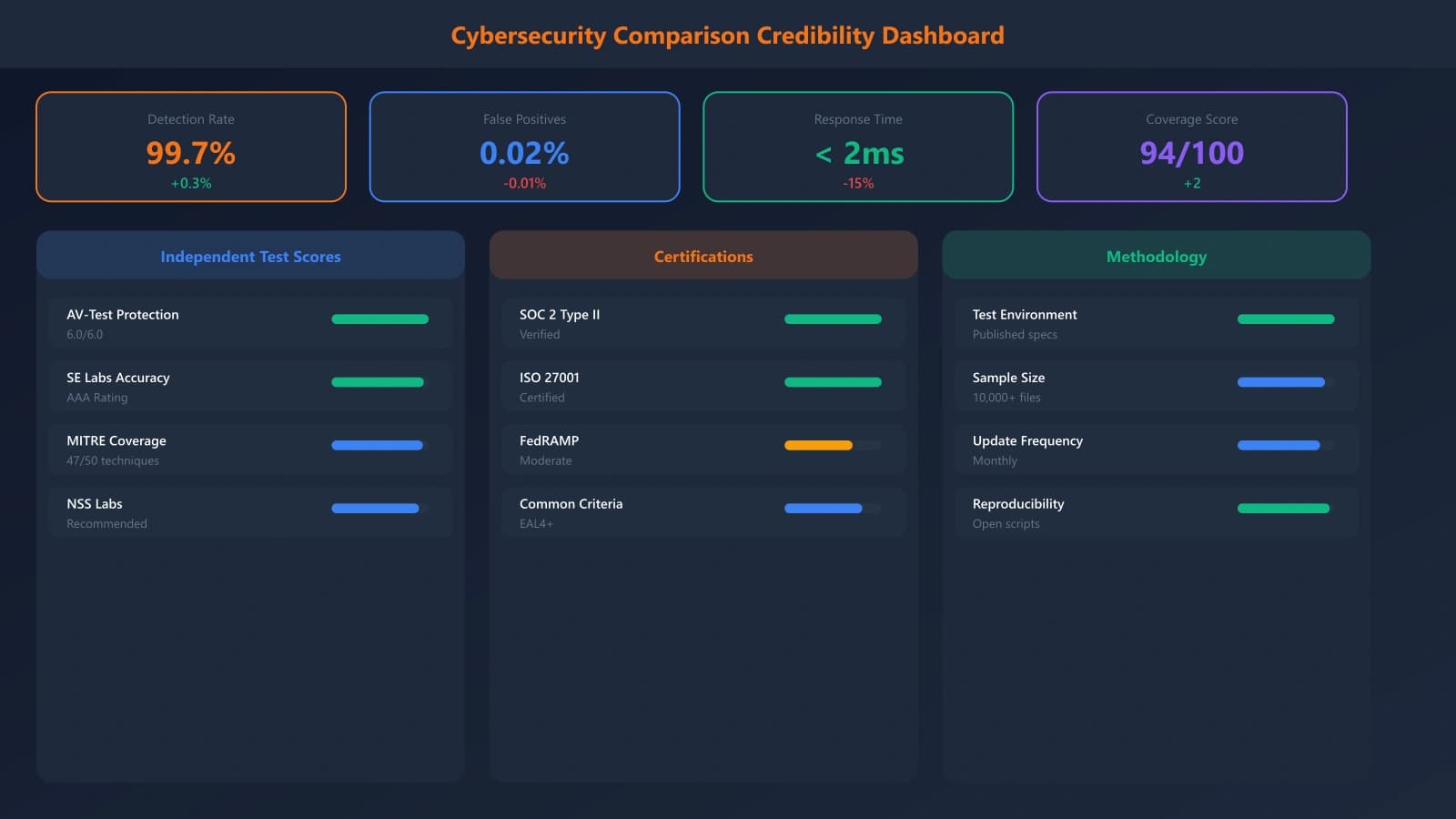
- Independent test lab references: AV-TEST, AV-Comparatives, SE Labs, MITRE ATT&CK evaluations
- Certification verification: SOC 2, FedRAMP, ISO 27001 status
- Methodology section: How you evaluated products
- Author security background: CISSP, CISM, or practical experience
- Update history: When content was last verified
- Disclosure statement: Compensation relationships clearly stated
Avoiding Trust Red Flags
Security buyers will dismiss content that shows:
- Marketing language: Vague claims without technical substance
- Missing methodology: Recommendations without explanation of evaluation
- Outdated information: References to old product versions or threats
- Hidden conflicts: Affiliate links without disclosure
- Technical errors: Even minor inaccuracies undermine credibility
- Fear-based writing: Sensationalized threat language
Category-Specific Approaches
Different security categories require different comparison approaches.
Consumer Antivirus/Endpoint
Consumer security is competitive but accessible:
- Reference independent tests: AV-TEST and AV-Comparatives publish regular results
- Performance impact: Compare system performance with each product
- Feature clarity: What's included vs. upsell
- Cross-platform coverage: Windows, Mac, mobile, and how they differ
- Value analysis: Cost per device, family plans
Enterprise Endpoint Protection
Enterprise endpoint (EPP/EDR) buyers are more sophisticated:
- MITRE ATT&CK evaluations: Reference specific evaluation results
- Detection vs. response: Prevention capabilities vs. detection and response
- Management complexity: Deployment, configuration, ongoing administration
- Integration depth: SIEM, SOAR, and security ecosystem integration
- Analyst requirements: Expertise needed to operate effectively
SIEM and SOAR
Security operations tools are complex purchases:
- Data ingestion: Sources supported, volume handling, retention
- Detection engineering: Rule creation, machine learning, threat intelligence
- Response capabilities: Automation, playbooks, orchestration
- Total cost: Licensing model, storage costs, analyst time
- Time to value: Implementation complexity, tuning requirements
Cloud Security
Cloud security is a growing comparison category:
- CSPM vs. CWPP: Posture management vs. workload protection
- Multi-cloud support: AWS, Azure, GCP coverage
- Compliance mapping: How tools map to compliance frameworks
- Developer experience: How security integrates with DevOps
- Visibility scope: What the tool actually monitors
Identity and Access Management
- Authentication methods: MFA options, passwordless support
- Directory integration: AD, Azure AD, LDAP, cloud directories
- Application coverage: Pre-built integrations, SAML/OIDC support
- Governance features: Access reviews, certification, lifecycle management
- Zero trust alignment: How tools support zero trust architecture
Security-Specific Content Elements
Cybersecurity comparisons benefit from specific content elements that establish credibility.
Independent Test Lab Integration
Reference independent testing authorities:
- AV-TEST: Monthly consumer and business endpoint testing
- AV-Comparatives: Detailed test reports and certifications
- SE Labs: Real-world protection testing
- MITRE ATT&CK: Enterprise detection evaluations
- NSS Labs: Enterprise security product testing (note: verify current availability)
Link directly to test results. Don't just claim products performed well—show the evidence.
Compliance and Certification
Verify and display security certifications:
- SOC 2 Type II: Operational security controls
- ISO 27001: Information security management
- FedRAMP: For government use cases
- HIPAA: For healthcare contexts
- PCI DSS: For payment handling
Threat Landscape Context
Ground recommendations in current threat reality:
- Relevant threat coverage: How does the tool address current threats?
- Ransomware specifically: Detection, prevention, recovery capabilities
- Attack surface: What the tool protects vs. what it doesn't
- Evolving threats: How the vendor keeps up with new techniques
Build Trusted Security Comparisons
Create cybersecurity comparison content that earns credibility with technical buyers.
Try for Free
Author Expertise Requirements
Author credibility matters more for security than most other categories.
Security Credentials That Matter
- CISSP, CISM, CISA: Recognized security certifications
- Practical experience: Years in security operations, engineering, or leadership
- Vendor-neutral background: Experience across multiple products/vendors
- Speaking/writing history: Other published security content
Building Security Author Credibility
If you're building a security comparison practice:
- Hire security expertise: Writers with genuine security backgrounds
- Expert review process: Have security professionals review before publishing
- Advisory relationships: Work with CISOs as advisors
- Transparent methodology: Document your evaluation process
Implementation Roadmap
To build successful cybersecurity comparison content:
- Establish author credibility: Ensure writers have genuine security expertise or implement expert review.
- Reference independent testing: Build content around third-party test results where available.
- Verify technical accuracy: Every claim must be technically correct.
- Document methodology: Explain exactly how you evaluated products.
- Disclose clearly: Be transparent about any compensation or conflicts.
- Maintain freshness: Security evolves fast; update frequently.
- Cover certifications: Verify and display compliance status.
- Segment appropriately: Consumer, SMB, and enterprise have different needs.
Cybersecurity comparison content is challenging because the audience is highly skeptical. But this also means that content which genuinely earns trust is highly valuable. Invest in the credibility signals that matter, and you can build content that security buyers actually use.
For general B2B trust signals, see our guide on Trust Signals That Convert B2B Software Buyers. For technical buyer audiences more broadly, check out DevTools Comparisons: What Technical Buyers Expect.

Product Manager at BestPage. Pioneer in AEO research since 2024, exploring the convergence of SEO and GEO (Generative Engine Optimization). Led multiple AI-powered content optimization projects that achieved 300%+ citation increases in ChatGPT and Perplexity.