

When someone searches “Allbirds vs Nike,” they're deep in the buying journey. They're not browsing—they're comparing. And for DTC brands, those searches represent some of the highest-intent traffic available.
But here's the tension: should a DTC brand create comparison content? The instinct is often no. It feels aggressive. It draws attention to competitors. It might even trigger legal issues if you're not careful with claims. Many DTC marketing teams avoid comparison content entirely.
That caution is understandable but often misguided. The comparison is happening whether you participate or not—the only question is whether you control the narrative. When potential customers search for comparisons between your brand and competitors, someone is ranking for those queries. Usually it's affiliate sites, review platforms, or Reddit threads you have zero control over.
This guide covers how DTC brands can capture comparison traffic ethically—building trust rather than burning it. For the broader e-commerce comparison strategy, see our E-commerce Comparison Playbook.
The Comparison Traffic Opportunity
Let's start with the numbers. Branded comparison queries—searches like “[Your Brand] vs [Competitor]”—typically show 3-10x higher purchase intent than generic category searches. According to research from Semrush, users searching branded comparisons are 67% more likely to convert within 24 hours compared to those searching category terms.
These users already know who you are. They've probably already visited your site. Now they're doing their due diligence before committing. If you can provide that comparative context yourself—fairly and transparently—you keep them in your ecosystem during the critical decision phase.
The alternative is ceding that moment to third parties. And third-party comparison content has its own biases. Affiliate sites favor products with higher commissions. Review platforms weight toward products with more reviews (which often means older, bigger brands). Reddit threads are uncontrolled and can be influenced by competitor marketing or disgruntled customers.
When you create your own comparison content, you can ensure it's accurate, current, and fair. That's not spin—that's actually better for consumers than the alternatives.
Positioning That Builds Trust
The key to ethical comparison content is positioning. You're not attacking competitors—you're helping buyers find the right fit. There's a massive difference between “Why We're Better Than Competitor X” and “Comparing Our Product to Competitor X: Which Is Right for You?”
The first sounds defensive and self-serving. The second sounds helpful. Same basic content, completely different perception.
Honest positioning means acknowledging where competitors genuinely win. If Nike has better distribution and you can't match their same-day shipping in most markets, say so. If your competitor's product is genuinely better for certain use cases, acknowledge that too. This honesty feels counterintuitive, but research consistently shows that acknowledging competitor strengths increases trust in your overall message.
A study from behavioral economics research found that two-sided arguments (presenting both pros and cons) are significantly more persuasive to educated audiences than one-sided pitches. Your comparison-shopping audience is, by definition, doing research—they're exactly the educated audience that responds to balanced presentation.
The goal isn't to win every comparison. It's to help shoppers self-select. When someone realizes your product genuinely isn't the right fit for them, that's a good outcome—you've avoided a customer who would likely return the product or leave a negative review anyway.
Structuring DTC Comparison Content
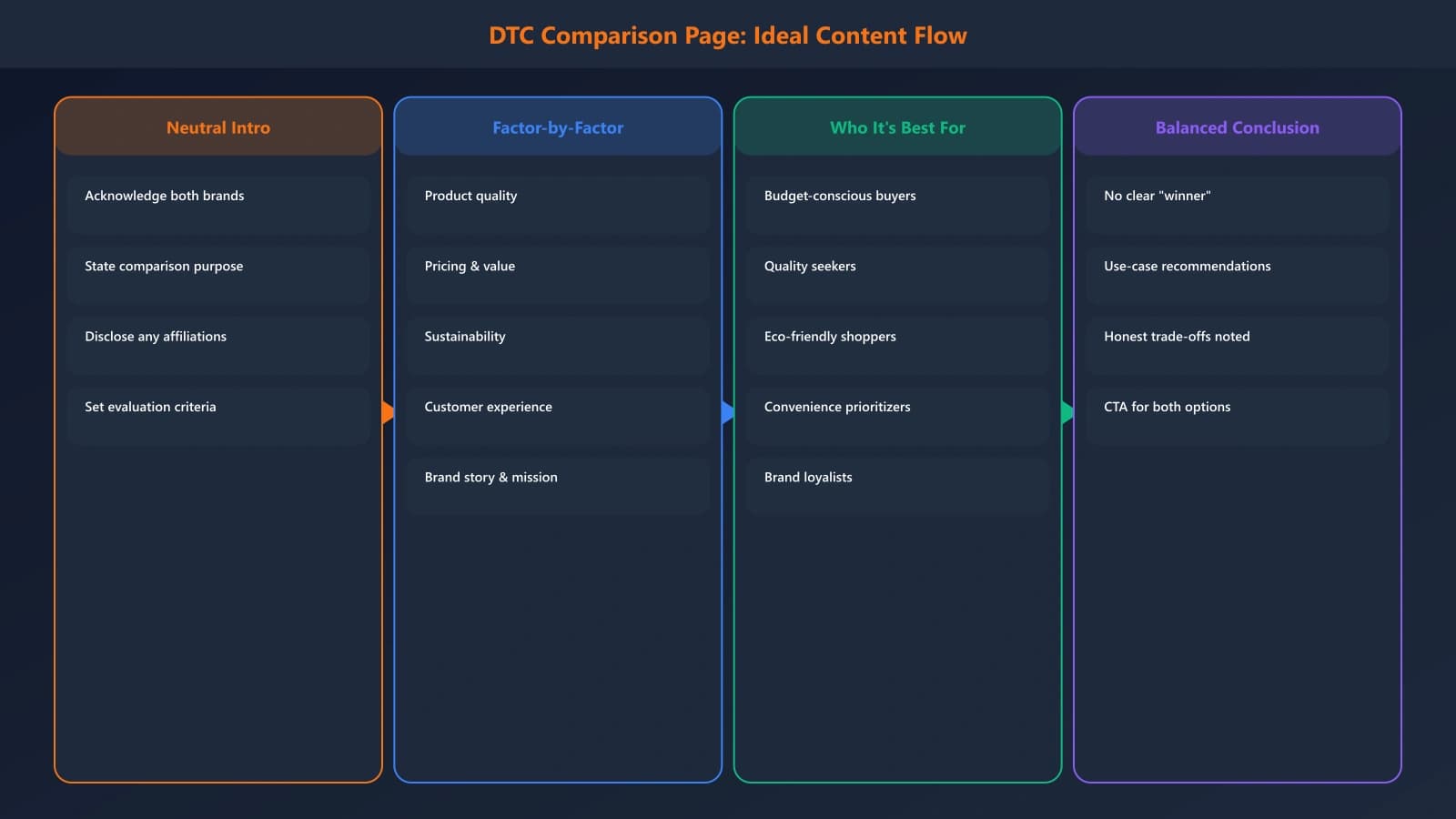
DTC comparison pages work best with a specific structure that emphasizes helpfulness over salesmanship. Start with a clear statement of what you're comparing and why—not “why we're great” but “what makes these products different.”
Lead with the factors that actually matter to buyers. For footwear, that might be comfort, durability, sustainability, and price. For skincare, it might be ingredients, skin type compatibility, and value per ounce. These categories should come from actual customer research, not your marketing team's assumptions.
Within each factor, present both products fairly. If you're claiming superiority on a dimension, support it with specifics. “Our insoles are 15% thicker with a dual-density foam construction” is credible. “We have better cushioning” is just an assertion.
Include a “Who It's Best For” section that genuinely segments the audience. Some people should buy your product. Some people should buy the competitor. Being clear about this distinction builds massive trust. Something like: “Choose us if sustainability and ethical manufacturing are priorities. Choose them if you need the widest possible style selection and retail availability.”
End with a summary that acknowledges the comparison is nuanced. Avoid “clearly we're the winner” conclusions. Instead: “The right choice depends on what matters most to you. We hope this comparison has helped clarify the differences.”
Legal Considerations
Comparison advertising is legally protected in most jurisdictions, but you need to stay within established boundaries. The FTC's guidance on comparative advertising is clear: comparisons must be truthful, non-deceptive, and substantiated.
Truthfulness means your claims must be accurate. If you say your product has “30% more cushioning,” you need to be able to prove it with actual testing data. Vague claims like “better quality” are harder to substantiate and can land you in trouble.
Non-deception means you can't mislead through omission or implication. Comparing your premium product to a competitor's budget line—without making that clear—is deceptive even if technically accurate. Always compare equivalent products or explicitly note when you're not.
Trademark usage requires some care. You can use competitor trademarks in comparative advertising—this is well-established in case law—but you can't imply endorsement, affiliation, or sponsorship. Using their logo is generally fine for comparison purposes; using their brand colors or design elements to suggest a relationship is not.
Build DTC Comparison Content That Builds Trust
Generate ethical competitor comparisons that capture high-intent traffic without damaging your brand. Balanced positioning, done right.
Try for Free
Choosing Which Competitors to Compare
Not every competitor deserves a comparison page. You should be strategic about where you invest content effort.
Start with search volume. Use tools like Ahrefs or Semrush to check how many people actually search for “[Your Brand] vs [Competitor].” Some competitor comparisons have meaningful volume; others are basically never searched. Focus on the ones people actually want.
Consider competitive positioning. Comparisons work best when there's genuine differentiation. If you and a competitor are virtually identical in product, price, and positioning, the comparison becomes awkward—there's nothing meaningful to say. Look for competitors where you can legitimately claim different strengths, not just “we're better.”
Think about the comparison frame. Being compared to an established giant can work in your favor—“David vs Goliath” positioning resonates with many consumers. Being compared to a smaller brand can feel like punching down, which rarely builds goodwill. Choose comparisons where the frame works for you.
Also consider your win rate. Some comparisons you'll genuinely win on most dimensions. Others are more balanced. A few, you'll honestly struggle to justify why someone should choose you. Focus content efforts on comparisons where you have a legitimate, honest case to make.
Avoiding Common Pitfalls
I've seen DTC brands damage their reputation with poorly executed comparison content. Here's what to avoid.
Don't attack competitor quality without evidence. Implying that a competitor's product is inferior without specific, substantiated claims reads as desperate and can create legal exposure. Stick to factual differences—materials, certifications, processes—rather than subjective quality judgments.
Don't pretend to be neutral when you're not. Visitors know they're on your website. They know you have a perspective. Pretending to be an impartial third-party evaluator is transparently false and destroys trust. Own your perspective while committing to accuracy.
Don't cherry-pick dimensions where you win. If you only compare the three factors where your product is superior while ignoring the five where the competitor wins, sophisticated shoppers will notice and discount everything you say. Include the dimensions that matter to buyers, even if some don't favor you.
Don't use stale competitor information. If your comparison references a competitor's old pricing or discontinued features, you look either dishonest or careless. Build processes to regularly verify competitor information and update your content accordingly.
Don't forget about the user who should choose the competitor. If every comparison concludes with “clearly we're the right choice,” you've written an ad, not a comparison. Genuine comparisons help some users select you and some users select alternatives—and that's fine.
Measuring Comparison Content Success
How do you know if your comparison strategy is working? The obvious metric is organic traffic to comparison pages, but that's just the beginning.
Track conversion rates from comparison pages versus other content. Comparison traffic should convert at a higher rate given the intent level—if it's not, something's wrong with your content or the comparison positions you unfavorably.
Monitor bounce rates and time on page. High bounce rates might indicate that users came looking for a comparison but found biased propaganda instead. Long time on page suggests genuine engagement with the comparison content.
Look at assisted conversions. Comparison pages might not generate immediate purchases but could influence buyers who return later. Set up attribution modeling that captures this behavior—users who viewed a comparison page and then purchased within 7-14 days.
Pay attention to customer feedback. Are people mentioning your comparison content in surveys or reviews? Comments like “your comparison really helped me decide” signal that your approach is working. Comments like “the comparison felt biased” suggest adjustments are needed.
Building Trust Through Transparency
DTC comparison content isn't about winning every comparison—it's about demonstrating transparency and helping customers make informed decisions. When you openly compare yourself to competitors, fairly acknowledge their strengths, and help buyers determine the right fit, you build the kind of trust that translates to long-term brand loyalty.
The brands that avoid comparison content entirely cede the narrative to third parties. The brands that create aggressive, one-sided “we're obviously better” content often damage their reputation. But brands that create genuinely helpful comparison content—honest, accurate, and customer-focused—capture high-intent traffic while reinforcing their values.
Start with one or two key competitors where you have a genuine story to tell. Create content that would make a consumer trust your brand more after reading it, even if they don't buy from you. Build from there as you learn what resonates with your audience.
For the complete e-commerce comparison strategy, see our E-commerce Comparison Playbook. And for category-level comparison content, explore our guide on e-commerce category listicles.

Product Manager at BestPage. Pioneer in AEO research since 2024, exploring the convergence of SEO and GEO (Generative Engine Optimization). Led multiple AI-powered content optimization projects that achieved 300%+ citation increases in ChatGPT and Perplexity.