
The online education market has exploded, and so has demand for comparison content. When someone considers spending $15,000 on a coding bootcamp or committing to a two-year online master's program, they want to compare options thoroughly before deciding. This creates massive opportunity for comparison content creators.
But education comparison has unique challenges. Unlike comparing SaaS tools (where you can test features yourself) or consumer products (where specs are objective), education outcomes are personal and variable. A bootcamp that transforms one person's career might be a poor fit for another. Your content needs to help learners find the right fit, not just rank programs by some arbitrary metric.
This guide provides the framework for building education comparison content that genuinely helps learners while capturing high-intent traffic. We'll cover comparison criteria by education type, content structures that address real learner questions, and monetization strategies specific to the education vertical.
Understanding Education Types
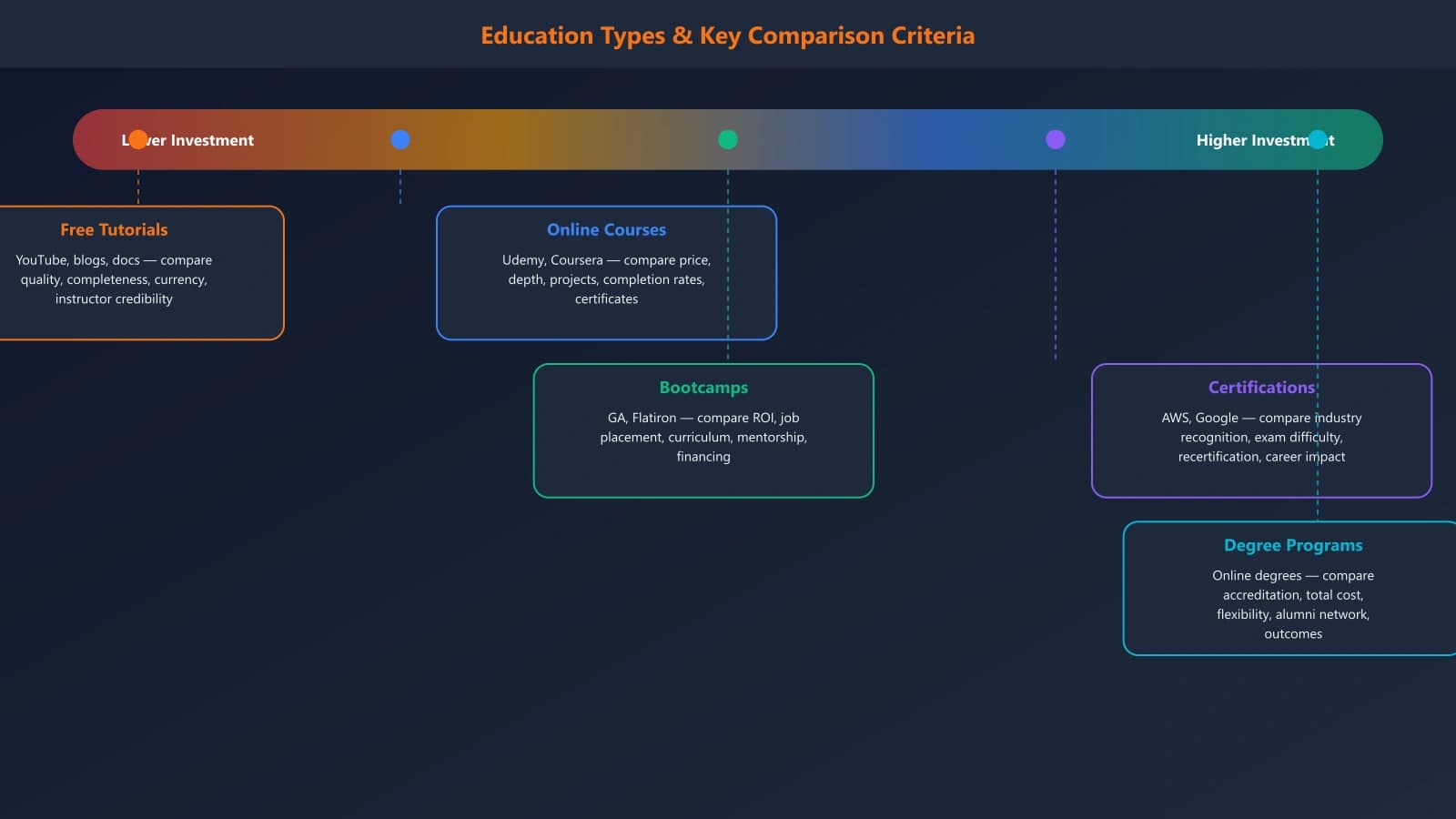
The first step in education comparison is understanding the different product types and what learners care about for each. The comparison criteria that matter for a $10 Udemy course are completely different from a $50,000 online MBA.
The Education Spectrum
| Education Type | Price Range | Time Commitment | Primary Value Prop |
|---|---|---|---|
| Short courses (Udemy, Skillshare) | $10-100 | Hours to days | Skill acquisition |
| Certification courses | $100-2,000 | Weeks to months | Credential + skills |
| Bootcamps | $5,000-20,000 | 3-6 months | Career transition |
| Online degrees | $10,000-80,000+ | 1-4 years | Credential + network + depth |
| Professional certificates | $2,000-15,000 | Months | Career advancement |
What Learners Care About (by Type)
Short courses: Learners prioritize instructor quality, course ratings, practical applicability, and price. They're less concerned about credentials because these courses don't typically provide recognized credentials. Comparison criteria: course content quality, instructor background, student reviews, hands-on projects.
Certification courses: Learners want to know if the certification is recognized by employers and whether it will help them get hired or promoted. They care about pass rates, exam prep quality, and industry recognition. Comparison criteria: certification recognition, pass rates, employer acceptance, career impact data.
Bootcamps: This is where outcomes data becomes critical. Learners are making major investments and often career transitions. They want job placement rates, salary data, hiring partner relationships, and real graduate outcomes. Comparison criteria: placement rates, salary outcomes, graduation rates, payment options (ISA vs upfront), curriculum currentness.
Online degrees: Learners care about accreditation, institution reputation, flexibility (asynchronous vs synchronous), networking opportunities, and total cost. Comparison criteria: accreditation status, school ranking, format flexibility, alumni network, financial aid availability.
Comparison Criteria Framework
Effective education comparison requires evaluating programs on criteria that actually matter for learner outcomes. Here's a framework for different education types.
Bootcamp Comparison Criteria
Bootcamps warrant the most rigorous evaluation because learners are making career-altering investments. Essential comparison criteria:
- Outcomes data quality: Does the bootcamp publish CIRR-verified outcomes? What percentage of graduates find jobs within 6 months? What's the median starting salary?
- Curriculum currentness: How recently was the curriculum updated? Does it cover current industry tools and practices?
- Instructor quality: What's the instructor-to-student ratio? What's the instructors' industry background?
- Career support: What job search support is provided? Are there hiring partner relationships?
- Payment options: Is there an ISA option? What's the total cost including interest if financing?
- Format and schedule: Full-time vs part-time? Remote vs in-person? Synchronous vs asynchronous?
Online Course Comparison Criteria
For shorter, lower-commitment courses, focus on:
- Instructor credentials: What's their background? Have they done what they're teaching?
- Student reviews: What do actual students say? What's the completion rate signal?
- Practical application: Are there hands-on projects? Can learners build a portfolio?
- Support and community: Is there instructor access? A student community?
- Updates and maintenance: Is the course kept current or is it years old?
Online Degree Comparison Criteria
For degree programs, institutional factors matter more:
- Accreditation: Regional vs national accreditation (regional is generally more valuable). Specialized accreditation for fields like business (AACSB) or engineering (ABET).
- Institution reputation: How does the school rank? Is the online degree equivalent to the on-campus version?
- Format flexibility: Fully asynchronous vs scheduled sessions? Self-paced vs cohort-based?
- Total cost: Tuition plus fees, and how it compares to similar programs.
- Career outcomes: Alumni employment data, salary impact, network quality.
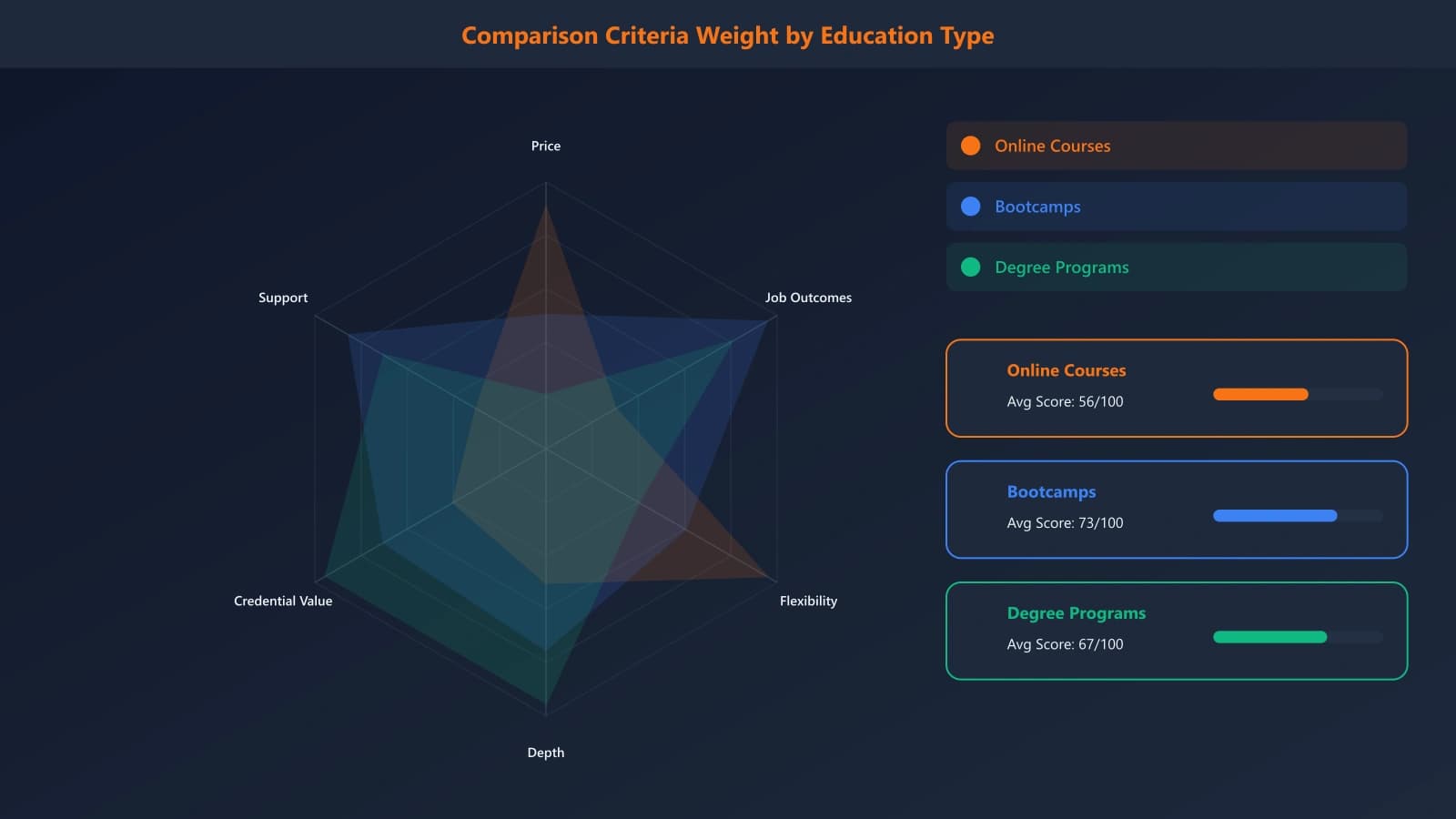
| Criteria Category | Short Courses | Bootcamps | Degrees |
|---|---|---|---|
| Outcomes data | Low priority | Critical | High priority |
| Instructor quality | High priority | High priority | Moderate priority |
| Credential value | Low priority | Moderate priority | Critical |
| Price sensitivity | High | Moderate | Moderate |
| Student reviews | High priority | Moderate priority | Moderate priority |
Content Structure for Education Comparisons
Education comparison pages need to address specific learner questions while maintaining good SEO structure. Here's the recommended framework.
Page Anatomy
An effective education comparison page includes:
- TL;DR with top picks by learner type (career changers, working professionals, beginners)
- Comparison table with key metrics (price, duration, format, outcomes)
- “How to choose” guidance (helping learners self-identify)
- Individual program reviews (detailed breakdown of each option)
- Outcomes data section (especially for bootcamps/degrees)
- FAQ section (addressing common learner questions)
- Disclosure section (affiliate relationships, methodology)
The Self-Identification Section
One of the most valuable sections for education content helps readers identify which type of program fits their situation. This increases engagement and conversion because readers feel the content speaks to their specific needs.
Choose a full-time bootcamp if: You can commit 40+ hours weekly, need a career change within 6 months, and have savings or ISA eligibility to cover the period without income.
Choose a part-time bootcamp if: You're currently employed and need to keep your income, can dedicate 20+ hours weekly, and have a 6-12 month timeline for career transition.
Choose an online degree if: You need a credential for career advancement, have a 2+ year timeline, and want the depth and network a degree provides.
Presenting Outcomes Data
For bootcamps and degree programs, outcomes data is critical. Present it with appropriate context:
- Source the data: Is it self-reported, CIRR-verified, or third-party?
- Define the metrics: What counts as “employed”? How is salary measured?
- Provide context: How does this compare to industry averages?
- Note limitations: Selection bias, self-reported issues, etc.
Generate Education Comparison Pages
Create course and bootcamp comparison pages with outcome-focused content structures.
Try for Free
Monetization in Education
Education affiliate programs are among the most lucrative in any vertical. Here's how to monetize education comparison content effectively.
Affiliate Program Landscape
Education affiliate opportunities vary by segment:
| Education Type | Typical Commission | Commission Model | Example Programs |
|---|---|---|---|
| Course platforms | 20-50% | Revenue share | Udemy, Skillshare, Coursera |
| Bootcamps | $500-2,000 | Per enrollment | Via partnerships or networks |
| Online degrees | $50-500 | Per lead or enrollment | School-specific programs |
| Certification prep | 30-50% | Revenue share | Certification-specific platforms |
Ethical Considerations
Education decisions are life-altering. Maintain ethical standards:
- Don't let commissions distort rankings. If your highest-paying affiliate has poor outcomes, don't rank them first.
- Include non-affiliate options. Some excellent programs don't have affiliate programs. Include them anyway.
- Be honest about outcomes. Don't oversell program results or hide negative reviews.
- Disclose clearly. Learners should know you may earn money from their enrollment.
SEO Considerations for Education Content
Education comparison content has specific SEO characteristics to consider.
Common Search Patterns
Education searchers typically use these query patterns:
- Comparison queries: “[Bootcamp A] vs [Bootcamp B]” or “[Platform] alternatives”
- Best-of queries: “Best [skill] bootcamps” or “Best online [degree] programs”
- Review queries: “[Program name] review” or “Is [program] worth it?”
- Outcome queries: “[Program] job placement rate” or “[Bootcamp] salary after”
- Cost queries: “[Program] cost” or “Affordable [skill] bootcamps”
E-E-A-T for Education Content
Google's quality guidelines apply to education content. Build E-E-A-T through:
- Experience: Have you or your team completed relevant programs? First-hand experience is valuable.
- Expertise: Do your authors understand the education landscape they're covering?
- Authoritativeness: Are you cited or referenced by others in the education space?
- Trustworthiness: Is your methodology transparent? Are disclosures clear?
Consider including graduate interviews, expert quotes from career counselors, or partnerships with industry professionals to strengthen your E-E-A-T signals.
Implementation Guide
Ready to build education comparison content? Here's your roadmap.
- Choose your segment. Start with one education type (bootcamps, courses, degrees) rather than trying to cover everything.
- Develop your criteria framework. Define what you'll evaluate and how you'll weight different factors.
- Build data collection processes. How will you gather outcomes data, pricing updates, and curriculum changes?
- Create your content template. Standardize your comparison page structure for consistency.
- Establish affiliate relationships. Apply to relevant programs before you need the links.
- Publish and iterate. Start with your highest-priority comparisons and expand based on performance.
Education comparison is a growing opportunity as more learning moves online. By focusing on genuine learner value—outcomes data, honest assessments, and helpful self-identification guidance—you can build content that ranks, converts, and actually helps people make better education decisions.
For the foundation of comparison page structure, see our AI-Optimized Listicle Template. For more industry-specific guidance, check out our Fintech Comparison Playbook for another high-stakes comparison vertical.

Product Manager at BestPage. Pioneer in AEO research since 2024, exploring the convergence of SEO and GEO (Generative Engine Optimization). Led multiple AI-powered content optimization projects that achieved 300%+ citation increases in ChatGPT and Perplexity.