

Financial product comparisons represent some of the highest-value content on the internet. When someone searches “best high-yield savings account” or “credit card comparison,” they're often ready to make decisions involving thousands of dollars. The clicks are worth $20-50+ each to advertisers, and the affiliate commissions can be substantial.
But there's a catch that separates fintech comparison from other verticals: regulatory scrutiny. The same high stakes that make these keywords valuable also make them dangerous. A poorly worded comparison could trigger SEC concerns, FTC enforcement, or state insurance commission investigations. Even if you avoid legal trouble, Google's YMYL (Your Money or Your Life) standards mean that financial content faces heightened quality evaluation.
This playbook provides the complete framework for building financial product comparison pages that perform well in search while staying on the right side of regulations. We'll cover everything from product category considerations to specific disclosure language, content structure to link building approaches, and monetization strategies that work without creating compliance risk.
Whether you're building a fintech comparison site from scratch or adding financial product comparisons to an existing publication, this guide gives you the knowledge to do it right.
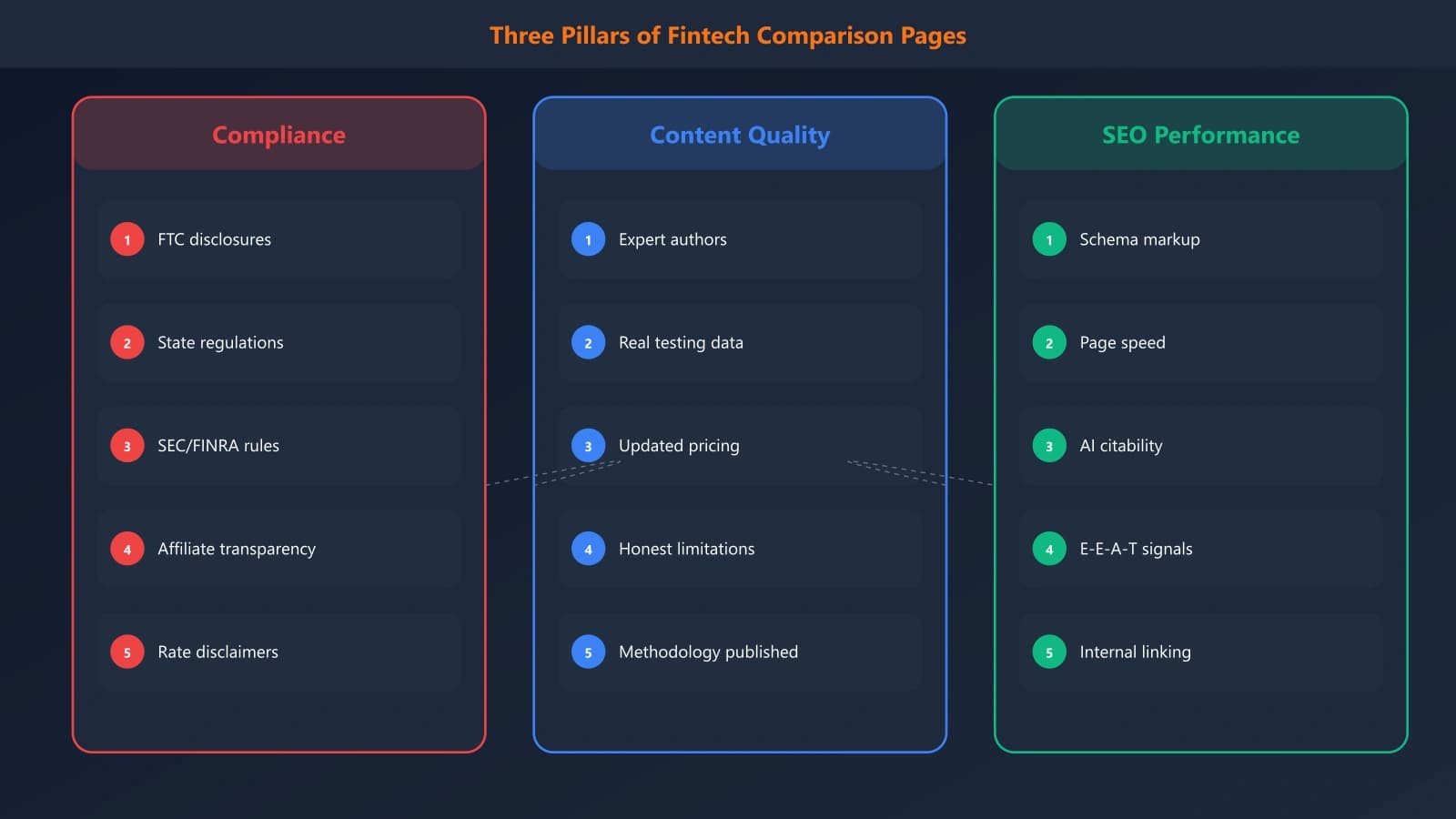
Understanding the Fintech Comparison Landscape
Before diving into tactics, let's map the landscape. Not all financial products carry the same regulatory burden, and understanding these differences helps you prioritize opportunities and allocate compliance resources appropriately.
Product Categories and Compliance Levels
Financial products exist on a compliance spectrum from relatively simple to heavily regulated. Your content strategy should account for where each product type falls:
| Product Category | Compliance Level | Key Regulators | Main Concerns |
|---|---|---|---|
| Banking (savings, checking) | Moderate | FDIC, OCC, State regulators | APY accuracy, fee disclosure |
| Credit Cards | High | CFPB, FTC, State AGs | APR disclosure, fee transparency |
| Personal Loans | High | CFPB, State regulators | Rate accuracy, eligibility claims |
| Investments/Trading | Very High | SEC, FINRA | Performance claims, recommendations |
| Insurance | Very High | State insurance commissions | Licensing, product descriptions |
| Crypto | Evolving | SEC, CFTC, State regulators | Securities status, risk disclosure |
YMYL Implications for Search
Google explicitly identifies financial topics as YMYL content, which means your pages face heightened scrutiny from search quality evaluators. The implications are significant:
- Higher E-E-A-T requirements: You need demonstrable expertise, credentials, and authoritative signals that wouldn't matter as much for other content types
- Accuracy standards: Outdated or incorrect information can tank your rankings, not just harm users
- Trust signals matter more: Author bios, about pages, editorial policies, and contact information carry more weight
- Content depth expectations: Thin comparisons are particularly penalized in financial verticals
Opportunity Assessment
The traffic and monetization potential in fintech comparison is substantial, but varies by category. Here's a realistic assessment of the opportunity:
| Category | Search Volume | Competition | Affiliate Potential | Compliance Burden |
|---|---|---|---|---|
| High-yield savings | High | Very High | $25-100/lead | Moderate |
| Credit cards | Very High | Extreme | $50-200/approval | High |
| Brokerage accounts | Moderate | High | $50-300/funded | Very High |
| Personal loans | High | High | $20-100/lead | High |
| Neobank comparisons | Moderate | Moderate | $25-75/signup | Moderate |
The sweet spot for new entrants is often in the moderate competition categories with reasonable compliance burden—neobank comparisons, specific credit card niches (travel, cashback for specific use cases), or emerging fintech categories where established players haven't yet dominated.
The Compliance Framework
Let's get specific about compliance requirements. This section covers the disclosures, language patterns, and structural requirements that keep your comparison content on the right side of regulations.
Required Disclosures by Product Type
Different financial products require different disclosure language. Here are the essentials:
Banking Products (Savings, Checking, CDs)
For deposit accounts, your disclosures should include:
- FDIC/NCUA insurance status and coverage limits
- APY accuracy date and source (“APY accurate as of [date], sourced from [institution] website”)
- Minimum balance requirements and how they affect the stated APY
- Fee disclosure when comparing fee structures
- Affiliate disclosure when using referral links
Credit Cards
Credit card comparisons require more extensive disclosures:
- Schumer Box reference or link for each card
- APR ranges with clear indication that rates vary by creditworthiness
- Annual fee disclosure prominently displayed
- Sign-up bonus terms including minimum spend requirements
- Clear statement that approval is not guaranteed
- Affiliate disclosure compliant with FTC guidelines
Investment Products
Investment comparisons face the strictest requirements:
- Clear statement that you are not providing investment advice
- Risk disclosure appropriate to product type
- Past performance disclaimer when showing returns
- No guarantees of future performance
- Disclosure of any compensation from featured platforms
- For registered investment advisors: appropriate regulatory disclosures
Affiliate Disclosure Best Practices
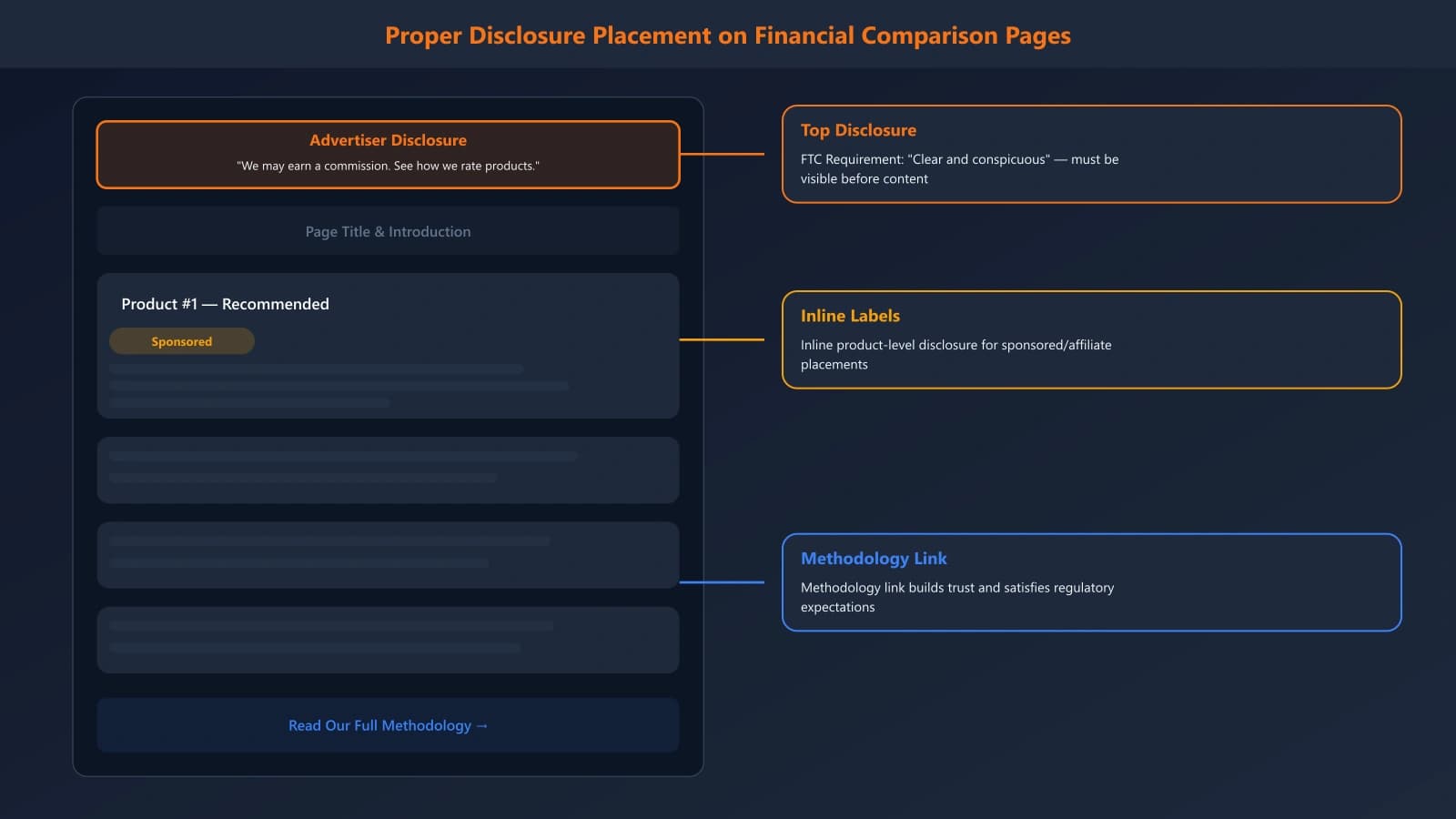
FTC guidelines require clear and conspicuous disclosure of material relationships. For fintech content, this means:
- Placement: Disclosures should appear before the first affiliate link, not buried at the bottom
- Clarity: Use plain language that readers understand (“We earn money when you click some links”)
- Consistency: Apply the same disclosure standard across all pages
- Visibility: Don't hide disclosures in collapsed sections or tiny fonts
Here's a disclosure template that balances compliance with readability:
Content Structure for Fintech Comparisons
The structure of your comparison pages needs to satisfy both SEO requirements and compliance standards. Here's the framework we recommend for fintech content.
Anatomy of a Compliant Comparison Page
A well-structured fintech comparison page includes these sections in order:
- TL;DR with top picks (immediate value for searchers)
- Disclosure section (affiliate and methodology transparency)
- Quick comparison table (scannable data for decision-making)
- Methodology explanation (E-E-A-T and trust building)
- Individual product reviews (depth and keyword targeting)
- How to choose guidance (decision framework for readers)
- FAQ section (long-tail query targeting)
- Regulatory footer (compliance disclosures)
Comparison Table Requirements
Comparison tables in fintech content need to be both useful and accurate. Key requirements:
- Date stamps: Include “Rates as of [date]” prominently
- Source attribution: Note where data comes from (institution websites, SEC filings, etc.)
- Rate ranges: Show ranges rather than single rates when rates vary by creditworthiness
- Important caveats: Note minimum balances, introductory vs ongoing rates, etc.
- Regular updates: Have a system to update rates weekly or when major changes occur
| Bank | APY* | Min Balance | Monthly Fee | FDIC Insured | Best For |
|---|---|---|---|---|---|
| Example Bank A | 5.00% | $0 | $0 | Yes | Highest rate seekers |
| Example Bank B | 4.75% | $100 | $0 | Yes | Branch access needed |
| Example Bank C | 4.50% | $1 | $0 | Yes | Mobile-first users |
*APYs accurate as of January 30, 2026. Rates subject to change. See institution websites for current rates and terms.
Individual Product Review Structure
Each product in your comparison should follow a consistent structure:
- Product name and key identifier (e.g., “Marcus by Goldman Sachs High-Yield Savings”)
- Quick summary (2-3 sentences on who it's best for)
- Key stats box (APY, fees, minimums in scannable format)
- Detailed pros/cons (specific to this product)
- Who should consider this (qualification guidance)
- Who should look elsewhere (honest limitations)
- Our verdict (clear recommendation statement)
The “who should look elsewhere” section is particularly important for fintech. It demonstrates honesty, reduces the perception of bias, and actually helps readers make better decisions—all of which improve both user satisfaction and E-E-A-T signals.
Generate Compliant Fintech Comparisons
Create financial product comparison pages with proper disclosures and regulatory-safe content structures.
Try for Free
SEO Strategy for Fintech Content
Now let's talk about ranking these pages. Fintech SEO has some unique characteristics that differentiate it from general comparison content SEO.
Keyword Strategy
The most obvious fintech keywords are also the most competitive. A smarter approach focuses on:
Specific use case queries: Instead of targeting “best savings account,” target “best savings account for emergency fund” or “best savings account for freelancers.” These queries have lower competition and higher intent clarity.
Comparison queries: “Marcus vs Ally savings” or “Wealthfront vs Betterment” have lower competition than category terms and very high conversion intent.
Problem-focused queries: “High-yield savings with no minimum balance” or “best credit card for 700 credit score” target specific user needs.
Feature-specific queries: “Savings accounts with ATM access” or “credit cards with no foreign transaction fees” capture feature-focused searchers.
Building E-E-A-T for Financial Content
Google's quality guidelines specifically call out financial topics as requiring strong E-E-A-T signals. Here's how to build them:
| E-E-A-T Element | How to Demonstrate | Implementation |
|---|---|---|
| Experience | Show you've actually used the products | First-person testing notes, screenshots, account setup walkthroughs |
| Expertise | Demonstrate financial knowledge | Author credentials, professional background, certifications |
| Authoritativeness | Be recognized as a trusted source | Expert quotes, media mentions, industry citations |
| Trustworthiness | Show transparency and accuracy | Clear methodology, update dates, correction policy, contact info |
Author Credentials Matter
For YMYL content, who writes the content matters. Ideal author profiles for fintech content include:
- CFP (Certified Financial Planner) or CFA credentials
- Professional experience in financial services
- Journalism credentials covering financial topics
- Academic background in finance or economics
- Verified byline with LinkedIn or professional website links
If you don't have in-house financial expertise, consider having content reviewed by qualified experts who can provide endorsements or fact-checking statements.
Link Building for Financial Content
Building links in the fintech space requires specific approaches:
Original research: Survey data about financial habits, analysis of rate trends, or studies about fintech adoption attract links naturally from journalists and other financial sites.
Data journalism: Visualizations of financial data, rate tracking tools, or calculators provide link-worthy utility.
Expert commentary: Offering expert quotes to journalists covering financial topics can result in attribution links.
Industry publications: Guest posts on financial planning sites, fintech blogs, or business publications with proper author attribution.
Monetization Approaches
Let's discuss how to monetize fintech comparison content while staying compliant. The good news is that financial products often have the highest affiliate payouts of any vertical.
Affiliate Programs and Networks
Major affiliate opportunities in fintech include:
- Credit card programs: Direct programs from issuers (Chase, Amex, Citi) or through networks like Commission Junction or FlexOffers
- Banking products: Many online banks have direct affiliate programs; also available through networks
- Investment platforms: Brokerages like Fidelity, Schwab, and robo-advisors often have referral programs
- Personal loans: Networks like LendingTree, Bankrate, or direct lender programs
- Insurance: Typically requires specific licensing; proceed with caution
Typical Commission Structures
| Product Type | Commission Model | Typical Range | Qualification Event |
|---|---|---|---|
| Credit cards | Per approval | $50-200 | Account approved |
| Savings accounts | Per funded account | $25-100 | Minimum deposit made |
| Brokerage | Per funded account | $50-300 | Minimum deposit/trade |
| Personal loans | Per lead or funded loan | $20-150 | Application or funding |
| Insurance | Varies by state/product | Highly variable | Policy binding |
Keeping Monetization Compliant
Several principles keep your monetization strategy on the right side of regulations:
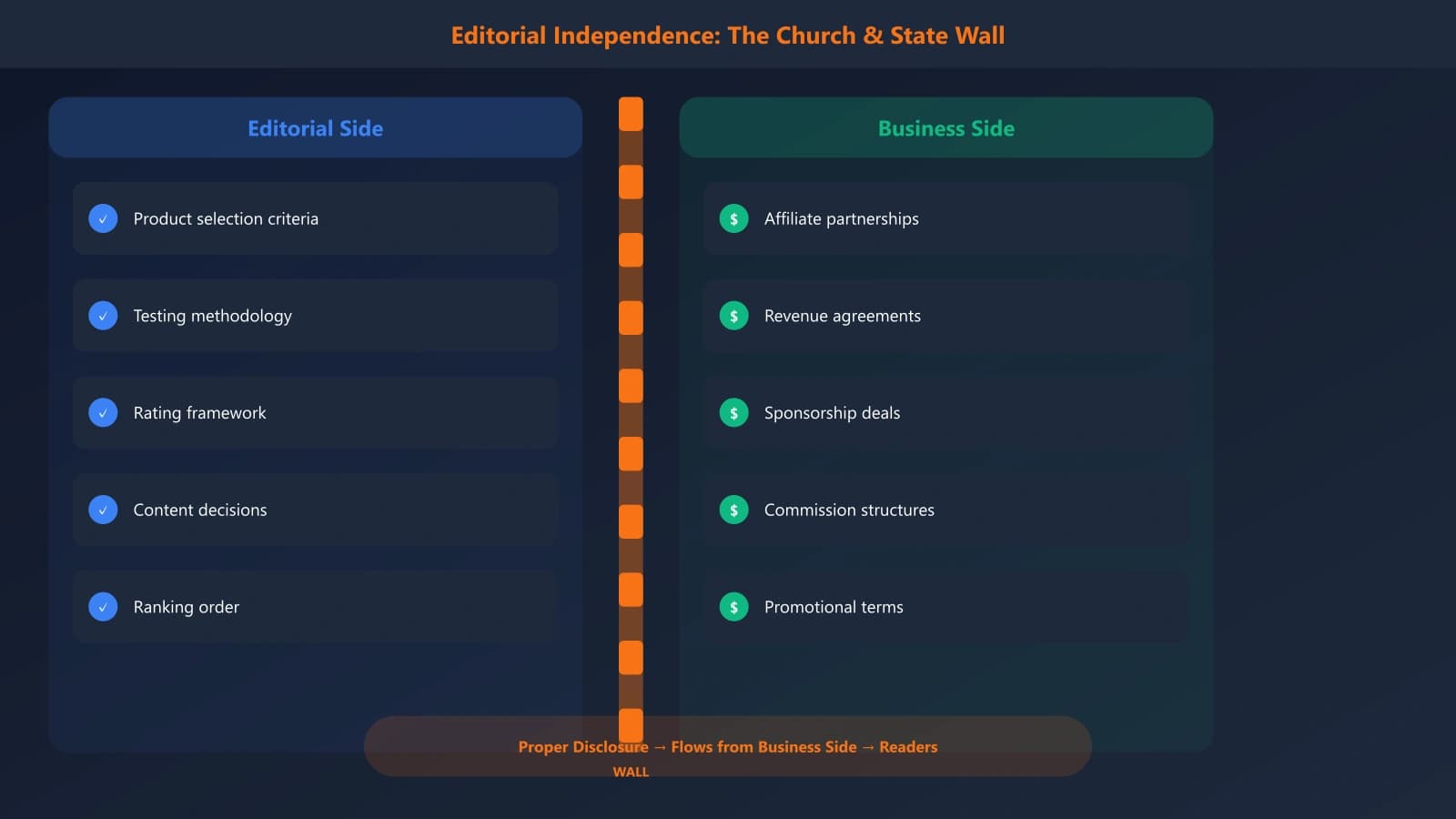
- Don't let compensation affect rankings. Your ranking methodology should be independent of affiliate relationships. If your #1 pick doesn't have an affiliate program, that's fine—recommend it anyway.
- Disclose clearly. Readers should understand that you earn money from some links before they click them.
- Keep some non-affiliate options. Including products without affiliate relationships demonstrates independence and helps with E-E-A-T.
- Update regularly. Stale affiliate content with outdated rates or terms is a compliance risk. Build update processes into your workflow.
- Separate editorial from business. Your content team should focus on quality; your business team handles affiliate relationships. Don't let the two influence each other inappropriately.
Content Maintenance and Updates
Financial content goes stale faster than almost any other vertical. Rates change, products launch and discontinue, terms evolve. A robust update process is essential.
Update Frequency by Content Type
| Content Type | Rate Updates | Full Review | Trigger Events |
|---|---|---|---|
| Savings account comparisons | Weekly | Monthly | Fed rate changes |
| Credit card comparisons | Monthly | Quarterly | New card launches, bonus changes |
| Brokerage comparisons | Quarterly | Bi-annually | Fee changes, feature launches |
| Loan comparisons | Weekly | Monthly | Rate environment changes |
Building an Update Process
A sustainable update process includes:
- Rate monitoring: Use tools or manual checks to track rate changes at key institutions
- Change documentation: Keep records of what changed and when for audit purposes
- Last updated timestamps: Display prominently and update them honestly
- Version history: Consider maintaining a changelog for major content updates
- Broken link checking: Financial institutions frequently change URLs; monitor for broken links
- Product discontinuation alerts: Remove or update references to discontinued products promptly
Common Mistakes to Avoid
After reviewing hundreds of fintech comparison sites, we've identified patterns that consistently cause problems. Avoid these mistakes:
Mistake 1: Making Specific Recommendations
“You should get this credit card” crosses a line that “This credit card may be a good fit for people who...” doesn't. The difference matters for both regulatory and user experience reasons.
Why it's a problem: Specific recommendations can be interpreted as financial advice, which has licensing requirements in many jurisdictions.
What to do instead: Frame all recommendations as informational and conditional. “Best for...” language is generally safer than “you should...”
Mistake 2: Implying Guaranteed Outcomes
“This investment will grow your wealth” or “You'll definitely get approved” are problematic claims that can't be substantiated.
Why it's a problem: Financial outcomes are never guaranteed. Implying otherwise is misleading and potentially actionable.
What to do instead: Use qualifying language. “Historically, diversified portfolios have...” or “Approval depends on your credit profile and other factors.”
Mistake 3: Letting Content Go Stale
A “best savings accounts in 2024” page still ranking in 2026 with 2024 rates is a liability, not an asset.
Why it's a problem: Outdated financial information misleads users and can constitute false advertising. It also signals low quality to Google.
What to do instead: Build update workflows into your content calendar. If you can't maintain a piece of content, consider removing it.
Mistake 4: Burying Disclosures
Putting affiliate disclosures only in the footer, in tiny text, or behind expandable sections doesn't satisfy FTC requirements for “clear and conspicuous” disclosure.
Why it's a problem: FTC enforcement actions have specifically targeted disclosure placement. The disclosure needs to be seen before the reader clicks affiliate links.
What to do instead: Place disclosures near the top of the content, in readable font sizes, before any affiliate links appear.
Implementation Guide
Building a fintech comparison site or adding financial comparisons to an existing publication requires systematic execution. Here's your implementation roadmap:
Phase 1: Foundation (Weeks 1-2)
- Define your product category focus (banking, credit cards, investments, etc.)
- Research compliance requirements for your chosen categories
- Draft disclosure language and get legal review if possible
- Set up author profiles with appropriate credentials
- Create your methodology documentation
- Apply to relevant affiliate programs
Phase 2: Content Development (Weeks 3-6)
- Build your comparison page template with all required sections
- Develop your product research and data collection process
- Create your first comparison page with full compliance elements
- Have compliance/legal review your initial content
- Iterate based on feedback
- Scale to additional comparison pages
Phase 3: Growth and Maintenance (Ongoing)
- Build link equity through original research and expert commentary
- Monitor rankings and adjust content based on performance
- Maintain update schedules for rate accuracy
- Expand to adjacent product categories
- Track regulatory changes and update compliance as needed
Measuring Success
| Metric | What It Measures | Target Range |
|---|---|---|
| Organic traffic | Search visibility | Consistent growth month-over-month |
| Click-through rate to products | Content engagement | 15-30% of visitors |
| Affiliate conversion rate | Revenue efficiency | Varies by product (1-10%) |
| Content freshness score | Update compliance | All pages updated within policy |
| Compliance audit pass rate | Regulatory safety | 100% on key elements |
Fintech comparison content is one of the most valuable content types you can build—but only if you do it right. The compliance requirements and quality standards are higher than other verticals, but so are the rewards. Follow this playbook, and you'll build financial comparison content that ranks, converts, and stays on the right side of regulations.
For more on building comparison content in regulated industries, see our guide on Insurance Comparisons: Navigate the Regulations. For the foundation of comparison page structure, check out The AI-Optimized Listicle Template.

Product Manager at BestPage. Pioneer in AEO research since 2024, exploring the convergence of SEO and GEO (Generative Engine Optimization). Led multiple AI-powered content optimization projects that achieved 300%+ citation increases in ChatGPT and Perplexity.