
Publishing comparison content about financial products isn't like comparing project management software. You're operating in one of the most heavily regulated content spaces online. Credit card comparisons require specific APR disclosures. Investment comparisons need performance disclaimers. Loan comparisons must follow Truth in Lending Act requirements. Get these wrong and you face real legal exposure.
The regulations vary significantly by product category. A “best credit cards” listicle has different requirements than a “best robo-advisors” comparison. State-by-state variations add another layer of complexity, especially for insurance and lending products.
This guide provides a comprehensive compliance checklist organized by financial product type. It's designed to help content teams, compliance officers, and SEO professionals work together to create listicles that are both effective and legally sound. Note that this is guidance, not legal advice—always consult with qualified legal counsel for your specific situation.
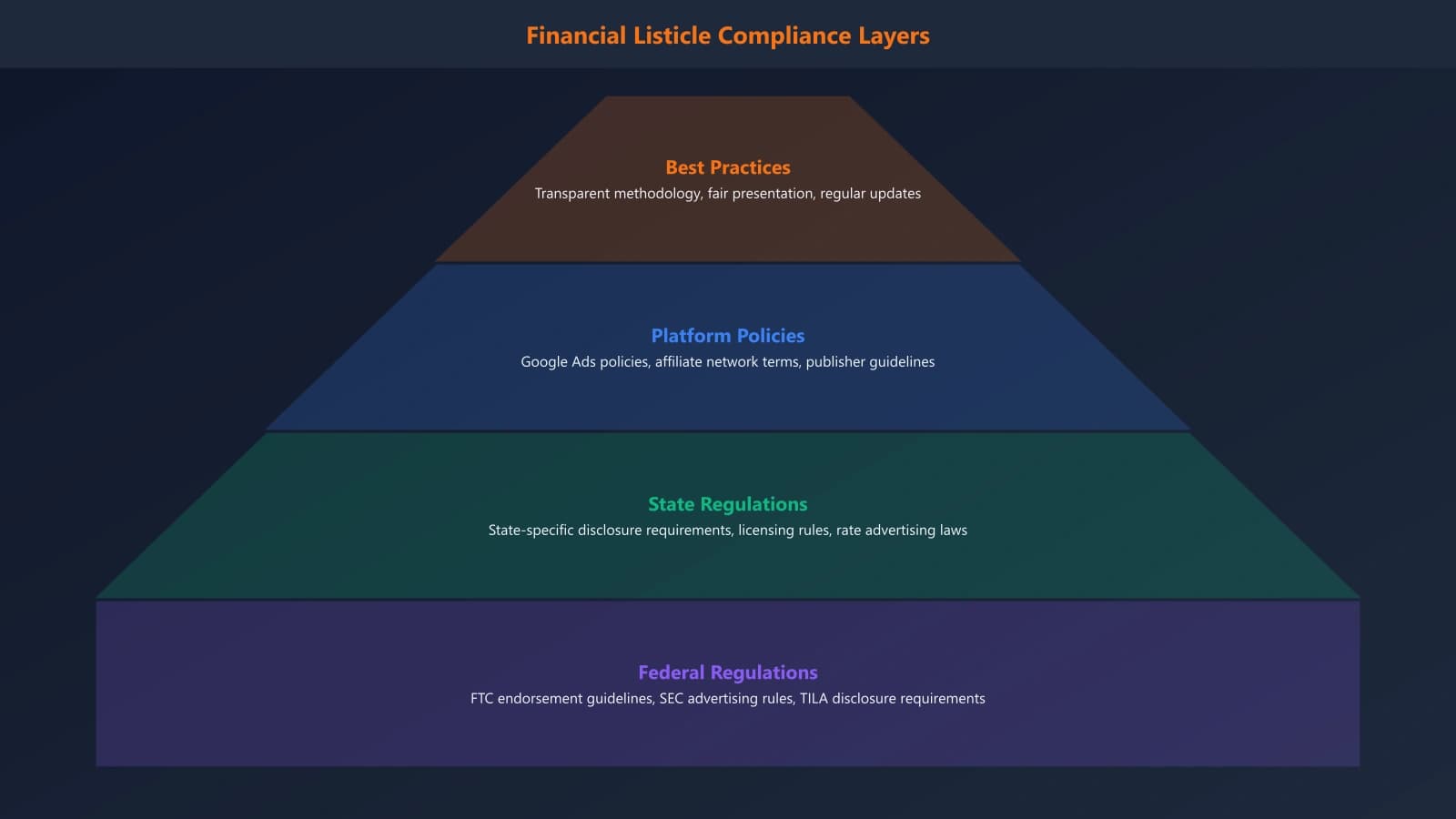
Universal Requirements (All Financial Products)
Regardless of the specific product type, all financial listicles must meet certain baseline requirements.
Affiliate and Compensation Disclosure
The FTC requires clear disclosure when you receive compensation for recommending products. For financial products, this is non-negotiable.
Disclosure placement requirements:
- Above the fold: Disclosure should be visible before users scroll
- Near rankings: Disclosure should appear close to where recommendations are made
- Readable format: Not hidden in fine print or obscured by design
- Clear language: Plain explanation that you may earn money from recommendations
What to disclose:
- That you may receive compensation when users apply for or purchase products
- That compensation may affect ranking order (if it does)
- That not all products are included (if your list is partial)
- Material connections to any issuers or providers
Accuracy and Currency Requirements
Financial product information changes frequently. Stale data creates compliance risk.
- Regular updates: APRs, rates, and fees should be verified regularly (monthly minimum for dynamic products)
- “As of” dates: Display when rate information was last verified
- Source attribution: Indicate where rate information comes from (issuer websites preferred)
- Disclaimers for variability: Note that rates may change and users should verify current terms
Fair and Balanced Presentation
Highlighting only benefits while downplaying risks or costs is a regulatory red flag.
- Include material risks: Not just features and benefits
- Show fees prominently: Not buried in fine print
- Balanced pros/cons: If you list benefits, include drawbacks
- Avoid superlatives without qualification: “Best” is opinion; make that clear
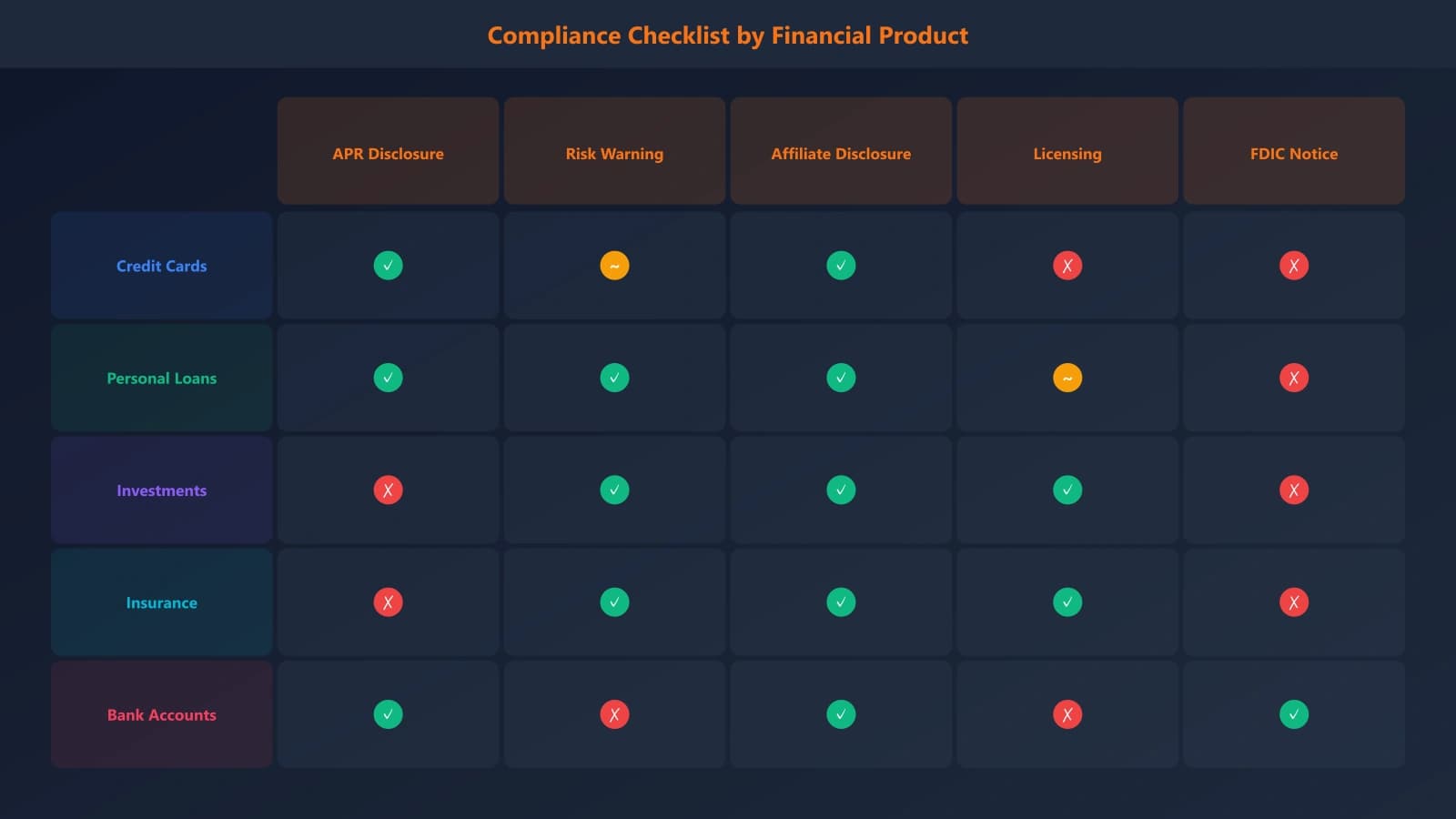
Credit Card Comparison Compliance
Credit card listicles face specific requirements under the Truth in Lending Act (TILA), Credit CARD Act, and various state regulations.
Truth in Lending Act Requirements
When displaying credit card terms, certain information must be disclosed in a specific manner.
Required disclosures for each card:
- APR(s): Purchase APR, balance transfer APR, cash advance APR
- Variable rate indicator: If APR is variable, say so
- Annual fee: Prominently displayed
- Penalty APR: If applicable, the rate and conditions that trigger it
- Minimum payment disclosure: How minimum is calculated
Schumer Box Integration
The standardized disclosure table (Schumer Box) contains legally required information. Your content should either include it or clearly link to it.
- Option 1: Embed Schumer Box for each card in your comparison
- Option 2: Link directly to each card's terms page with Schumer Box
- Option 3: Include expandable section with full disclosures
Credit Card Advertising Rules
If you mention specific promotional rates or offers, additional rules apply.
- Intro APR offers: Must include duration and post-promotional rate
- Sign-up bonuses: Must include conditions to earn (spending requirements)
- “No annual fee” claims: Must be accurate for the full first year minimum
- Reward rates: Must clarify any category restrictions or caps
Loan and Lending Compliance
Personal loans, mortgages, and other lending product comparisons have their own regulatory landscape.
Mortgage Comparison Requirements
Mortgage comparisons face RESPA, TILA, and state licensing considerations.
- APR display: Must show APR, not just interest rate
- Points and fees: Must disclose if rate includes points
- Rate assumptions: What loan amount, credit score, LTV was assumed
- Rate quotes vs estimates: Clarify that displayed rates are informational, not quotes
- NMLS requirements: If you're a licensed referrer, display NMLS ID
Personal Loan Requirements
Personal loan comparisons must address rate variability and qualification factors.
- Rate ranges: Show the range of APRs available (e.g., “6.99%-24.99% APR”)
- Qualification disclosure: Note that rates depend on creditworthiness
- Fee disclosure: Origination fees, prepayment penalties
- Example payments: If included, show assumptions used
State-Specific Lending Rules
Lending laws vary significantly by state. Some states have specific requirements for comparison advertising:
- California: Specific DFPI disclosure requirements
- New York: DFS advertising guidelines
- Various states: Rate caps that affect what products you can recommend
If you target specific states, verify compliance with that state's lending advertising rules.
Investment Product Compliance
Robo-advisors, brokerage comparisons, and investment product listicles face SEC and FINRA oversight.
SEC Advertising Rules
The SEC's Marketing Rule affects how investment performance and comparisons can be presented.
- No cherry-picking: Performance comparisons must be fair and not misleading
- Testimonials and endorsements: Special rules apply to paid testimonials
- Hypothetical performance: If shown, requires specific disclosures
- Past performance disclaimer: Must note that past performance doesn't guarantee future results
Robo-Advisor Comparisons
When comparing robo-advisors and wealth management platforms:
- Fee transparency: Management fees, underlying fund fees, account minimums
- Investment strategy disclosure: Passive vs active, asset allocation approach
- Risk disclosures: Note that investments can lose value
- Fiduciary status: Clarify if advisors are fiduciaries
Cryptocurrency Considerations
Crypto exchange and product comparisons face an evolving regulatory landscape.
- Volatility warnings: Prominently note crypto's volatility and risk
- Regulatory uncertainty: Mention that regulations are evolving
- Not FDIC insured: Note lack of traditional protections
- State restrictions: Some crypto products unavailable in certain states
Build Compliant Financial Comparisons
Create finance comparison content with built-in disclosure frameworks and compliance checks.
Try for Free
Insurance Comparison Compliance
Insurance comparisons face state-by-state regulation. Each state has its own insurance department with specific advertising rules.
General Insurance Requirements
- Licensing: Many states require licensure to recommend insurance products
- Accuracy: Premium and coverage information must be accurate
- Availability: Not all products available in all states
- Carrier ratings: If citing AM Best or similar, source properly
Health Insurance Specifics
Health insurance content has additional compliance requirements, especially around ACA plans.
- Essential health benefits: Cannot compare by excluding required coverages
- Network accuracy: Network claims should be verifiable
- Subsidy eligibility: Note that premium tax credits affect pricing
- Open enrollment: Include timing information during relevant periods
Life Insurance Specifics
- Premium assumptions: Clearly state age, health class, coverage amount used
- Policy type clarity: Distinguish term, whole, universal clearly
- Cash value disclosures: For permanent policies, explain how value builds
- Illustration limitations: Illustrations aren't guarantees
Implementation Checklist
Use this checklist for every financial product listicle you publish:
Before Publishing
- Affiliate disclosure in place: Above fold, clear language, near rankings
- Rate data verified: All APRs, fees, terms checked against issuer sites
- “As of” dates added: When was data last verified
- Product-specific disclosures: Schumer boxes, risk disclaimers per product type
- Fair balance check: Risks and fees included, not just benefits
- Legal review: Compliance or legal team has reviewed (especially for new product types)
- State availability noted: If products have state restrictions
Ongoing Maintenance
- Monthly rate verification: Check current APRs and fees
- Quarterly legal review: Ensure regulatory landscape hasn't changed
- Update timestamps: Reflect last verification date
- Broken link monitoring: Ensure disclosure links work
- Product availability: Remove discontinued products promptly
Documentation Best Practices
- Keep records: Document when rates were verified and how
- Screenshot sources: Capture issuer website data as verification
- Maintain update log: Track what changed and when
- Version control: Keep historical versions for compliance review
Financial content compliance is complex and constantly evolving. This checklist provides a foundation, but it's not a substitute for legal counsel familiar with your specific products, business model, and jurisdictions. Invest in proper compliance infrastructure—the cost of getting it wrong far exceeds the cost of getting it right.
For the broader fintech comparison strategy, see our guide on Fintech Comparison Playbook: Compliance + SEO. For insurance-specific guidance, check out Insurance Comparisons: Navigate the Regulations.

Product Manager at BestPage. Pioneer in AEO research since 2024, exploring the convergence of SEO and GEO (Generative Engine Optimization). Led multiple AI-powered content optimization projects that achieved 300%+ citation increases in ChatGPT and Perplexity.