

Google Business Profiles are the central hub of local search. When someone searches for local services, GBP listings dominate—the local pack, maps results, and knowledge panels all draw from GBP data. For local comparison content creators, GBP represents both a data source and a strategic consideration.
The relationship between comparison pages and GBP is bidirectional. Comparison pages can leverage GBP data to provide accurate, current information about local businesses. Meanwhile, businesses featured in comparison content often see GBP signals improve as users search for and engage with their profiles. Understanding this relationship helps create more effective local comparison strategies.
This guide covers how to integrate GBP data into local comparison content, how to structure comparisons that complement rather than compete with local pack results, and how businesses can leverage comparison page inclusion as part of broader GBP strategy. Whether you're a publisher creating local comparison content or a business seeking comparison visibility, these strategies help connect the two ecosystems.
The integration opportunities extend from simple data sourcing—pulling review scores and business information from GBP—to more sophisticated strategies around keyword alignment, category targeting, and multi-location coordination. We'll explore each level of integration and the requirements for implementation.
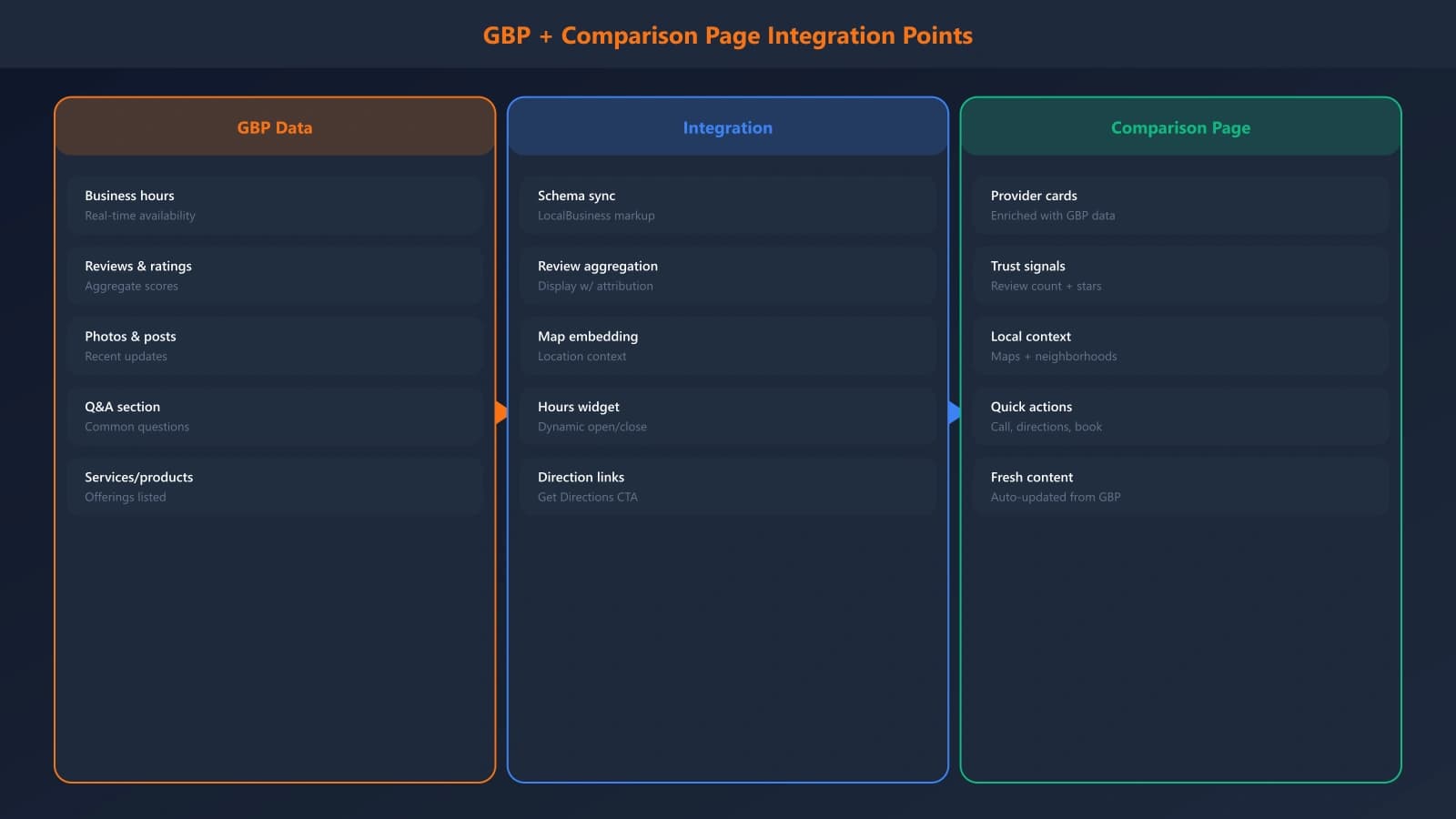
Leveraging GBP Data for Comparisons
GBP contains rich, relatively current data that can enhance comparison content.
Available GBP Data Points
Key data points accessible from Google Business Profiles:
- Review ratings: Aggregate star ratings and review counts
- Business categories: Primary and secondary category classifications
- Business attributes: Features, amenities, accessibility, payment methods
- Hours of operation: Regular hours and special hours
- Photos: Business images, both owner-uploaded and user-submitted
- Q&A content: Questions and answers from the business profile
- Posts and updates: Recent business posts and announcements
- Service areas: For service-area businesses, their coverage zones
This data is particularly valuable because it's often more current than other sources—businesses actively maintain their GBP to appear in local search.
Data Extraction Methods
Several approaches exist for accessing GBP data:
GBP data access methods:
• Places API: Official Google API providing structured business data (costs apply)
• Manual research: Reviewing profiles directly for key information
• Third-party aggregators: Services that compile GBP data (verify terms of use)
• Business partnerships: Direct data sharing with featured businesses
• Hybrid approaches: API for scale, manual verification for accuracy
For programmatic comparison sites, the Places API provides scalable access but requires budget consideration. For smaller sites, manual research supplemented by verification processes works well.
Enriching Comparison Content
Once you have access to GBP data, integrate it strategically into comparison pages.
Review Score Integration
GBP reviews provide valuable credibility signals:
- Aggregate display: Show GBP rating alongside other platform ratings
- Review volume context: Display review count—100 reviews at 4.5 stars is more meaningful than 5 reviews at 5 stars
- Recency indicators: Note when reviews are recent vs stale
- Response patterns: Highlight businesses that actively respond to reviews
- Verification links: Link to the GBP profile so users can verify and read full reviews
Presenting GBP reviews alongside reviews from other platforms provides multi-source validation that builds user trust.
Attribute and Feature Integration
GBP attributes provide standardized feature information valuable for comparisons:
Useful GBP attributes for comparisons:
• Accessibility features (wheelchair accessible, accessible parking)
• Payment methods accepted
• Service options (delivery, curbside, dine-in for restaurants)
• Health and safety measures
• Amenities (Wi-Fi, outdoor seating, parking)
• Crowd patterns and busy times
• Appointment requirements
These attributes enable filtering and comparison on dimensions users actually care about when making local decisions.
Strategic Alignment
Beyond data, align comparison strategy with local search dynamics.
| Search Intent | GBP Dominance | Comparison Opportunity | Strategy |
|---|---|---|---|
| “Plumber near me” | High (local pack) | Low for this query | Target related comparison queries instead |
| “Best plumbers in Austin” | Medium (local pack + organic) | Medium | Optimize for organic; complement local pack |
| “Emergency plumber reviews” | Low | High | Create review-focused comparison content |
| “Plumber vs handyman for X” | Very low | Very high | Educational comparison content |
| “Top rated plumbers [city]” | Medium | High | Rating-focused listicle content |
Complementary Positioning
Rather than competing with local pack results, position comparison content to complement them:
- Pre-decision research: Users often research before searching for specific businesses
- Post-pack comparison: After seeing local pack, users may want deeper comparison
- Evaluation content: “How to choose” and “what to look for” content complements pack results
- Review aggregation: Consolidating reviews across platforms adds value beyond GBP alone
Effective local comparison content works with the local search ecosystem, not against it.
Build GBP-Integrated Comparisons
Generate local listicles that leverage and complement Google Business Profile data.
Try for Free
For Businesses: Leveraging Comparison Inclusion
From the business perspective, comparison page inclusion can enhance GBP strategy.
Citation and Authority Value
Being featured in quality comparison content provides:
- Citation signals: NAP mentions that contribute to local SEO authority
- Referral traffic: Visitors who find you through comparison research
- Brand searches: Users who search for your business name after seeing you featured
- Review motivation: Users may leave reviews after engaging with your GBP via comparison content
- Credibility halo: Being featured in “best of” lists enhances perceived quality
For multi-location businesses, systematic comparison page inclusion across markets can amplify local SEO efforts.
GBP Optimization for Comparison Visibility
Businesses can optimize their GBP to be more attractive for comparison inclusion:
GBP optimization for comparisons:
• Complete all profile sections to provide comprehensive data
• Actively manage reviews to maintain strong ratings
• Use relevant categories and attributes accurately
• Post regularly to show active business presence
• Respond to reviews demonstrating engagement
• Upload quality photos that comparison sites may feature
Well-optimized GBP profiles make businesses more attractive candidates for comparison content inclusion.
Connecting the Ecosystems
Google Business Profiles and comparison content serve complementary roles in local search. GBP dominates immediate “near me” searches; comparison content serves the research and evaluation phase. Connecting these ecosystems—using GBP data to enrich comparisons, aligning comparison strategy with local search dynamics, and for businesses, leveraging comparison inclusion within GBP strategy—creates more effective local marketing overall.
For publishers, the opportunity is building comparison content that adds value beyond what GBP alone provides: multi-platform review aggregation, deeper evaluation criteria, expert perspective, and comprehensive comparison across many options. For businesses, the opportunity is ensuring GBP optimization supports not just local pack visibility but also comparison content inclusion.
The local search landscape continues evolving, but the fundamental value exchange remains: users need help making local decisions, and content that genuinely helps will continue to find audience and ranking opportunities.
For local trust signals, see Local Business Trust Signals. For multi-location strategy, see Multi-Location Best-Of Template.

Product Manager at BestPage. Pioneer in AEO research since 2024, exploring the convergence of SEO and GEO (Generative Engine Optimization). Led multiple AI-powered content optimization projects that achieved 300%+ citation increases in ChatGPT and Perplexity.