

“Best plumbers in Austin” and “best plumbers in Dallas” are fundamentally the same content type with different location data. If you have a system for sourcing local business data, you can generate best-of pages for hundreds of cities from a single template. This is programmatic local SEO—and it works when done correctly.
The challenge is ensuring each page has sufficient unique value. Google aggressively penalizes thin, duplicative location pages that exist only for keyword targeting without providing genuine local value. The template approach must balance efficiency at scale with meaningful local differentiation.
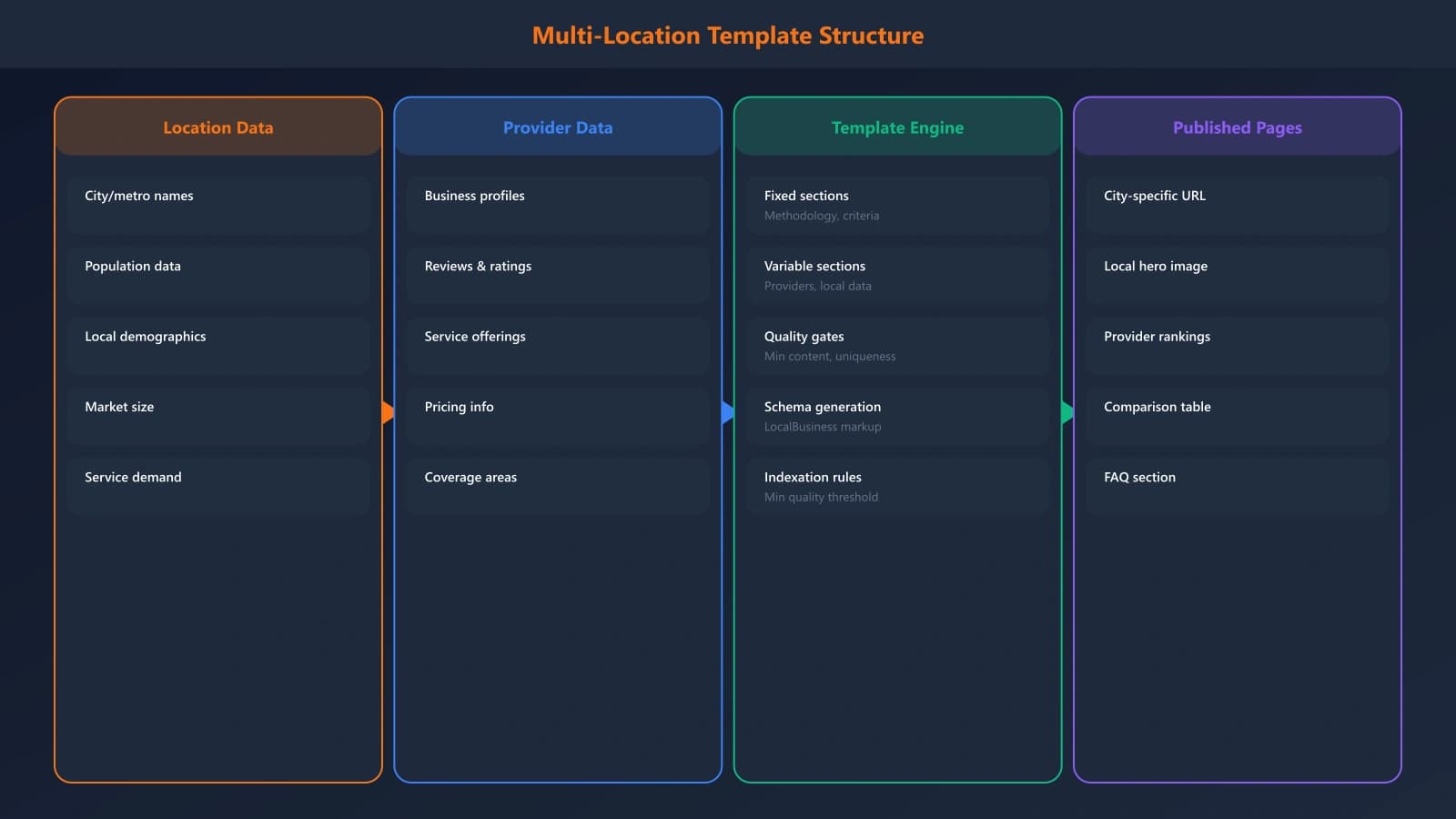
This template provides a structure designed for scale while maintaining quality. Each section includes guidance on what must be unique per location versus what can be templated. Copy and adapt this template for your specific category and data sources. The template assumes you have access to local business data—the structure works regardless of how you source that data.
The template is organized by page section, with each section including the purpose, template structure, required data points, and customization guidance. Follow the structure to build location pages that rank without triggering thin content issues.
Section 1: Page Header and Meta
The header section establishes what the page is and where it applies.
TEMPLATE: Title and Meta Description
Title: Best [Service Category] in [City], [State] ([Year]) | [Brand]
Example: Best Plumbers in Austin, TX (2026) | LocalRankings
Meta Description: Find the top-rated [service category] in [City]. We researched [X] local [providers] based on reviews, credentials, and reputation. Updated [Month Year].
Example: Find the top-rated plumbers in Austin. We researched 47 local plumbing companies based on reviews, credentials, and reputation. Updated January 2026.
Customization notes: The title and meta description must include the specific city. The number of providers researched should be accurate per location—don't claim “50 providers” if you only found 12 in that market. The update date should reflect when that specific location page was last verified.
H1 and Opening
TEMPLATE: H1 and Opening Paragraph
H1: Best [Service Category] in [City], [State]
Opening paragraph: Looking for a reliable [service type] in [City]? We researched [X] [providers] serving [City] and the surrounding [County/Region] area. Our top picks are based on [evaluation criteria]. Whether you need [common service 1] or [common service 2], these [City] [providers] stand out.
Data requirements: City name, state, accurate provider count, county/region name, 2-3 common services for this category.
Section 2: Top Picks Summary
Immediately after the opening, provide a quick-reference summary of top picks.
TEMPLATE: Quick Picks Box
Our Top [City] [Service Category] Picks:
1. [Business Name 1] — [One-line differentiator or specialty]
2. [Business Name 2] — [One-line differentiator or specialty]
3. [Business Name 3] — [One-line differentiator or specialty]
[Optional: 2-3 more picks if data supports]
Customization notes: This section is 100% location-specific. The business names and differentiators come from your local data. The differentiators should highlight what makes each business notable—specialties, years in business, review highlights, or unique offerings.
Methodology Brief
TEMPLATE: Methodology Summary
How We Chose These [City] [Providers]: We evaluated [providers] based on [3-4 criteria]. For [City] specifically, we considered [any local factors—market size, typical pricing, regional considerations]. [Link to full methodology page if available].
Customization: The methodology can be mostly templated, but include at least one city-specific observation. This might reference local market conditions, typical pricing in that area, or regional service considerations.
Section 3: Individual Provider Listings
The bulk of unique content comes from individual provider profiles.
TEMPLATE: Individual Provider Entry
## [Business Name]
[2-3 sentence overview of this business, what they're known for, years serving [City]]
Location: [Address], [City], [State] [ZIP]
Specialties: [List of services or specializations]
Ratings: [X] stars on Google ([Y] reviews) | [Other platforms if available]
Why they made our list: [1-2 sentences on what distinguishes this provider]
Best for: [Specific use case or customer type this provider serves well]
[Optional: Contact information, hours, website link]
Data requirements per listing: Business name, full address, specialty list, Google rating and review count, at least one unique insight about why this provider stands out.
Minimum listings: Aim for 5-10 quality listings per location. Pages with only 2-3 listings feel thin; pages with 20+ may overwhelm users. Adjust based on market size—smaller cities may genuinely have fewer quality options.
Section 4: Local Context Section
This section provides location-specific content that can't be templated—essential for avoiding thin content penalties.
TEMPLATE: Local Context
## [Service Category] in [City]: What to Know
[2-3 paragraphs covering:]
• Local market characteristics (size, typical pricing, demand patterns)
• Regional considerations (climate factors, local regulations, common issues)
• [City]-specific insights (neighborhood variations, seasonal factors)
• How [City] compares to nearby markets if relevant
Customization: This section requires genuine local research or knowledge. It cannot be effectively templated. Options for sourcing this content include local market research per major city, regional grouping (Southwest cities share climate considerations), local expert input, and user-generated content from that market.
For truly scalable generation, consider creating regional context templates—one for Texas cities, one for Florida cities, etc.—that capture shared regional factors while requiring less per-city research.
Generate Multi-Location Listicles at Scale
Build hundreds of local best-of pages from templates with unique, valuable content.
Try for Free
Section 5: FAQ Section
FAQs provide additional unique content opportunities and target long-tail queries.
TEMPLATE: FAQ Section
## Frequently Asked Questions About [Service Category] in [City]
Q: How much does [service] cost in [City]?
A: [City] [service] costs typically range from $[X] to $[Y] depending on [factors]. [Optional: how this compares to state/national averages]
Q: How many [providers] are there in [City]?
A: [City] has approximately [X] licensed [providers]. We evaluated [Y] of them for this list based on [criteria].
Q: Do [City] [providers] require licenses?
A: Yes, [State] requires [licensing requirements]. Verify licenses through [state licensing body].
[2-4 additional FAQs relevant to this category and location]
Customization: Pricing and provider counts must be location-specific. Licensing requirements are typically state-level, so one answer covers all cities in a state. Create a mix of location-specific and state-level FAQs for efficiency.
Section 6: Closing and Cross-Links
Close with summary and internal linking to related content.
TEMPLATE: Closing
Finding the Right [Provider] in [City]
The [City] [service category] market offers solid options for both [common need 1] and [common need 2]. Our top recommendations—[Top Pick 1] and [Top Pick 2]—stand out for [reasons]. Remember to verify licenses, get multiple quotes, and check recent reviews before making your decision.
Related Resources:
• [Link to state-level guide if available]
• [Link to nearby city pages]
• [Link to category hub page]
Cross-linking strategy: Link to nearby cities creates a network of related pages. Link to state or category hub pages builds topical authority. This internal linking structure helps both users and search engines understand your content organization.
Implementation Considerations
Using this template effectively requires attention to data quality and content differentiation.
Data Requirements Summary
For each location page, you need:
- 5-10 verified local businesses with complete profile data
- Accurate ratings and review counts from at least one platform
- Unique differentiators for each listed business
- Local pricing data or regional estimates
- Local context content (at least 2-3 unique paragraphs)
If you can't source quality data for a location, don't generate a page for it. Thin pages with poor data harm your entire domain's quality signals.
Quality Thresholds
Before publishing any location page, verify it meets minimum quality standards. The page should have at least 5 quality business listings, unique local context content, accurate and current data, and functioning internal links. Pages failing these thresholds should not be published—better to have fewer, higher-quality pages than many thin pages.
For programmatic quality processes, see PSEO Editorial Review. For local trust signals, see Local Business Trust Signals.

Product Manager at BestPage. Pioneer in AEO research since 2024, exploring the convergence of SEO and GEO (Generative Engine Optimization). Led multiple AI-powered content optimization projects that achieved 300%+ citation increases in ChatGPT and Perplexity.