
Programmatic SEO (PSEO) promises scale: thousands of pages targeting long-tail keywords, each generated from templates and data. The math is compelling—one template, one data source, thousands of unique URLs. But the math hides a critical challenge: quality at scale requires processes that traditional editorial workflows weren't designed for.
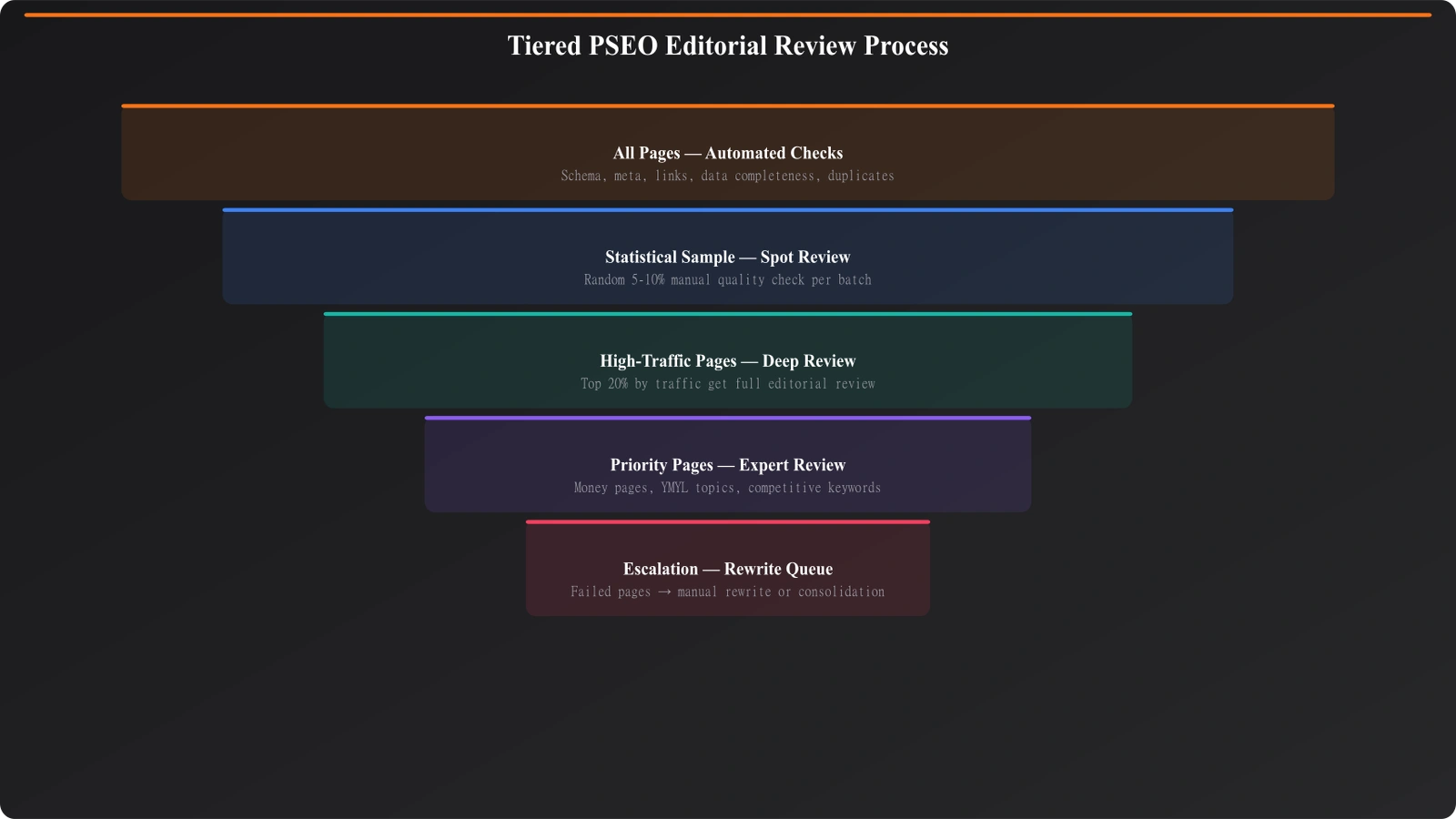
You can't have an editor carefully review every page when you're publishing thousands. But you also can't publish thousands of pages without any editorial oversight and expect good outcomes. The solution is tiered review: different levels of scrutiny for different content tiers, automated checks catching obvious problems, human review focused where it matters most.
This guide covers how to build editorial review processes that work at PSEO scale. The goal isn't to eliminate human judgment—it's to focus human judgment where it has the most impact while automated systems handle the rest.
Quality Problems at Scale
Understanding what goes wrong helps design processes that prevent it.
Common PSEO Quality Failures
Programmatic content fails in predictable ways:
- Template artifacts: Placeholder text that wasn't replaced, conditional logic that rendered incorrectly, formatting that broke with certain data inputs.
- Data quality issues: Incorrect information pulled from source data, outdated data that should have been refreshed, missing data creating incomplete content.
- Thin content: Pages with too little unique value, particularly when data for that entity is sparse.
- Duplicate content: Pages too similar to each other, either from template limitations or overlapping data.
- Factual errors: Incorrect claims derived from misunderstood data or flawed template logic.
- Poor readability: Content that's technically correct but awkward or unhelpful for readers.
Each failure type requires different detection and prevention strategies. Template artifacts can be caught automatically; poor readability requires human judgment.
Why Scale Compounds Problems
A 1% error rate sounds acceptable until you realize that means 100 broken pages out of 10,000. And broken pages don't distribute evenly—if the error comes from a template bug, it might affect every page using that template section. One flawed conditional statement becomes thousands of flawed pages.
Google's helpful content system evaluates sites holistically. A large volume of low-quality pages can affect the perceived quality of your entire domain, potentially impacting even your high-quality content. The stakes of PSEO quality extend beyond the programmatic pages themselves.
Layer 1: Automated Quality Checks
The foundation of PSEO quality is automated checks that catch obvious problems before publication.
Technical Validation
Every page should pass automated technical checks:
- HTML validity: No unclosed tags, proper structure
- Required elements: Title, meta description, H1 present
- No placeholder text: Scan for common placeholder patterns ([INSERT], TODO, Lorem ipsum)
- Image validity: All image references resolve to real files
- Link checking: Internal links work, external links are valid
- Schema validation: Structured data is properly formatted
These checks should run automatically before any page publishes. Failed checks should block publication until resolved.
Content Quality Signals
Beyond technical validation, automated checks can flag potential quality issues:
- Word count thresholds: Flag pages below minimum content length
- Similarity scoring: Flag pages too similar to other pages
- Data completeness: Flag pages where key data fields are empty
- Readability scoring: Flag content with unusual complexity scores
- Keyword presence: Ensure target keyword appears appropriately
These checks don't guarantee quality—they identify pages that need human review. High similarity scores don't automatically mean duplicate content, but they warrant investigation.
Layer 2: Tiered Human Review
With automated checks handling obvious issues, human review can focus where judgment matters.
| Review Tier | Coverage | Focus | Reviewer Type |
|---|---|---|---|
| Deep editorial | Top 5-10% by traffic/value | Full editorial review, expert verification | Senior editor + subject expert |
| Standard review | Next 20-30% | Accuracy, readability, completeness | Staff editor or trained reviewer |
| Spot check | Random 5-10% of remaining | Sample quality verification | QA team member |
| Flagged review | Any page flagged by automation | Investigate specific concern | Appropriate reviewer for issue type |
| Automated only | Remainder passing all checks | Trust automation + spot checks | None unless flagged |
Prioritization Logic
Which pages get deep review? Prioritize based on:
- Traffic potential: Higher search volume keywords deserve more attention
- Commercial value: Pages driving conversions or revenue matter more
- Reputation risk: Content about well-known entities gets more scrutiny
- Template newness: New templates get extra review until proven stable
- Data source reliability: Content from less reliable sources needs more verification
The goal is proportional effort: more review investment where more value (or risk) exists.
Build Quality PSEO at Scale
Generate programmatic listicles with built-in quality signals and review workflows.
Try for Free
Implementing Review Workflows
Effective review requires clear workflows and appropriate tooling.
Standard Review Checklist
Reviewers should evaluate consistent criteria:
- Accuracy: Are factual claims correct and current?
- Completeness: Does the page adequately address the topic?
- Readability: Is the content clear and well-structured?
- Helpfulness: Would a reader find this genuinely useful?
- Uniqueness: Does this add value beyond similar pages?
- Technical quality: Are formatting, links, and images working?
Standardized criteria ensure consistent review regardless of which reviewer handles the page.
Feedback Loops to Templates
Review findings should flow back to template improvement. If reviewers consistently find the same issues, that signals template problems worth fixing:
Feedback loop process:
1. Reviewer documents specific issue found
2. Issue categorized: template problem vs. data problem vs. one-off
3. Template problems trigger template revision
4. Revised template regenerates affected pages
5. Sample review verifies fix
This continuous improvement process means quality compounds over time. Each template iteration reduces future review burden.
Ongoing Quality Monitoring
Quality isn't a one-time check—it requires ongoing monitoring.
Performance-Based Quality Signals
Post-publication data reveals quality issues automation might miss:
- Bounce rates: Pages with unusually high bounce rates may have quality problems
- Time on page: Very short sessions suggest content didn't meet expectations
- Pogo-sticking: Users returning to search results indicates unmet intent
- Ranking changes: Sudden drops may signal Google quality concerns
- User feedback: Comments, support tickets, or survey feedback about content
Build dashboards that surface outliers for investigation. A page performing significantly worse than similar pages warrants manual review.
Regular Quality Audits
Schedule periodic comprehensive audits beyond ongoing monitoring. Quarterly audits might include re-reviewing a sample of previously-reviewed pages, checking high-traffic pages for freshness and accuracy, evaluating overall quality trajectory, and reassessing template effectiveness.
Audits catch gradual quality drift that day-to-day monitoring might miss.
Quality as Competitive Advantage
PSEO without quality control is a race to the bottom—publishing increasingly thin content until Google notices and devalues your entire domain. PSEO with rigorous quality processes is a sustainable advantage: scale that competitors can't easily match, combined with quality that protects and builds domain authority.
The investment in tiered review, automated checks, and continuous improvement pays off through better rankings, lower risk, and content that actually serves users. Build quality into your PSEO process from the start, not as an afterthought.
For related methodology, see Feature Verification Process. For pricing data specifically, see Pricing Data Collection System.

Product Manager at BestPage. Pioneer in AEO research since 2024, exploring the convergence of SEO and GEO (Generative Engine Optimization). Led multiple AI-powered content optimization projects that achieved 300%+ citation increases in ChatGPT and Perplexity.