
Pricing accuracy seems like a basic requirement, but it's surprisingly hard to maintain at scale. A SaaS company might change pricing without announcement. A product might add or remove tiers. Currency fluctuations affect international pricing. Annual vs monthly billing creates confusion. Promotional pricing muddles the picture further.
The result: most comparison content has pricing errors. Users discover these errors when they click through, find different numbers, and immediately lose trust in everything else on the page. If the price is wrong, what else is wrong?
This guide covers how to build pricing data systems that maintain accuracy across many products and over time. The investment pays off through improved trust, better conversions, and reduced maintenance burden from user complaints about outdated information.
Pricing Data Sources
Different sources have different reliability and accessibility. Understanding the landscape helps prioritize collection methods.
| Data Source | Reliability | Update Speed | Access Method | Challenges |
|---|---|---|---|---|
| Official pricing pages | High | Real-time | Web scraping | Format changes, anti-scraping |
| Vendor APIs | Very high | Real-time | API integration | Limited availability, rate limits |
| Vendor partnerships | Very high | Varies | Data feed | Relationship required, selective data |
| Third-party aggregators | Medium | Delayed | API or data export | May be outdated, coverage gaps |
| Manual research | High (at capture) | Slow | Human research | Doesn't scale, becomes stale |
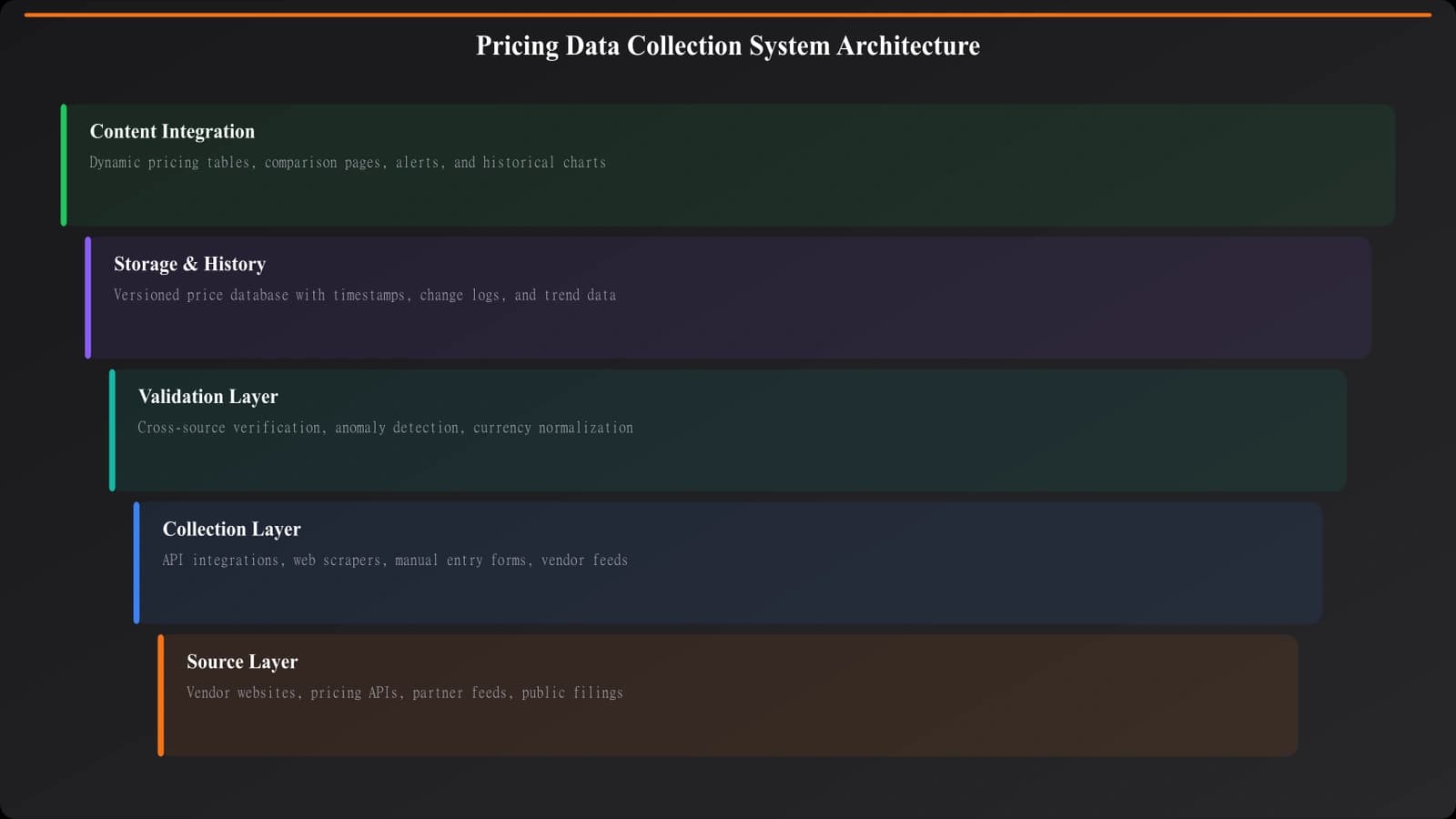
For most publishers, a hybrid approach works best: automated scraping of official pages as the primary source, supplemented by manual verification and vendor relationships for high-priority products.
Collection Methods
How you collect pricing data affects accuracy, freshness, and maintenance burden.
Automated Scraping
Web scraping official pricing pages is the most common approach. Key considerations:
- Page structure monitoring: Pricing pages change format. Build scrapers that detect structural changes and alert for updates.
- Multiple price points: Most products have multiple tiers. Capture all relevant prices, not just entry-level.
- Billing frequency: Distinguish monthly vs annual pricing. Display both or clearly indicate which you show.
- Currency handling: Decide on currency normalization. USD is common but may not serve international audiences.
- Change detection: Track price changes over time. Sudden changes might indicate errors.
Scraping frequency depends on how often products change pricing. Weekly updates catch most changes; daily updates might be necessary for volatile categories.
API Integration
Some vendors provide pricing APIs, though they're rare for public pricing. More common are affiliate or partner APIs that include pricing data. When available, APIs provide the most reliable and structured data.
API considerations include rate limits, data format standardization across different APIs, authentication management, and handling API downtime or deprecation.
Vendor Relationships
For high-priority products, direct relationships with vendors can provide pricing data feeds. This works especially well when you drive meaningful referral volume—vendors have incentive to keep your data accurate.
Relationship-based data is often the most reliable but doesn't scale across hundreds of products. Reserve this approach for your most important listings.
Validation Systems
Collection alone isn't enough—you need validation to catch errors before they reach users.
Automated Validation Rules
Build validation rules that flag suspicious data:
- Range checks: Flag prices outside expected ranges for the category
- Change magnitude: Flag price changes greater than reasonable thresholds (e.g., 50%+ change)
- Format validation: Ensure prices are numeric, in expected currency format
- Tier ordering: Verify that higher tiers cost more than lower tiers
- Historical comparison: Flag prices that differ significantly from historical averages
Flags don't necessarily mean errors—they indicate data worth human verification before publication.
Cross-Reference Verification
When possible, verify pricing from multiple sources. If your scraper shows $99/month but a third-party source shows $79/month, investigate before publishing.
Cross-reference sources:
• Official pricing page vs. app store listing
• Vendor website vs. affiliate data feed
• Current pricing vs. recent review site data
• Claimed pricing vs. actual checkout flow
Discrepancies often reveal promotional pricing, regional differences, or one source being outdated. Investigation clarifies which data to publish.
Generate Comparison Pages with Accurate Pricing
Build listicles with structured data fields ready for your pricing system integration.
Try for Free
Presentation Best Practices
How you display pricing affects both usefulness and liability for accuracy.
Transparency Elements
Build transparency into pricing display:
- Last verified date: Show when pricing was last confirmed accurate
- Pricing complexity disclaimer: Note that pricing may vary by region, promotion, or negotiation
- Link to official pricing: Always link to the vendor's official pricing page
- Billing basis: Clearly indicate whether prices are monthly, annual, per-user, etc.
- Starting vs. typical: Clarify whether you show entry-level or typical plan pricing
Transparency protects you from accuracy complaints while helping users understand the data they're seeing.
Update Workflow
When pricing changes, your content should update quickly:
- Pricing system detects change or receives update
- Validation rules check for errors
- Content system receives validated new pricing
- Affected pages regenerate or update dynamically
- Verification confirms pages show correct data
The tighter this loop, the less time users spend seeing outdated information. Dynamic pricing display (pulling from database at render time) beats static content that requires republication.
Building Pricing Trust
Pricing accuracy is a competitive advantage in comparison content. Most publishers get it wrong—showing stale data, outdated tiers, or incorrect numbers. Building reliable pricing systems differentiates your content and builds the trust that drives conversions.
Start with the products that matter most: high-traffic pages, high-commission affiliates, frequently-changing products. Build collection and validation for these first, then expand systematically. Manual checking doesn't scale, but selective automation can cover your critical listings.
For related methodology, see Feature Verification Process. For editorial quality systems, see PSEO Editorial Review.

Product Manager at BestPage. Pioneer in AEO research since 2024, exploring the convergence of SEO and GEO (Generative Engine Optimization). Led multiple AI-powered content optimization projects that achieved 300%+ citation increases in ChatGPT and Perplexity.