
“Tool X has native integration with Salesforce.” “Tool Y offers unlimited storage on all plans.” “Tool Z supports custom workflows.” These are the claims that make comparison content useful—and the claims most likely to be wrong. Features change constantly. What was true when you researched might not be true when users read.
Incorrect feature claims damage trust more than almost any other content error. Users rely on feature information to make decisions. When they discover your claim is wrong—often after clicking through and not finding the promised feature—they don't just leave. They actively distrust everything else you've written. One wrong feature claim taints the entire comparison.
This guide covers how to build verification processes that catch feature errors before publication and keep claims accurate over time. The goal isn't perfection—it's systematic risk reduction that makes serious errors rare.
Common Error Sources
Understanding how feature errors occur helps design verification processes that catch them.
Research Phase Errors
Feature research often goes wrong in predictable ways:
- Marketing vs reality: Marketing pages describe capabilities in aspirational terms that don't match actual functionality.
- Tier confusion: Features available on Enterprise but claimed as if they're on all plans.
- Integration vs native: Features requiring third-party integration described as built-in.
- Beta vs production: Announced features that aren't yet generally available.
- Deprecated features: Capabilities that existed but have been removed or sunset.
- Misunderstood terminology: Terms that mean different things to the product than to the writer.
Each error type requires different verification approaches. Marketing exaggeration requires hands-on verification; tier confusion requires careful plan comparison; deprecated features require recency checks.
Post-Publication Drift
Even accurate content becomes inaccurate over time:
- Feature additions: New capabilities make your “Tool X lacks Y” claims obsolete
- Feature removals: Capabilities you mentioned no longer exist
- Feature changes: How a feature works has changed substantially
- Tier restructuring: Features moved between pricing tiers
- Renaming: Feature names changed, making your references confusing
Post-publication drift is inevitable. The question is whether you have systems to detect and correct it before users discover your information is stale.
Verification Methods
Different verification methods suit different situations and confidence levels.
Primary Source Verification
The gold standard: verify features by actually using the product.
- Free trial testing: Sign up for trials and verify claimed features firsthand
- Demo account access: Request demo accounts for products without public trials
- Paid subscriptions: For critical products, maintain paid access for ongoing verification
- Documentation review: Official documentation is more reliable than marketing pages
- Support verification: Ask support directly about ambiguous capabilities
Primary source verification takes time but provides the highest confidence. Prioritize it for high-traffic content and specific claims that significantly affect your recommendations.
Secondary Source Cross-Reference
When primary verification isn't practical, cross-reference multiple secondary sources:
Secondary source hierarchy:
1. Official help documentation (most reliable)
2. Official changelog or release notes
3. Verified user reviews mentioning specific features
4. Industry analyst reports
5. User forum discussions with specific details
6. Marketing pages (least reliable, treat with skepticism)
Multiple sources agreeing increases confidence. A single marketing page claim deserves skepticism; the same claim confirmed by help docs and user reviews is more trustworthy.
Confidence Levels
Not all claims need the same verification rigor. Assign confidence levels based on claim importance and verification thoroughness:
- High confidence: Verified via primary source testing or multiple authoritative sources
- Medium confidence: Verified via reliable secondary sources; minor discrepancies possible
- Low confidence: Based on limited sources; needs additional verification before publication
Never publish claims with low confidence in critical positions (like major differentiators or explicit “lacks feature” claims). Either verify further or soften the claim language.
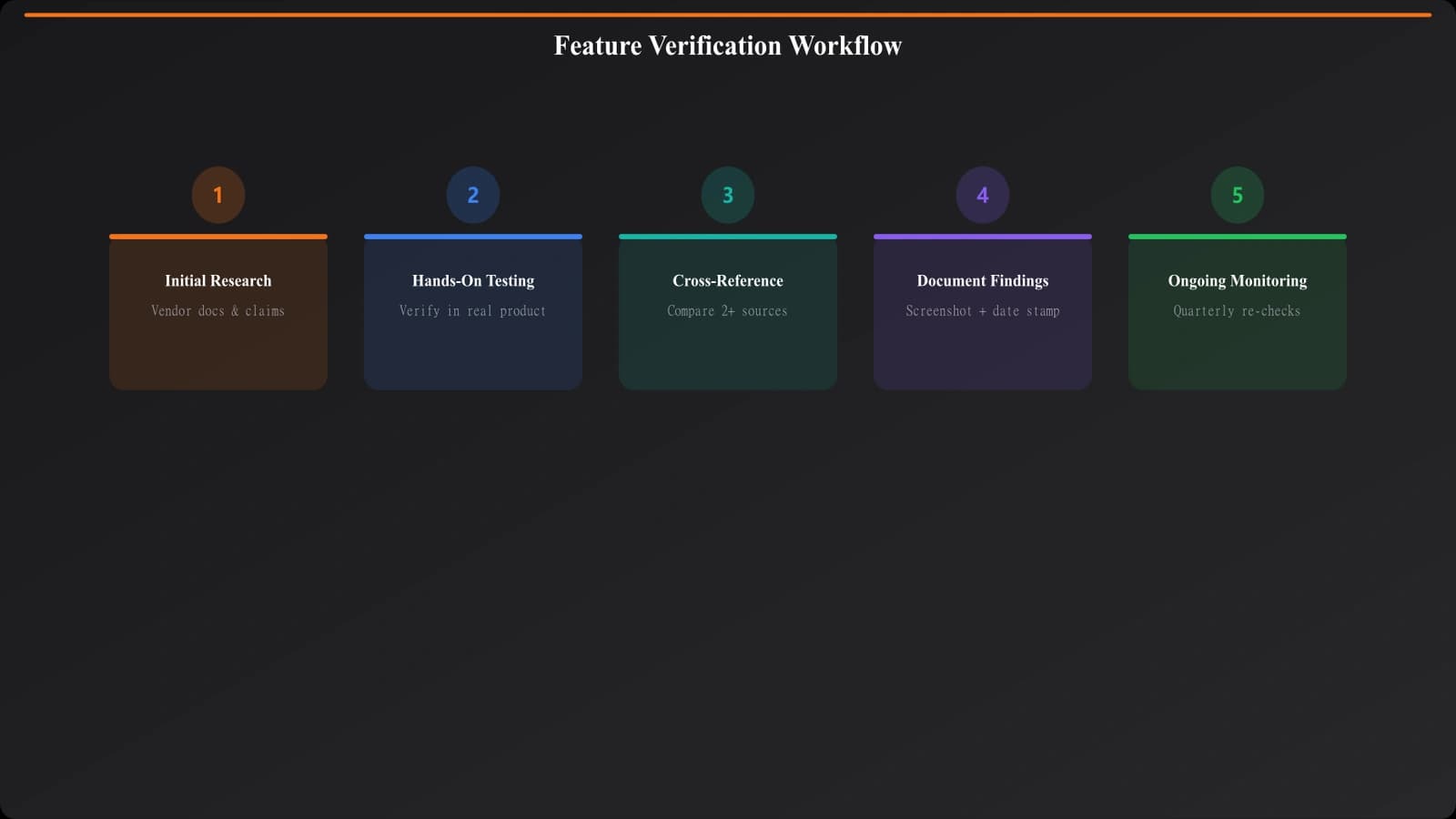
Verification Workflow
Systematic workflow ensures verification happens consistently.
Pre-Publication Checklist
Before publishing any comparison content:
- Feature claim inventory: List every specific feature claim in the content
- Source documentation: Document the source for each claim
- Verification status: Mark each claim as verified, needs verification, or hedged
- Critical claim review: Prioritize verification of claims that drive recommendations
- Negative claim audit: Double-check any “doesn't have” or “lacks” claims
- Tier attribution: Verify which plan tier each feature requires
This checklist catches errors that slip through casual review. Documenting sources also enables efficient re-verification later.
Negative Claim Protocol
“Tool X doesn't have feature Y” claims deserve extra scrutiny because they're hardest to verify and most damaging when wrong.
Before publishing negative claims:
• Search official documentation for the feature
• Search the product changelog for the feature
• Search user forums for mentions of the feature
• Consider whether the feature might exist under a different name
• Check if the feature might be available via integration
• Consider contacting vendor support for confirmation
Absence of evidence isn't evidence of absence. When uncertain, soften to “we couldn't find evidence of...” rather than definitive “lacks.”
Generate Verified Comparison Content
Build listicle frameworks with structured feature claims ready for systematic verification.
Try for Free
Ongoing Maintenance
Verification isn't one-time—it requires ongoing maintenance to catch post-publication drift.
Monitoring Signals
Set up monitoring for signals that feature claims might be outdated:
- Changelog monitoring: Subscribe to or scrape product changelogs for feature updates
- User feedback: Create easy channels for users to report inaccuracies
- Competitor updates: Monitor when competitors announce features you claim they lack
- Traffic patterns: Sudden traffic drops might indicate content quality issues
- Review site monitoring: Watch for new reviews mentioning features differently than you describe
Automated monitoring catches many changes before manual review. But monitoring requires action—flagged changes need investigation and content updates.
Refresh Cycles
Schedule regular verification refreshes:
- High-traffic pages: Monthly verification review
- Standard pages: Quarterly verification review
- Long-tail pages: Semi-annual verification review
- Event-triggered: Immediate review when major product updates announced
Refresh reviews don't require complete re-verification. Focus on claims most likely to have changed: integrations, recently-announced features, tier assignments, and any negative claims.
Accuracy as Competitive Advantage
In a content landscape full of outdated feature claims copied from other outdated content, verification accuracy becomes a competitive advantage. Users learn which sources they can trust. Search engines increasingly factor content quality into rankings. The investment in verification pays dividends in trust, traffic, and conversions.
Start with your highest-value content: your best-performing comparison pages, your most competitive product categories, claims that most significantly affect recommendations. Build verification habits there, then extend systematically to broader content.
For related methodology, see Pricing Data System. For expert input to improve verification, see Expert Review Integration.

Product Manager at BestPage. Pioneer in AEO research since 2024, exploring the convergence of SEO and GEO (Generative Engine Optimization). Led multiple AI-powered content optimization projects that achieved 300%+ citation increases in ChatGPT and Perplexity.