
The difference between a forgettable “10 best tools” list and authoritative comparison content often comes down to expertise. Anyone can compile a list from other lists. But when a practicing professional shares their perspective—explaining why certain tools work in real workflows, what problems they actually solve, and what the marketing copy doesn't tell you—the content becomes genuinely valuable.
Google's E-E-A-T framework (Experience, Expertise, Authoritativeness, Trustworthiness) makes expert involvement increasingly important for search visibility. But the value goes beyond SEO. Expert input makes content better for readers, which is why it also performs better in search. The two goals align when expertise is genuine.
This guide covers how to integrate subject matter experts into your listicle and comparison content: finding the right experts, structuring their contribution, and presenting their insights effectively. The goal isn't to create the appearance of expertise—it's to actually make your content more expert.
Why Expert Input Matters
Expert involvement addresses several problems that plague comparison content.
The Credibility Gap
Most listicle content is written by generalist content writers who research topics but don't use the tools professionally. Readers can tell. The descriptions are accurate but shallow—reciting features without understanding workflows, missing the nuances that practitioners care about.
When a project manager with 15 years of experience evaluates project management tools, they notice things a researcher wouldn't: how the tool handles edge cases, integration quirks that matter in real environments, cultural fit for different team types. This depth is visible in the content.
Expert perspective example:
“Most reviews praise Monday.com's flexibility, but that's actually a challenge for large teams. Without strict governance, you end up with 50 different ways boards are structured across departments. Asana's more opinionated design forces consistency—which is a feature when you're managing 200 people, not a limitation.”
— Operations Director, enterprise SaaS company
That insight—flexibility as a potential weakness in certain contexts—wouldn't appear in content written by someone who's never managed cross-departmental workflows.
E-E-A-T Signal Building
Google's quality rater guidelines explicitly look for evidence of experience and expertise. Content created or reviewed by subject matter experts sends clear signals: author credentials, expert quotes with attributable sources, nuanced perspectives that demonstrate genuine knowledge.
These signals matter most in YMYL (Your Money or Your Life) categories—finance, health, legal—but increasingly affect any competitive content category. Comparison content often involves significant purchase decisions, making E-E-A-T relevant.
Finding the Right Experts
Effective expert integration starts with identifying people whose input will genuinely improve your content.
Types of Relevant Experts
Different content types benefit from different expert profiles:
- Practitioners: Professionals who use tools daily in their work. Their experience-based insights are invaluable for practical recommendations.
- Industry analysts: People who track market trends, vendor developments, and category evolution. Useful for context and market positioning.
- Consultants: Professionals who've implemented tools across multiple organizations. They see patterns across deployments that single-company users miss.
- Technical specialists: For technical comparisons, engineers or architects who understand implementation details.
- Buying decision-makers: People who've actually evaluated and selected tools for their organizations.
The best expert depends on your content focus. Practitioner input works best for “how it actually works” content. Analyst perspectives suit market overview content. Consultant insights help “how to choose” guidance.
Where to Find Experts
Building an expert network takes time but creates lasting content advantage:
Expert sourcing channels:
• LinkedIn: Search for job titles and relevant experience. Many professionals are willing to share insights for attribution and exposure.
• Industry communities: Slack groups, Discord servers, professional associations where practitioners gather.
• Conference speakers: People already comfortable sharing expertise publicly.
• Podcast guests: Professionals with existing visibility who understand content value.
• Product communities: Power users in vendor communities often have deep expertise.
• Author outreach: Writers of relevant books or articles are often available for quotes.
Start with easier sources—public commentators, community members—and build toward higher-profile experts as your publication gains credibility.
Structuring Expert Contributions
How experts contribute varies based on their availability, your needs, and the content type.
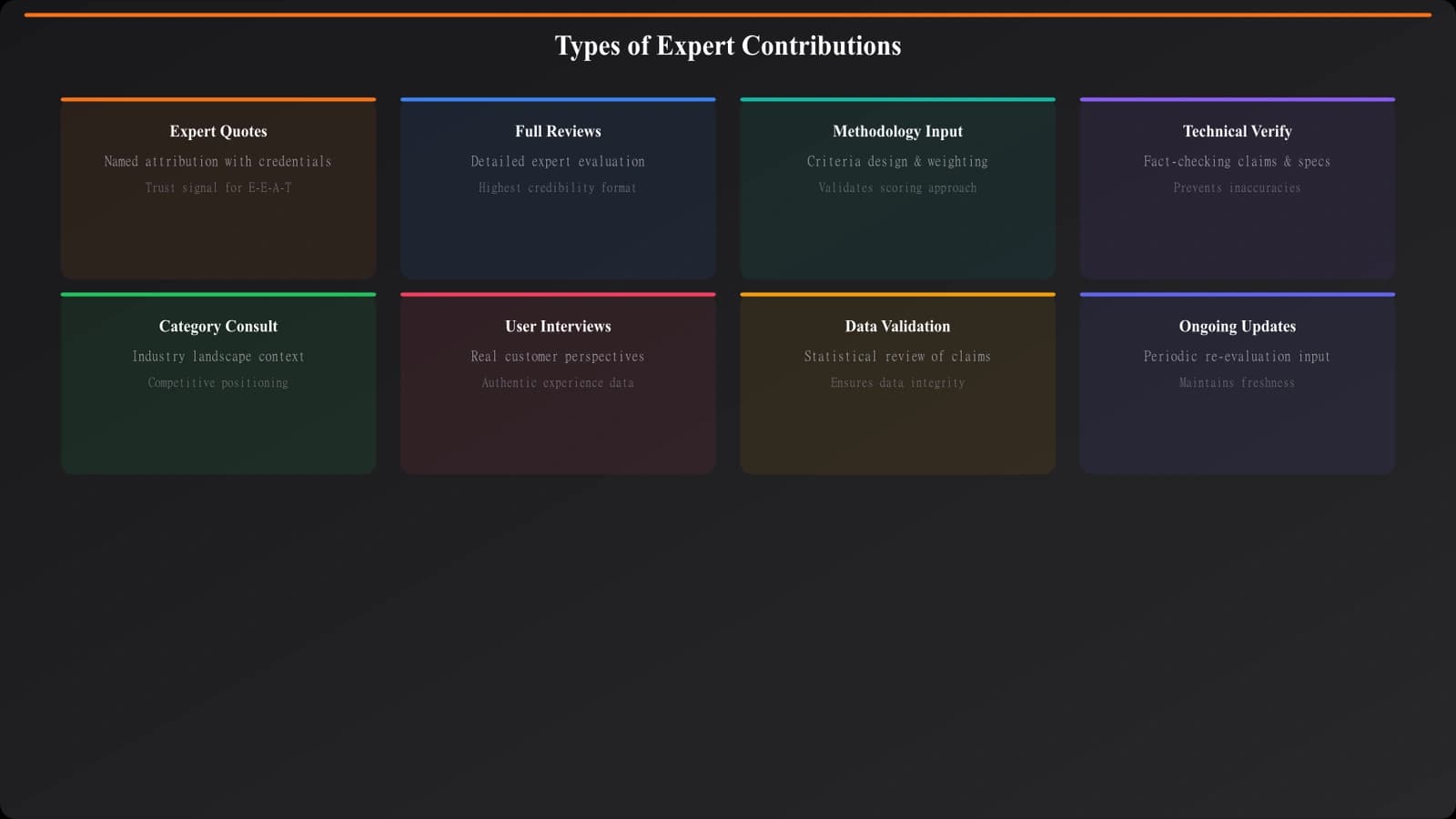
Quote Contributions
The simplest model: experts provide specific quotes or perspectives that you integrate into your content. This works well for adding credibility to specific claims or providing practitioner perspectives on tools.
Effective quote request:
“We're writing about CRM tools for small sales teams. Based on your experience with HubSpot and Pipedrive, could you share 2-3 sentences on what small teams should prioritize when choosing between them?”
Specific questions get better quotes than open-ended requests. Guide experts toward the insights you need while leaving room for their genuine perspective.
Full Review Contributions
For deeper involvement, experts write or co-write full tool reviews. This model requires more expert time but produces content with genuine depth. The expert's byline adds credibility, and their involvement ensures accuracy throughout.
Compensation expectations increase with contribution level. Quote contributions often happen for attribution alone. Full reviews typically require payment or significant value exchange.
Technical Review Model
Your team writes the content; experts review for accuracy and add insights. This model balances expert time with content quality:
- Your writer creates the draft based on research
- Expert reviews for accuracy, flagging errors or oversimplifications
- Expert adds 3-5 insights or quotes from their experience
- Final content is attributed as “reviewed by [Expert Name]”
This model respects expert time while still incorporating their knowledge and lending their credibility.
Build Expert-Quality Comparisons
Generate listicle frameworks ready for expert input and review.
Try for Free
Presenting Expert Input Effectively
How you display expert contributions affects both perceived credibility and actual usefulness.
Attribution Best Practices
Proper attribution builds trust and rewards experts for their contribution:
- Full name and title: “Sarah Chen, Senior Marketing Operations Manager”
- Company context (when permitted): “...at a Fortune 500 financial services company”
- Relevant experience: “...with 8 years of marketing automation experience”
- LinkedIn link (when agreed): Lets readers verify credentials themselves
Some experts prefer anonymity or can't name employers. Work with their constraints while maximizing attributable credibility where possible.
Quote Formatting and Context
Effective quote presentation:
“The biggest mistake I see teams make with Notion is trying to use it for everything. It's brilliant for documentation and light project tracking, but once you need real workflow automation or time tracking, you're fighting the tool. Know its boundaries.”
— Marcus Williams, Operations Consultant | 12+ years in productivity systems
Context makes quotes more valuable. Introduce why this expert's perspective matters before presenting their insight. Follow up with how the quote relates to your broader point.
Integration Patterns
Expert input should feel woven into content, not tacked on:
- Validation pattern: Make a claim, then reinforce with expert quote
- Counterpoint pattern: Present common perception, then expert provides nuanced reality
- Experience pattern: Expert shares specific real-world example
- Decision pattern: Expert explains how they approach a choice readers face
Avoid using expert quotes as filler. Each quote should add information or perspective that improves the reader's understanding.
Building Ongoing Expert Relationships
One-off expert contributions are valuable, but ongoing relationships multiply content quality over time.
The Value Exchange
Experts contribute for various reasons. Understanding their motivation helps you provide appropriate value:
- Visibility: Attribution and links to their profiles or work
- Thought leadership: Platform to share their perspectives
- Network building: Connection with your audience and other experts
- Compensation: Direct payment for significant contributions
- Content for their use: Rights to repurpose their quotes or insights
Ask what value they're seeking rather than assuming. Some experts want visibility; others specifically don't want public exposure but will help if compensated.
Maintaining Relationships
Good expert relationships require ongoing attention:
- Send published content: Always share links when their contribution goes live
- Share performance: Let them know if content performed well
- Credit appropriately: Thank them publicly on social when sharing content
- Respect their time: Don't over-request; space out asks appropriately
- Offer value back: Share relevant opportunities, make introductions, provide reciprocal support
Experts who have good experiences become advocates who recommend other experts. Poor experiences—missed attribution, mangled quotes, excessive demands—burn bridges and reputations.
Making Expertise Central
Expert integration isn't a checkbox exercise. The goal isn't to sprinkle quotes for SEO signals—it's to genuinely make content better through practitioner knowledge. When done well, expert involvement transforms generic content into genuinely useful resources that readers trust and return to.
Start small: add one or two expert perspectives to your next comparison piece. Build relationships with professionals in your content areas. Develop processes for regular expert contribution. Over time, expert involvement becomes a competitive advantage that commodity content producers can't easily replicate.
For related content methodology, see Tool Evaluation Framework. For quality processes at scale, see PSEO Editorial Review Process.

Product Manager at BestPage. Pioneer in AEO research since 2024, exploring the convergence of SEO and GEO (Generative Engine Optimization). Led multiple AI-powered content optimization projects that achieved 300%+ citation increases in ChatGPT and Perplexity.