
The HR software market is massive—and so is the volume of comparison content targeting it. From “best HRIS systems” to “top payroll software,” nearly every valuable keyword has dozens of competing articles. Established players like G2, Capterra, and industry publications like SHRM hold dominant positions.
Breaking into this market requires strategic positioning. You won't outrank G2 on “best HR software” without significant resources. But you can build valuable comparison content by targeting specific segments, use cases, and integration scenarios that generic listicles don't address.
This guide provides a framework for creating HR software comparison content that can compete in this crowded market. We'll cover market segmentation, differentiation strategies, and the specific content elements that help HR tech comparisons succeed.
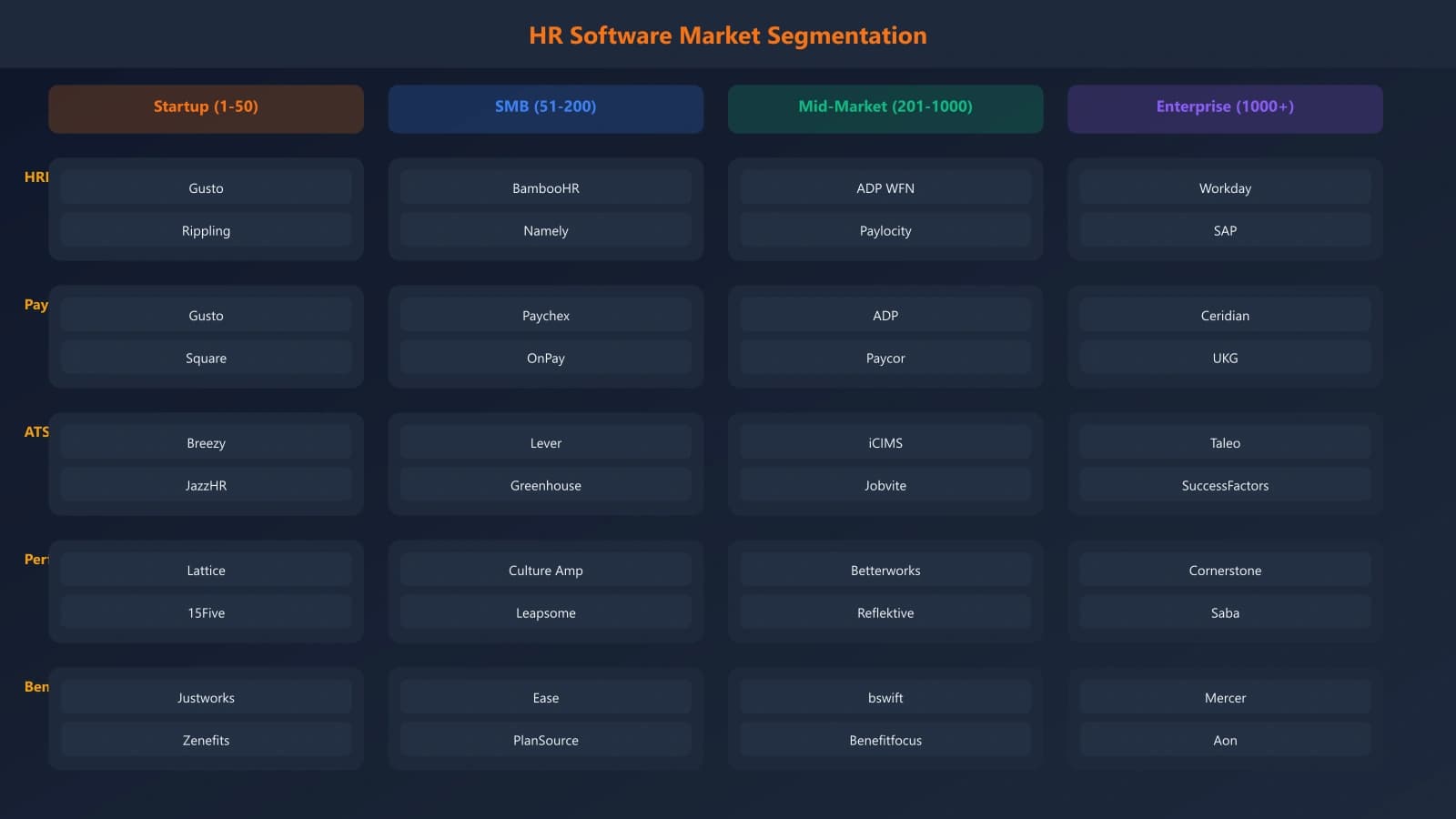
Market Segmentation Strategy
The most important decision in HR software comparison content is how you segment the market. Generic “best HR software” content struggles; segmented content can rank and convert.
Company Size Segmentation
HR software needs vary dramatically by company size. A 10-person startup has completely different requirements than a 5,000-person enterprise. Segment accordingly:
- Small business (1-50 employees): Price-sensitive, need simplicity, limited HR expertise
- Mid-market (51-500 employees): Growing complexity, need compliance tools, often first “real” HRIS purchase
- Enterprise (500+ employees): Need customization, integrations, security, and compliance at scale
Content targeting “best HRIS for startups under 50 employees” faces less competition and delivers more relevant recommendations than generic content.
HR Function Segmentation
HR software spans many functional areas. Specialize rather than generalize:
- Core HRIS: Employee records, self-service, organizational management
- Payroll: Payroll processing, tax compliance, benefits administration
- Talent acquisition: ATS, recruiting, candidate experience
- Performance management: Reviews, goals, feedback, 1:1s
- Learning and development: LMS, training, career pathing
- Time and attendance: Time tracking, scheduling, PTO management
- Employee engagement: Surveys, recognition, culture tools
Industry-Specific Content
Certain industries have unique HR requirements that create comparison opportunities:
- Healthcare: Credentialing, shift scheduling, compliance
- Restaurants/hospitality: Tip management, high turnover, hourly workforce
- Manufacturing: Safety training, certifications, shift management
- Remote/distributed: Global payroll, async tools, time zone management
- Nonprofits: Budget constraints, volunteer management, grant compliance
Differentiation Approaches
Beyond segmentation, you need content that's meaningfully different from competitors.
Depth Over Breadth
Generic listicles cover 10-15 products with superficial descriptions. Differentiate with depth:
- Implementation analysis: How long does implementation take? What resources are needed?
- Integration deep-dives: Specific integration quality with common tools (QuickBooks, Slack, etc.)
- Hidden costs: Implementation fees, per-employee pricing tiers, module add-ons
- Exit analysis: How hard is it to migrate away if you outgrow the tool?
Use Case Focus
Instead of feature lists, organize content around use cases:
- “Best HRIS for companies going through rapid hiring”
- “Best payroll for companies with contractors and employees”
- “Best ATS for technical recruiting”
- “Best HR software for managing a remote-first team”
Use case content answers specific questions buyers have, making it more likely to rank for long-tail queries and convert visitors who find it.
Buyer Journey Content
Create content for different stages of the buying process:
- Awareness: “Do you need an HRIS?” “Signs you've outgrown spreadsheet HR”
- Consideration: Category comparisons, feature explanations
- Decision: Head-to-head comparisons, specific product reviews
- Implementation: Implementation guides, migration checklists
Essential Content Elements
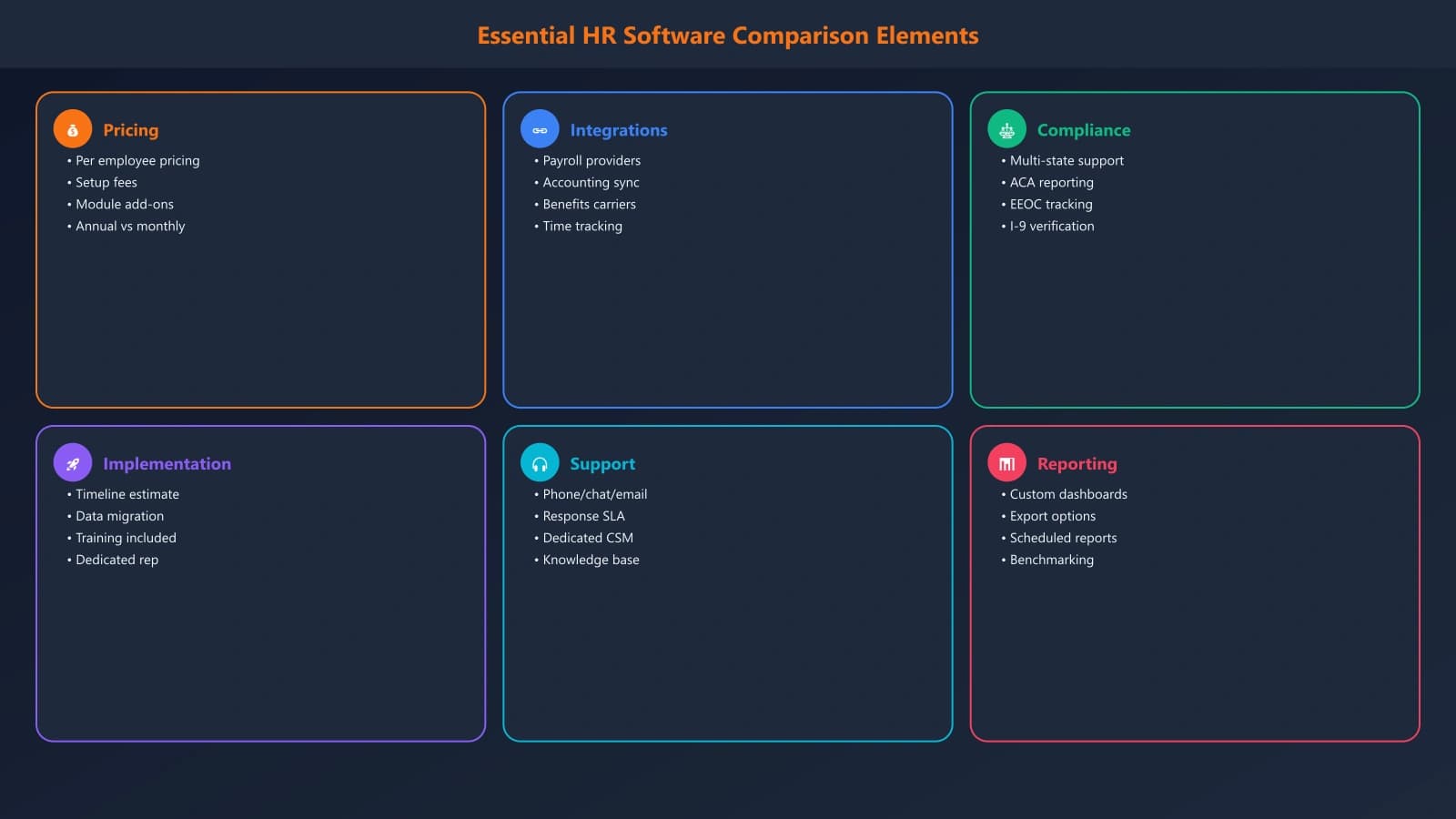
Effective HR software comparisons include specific elements that generic listicles often miss.
Pricing Transparency
HR software pricing is often opaque. Provide clarity:
- Base pricing: Per-employee costs where available
- Tiers: What features unlock at each tier
- Hidden costs: Implementation, integrations, add-on modules
- Scaling: How pricing changes as company grows
- Competitor comparison: How similar tools price differently
Integration Ecosystem
HR software rarely works in isolation. Cover integration capabilities:
- Payroll integrations: Which accounting tools does it connect to?
- Benefits integrations: Does it connect to benefits providers?
- Productivity tools: Slack, Microsoft Teams, Google Workspace
- SSO and identity: Okta, Azure AD, Google SAML
- Open API: For custom integrations
Compliance Coverage
HR software must help with compliance. Address:
- Geographic coverage: Which states/countries are supported for payroll/compliance?
- Regulatory features: ACA compliance, I-9 management, EEO reporting
- Data security: SOC 2, GDPR compliance, data residency
- Audit trails: For compliance documentation
Create HR Software Comparisons
Build comparison content that stands out in the crowded HR tech market.
Try for Free
Competitive Tactics
Specific tactics for competing against established HR tech content.
Long-Tail First Strategy
Build authority starting with less competitive queries:
- Start with specifics: “Best HRIS for remote teams under 100 employees”
- Build internal links: Connect specific content to category pages
- Move up gradually: As authority builds, target broader terms
- Monitor what ranks: Double down on successful angles
Freshness as Advantage
Established competitors often have stale content. Win on freshness:
- Regular updates: Quarterly pricing and feature verification
- New product coverage: Cover new entrants before competitors do
- Market changes: Cover acquisitions, shutdowns, major updates
- Year-specific content: “Best HRIS 2026” with genuinely current information
Original Research
Create content competitors can't replicate:
- User surveys: Survey HR professionals about their tool experiences
- Hands-on testing: Actually use the tools and document findings
- Implementation stories: Interview companies about their selection and implementation
- Cost analysis: Calculate true total cost for different scenarios
Implementation Roadmap
To build successful HR software comparison content:
- Choose your segment: Pick a company size, function, or industry to focus on initially.
- Map the competitive landscape: See what exists, identify gaps.
- Start with long-tail content: Build authority on specific queries first.
- Develop unique value: Pricing transparency, integration details, or original research.
- Create head-to-head comparisons: Specific product matchups serve decision-stage buyers.
- Build internal linking: Connect specific content to broader category pages.
- Maintain freshness: Update quarterly as pricing and features change.
- Expand gradually: Move to adjacent segments as authority builds.
The HR software comparison market is crowded but not impenetrable. Success requires focused segmentation, genuine depth of analysis, and consistent freshness that established competitors often lack. Build from specifics to general, and always provide information that generic listicles omit.
For broader B2B software comparison strategy, see our guide on SaaS Comparison Page Playbook. For enterprise buyer considerations, check out Trust Signals That Convert B2B Software Buyers.

Product Manager at BestPage. Pioneer in AEO research since 2024, exploring the convergence of SEO and GEO (Generative Engine Optimization). Led multiple AI-powered content optimization projects that achieved 300%+ citation increases in ChatGPT and Perplexity.