

“Best plumbers” without a location is nearly useless—plumbers serve specific areas. “Best project management software in Austin” is oddly specific—software works anywhere. The geographic scope of comparison content should match the geographic scope of the services or products being compared. Getting this wrong wastes content resources and fails to capture relevant search intent.
This guide provides a framework for making geographic scope decisions for comparison content. We'll cover how to analyze whether a category warrants local, national, or hybrid treatment; how to assess search volume and competition at each geographic level; and how to structure content hierarchies that capture both local and national intent where appropriate.
The framework applies whether you're building a single comparison or planning a programmatic content library. Making correct geographic scope decisions upfront prevents wasted effort and improves targeting efficiency across your content portfolio.
Geographic Scope Decision Framework
Use this framework to assess appropriate geographic scope for any comparison category.
| Factor | Favors Local Pages | Favors National Pages |
|---|---|---|
| Service delivery | In-person, location-dependent | Remote, digital, shipped |
| Provider availability | Varies significantly by location | Same providers nationwide |
| Pricing | Varies by local market | Consistent nationally |
| Regulations | State/local licensing requirements | Federal or no regulation |
| Search patterns | “near me,” city-specific queries | Generic category queries |
| Competition | Local pack dominates SERPs | Organic results dominate |
| Content requirements | Requires local data per location | Same content works everywhere |
Categories scoring heavily toward “local” factors warrant local-specific pages. Categories scoring toward “national” factors work best as single national pages. Mixed categories may benefit from hybrid approaches.
When to Build Local Pages
Local-specific comparison pages work best for categories with inherent geographic constraints.
Strong Local Page Indicators
Build local pages when most of these conditions apply:
- Physical service delivery: The service requires provider presence (plumbers, dentists, restaurants)
- Location-specific providers: Different businesses serve different areas
- Local pricing variation: Costs differ meaningfully by market
- State/local regulation: Licensing or certification varies by jurisdiction
- Local search dominance: “Best X in [city]” has meaningful search volume
Categories typically requiring local pages:
• Home services (plumbers, electricians, contractors)
• Healthcare providers (doctors, dentists, specialists)
• Professional services (lawyers, accountants, real estate agents)
• Restaurants and hospitality
• Auto services and repair
• Personal services (salons, gyms, tutors)
Local Content Requirements
Local pages require genuinely local content to avoid thin content penalties. Each local page needs location-specific provider listings, local market context or pricing information, accurate geographic coverage, and differentiation from other location pages. Pages that simply swap the city name without changing substantive content will be recognized as doorway pages and penalized.
When to Build National Pages
National comparison pages work for categories where geography doesn't affect the comparison.
Strong National Page Indicators
Build national pages when these conditions apply:
- Digital/remote delivery: Software, online services, digital products
- Nationwide availability: Same products/services available everywhere
- Consistent pricing: No meaningful regional price variation
- No local regulation: Federal or no regulatory requirements
- Generic search patterns: Users search “best X” without location
Categories typically working nationally:
• SaaS and software products
• E-commerce platforms and tools
• Online learning and courses
• Digital marketing services
• Subscription services
• Consumer electronics and products (shipped nationally)
National Content Approach
National pages can invest fully in depth rather than breadth. Focus resources on comprehensive coverage, expert evaluation, and ongoing updates rather than geographic variants. The content only needs to be created once and maintained centrally.
Hybrid Geographic Strategies
Some categories benefit from both national and local content.
Hub-and-Spoke Model
Create a national hub with local spoke pages. The national hub provides comprehensive category overview, methodology, and general guidance. Local spoke pages provide city-specific recommendations with links back to the hub. This structure works for categories like moving companies (national brands plus local providers) or insurance (national carriers plus local agents).
Hub-and-spoke structure:
• National hub: “Best Moving Companies (2026 Guide)”
• Local spokes: “Best Moving Companies in Austin, TX”
• Hub links to all spokes; spokes link back to hub
• Hub covers national providers; spokes add local options
• Shared methodology and evaluation criteria
Regional Aggregation
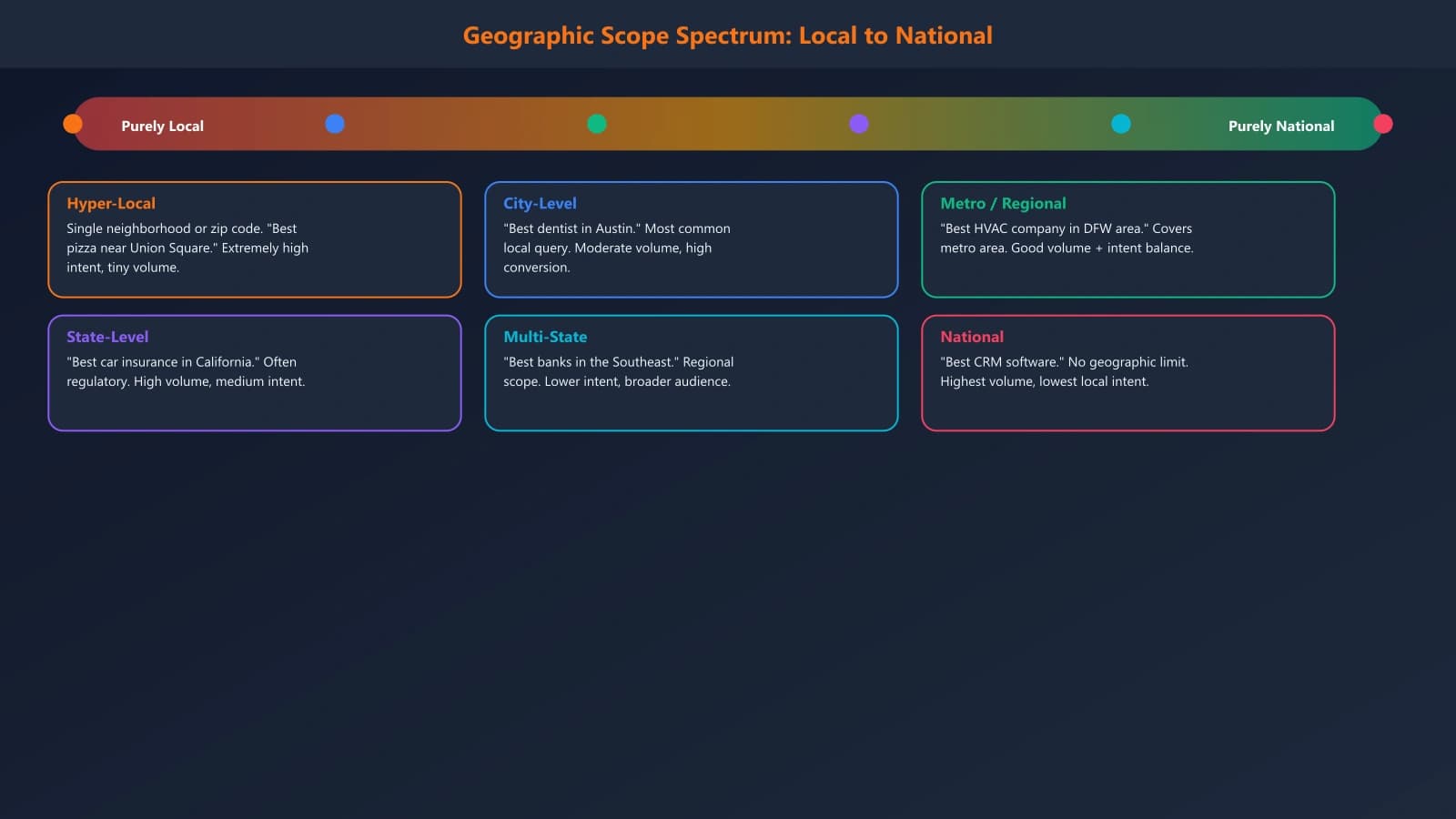
For some categories, state or regional pages work better than city-level. This applies when regulations are state-level, markets don't vary within states significantly, or city-level search volume is too low. “Best contractors in Texas” might capture more value than individual city pages for smaller markets.
Build Geographic-Smart Comparisons
Generate local, national, or hybrid comparison structures based on your category requirements.
Try for Free
Search Volume and Competition Analysis
Data should validate your geographic scope decisions.
Volume Assessment Process
For any category, research search volume at different geographic levels. Check volume for generic queries (“best X”), city-specific queries (“best X in Austin”), state-level queries (“best X in Texas”), and “near me” variations. The distribution of volume across these patterns indicates appropriate scope.
If city-specific queries have significant volume across many cities, local pages are warranted. If generic queries dominate with minimal city-specific volume, national focus is more efficient.
Competition Assessment
Analyze SERPs for target queries at each geographic level. Local pack presence indicates local intent and local page opportunity. Organic results from major national sites suggest national page competition. The competitive landscape helps determine where you can realistically rank and the content investment required.
Implementation Considerations
Executing the right geographic strategy requires appropriate resources.
Resource Requirements
Local page strategies require more ongoing resources than national strategies. Each location needs unique provider data, local market research, and individual maintenance. Assess whether you can sustain the content quality requirements across the number of locations you plan to target.
For programmatic local pages, see Multi-Location Template. For local trust signals, see Local Business Trust Signals.
Making the Right Geographic Choice
Geographic scope decisions significantly impact content strategy efficiency and effectiveness. Matching content scope to category characteristics captures relevant intent while avoiding wasted resources. Use the framework in this guide to assess each category, validate with search data, and choose approaches your resources can sustain.
The key insight: let the category's inherent geographic nature guide your content geography. Don't force local pages on national categories or national pages on inherently local services. Match content to reality, and search performance follows.

Product Manager at BestPage. Pioneer in AEO research since 2024, exploring the convergence of SEO and GEO (Generative Engine Optimization). Led multiple AI-powered content optimization projects that achieved 300%+ citation increases in ChatGPT and Perplexity.