
The MarTech landscape has exploded. Scott Brinker's famous MarTech map now includes over 11,000 solutions across dozens of categories. Every one of those categories has dozens of “best of” listicles competing for the same keywords. Breaking through requires more than just publishing another “best email marketing tools” article.
The good news is that much of the existing MarTech comparison content is mediocre. Generic listicles with surface-level descriptions, outdated pricing, and minimal differentiation. There's opportunity for content that goes deeper—content that helps marketers make decisions rather than just listing options.
This guide provides strategies for creating MarTech comparison content that can compete in this saturated market. We'll cover the major categories, differentiation approaches, and specific tactics for standing out.
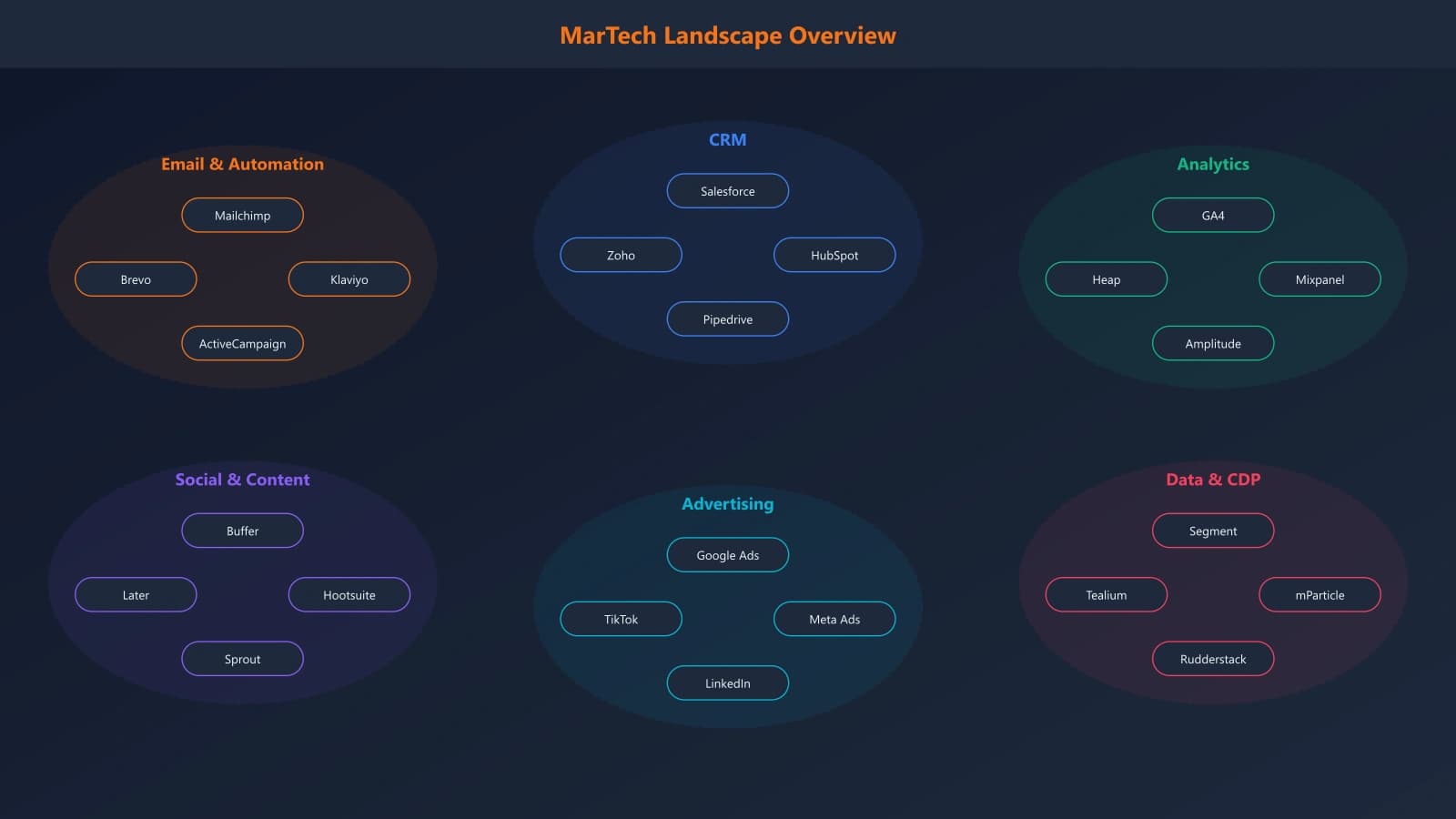
Category-Specific Strategies
Different MarTech categories have different competitive dynamics. Here's how to approach each.
Email Marketing Comparisons
Email marketing is one of the most competitive comparison categories. Differentiation approaches:
- Segment by use case: “Best for newsletters,” “Best for e-commerce,” “Best for transactional email”
- Segment by size: Creator/solo, small business, mid-market, enterprise
- Deliverability focus: Compare actual deliverability, not just features
- Template quality: Assess template libraries and builder capabilities
- Integration depth: Which e-commerce, CRM, and CMS integrations matter
- Pricing transparency: Calculate cost per 10K, 50K, 100K subscribers
CRM Comparisons
CRM is dominated by comparisons from the vendors themselves. Neutral comparison opportunities:
- Industry-specific: CRM for real estate, healthcare, consulting, SaaS
- Use case focus: Sales-focused vs marketing-focused vs support-focused
- Implementation reality: Time to value, training requirements, migration difficulty
- Alternative positioning: Alternatives pages for Salesforce, HubSpot, Zoho
- Budget-tier focus: Best free CRMs, best under $50/user/month
Marketing Automation Comparisons
Marketing automation spans a wide range of complexity and price:
- Complexity segmentation: Simple automation vs enterprise orchestration
- Channel coverage: Email-only vs multi-channel vs omnichannel
- B2B vs B2C: Lead nurturing vs customer lifecycle focus
- Integration ecosystem: Which CRMs and data sources does it connect to
- Learning curve: Time to build first automation, required expertise
Analytics and Attribution
Analytics comparison opportunities as the space evolves post-Universal Analytics:
- Privacy-first focus: Cookie-less analytics, privacy compliance
- GA4 alternatives: For those unhappy with GA4 transition
- Attribution focus: Multi-touch attribution tool comparisons
- E-commerce analytics: Specialized for online retail
- B2B analytics: Account-level, not just user-level
Social Media Management
Social media tool comparisons can differentiate through:
- Platform specialization: Best for TikTok, best for LinkedIn, best for multi-platform
- Workflow focus: Best for agencies, best for solo creators, best for enterprises
- Feature depth: Scheduling vs analytics vs listening vs engagement
- AI capabilities: Content generation, optimal posting, performance prediction
Differentiation Strategies
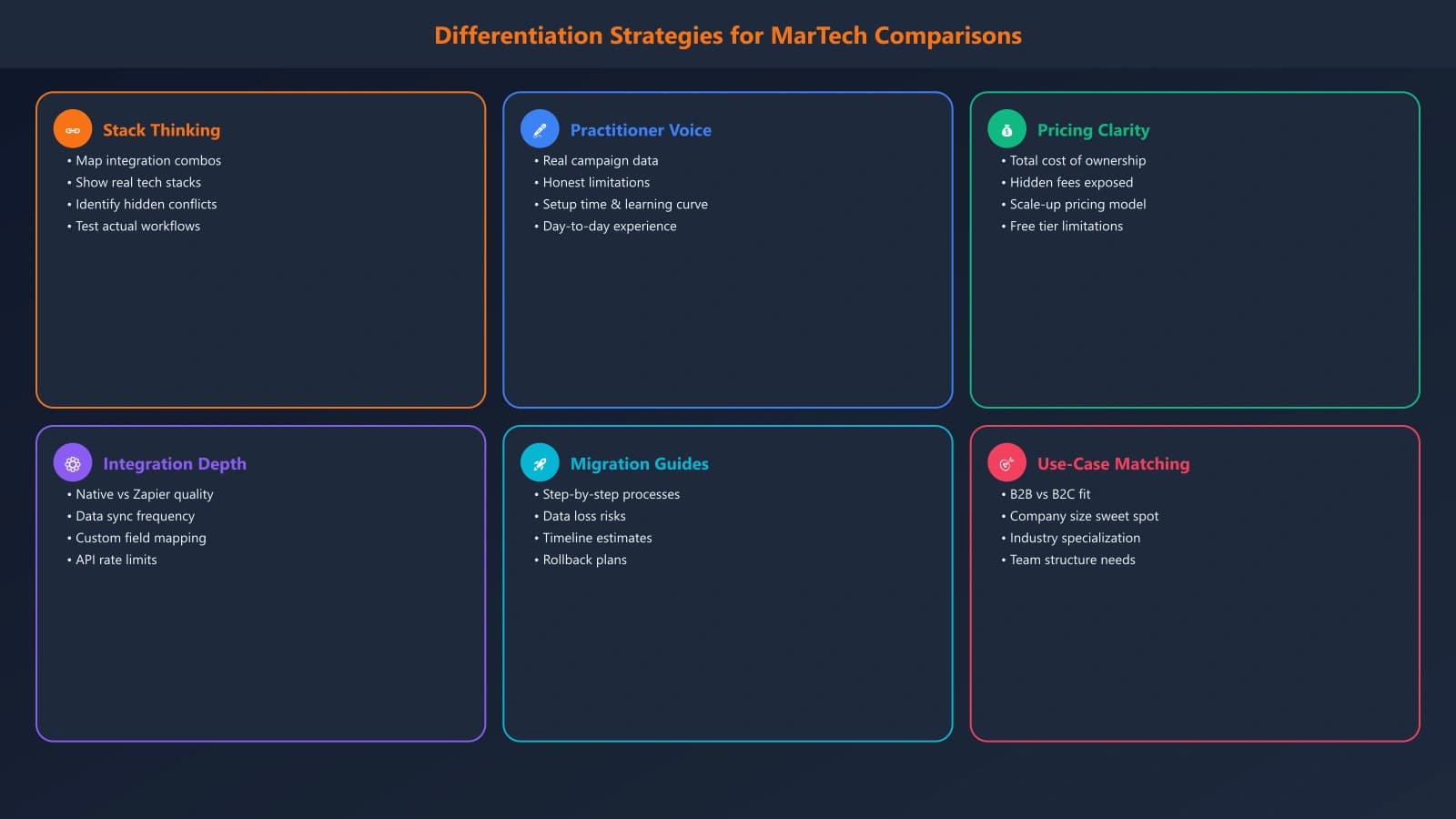
Beyond category tactics, broader differentiation strategies help MarTech content stand out.
Stack-Based Thinking
Marketers don't buy individual tools—they build stacks. Content that addresses stacks wins:
- Stack recommendations: “Complete marketing stack for e-commerce under $500/month”
- Integration compatibility: Which tools work best together
- Migration paths: How to move from one stack to another
- Vendor lock-in analysis: How hard is it to switch if you're unhappy
Practitioner Voice
Much MarTech content is written by content marketers who haven't used the tools. Practitioner content wins:
- Hands-on testing: Actually use the tools and document findings
- Real campaign examples: Show what you built with each tool
- Honest limitations: What didn't work, what was frustrating
- Expert interviews: Talk to power users of each platform
Pricing Clarity
MarTech pricing is notoriously opaque. Clear pricing analysis is valuable:
- Total cost modeling: What will you actually pay at different scales
- Hidden fees: Implementation, add-ons, overage charges
- Contract terms: Annual vs monthly, cancellation policies
- Discount transparency: When negotiation is possible
Build MarTech Comparison Content
Create marketing technology comparisons that stand out in a saturated market.
Try for Free
Competitive Positioning
Specific tactics for competing against established MarTech content.
Alternative Page Strategy
“X alternatives” pages can be more accessible than generic category pages:
- Major platform alternatives: HubSpot alternatives, Mailchimp alternatives, Salesforce alternatives
- Reason-based alternatives: “Mailchimp alternatives for better deliverability”
- Cost-based alternatives: “Cheaper alternatives to [expensive platform]”
- Migration guides: Pair alternatives with “how to switch from X to Y”
Emerging Category Focus
Established categories are crowded. Emerging categories have less competition:
- AI marketing tools: New category with rapid innovation
- Composable CDP: Emerging architecture approach
- Revenue intelligence: Growing category distinct from CRM
- Conversational marketing: Chat, voice, messaging platforms
- Customer data platforms: Still maturing, less saturated
Cross-Category Content
Content that spans categories serves real buying scenarios:
- “CRM with built-in email marketing: Is all-in-one better?”
- “Marketing automation vs CDP: What do you actually need?”
- “When to use separate tools vs an integrated suite”
Implementation Roadmap
To build successful MarTech comparison content:
- Pick your category focus: Don't try to cover all of MarTech. Pick 2-3 categories to own.
- Identify differentiation angles: What will make your content different from the 50 existing articles?
- Build practitioner credibility: Actually use tools, document real experiences.
- Create pricing transparency: Provide the pricing clarity competitors don't.
- Develop stack content: Help buyers think about tool combinations, not just individual tools.
- Target alternatives pages: Often more accessible than category pages.
- Watch emerging categories: Get in early on new MarTech segments.
- Maintain aggressively: MarTech changes fast; outdated content loses quickly.
MarTech comparison is saturated but not impenetrable. The key is finding angles that established content doesn't cover and providing depth that surface-level listicles lack. Practitioner expertise, pricing clarity, and stack-level thinking differentiate winning content.
For SaaS comparison strategy more broadly, see our guide on SaaS Comparison Page Playbook. For building trust with B2B buyers, check out Trust Signals That Convert B2B Software Buyers.

Product Manager at BestPage. Pioneer in AEO research since 2024, exploring the convergence of SEO and GEO (Generative Engine Optimization). Led multiple AI-powered content optimization projects that achieved 300%+ citation increases in ChatGPT and Perplexity.