
Real estate is one of the most searched verticals online, with billions of searches annually around buying, selling, renting, and investing in property. This creates significant opportunity for comparison content—but also significant competition from well-funded portals and established directories.
The challenge for comparison publishers is that real estate content often needs to be local to be valuable. A generic “best real estate agents” article has limited utility compared to “best real estate agents in Austin” or “top buyer's agents in Denver suburbs.” This local requirement affects both your content strategy and your competitive position.
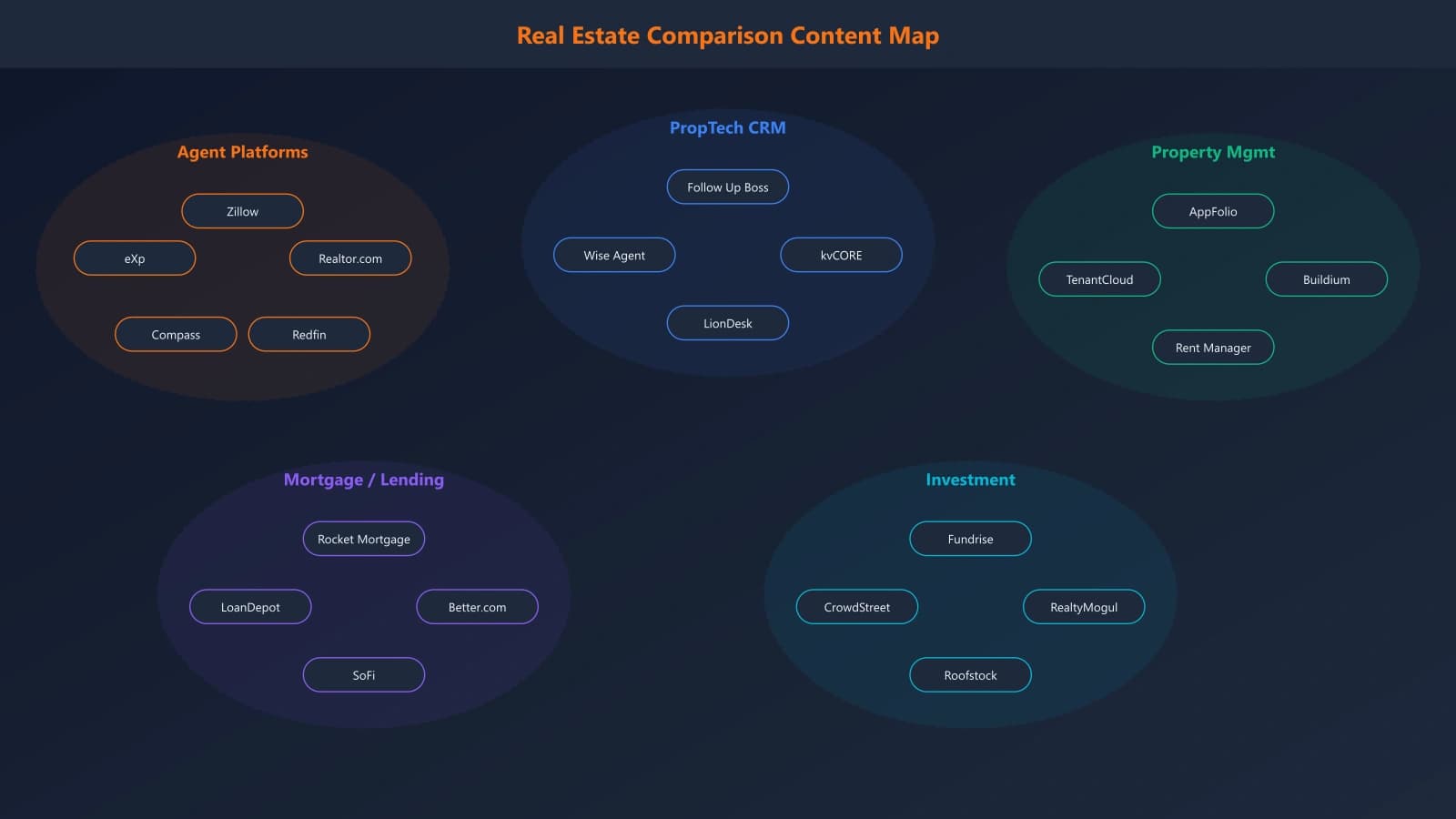
This guide covers comparison strategies for the main real estate content categories: agent and broker directories, PropTech and real estate technology, property management software, mortgage comparisons, and real estate investment platforms. We'll address the unique challenges of each and provide frameworks for competing effectively.
Agent and Broker Comparisons
Agent comparison content is highly local and relationship-driven. Users searching for agents typically want specific geographic coverage and transaction type expertise.
Unique Challenges
Agent comparisons face several distinctive challenges:
- Hyperlocal focus: Agents are valuable based on local market knowledge
- Licensing verification: Agent credentials need to be verifiable
- Performance data: Transaction history can be hard to obtain accurately
- Relationship sensitivity: Agents may not want to be compared directly
- Established competitors: Zillow, Realtor.com, Redfin dominate rankings
Competitive Strategy
To compete in agent comparisons without Zillow's resources:
- Specialize by transaction type: “Best luxury agents,” “Best first-time buyer agents,” “Best investment property agents”
- Go hyperlocal: Target neighborhoods or submarkets the giants don't cover deeply
- Add unique value: Interview agents, provide market analysis, offer buyer guidance
- Methodology transparency: Explain how you evaluate agents (reviews, transactions, specialties)
- Regular updates: Market conditions change; keep content current
Content Elements for Agent Pages
- License verification: Note that agents are licensed and how to verify
- Transaction history: Sales volume, average price point, property types
- Client reviews: Aggregated from multiple sources (Zillow, Google, Yelp)
- Specialty areas: Geographic focus, property types, buyer vs seller representation
- Contact information: Direct ways to reach the agent
PropTech Tool Comparisons
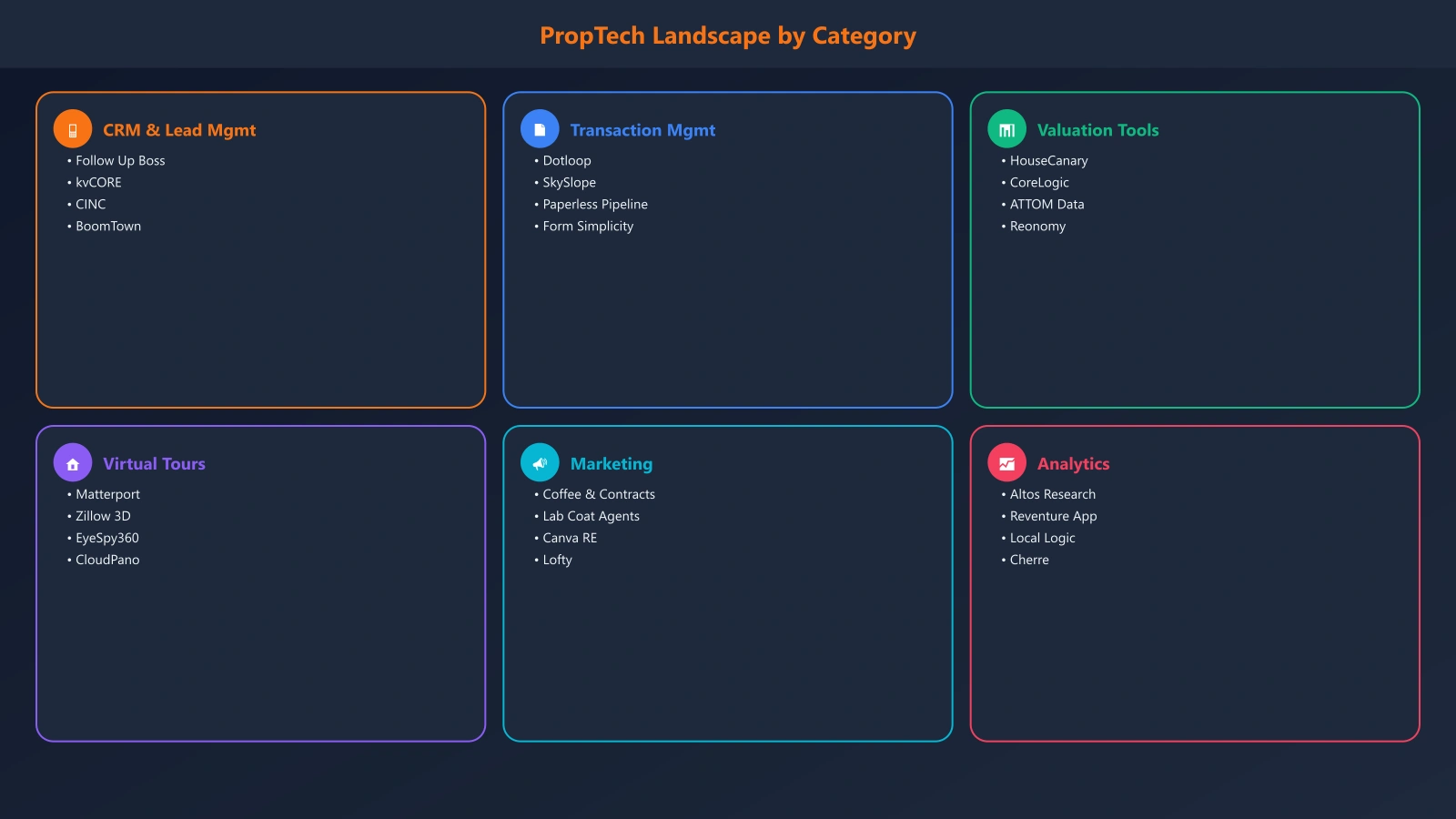
PropTech—property technology—is a growing category that includes everything from CRM tools for agents to virtual tour software to transaction management platforms.
PropTech Categories to Cover
- Real estate CRM: Lead management and client relationship tools
- Transaction management: Digital closing and document management
- Marketing tools: Listing presentation, virtual tours, social media
- Lead generation: Platforms that provide buyer/seller leads
- Market analysis: Comp tools, pricing analytics, investment analysis
- Brokerage platforms: All-in-one tools for brokerages
Understanding the Audience
PropTech buyers include individual agents, teams, brokerages, and investors—each with different needs:
- Solo agents: Price-sensitive, need ease of use, limited tech support
- Teams: Need collaboration features, lead routing, accountability tools
- Brokerages: Need enterprise features, white-labeling, compliance tools
- Investors: Need analysis tools, deal tracking, portfolio management
Tailor comparison content to specific audience segments for better relevance and conversion.
Key Comparison Factors
- MLS integration: Which MLS systems does the tool connect to?
- Pricing model: Per-agent, per-transaction, or flat fee?
- Mobile capability: Critical for agents in the field
- Training and support: How easy is onboarding?
- Integration ecosystem: Does it work with other tools agents use?
Property Management Software
Property management software serves landlords, property managers, and real estate investors managing rental portfolios.
Market Segments
- Individual landlords: 1-10 units, price-sensitive, need simplicity
- Small property managers: 10-100 units, need tenant screening, accounting
- Enterprise property management: 100+ units, need full operations suite
- HOA/community management: Different feature set for associations
Features to Compare
- Rent collection: Online payments, ACH, payment tracking
- Tenant screening: Credit checks, background checks, income verification
- Maintenance management: Work orders, vendor coordination
- Accounting: Income/expense tracking, reporting, tax preparation
- Lease management: Digital leases, e-signatures, renewal tracking
- Tenant portal: Communication, document access, payment history
Pricing Considerations
Property management software pricing varies significantly by model:
- Per-unit pricing: Common for larger portfolios
- Flat monthly fee: Common for small landlord tools
- Transaction fees: Some tools take a cut of rent collected
- Free tiers: Several tools offer free versions for small portfolios
Be explicit about total cost for different portfolio sizes in your comparisons.
Build Real Estate Comparison Content
Create property tech and agent comparisons that rank and convert.
Try for Free
Mortgage and Lending Comparisons
Mortgage comparisons overlap with financial content and carry similar compliance requirements (see our finance compliance guide for details).
Comparison Content Types
- Lender comparisons: Traditional banks vs credit unions vs online lenders
- Product comparisons: Fixed vs ARM, conventional vs FHA vs VA
- Rate aggregation: Current rate comparisons across lenders
- Refinance comparisons: When and where to refinance
- HELOC comparisons: Home equity lines of credit
Key Considerations
- Rate accuracy: Mortgage rates change daily; freshness is critical
- Assumption transparency: What credit score, LTV, loan amount assumed?
- Fee comparison: Origination fees, closing costs, points
- TILA compliance: APR disclosure requirements apply
- Local availability: Not all lenders operate in all states
Real Estate Investment Platforms
Real estate investment platforms include REITs, crowdfunding platforms, and fractional ownership platforms.
Categories to Compare
- REIT platforms: Access to public and private REITs
- Crowdfunding: Equity and debt investment in specific properties
- Fractional ownership: Owning shares of individual properties
- Syndication platforms: Passive investing in syndicated deals
Comparison Factors
- Accreditation requirements: Some platforms require accredited investors
- Minimum investment: Ranges from $10 to $25,000+
- Liquidity: Can you sell before the investment matures?
- Returns and fees: Historical performance, management fees
- Property types: Commercial, residential, industrial, mixed
Implementation Strategy
To build effective real estate comparison content:
- Choose your niche: Don't try to compete with Zillow on agent directories. Find underserved segments—specific property types, local submarkets, or professional verticals.
- Prioritize local content: For agent and mortgage content, local is essential. Build location-based content at scale using PSEO approaches.
- Maintain accuracy: Real estate data changes constantly. Build systems for regular data verification and updates.
- Handle licensing carefully: If referencing agent or broker licensing, verify credentials. Link to state licensing databases.
- Address compliance: Mortgage and investment content requires proper disclosures. Build them into your templates.
- Add unique value: Market analysis, buyer guides, and educational content differentiate you from data-only directories.
Real estate comparison content can be highly valuable—the transactions involved are large and users research extensively before committing. Success requires finding niches the giants haven't filled and maintaining the accuracy and freshness that builds trust.
For local comparison strategies, see our guide on Local Service Comparison Playbook. For mortgage and finance compliance, check out Finance Listicle Compliance: Full Checklist.

Product Manager at BestPage. Pioneer in AEO research since 2024, exploring the convergence of SEO and GEO (Generative Engine Optimization). Led multiple AI-powered content optimization projects that achieved 300%+ citation increases in ChatGPT and Perplexity.