
When someone searches “best project management software for agencies,” they're not casually browsing. They have a problem, they've decided a tool will solve it, and they're actively evaluating options. This is bottom-of-funnel traffic—the most valuable kind for SaaS comparison content.
But not all SaaS comparison keywords are created equal. Some have massive volume but brutal competition. Others have moderate volume but exceptional intent and winnable SERPs. Finding the right keywords to target is the foundation of a successful SaaS comparison content strategy.
This guide provides a research framework specifically for SaaS listicle keywords. We'll cover the keyword patterns that matter, how to evaluate opportunities, and a systematic process for building your keyword list. By the end, you'll have a repeatable approach for identifying high-value comparison keywords in any SaaS category.
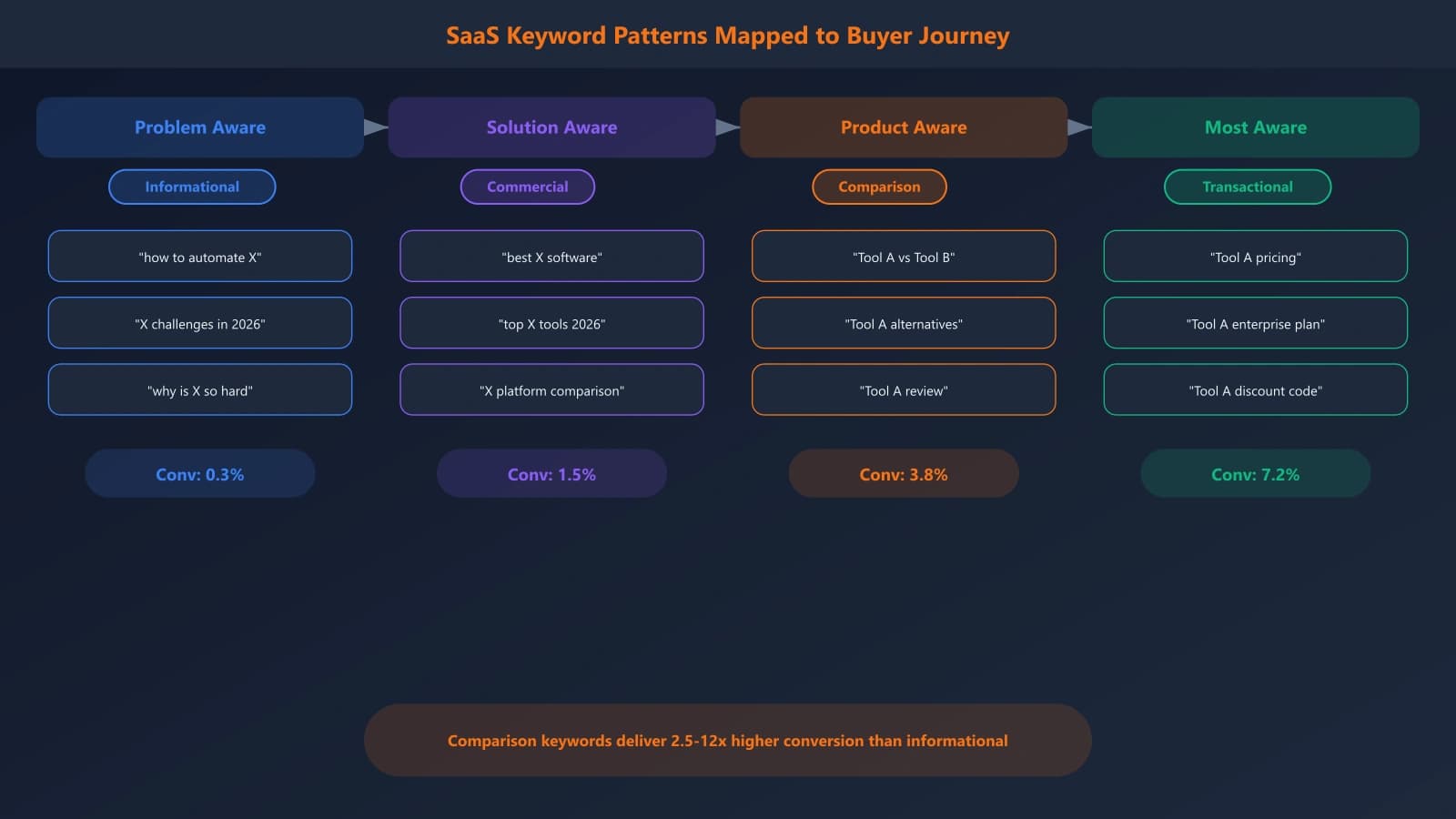
The Five SaaS Keyword Patterns
SaaS comparison queries follow predictable patterns. Understanding these patterns helps you systematically identify opportunities across any software category.
Pattern 1: Category + Best
The classic listicle keyword: “best [category] software” or “best [category] tools.”
Examples:
- Best project management software
- Best CRM for small business
- Best email marketing tools
- Best accounting software for freelancers
Characteristics: These keywords typically have the highest volume but also the highest competition. They're dominated by established players like G2, Capterra, and major publications.
Strategy: Target long-tail variations that add specificity (for + use case, by + business size, with + feature requirement) rather than competing for broad category terms.
Pattern 2: Alternatives
Users searching for alternatives to a specific product: “[Product] alternatives.”
Examples:
- Salesforce alternatives
- Slack alternatives
- Notion alternatives
- HubSpot alternatives for small business
Characteristics: High intent—these users know they want something different from a specific product. Competition varies based on the product's popularity.
Strategy: Focus on alternatives to mid-tier products with significant market share but less search dominance. “Asana alternatives” is more winnable than “Salesforce alternatives.”
Pattern 3: Vs Comparisons
Direct head-to-head comparisons: “[Product A] vs [Product B].”
Examples:
- Notion vs Asana
- HubSpot vs Salesforce
- Mailchimp vs ConvertKit
- Monday vs Asana vs Trello
Characteristics: Extremely high intent—users are in the final decision stage. Lower volume but higher conversion potential.
Strategy: Cover the obvious pairings in your category, but also look for emerging product comparisons where content doesn't exist yet.
Pattern 4: For + Use Case
Category searches qualified by specific use cases or industries: “best [category] for [use case].”
Examples:
- Best CRM for real estate agents
- Best project management for marketing teams
- Best accounting software for contractors
- Best email marketing for ecommerce
Characteristics: Moderate volume with excellent intent. Users know their specific context, making them easier to convert.
Strategy: These are often the sweet spot for new content. Competition is lower, and you can provide genuine value through specialized knowledge.
Pattern 5: Reviews and Ratings
Users seeking validation of specific products: “[Product] review” or “is [Product] good?”
Examples:
- Monday.com review
- Is HubSpot worth it?
- Notion review 2026
- Asana honest review
Characteristics: High intent but more product-specific. Users are validating a choice they're leaning toward.
Strategy: Review content can live alongside listicle content. Consider deep-dive reviews for top products in your target categories.
| Pattern | Typical Volume | Buyer Intent | Competition | Priority |
|---|---|---|---|---|
| Category + Best | High | High | Very High | Target long-tail |
| Alternatives | Medium | Very High | Varies | High priority |
| Vs Comparisons | Low-Medium | Very High | Moderate | High priority |
| For + Use Case | Low-Medium | High | Low-Moderate | Highest priority |
| Reviews | Medium | High | Varies | Secondary priority |
Keyword Evaluation Framework
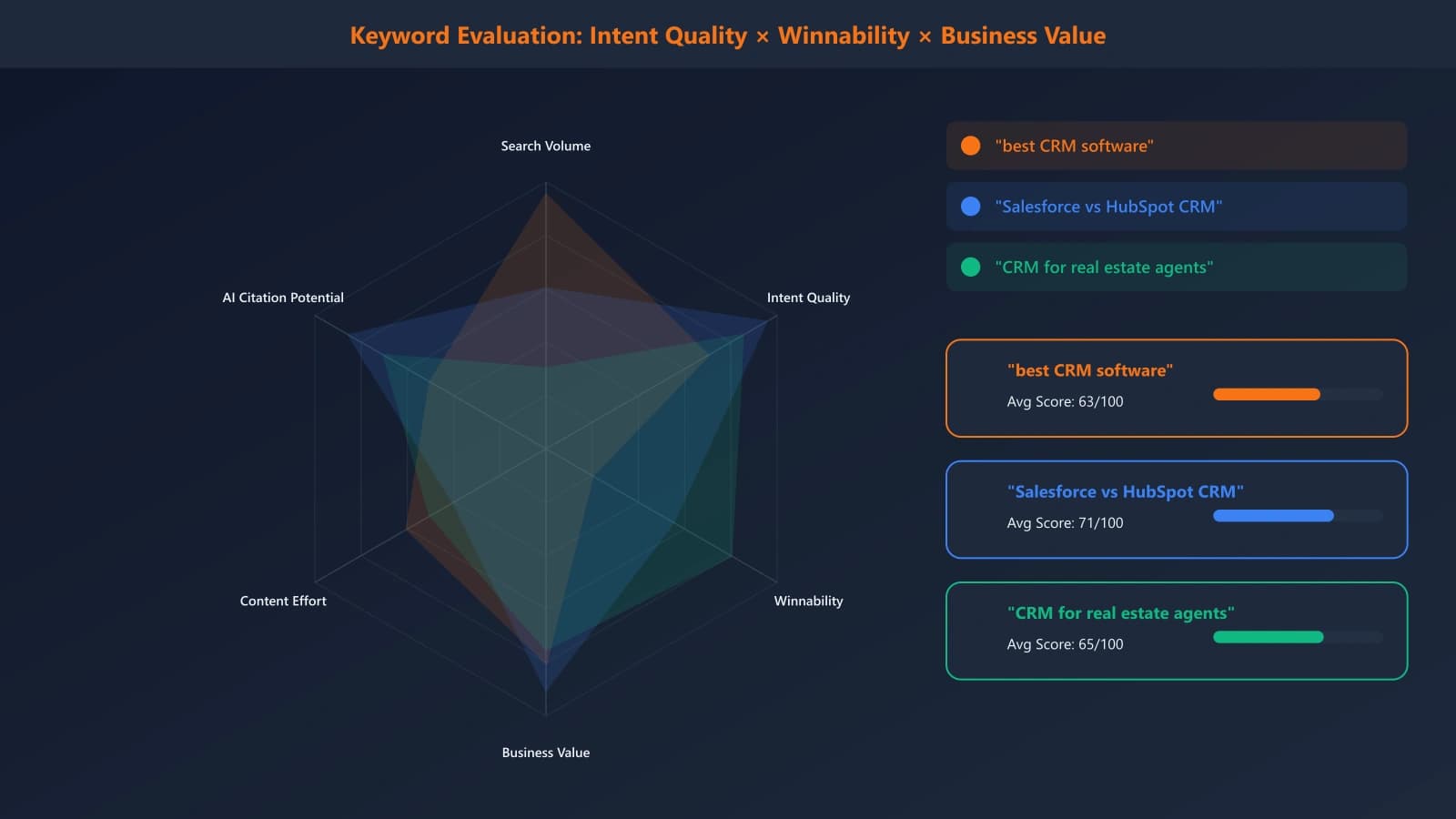
Not every comparison keyword is worth targeting. Here's how to evaluate opportunities systematically.
Intent Quality Over Volume
The biggest mistake in SaaS keyword research is optimizing for search volume. A 10,000 monthly search keyword with ambiguous intent is worth less than a 500 monthly search keyword with clear buyer intent.
High intent signals:
- Specific tool names (shows awareness)
- Use case qualifiers (shows need)
- Comparison language (shows active evaluation)
- Time qualifiers like “2026” (shows current need)
- Business context (for small business, for enterprise)
Lower intent signals:
- Broad category terms without qualifiers
- Educational framing (“what is CRM software”)
- Free-focused queries (“free project management”—intent is there but willingness to pay is questionable)
Competition Assessment
Before targeting a keyword, evaluate what you're competing against. Key questions:
- Who ranks currently? Is it dominated by aggregators (G2, Capterra) or publishers (PCMag, TechCrunch)?
- What's the content quality? Is top-ranking content thorough or thin?
- What's their domain authority? Can you compete on authority, or do you need to differentiate on content quality?
- Are there gaps? Is the top content missing perspectives (specific use cases, recent products, depth)?
The ideal opportunity has moderate volume, clear intent, and competition you can either match or outflank with better content.
Business Value Assessment
Finally, consider the business value of ranking for a keyword:
- Monetization potential: Are there affiliate programs for the products you'd cover?
- Advertiser interest: High CPC indicates advertiser demand (you could monetize with display)
- Content scalability: Can you create similar content for related keywords?
- Authority building: Does this keyword establish expertise in a valuable category?
The Research Process
Here's a systematic process for building your SaaS keyword list from scratch.
Step 1: Category Mapping
Start by mapping the SaaS categories relevant to your site or expertise. For each category, identify:
- Primary category terms (CRM, project management, email marketing)
- Alternative terminology (CRM vs customer relationship management)
- Sub-categories (CRM for real estate, CRM for nonprofits)
- Major players in the category (for alternatives and vs keywords)
Step 2: Seed Keyword Generation
For each category, generate seed keywords using the five patterns:
- Best [category] software/tools
- [Major product] alternatives
- [Product A] vs [Product B] for top product pairings
- Best [category] for [common use cases]
- [Top products] review
This gives you a starting list of 20-50 keywords per category.
Step 3: Keyword Expansion
Use keyword research tools to expand your seed list:
- Related queries: What else do people search after searching your seed terms?
- Long-tail variations: What modifiers appear (for small business, for teams, with [feature])?
- Question keywords: What questions do people ask about these categories?
- Emerging products: What newer tools are generating search interest?
Step 4: Evaluation and Prioritization
Run each keyword through your evaluation framework:
| Keyword | Volume | Intent | Competition | Value | Priority |
|---|---|---|---|---|---|
| Best CRM software | 12,000 | High | Extreme | High | Low (too competitive) |
| Best CRM for real estate | 1,200 | Very High | Moderate | High | High |
| Pipedrive vs HubSpot | 600 | Very High | Low | High | High |
| Salesforce alternatives | 4,800 | Very High | High | Very High | Medium (worth attempting) |
Step 5: Content Planning
Group related keywords into content pieces. A single listicle can target multiple related keywords:
- “Best CRM for real estate” (primary)
- “Real estate CRM software” (secondary)
- “CRM for real estate agents” (secondary)
- “Best CRM for realtors” (secondary)
This keyword clustering ensures you're not creating competing pages for related terms.
Generate SaaS Comparison Pages
Create high-converting SaaS comparison content targeting the keywords you've researched.
Try for Free
Finding Opportunities Others Miss
The obvious keywords are obvious to everyone. Here's how to find opportunities competitors overlook.
Emerging Products
New SaaS products generate search interest before comparison content exists. Monitor:
- Product Hunt launches in your categories
- Venture funding announcements (funded startups often generate interest)
- Industry publications covering new tools
- Reddit and Twitter discussions about emerging alternatives
Being first to cover “[New Product] alternatives” or “[New Product] vs [Established Product]” gives you a significant advantage.
Niche Use Cases
The more specific the use case, the less competition. Examples:
- Not “best project management” but “best project management for construction contractors”
- Not “best CRM” but “best CRM for real estate teams of 5-10 people”
- Not “best email marketing” but “best email marketing for Shopify stores with 1000+ subscribers”
These ultra-specific terms have lower volume but much higher conversion potential because you're speaking directly to the searcher's exact situation.
Integration-Focused Keywords
Users often search for tools based on what they integrate with:
- “Best project management that integrates with Slack”
- “CRM that works with Gmail”
- “Accounting software with Stripe integration”
These integration keywords are often underserved because they're not the primary way tools market themselves, but they reflect real user needs.
Putting It Into Practice
Keyword research is the foundation of successful SaaS comparison content. Without the right keywords, even great content struggles to find its audience.
Here's your action plan:
- Map your categories. Identify the SaaS categories you want to cover and document the major players in each.
- Generate seeds. Create 20-50 seed keywords per category using the five patterns.
- Expand systematically. Use tools to find long-tail variations, questions, and related terms.
- Evaluate rigorously. Apply the Intent × Winnability × Value framework to prioritize opportunities.
- Cluster for content. Group related keywords into single content pieces to avoid cannibalization.
- Hunt for gaps. Look for emerging products, niche use cases, and integration keywords that competitors miss.
- Prioritize intent over volume. A high-intent, low-volume keyword often delivers more value than the reverse.
The SaaS comparison space is competitive, but opportunities exist for publishers who research systematically and target strategically. Focus on intent quality, find the gaps others miss, and build content that genuinely serves comparison shoppers.
For the next step—creating the actual comparison content—see our SaaS Comparison Page Playbook. For the broader framework on listicle structure, check out The AI-Optimized Listicle Template.

Product Manager at BestPage. Pioneer in AEO research since 2024, exploring the convergence of SEO and GEO (Generative Engine Optimization). Led multiple AI-powered content optimization projects that achieved 300%+ citation increases in ChatGPT and Perplexity.