
Search for “best restaurants in Austin” or “best plumbers in Chicago” and Yelp appears near the top with remarkable consistency. This isn't luck—it's the result of systematic content architecture, massive domain authority, and patterns refined over years of local search optimization.
For independent publishers entering the local comparison space, Yelp is often the competitor to beat. Understanding how they win helps you either compete directly with differentiated approaches or find adjacent opportunities where their template-based approach creates gaps. This teardown examines Yelp's local best-of strategy in detail, extracting actionable lessons for smaller publishers.
We analyzed Yelp's best-of pages across multiple cities and categories, examining URL structure, page architecture, content patterns, internal linking, user-generated content integration, and schema implementation. The findings reveal both their strengths and their vulnerabilities—opportunities for competitors to differentiate.
Finding 1: URL Architecture and Scale
Yelp's URL structure enables systematic coverage of location-category combinations at massive scale.
URL Pattern Analysis
Yelp uses a consistent, predictable URL pattern for best-of pages:
Yelp URL structure:
• Base pattern: /biz/[category]-[city]-[state]
• Best-of pattern: /search?find_desc=[category]&find_loc=[city]
• Collection pages: /collection/[city]/best-[category]
• Category hubs: /[city]/[category]
This structure enables programmatic generation across thousands of location-category combinations. The predictability helps both users and search engines understand content relationships and enables efficient internal linking.
Scale of Coverage
Yelp maintains best-of presence for essentially every searchable location-category combination in the US. This comprehensive coverage creates several advantages: they capture long-tail queries smaller publishers miss, their internal linking network is massive, and they establish topical authority across all local service categories.
For independents, matching this scale is impractical. The lesson is focus: dominate specific categories or regions rather than attempting broad coverage.
Finding 2: Content Patterns
Yelp's best-of pages follow consistent content patterns with predictable elements.
Standard Page Structure
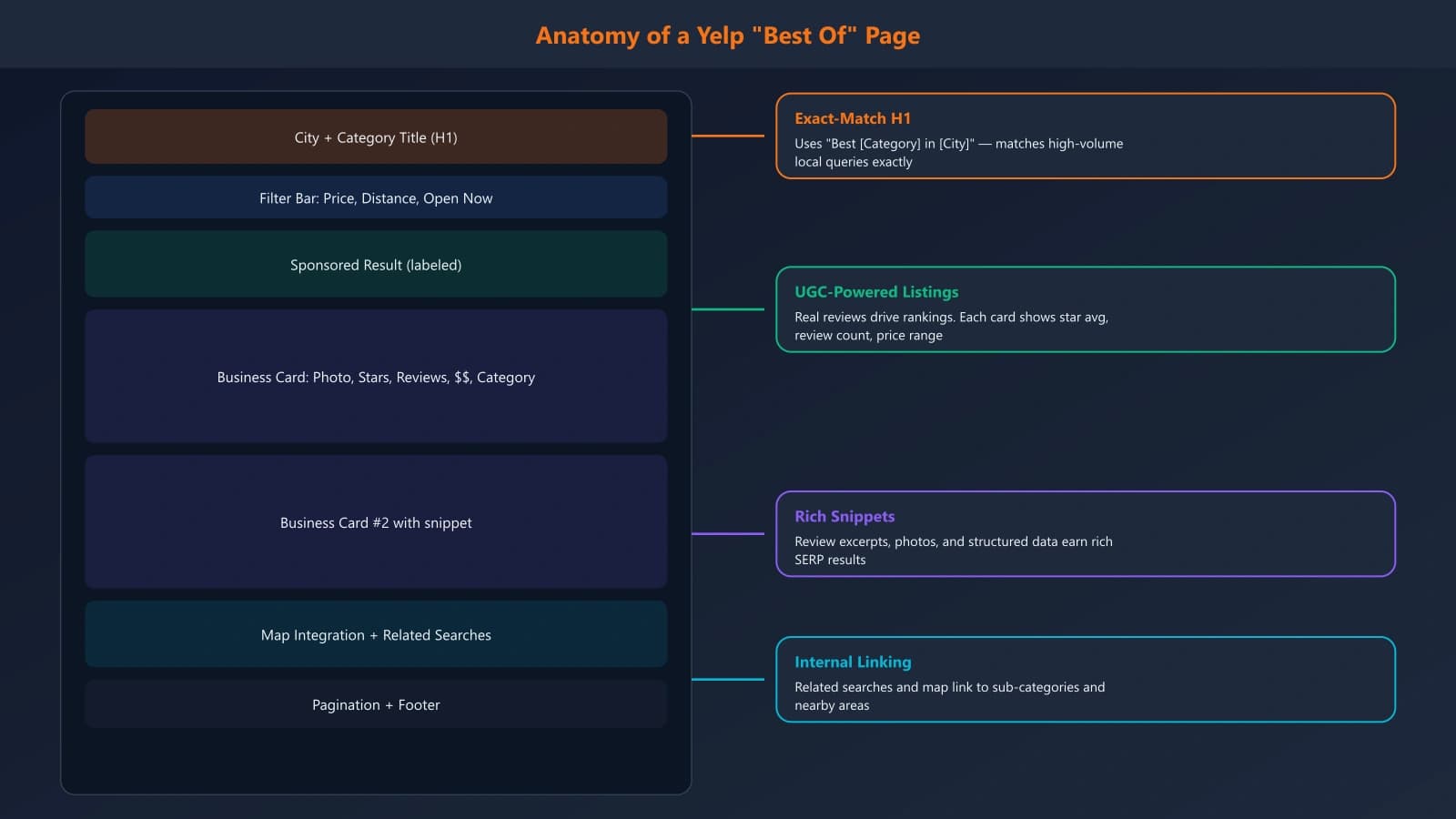
Each Yelp best-of page includes these elements in consistent order:
- Category and location header: Clear identification of what and where
- Filter options: Price, distance, features, open now
- Sponsored listings: Paid placements clearly marked
- Organic listings: Ordered by Yelp's recommendation algorithm
- Individual business cards: Rating, review count, category, price range, snippet
- Related searches: Links to related categories and locations
- FAQ/About section: Generic category information
The consistency enables users to quickly find information and enables efficient template-based generation at scale.
User-Generated Content Integration
Yelp's key content advantage is authentic user-generated content:
UGC elements on Yelp pages:
• Review snippets from actual users
• User-uploaded photos
• Review counts as social proof
• “People also viewed” based on user behavior
• Check-in data and tips
This UGC creates unique, constantly-updating content that search engines value. Independent publishers without review platforms must find alternative sources of unique, user-validated content.
Finding 3: Authority Signals
Yelp's domain authority and trust signals are significant competitive advantages.
Domain Authority Advantage
Yelp's domain has massive accumulated authority from millions of backlinks across virtually every business category. They receive links from businesses displaying Yelp badges, media citations, business directories, and organic editorial mentions. This authority transfers to new pages quickly, making it difficult for new entrants to compete purely on authority signals.
Trust and Brand Recognition
Beyond technical authority, Yelp benefits from brand recognition. Users trust Yelp for local business information based on years of reputation. This trust translates to engagement signals—click-through rates, time on site, return visits—that reinforce ranking performance.
For independents, building comparable authority requires years of consistent effort. The faster path is demonstrating expertise and trust in narrower categories where Yelp's generic approach creates opportunity.
Finding 4: Yelp's Vulnerabilities
Despite their dominance, Yelp's approach has exploitable weaknesses.
Template-Based Limitations
Yelp's scale requires templated content, which creates gaps:
Yelp template limitations:
• Generic category descriptions (same text across cities)
• No local market insights or expertise
• Minimal editorial curation or evaluation
• Algorithm-driven rankings without transparent methodology
• Limited depth on any individual business
Independent publishers can differentiate by providing genuine local expertise, transparent evaluation methodology, and deeper coverage of selected businesses.
Category and Quality Gaps
Yelp coverage is uneven. Some categories have rich review data; others have sparse coverage. Smaller markets may have few quality reviews. B2B services, professional services, and niche categories often have limited Yelp presence.
These gaps represent opportunities for focused competitors to provide superior coverage where Yelp is weakest.
Build Yelp-Competitive Local Pages
Generate local comparison content with the depth and expertise Yelp lacks.
Try for Free
Actionable Lessons for Independents
Synthesizing the teardown into actionable strategy for independent publishers:
- Focus beats breadth: Dominate specific categories or regions rather than competing across all local search
- Depth beats templates: Provide genuine expertise, local insights, and transparent methodology
- Find the gaps: Target categories and markets where Yelp coverage is weakest
- Alternative trust signals: Build expert credibility, industry partnerships, and specialized authority
- Unique content sources: Proprietary evaluation, expert reviews, aggregated multi-platform data
- Long-term authority building: Accept that competing with Yelp requires sustained investment
Yelp's dominance isn't unassailable—it's based on patterns that create predictable gaps. Smart independents exploit those gaps rather than competing head-to-head where Yelp is strongest.
For local trust signal implementation, see Local Business Trust Signals. For multi-location strategy, see Multi-Location Template.

Product Manager at BestPage. Pioneer in AEO research since 2024, exploring the convergence of SEO and GEO (Generative Engine Optimization). Led multiple AI-powered content optimization projects that achieved 300%+ citation increases in ChatGPT and Perplexity.