
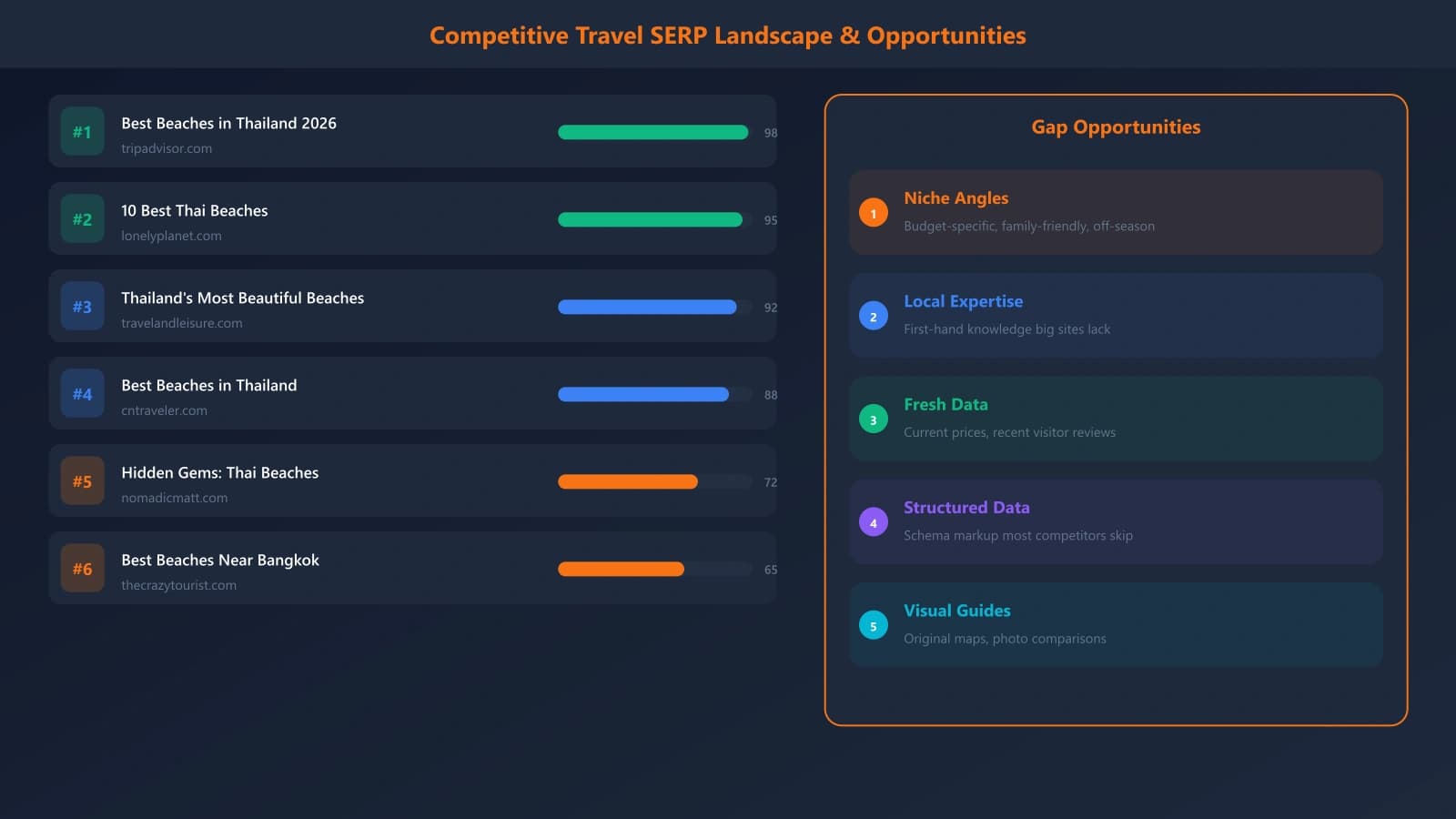
“Best beaches in Thailand.” “Top things to do in Paris.” “Most beautiful places to visit in 2026.” These queries get millions of searches, and the SERPs are dominated by travel giants with decades of authority, massive content libraries, and seemingly unlimited budgets for photography and on-the-ground reporting.
So why even try? Because despite the competition, there are real opportunities in travel listicle content. The giants can't cover everything. They often lack depth on niche topics, specific traveler types, or emerging destinations. And their scale sometimes works against them—generic content that tries to serve everyone often serves no one particularly well.
This guide provides a framework for building travel destination listicles that can compete. We'll cover how to find winnable angles, content approaches that differentiate from competitors, and monetization strategies that work for travel content creators.
Finding Winnable Opportunities
The first challenge in travel content is finding topics where you can actually compete. Going head-to-head with TripAdvisor on “best hotels in New York” is a losing battle for most publishers. Here's how to find better opportunities.
The Niche-Down Strategy
The most common winning approach is extreme niche focus. Instead of competing for broad terms, dominate narrow ones:
| Broad (Avoid) | Niche (Target) | Why It Works |
|---|---|---|
| Best beaches in Europe | Best beaches for digital nomads with fast WiFi | Specific traveler type, specific need |
| Things to do in Tokyo | Best Tokyo experiences for first-time solo female travelers | Specific audience, specific concern (safety) |
| Best honeymoon destinations | Best adventure honeymoons for active couples | Specific subset of honeymoon interest |
| Best hotels in Paris | Best boutique hotels in Le Marais under $200 | Specific area, specific price point |
Traveler Type Focus
Another differentiation strategy is building expertise around a specific traveler type:
- Digital nomads: WiFi quality, coworking spaces, visa situations, cost of living
- Families with young children: Kid-friendly activities, stroller accessibility, family accommodations
- Budget backpackers: Hostel quality, free activities, transportation hacks
- Luxury travelers: Five-star experiences, private tours, exclusive access
- Solo female travelers: Safety information, social hostels, solo-friendly tours
- LGBTQ+ travelers: Welcoming destinations, legal considerations, community spaces
- Accessibility needs: Wheelchair-accessible attractions, accessible hotels, mobility considerations
Serving a specific traveler type deeply is often more valuable than serving all travelers superficially. And these niches often have passionate communities that share and link to helpful content.
Finding Destination Gaps
Major travel publishers focus on major destinations. Less-covered areas offer opportunities:
- Secondary cities: Not Paris, but Lyon. Not Bangkok, but Chiang Mai.
- Emerging destinations: Places just entering the tourism spotlight
- Specific regions: Not “Italy” but “Puglia” or “Cinque Terre alternatives”
- Seasonal niches: Best destinations in shoulder seasons, off-peak alternatives
Content Differentiation Strategies
Once you've identified your angle, you need content that stands out from what's already ranking. Here are approaches that work.
First-Party Content Advantage
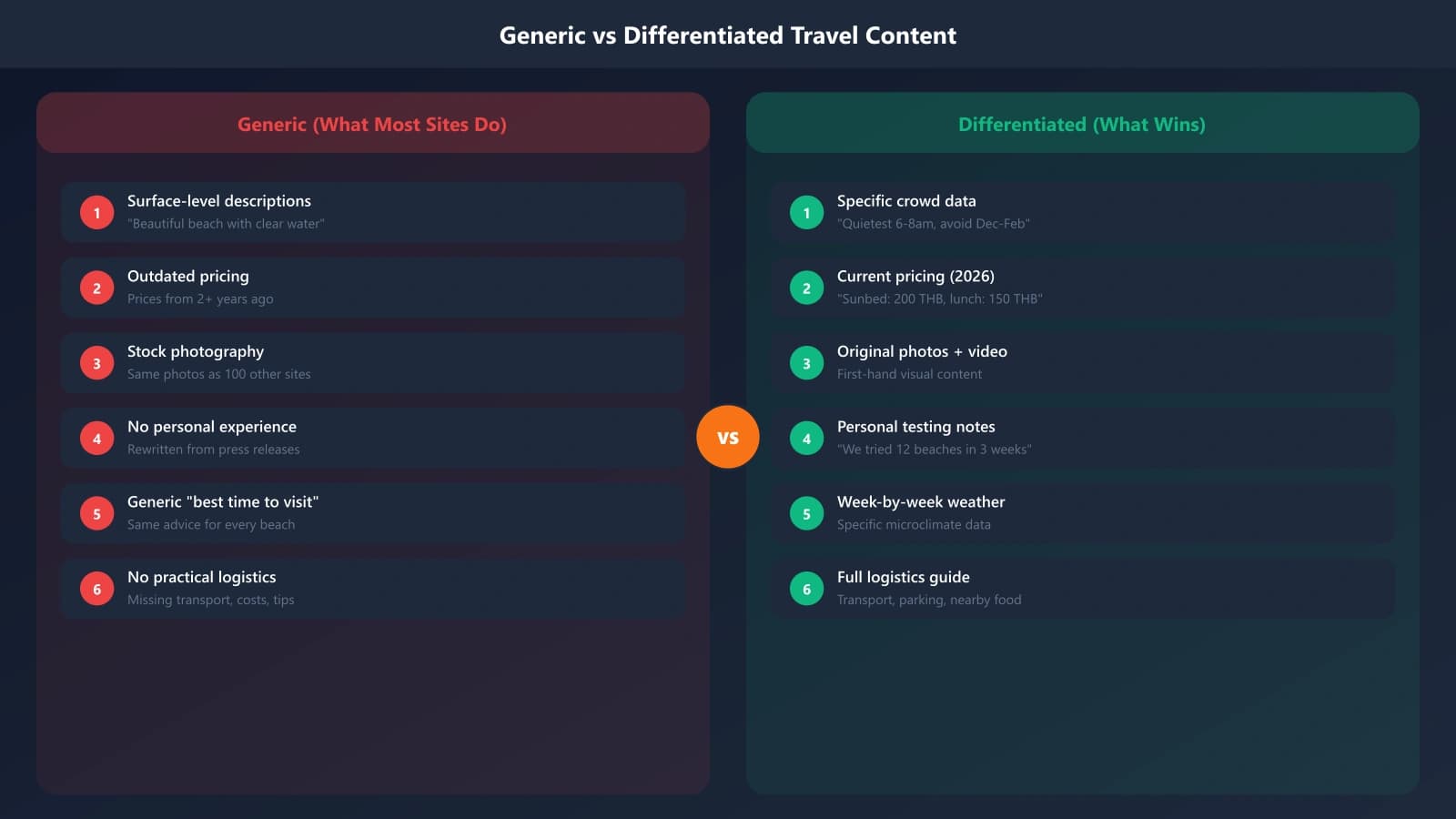
The most defensible advantage in travel content is first-party experience. Content created from actual visits, with original photography and specific observations, is difficult for competitors to replicate.
What first-party content includes:
- Original photos taken during actual visits
- Specific details that only come from being there (opening hours that differ from listed, hidden entrances, local tips)
- Personal recommendations based on genuine experience
- Honest assessments including negatives
- Practical information verified on the ground
This approach is resource-intensive—you need to actually travel—but it creates content that's genuinely more valuable than aggregated information from other sources.
The Depth Strategy
Another differentiation approach is going deeper than competitors. If the top-ranking article lists “10 best beaches in Bali” with a paragraph each, you can create the definitive guide with detailed information on each beach:
- When to visit (time of day, time of year)
- How to get there (specific directions, transportation options)
- What to expect (crowd levels, facilities, water conditions)
- Who it's best for (families, surfers, snorkelers, photography)
- What to bring (specific gear recommendations)
- Where to eat nearby (specific restaurant recommendations)
Depth content serves users better and signals expertise to search engines. It also tends to earn more links because it becomes the reference resource for that topic.
Data-Driven Angles
Original data provides unique value that can't be replicated. Travel data angles include:
- Price analysis: Average costs across destinations, best value timing
- Crowd data: Analysis of when attractions are least crowded
- Safety data: Crime statistics, health data, safety ratings
- Weather patterns: Detailed climate analysis beyond generic “best time to visit”
- Flight pricing: When to book, cheapest routes, layover strategies
Content Structure for Travel Listicles
Travel listicles need specific structural elements to serve travelers well and rank in search.
Essential Elements
- Quick overview with top picks: Travelers often want a quick answer before deciding whether to read the full article
- Comparison table: Key attributes at a glance (cost level, best for, best time to visit)
- Individual destination sections: Detailed coverage of each item in the list
- Practical information: How to get there, where to stay, what to bring
- When to visit guidance: Seasonality, crowds, weather, events
- Budget estimates: What to expect to spend
- Map or location context: Visual orientation of where destinations are
Individual Destination Section Template
Each destination in your listicle should include:
- Opening hook: What makes this destination special in 2-3 sentences
- Best for: Who will love this destination
- Highlights: Top 3-5 things to see or do
- Practical details: Getting there, best base area, budget guidance
- Pro tip: Insider knowledge that adds value
- When to go: Best timing for this specific destination
- Original photo(s): If available, your own images
| Destination | Best For | Budget Level | Best Time | Highlights |
|---|---|---|---|---|
| Example Destination A | Beach lovers, families | $$$ | Apr-Oct | Pristine beaches, water sports |
| Example Destination B | History buffs, culture seekers | $$ | Mar-May, Sep-Nov | Ancient ruins, local cuisine |
| Example Destination C | Adventure travelers, hikers | $ | Dec-Feb | Mountain treks, wildlife |
Generate Travel Destination Listicles
Create detailed travel comparison pages with structured destination sections and practical travel information.
Try for Free
Monetization for Travel Content
Travel content has multiple monetization paths. Here's what works for listicle-style content.
Affiliate Booking Links
The most direct monetization is affiliate commissions on bookings:
- Booking.com: 25-40% commission on hotel bookings
- TripAdvisor: CPC model for clicks to their booking platform
- Viator/GetYourGuide: 8% commission on tour and activity bookings
- Skyscanner/Kayak: CPC for flight search referrals
- Hostelworld: Commission on hostel bookings (good for budget travel content)
- Amazon: Product links for travel gear recommendations
Destination Marketing Partnerships
Tourism boards and destination marketing organizations often have budgets for content partnerships:
- Sponsored trips in exchange for coverage
- Paid content partnerships with tourism boards
- Long-term ambassador relationships with destinations
These partnerships work best when you have established authority in a specific travel niche or region.
Display Advertising
Travel content tends to have strong CPMs due to advertiser interest. With significant traffic, display advertising through premium ad networks can be substantial.
Making It Work
Travel listicle content is challenging but far from impossible. Success requires strategic focus and genuine differentiation from established competitors.
Here's your implementation path:
- Find your angle. Choose a niche traveler type, underserved destination category, or specific travel style to focus on.
- Invest in first-party content. If possible, create content from actual travel experience with original photography.
- Go deeper than competitors. More detail, more practical information, more insider knowledge.
- Build topical authority. Focus on becoming the definitive resource for your chosen niche rather than covering everything.
- Diversify monetization. Combine affiliate, advertising, and partnership revenue.
- Keep content fresh. Travel information changes constantly; build update processes into your workflow.
The travel content space rewards genuine expertise and differentiated perspectives. Find your unique angle, create content that genuinely helps travelers, and build authority in your chosen niche. The opportunities exist—you just need to be strategic about where you compete.
For the foundation of comparison page structure, see our AI-Optimized Listicle Template. For seasonal content strategies that apply well to travel, check out Seasonal Listicles: Build Once and Update Forever.

Product Manager at BestPage. Pioneer in AEO research since 2024, exploring the convergence of SEO and GEO (Generative Engine Optimization). Led multiple AI-powered content optimization projects that achieved 300%+ citation increases in ChatGPT and Perplexity.