
Here's a conversation I've had more times than I can count: “We need a comparison page for Salesforce alternatives.” And every time, I have to pump the brakes. Because “Salesforce alternatives” isn't a comparison keyword—it's an alternatives keyword. Different intent, different format, different page.
The distinction between best-of, alternatives, and comparison pages isn't just semantic nitpicking. These three formats serve fundamentally different user needs. Build the wrong one, and you're essentially handing your rankings to whoever got it right.
For the complete framework on matching keywords to page types, check out our Keyword to Page Type Mapping guide. This article zooms in on understanding the three core intent types—because getting this part wrong is where most content strategies fall apart.
Discovery Intent: When Users Want Best-Of Pages
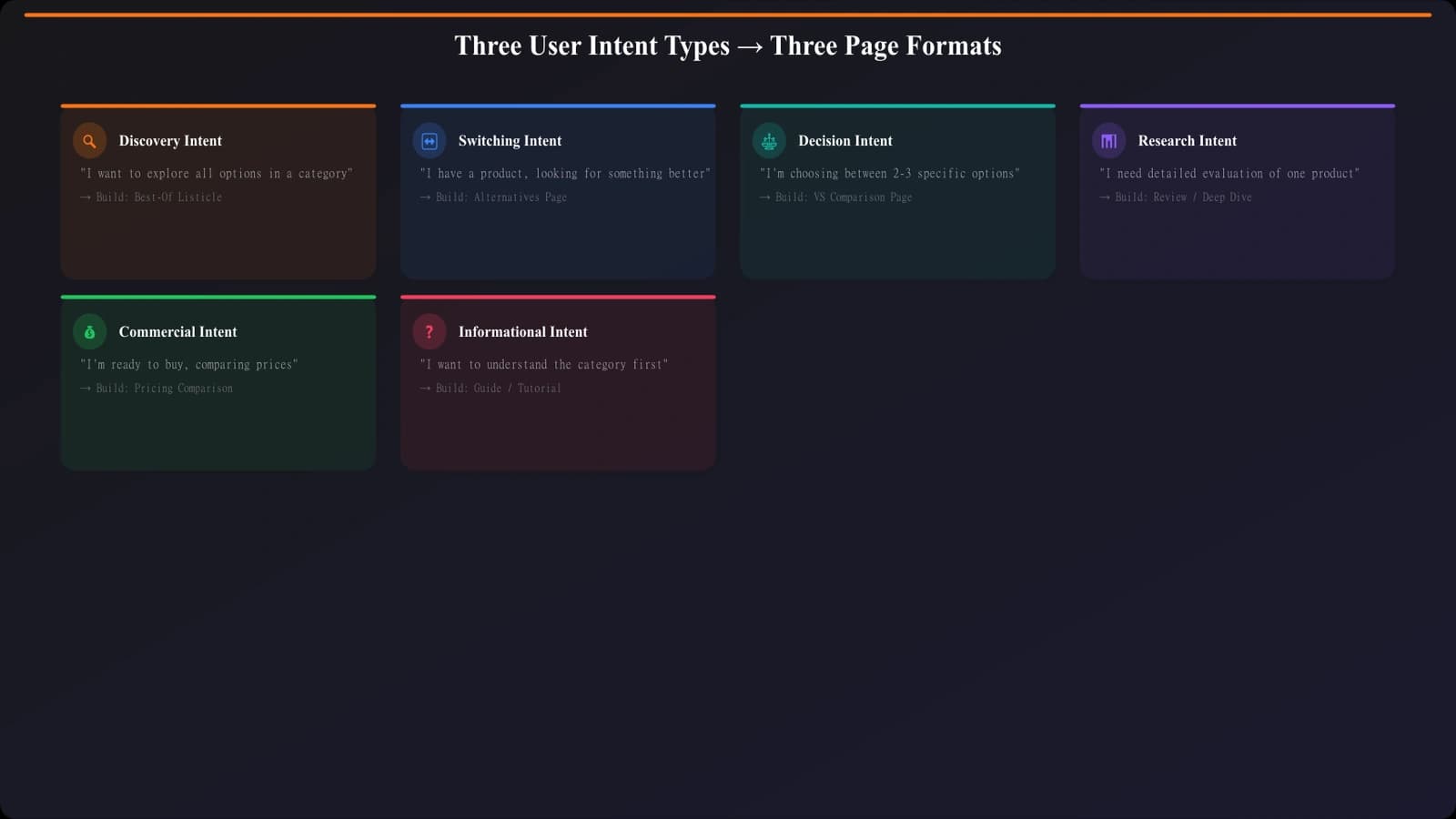
Discovery intent is the broadest of the three. The user knows they need something in a category, but they haven't zeroed in on specific products yet. They're exploring. Browsing. Getting the lay of the land.
Think about it from their perspective: “I need project management software for my team. What's good?” They're not asking about Asana vs Monday. They don't even know those are the options yet. They need someone to show them what exists.
What Discovery Intent Looks Like
- Keyword patterns: “Best CRM software,” “Top email marketing tools 2026,” “Leading HR platforms”
- User mindset: “Show me good options—I'll narrow it down from there”
- Zero specific products mentioned in the query
- Often includes qualifiers: “for small business,” “for startups,” “free”
What Best-Of Pages Need to Deliver
When someone has discovery intent, they need comprehensive coverage. They're not looking for your opinion on one product—they want to see the whole category laid out so they can form their own shortlist.
A solid best-of page typically includes:
- 8-15 options ranked or organized by use case
- Clear criteria for why each made the list
- Enough detail to form an initial opinion (features, pricing tier, best-for)
- Comparison tables for quick scanning
Switching Intent: When Users Want Alternatives Pages
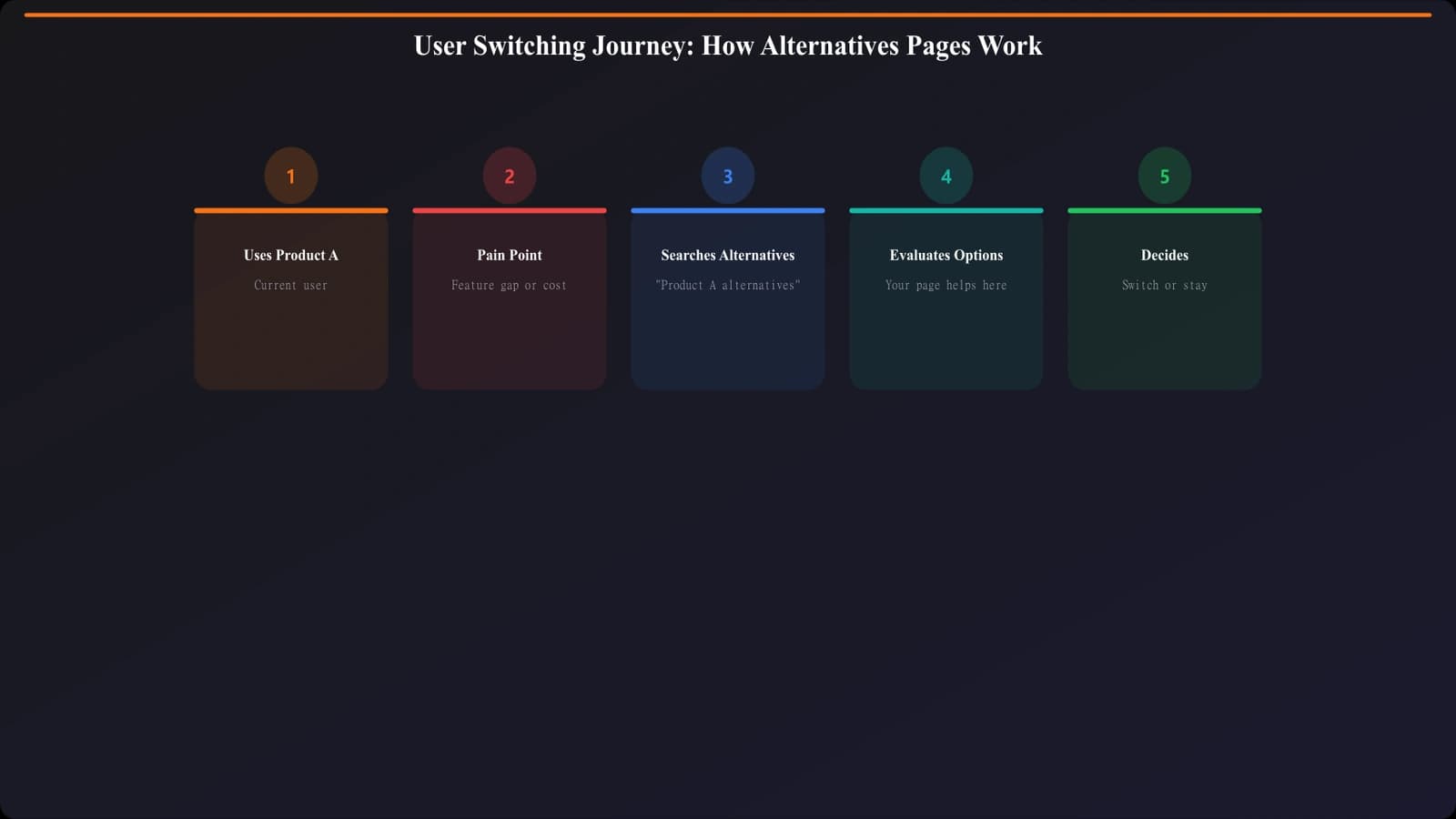
Switching intent is completely different. Here, the user already knows a specific product—they either use it, used to use it, or have heard enough about it to use it as a reference point. They're looking for other options.
The key word is switching. “Salesforce alternatives” means “I know Salesforce, and I want something else.” Maybe they're unhappy with pricing. Maybe they've outgrown it. Maybe they just want to see what else is out there before committing. But they're using a known product as their anchor point.
What Switching Intent Looks Like
- Keyword patterns: “Salesforce alternatives,” “tools like Notion,” “HubSpot competitors”
- User mindset: “I know [Product X]—what else should I consider?”
- One specific product mentioned as the anchor
- Switching words: alternatives, competitors, similar to, like, instead of
Generate Alternatives Pages That Convert
Build competitor and alternatives pages that capture switching traffic automatically.
Try for Free
What Alternatives Pages Need to Deliver
The critical difference: users already understand the anchor product. They don't need you to explain what Salesforce is or what a CRM does. They need you to show how alternatives differ from that anchor.
Effective alternatives pages include:
- Clear differentiation from the anchor product (not just features, but philosophy, pricing model, target user)
- Why someone might switch (the pain points alternatives solve)
- Migration considerations (how hard is it to move?)
- A ranked list of 8-12 alternatives, often organized by use case
Decision Intent: When Users Want Comparison Pages
Decision intent is the most focused of the three. The user has already done their discovery. They've narrowed down to 2-4 specific products. Now they need help making the final call.
This is late-funnel, high-intent traffic. Someone searching “HubSpot vs Salesforce” isn't exploring anymore—they're deciding. They know exactly which options they're considering and need detailed feature-by-feature analysis.
What Decision Intent Looks Like
- Keyword patterns: “Slack vs Teams,” “Notion versus Coda,” “Asana compared to Monday”
- User mindset: “I'm choosing between these specific options—help me decide”
- Two or more specific products mentioned
- Comparison words: vs, versus, compared to, or, which is better
What Comparison Pages Need to Deliver
Users with decision intent don't want to see 10 other options—they've already filtered those out. They want depth on the specific products they're considering.
Strong comparison pages include:
- Deep feature-by-feature analysis
- Detailed pricing comparison (including tiers and hidden costs)
- Clear “best for” recommendations by use case
- A definitive verdict—users want guidance, not “it depends”
- Pros/cons for each option
Why Mixing These Up Destroys Performance
Let's make this concrete. Here's what happens when you build the wrong format:
Listicle for a Comparison Keyword
User searches “Slack vs Teams.” You show them “15 Best Team Chat Tools.” They bounce immediately. They didn't want 15 options—they'd already narrowed it to 2. You wasted their time.
Comparison for an Alternatives Keyword
User searches “Salesforce alternatives.” You show them a detailed HubSpot vs Pipedrive comparison. But they didn't ask about those two specifically—they wanted to see the whole landscape of options beyond Salesforce.
Alternatives Page for a Best-Of Keyword
User searches “best CRM software.” You show them “Salesforce Alternatives.” But they don't know Salesforce yet! They're not anchoring to anything—they wanted a broad overview of the category.
In each case, the content might be excellent for a different keyword. But for the keyword the user actually searched? It's a mismatch. And Google knows.
Quick Classification Framework
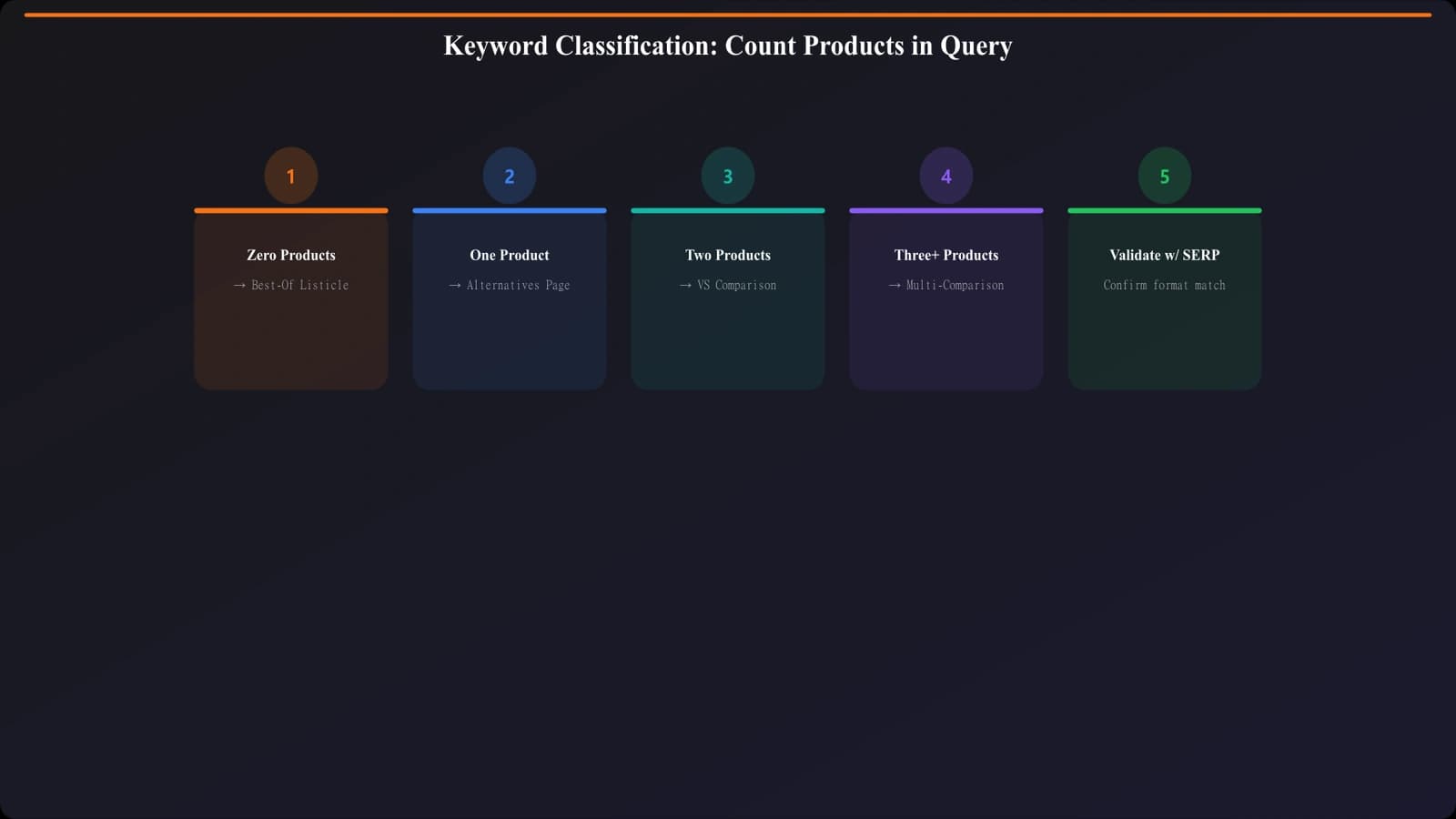
Here's a 30-second process for classifying any comparison-oriented keyword:
| Question | Answer | Page Type |
|---|---|---|
| How many products are named? | Zero | Best-Of (Listicle) |
| How many products are named? | One | Alternatives |
| How many products are named? | Two or more | Comparison |
That's your starting hypothesis. Then validate with a SERP check—if 8+ of the top 10 results match that format, you're good. If the SERP shows something different, follow the SERP.
Conversion Differences You Should Know
These three page types don't just rank for different keywords—they convert differently too. Understanding this helps you prioritize:
| Page Type | Traffic Volume | Conversion Rate | Best Monetization |
|---|---|---|---|
| Best-Of (Listicle) | Highest | Lower (1-3%) | Affiliate, display ads |
| Alternatives | Medium | Medium (2-5%) | Affiliate, lead capture |
| Comparison | Lower | Highest (3-8%) | Affiliate, direct leads |
Best-of pages cast a wide net but catch users early. Comparison pages get fewer visitors but those visitors are ready to act. A balanced content strategy usually includes all three.
Getting This Right Every Time
The distinction between these three page types is honestly one of the most important concepts in comparison content strategy. Get it wrong, and you're fighting an uphill battle no amount of content quality can overcome.
Here's the quick version:
- Zero products named = Discovery intent = Best-of/Listicle
- One product named = Switching intent = Alternatives page
- Two+ products named = Decision intent = Comparison page
Nail this classification step, validate with a quick SERP check, and you'll never waste time building the wrong format again.
For the complete decision framework including edge cases and implementation workflow, see our comprehensive guide: Keyword to Page Type Mapping: Complete Framework. And for the specific techniques on reading SERPs, check out SERP Analysis: Pick the Right Page Type Every Time.

Product Manager at BestPage. Pioneer in AEO research since 2024, exploring the convergence of SEO and GEO (Generative Engine Optimization). Led multiple AI-powered content optimization projects that achieved 300%+ citation increases in ChatGPT and Perplexity.