
I'm going to make a bold claim: no piece of content should ever be created without a SERP check first.
Not because keyword research isn't valuable—it is. But keyword modifiers only tell you what format a query probably wants. The SERP tells you what format Google actually rewards. And when those two things conflict? The SERP wins. Every single time.
This guide breaks down exactly how to read a SERP for page type decisions. It's the validation step in our broader Keyword to Page Type Mapping Framework—and honestly, it's the most important step.
Why SERP Analysis is Non-Negotiable
Here's the thing about Google: they've watched billions of users search, click, read, and bounce. They have more data about what satisfies a query than any of us could ever hope to compile.
When Google shows 8 listicles for “best project management tools,” that's not random. It's the result of years of user behavior data telling them that listicles satisfy that intent better than any other format.
Your job isn't to guess what users want. Your job is to read what Google has already figured out.
The 6-Step SERP Analysis Process
Here's the exact process I use for every keyword before committing to a page type.
Step 1: Set Up a Clean Search
Open an incognito or private browser window. Your search history, location, and browsing behavior all affect results. You need to see what a neutral user sees.
If you're targeting a specific location, use a VPN or search with a location parameter. US results can look very different from UK results for the same query.
Step 2: Search the Exact Keyword
Type the keyword exactly as you're planning to target it. Don't add quotes, operators, or modifications. Just the raw keyword.
Before clicking anything, take in the full SERP. What's above the fold? What features does Google show? First impressions matter.
Step 3: Categorize the Top 10 Organic Results
For each of the top 10 organic results (skip ads and featured snippets for now), categorize the page type:
- Listicle →“10 Best...”, “Top X...”, numbered rankings
- Comparison →“X vs Y”, head-to-head, feature tables
- Alternatives →“X Alternatives”, competitor roundups anchored to one product
- Product page →vendor landing pages, pricing pages
- Guide/Editorial →how-to content, reviews, thought leadership
- Other →forums, directories, YouTube, etc.
Step 4: Count the Format Distribution
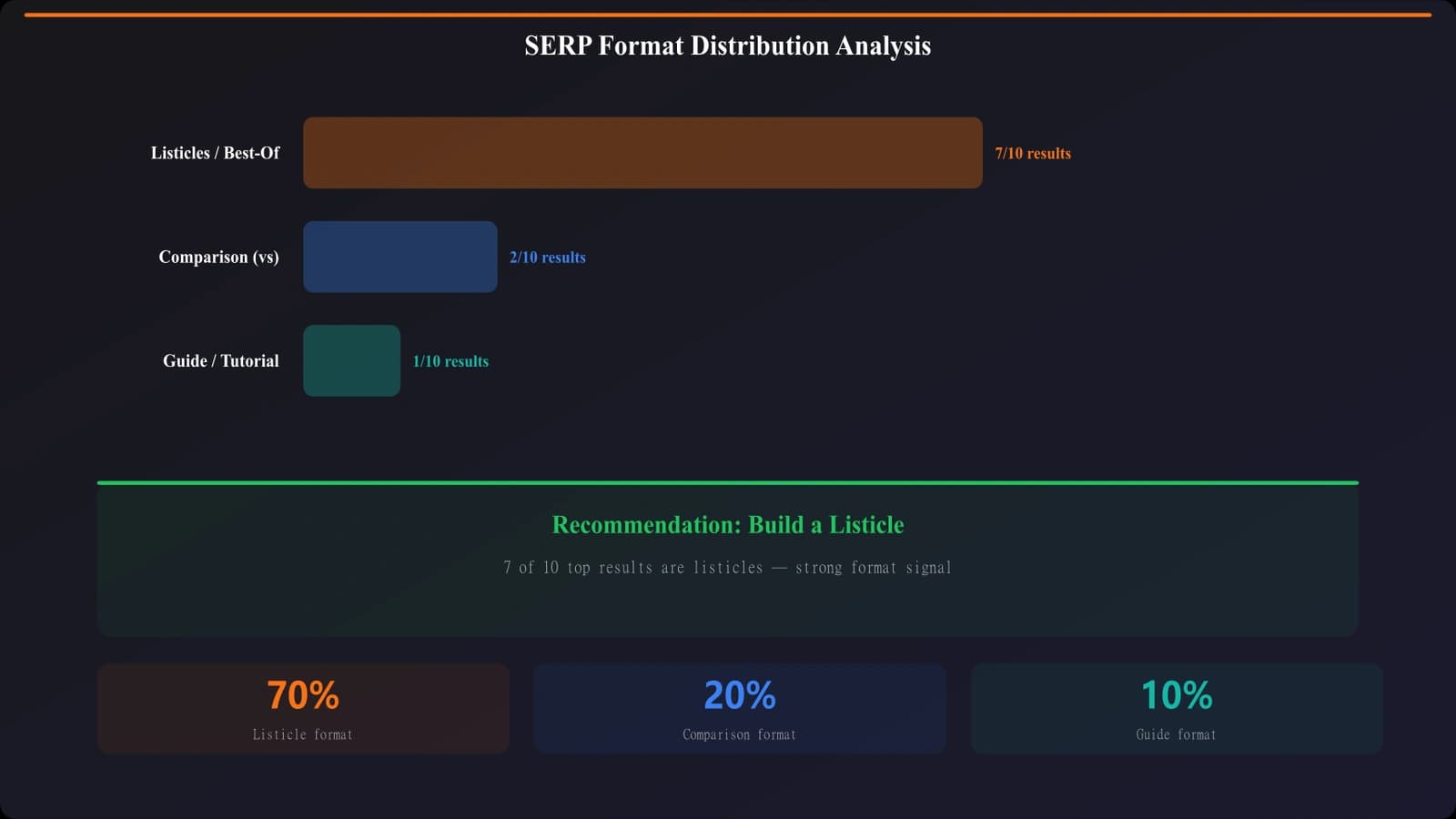
Tally up how many results fall into each category. This is your decision data.
| Count | Interpretation | Your Action |
|---|---|---|
| 8-10 same format | Clear, strong intent | Build exactly this format |
| 6-7 same format | Dominant intent | Build this format unless positions 1-3 differ |
| 4-5 same format | Mixed intent | Match what's in positions 1-3 |
| 0-3 of any format | Highly mixed or unclear | Consider if this is really a content opportunity |
Step 5: Examine SERP Features
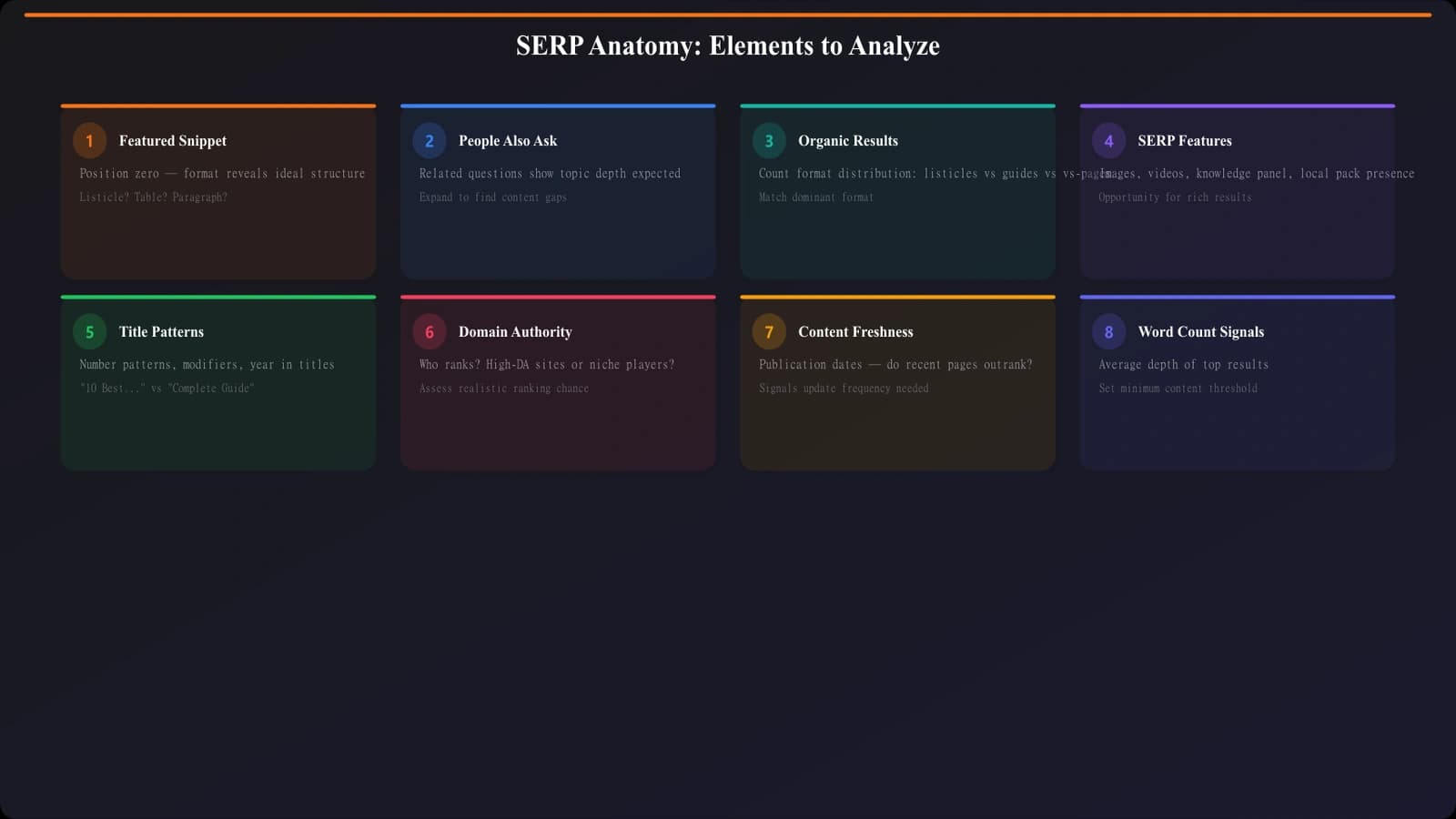
SERP features give you additional intent signals:
- Featured snippet with a list? Strong listicle signal—structure your content for snippet capture
- Featured snippet with a table? Comparison intent—include comparison tables
- People Also Ask questions? These reveal related intents and section topics
- Shopping results? Transactional intent—might not be a content opportunity
Step 6: Note the Competition
Who ranks in positions 1-3? This tells you what you're up against:
- Major publications (Forbes, TechCrunch) →high authority needed, consider niching down
- Review sites (G2, Capterra) →strong competition, need unique angle
- Direct competitors →beatable with better content
- Niche blogs →good opportunity, quality content can win
- Product pages →content gap exists, build the comparison content users want
Generate SERP-Validated Content
Build pages that match exactly what Google rewards for your target keywords.
Try for Free
Handling Mixed SERPs
Not every SERP gives you a clean 8-10 of one format. Here's how to handle the gray areas.
Position 1-3 Priority
When the overall distribution is mixed (4-5 of one format), look at positions 1-3 specifically. These are what Google is most confident about. If positions 1-3 are all listicles but positions 4-10 are mixed, build a listicle.
Let the Featured Snippet Guide You
If there's a featured snippet, its format is a strong signal. A list snippet suggests listicle intent. A table snippet suggests comparison intent. Match the snippet format for your best chance of capturing it.
When Intent Is Genuinely Split
Sometimes queries legitimately serve multiple intents. “CRM software” might show listicles, vendor pages, and guides all in the top 10 because users searching this term are at different stages.
In these cases, ask: which format gives you the best competitive angle? If you can't beat G2 on a listicle, maybe a more opinionated comparison has less competition.
Common SERP Patterns by Keyword Type
After analyzing hundreds of comparison SERPs, these patterns show up consistently:
“Best X” Keywords
- 85% of the time: listicle results dominate
- Exception: very broad terms may show category pages or guides
- SERP features: often list snippets, “what is the best...” PAA questions
“X vs Y” Keywords
- 90%+ of the time: comparison results dominate
- Exception: mismatched products may show “did you mean” patterns
- SERP features: often table snippets, feature comparison PAA
“X Alternatives” Keywords
- 80% of the time: alternatives pages dominate
- Exception: very small products may lack dedicated pages
- SERP features: often list snippets, “why switch from X” PAA
These patterns are your baseline—but always verify. Specific queries can deviate from category norms.
When to Re-Analyze SERPs
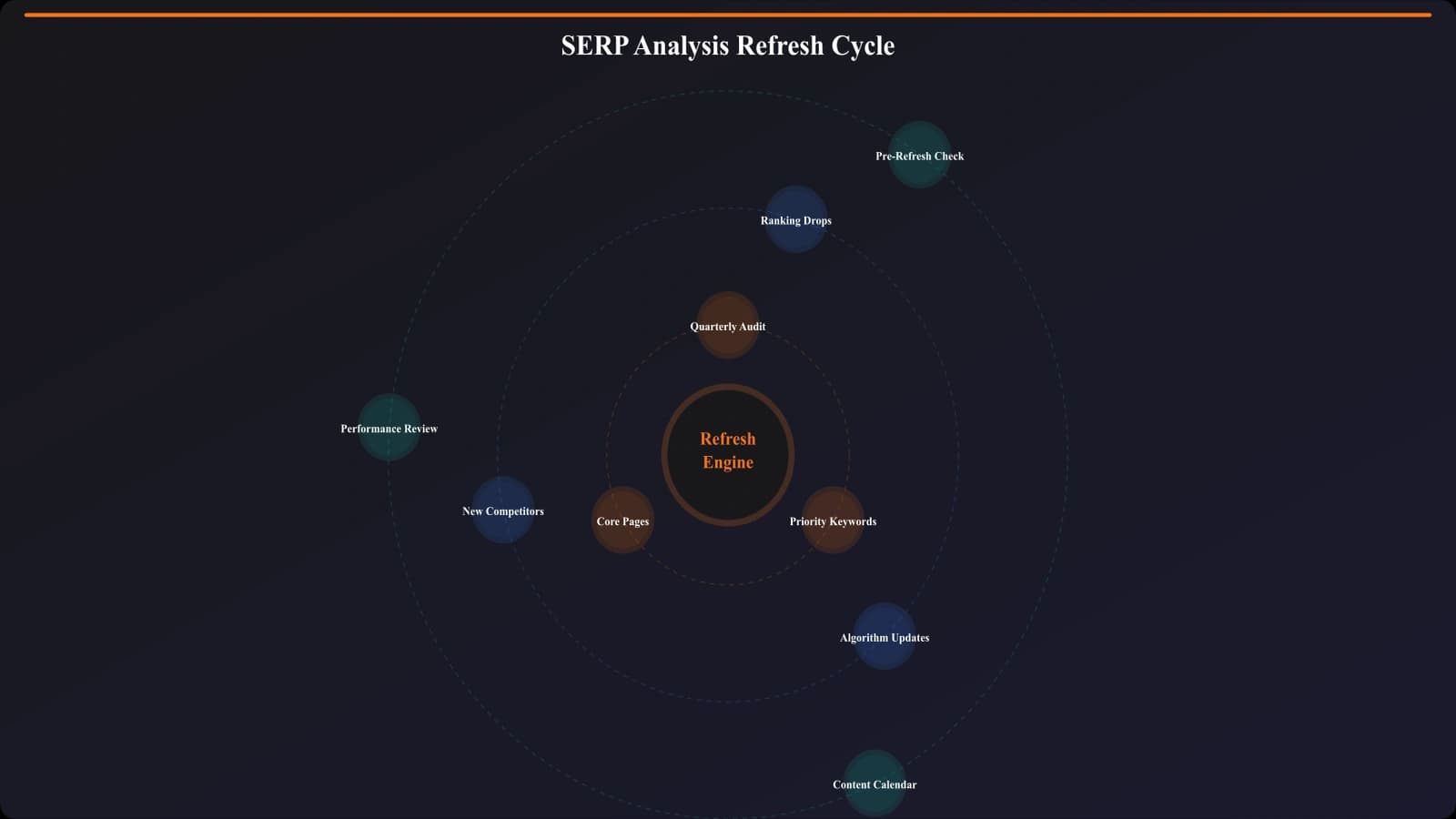
SERPs aren't static. Intent understanding evolves. Set a refresh schedule:
- Quarterly: Re-check your top 20 target keywords
- After algorithm updates: Core updates can shift format preferences
- When rankings drop: If you lose 5+ positions, re-analyze the SERP
- Before content refreshes: Verify the format still matches before investing in updates
Making SERP Analysis a Habit
The 2-3 minutes it takes to run a proper SERP analysis is some of the highest-leverage time you can spend in content planning. It prevents weeks of wasted effort on content built for the wrong format.
Here's the quick checklist:
- Search in incognito →get neutral results
- Count formats in top 10 →what dominates?
- Pay attention to positions 1-3 →especially when mixed
- Check SERP features →snippets and PAA give extra signals
- Note competition level →can you realistically win?
- Document and re-check →SERPs evolve
Make this a non-negotiable step before any content project. Your hit rate will go up dramatically.
For the complete decision framework that includes this SERP analysis step, see Keyword to Page Type Mapping: Complete Framework. And to understand the different intent types you're analyzing for, check out Best-Of vs Alternatives vs Comparison: Know the Difference.

Product Manager at BestPage. Pioneer in AEO research since 2024, exploring the convergence of SEO and GEO (Generative Engine Optimization). Led multiple AI-powered content optimization projects that achieved 300%+ citation increases in ChatGPT and Perplexity.