
Users trust comparison content to provide objective guidance. When that trust is violated—when rankings are influenced by payments, relationships, or hidden incentives—the content loses its value. Users who discover bias lose trust permanently. Search engines increasingly evaluate content trustworthiness, and biased rankings fail those evaluations.
Bias in comparison content isn't always intentional. Unconscious preferences, incomplete research, or structural incentives can introduce bias without malicious intent. The challenge is building systems that prevent bias regardless of its source—creating methodologies and processes that produce trustworthy results even when individual humans might have unconscious preferences.
This guide covers bias prevention from multiple angles: identifying common bias sources in comparison content, building methodology structures that prevent bias, documenting and communicating your approach transparently, and ongoing monitoring for bias drift. The goal is content that's genuinely trustworthy—not just content that appears trustworthy while hiding conflicts.
Trust is the core asset of comparison content. Every element of your methodology should reinforce rather than undermine that trust. Users making decisions based on your rankings deserve objectivity, and building genuinely objective processes protects your long-term content value.
Common Bias Types in Comparison Content
Understanding bias sources helps prevent them systematically.
| Bias Type | Source | Manifestation | Prevention |
|---|---|---|---|
| Affiliate bias | Higher commissions from some products | High-commission products ranked higher | Blind evaluation; separate ranking from monetization |
| Advertiser bias | Paid relationships with featured companies | Advertisers featured prominently regardless of merit | Clear disclosure; editorial independence |
| Access bias | Better access to some products for testing | Products with press access over-represented | Standardized evaluation criteria; gap disclosure |
| Familiarity bias | Personal experience with some products | Familiar products rated higher than unfamiliar | Structured evaluation rubrics; multiple reviewers |
| Recency bias | Recently reviewed products fresher in mind | Recently reviewed products ranked higher | Systematic re-evaluation cycles |
| Selection bias | Choosing which products to include | Excluding competitors to sponsors | Transparent inclusion criteria |
Each bias type requires specific countermeasures. Effective bias prevention addresses all potential sources, not just the most obvious ones.
Structural Bias Prevention
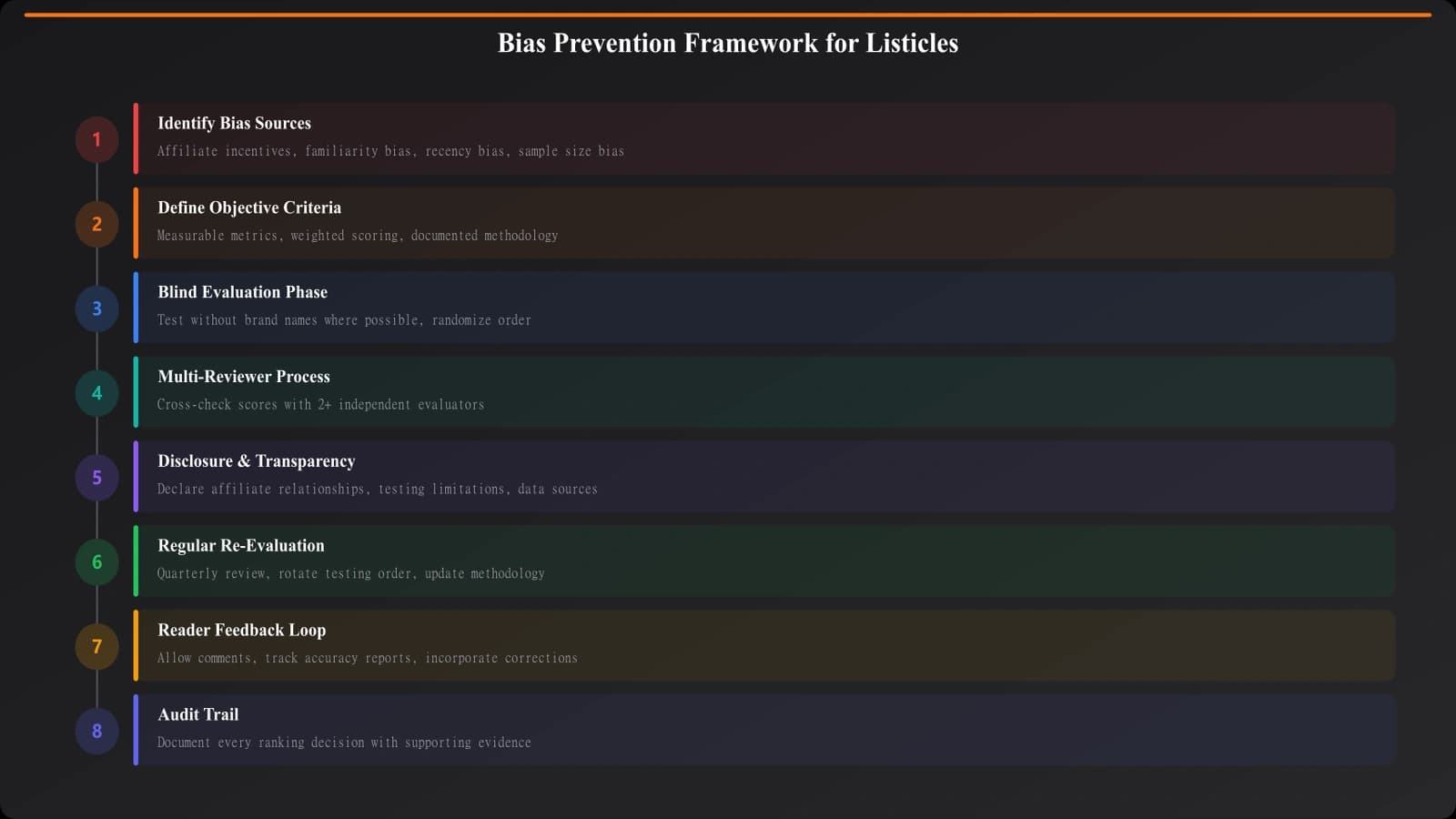
Build bias prevention into your methodology structure rather than relying on individual judgment.
Separation of Concerns
Separate evaluation from monetization decisions. The people determining rankings should not know commission rates or advertiser relationships. This structural separation prevents financial incentives from influencing editorial judgment, even unconsciously.
Separation structure example:
• Editorial team: Determines rankings based on evaluation criteria
• Business team: Manages affiliate relationships and advertising
• No cross-communication about specific rankings
• Rankings finalized before monetization applied
• Business team cannot request ranking changes
For smaller teams where separation isn't practical, document decision rationale in detail. Require written justification for ranking decisions that can be audited for bias patterns.
Blind Evaluation Protocols
Where possible, evaluate products without knowing factors that might introduce bias:
- Blind affiliate status: Evaluators don't know which products have affiliate programs
- Blind advertiser status: Evaluation happens before knowing who might advertise
- Standardized criteria: Same evaluation rubric applied to all products
- Multiple evaluators: Different people evaluate; scores averaged or reconciled
- Documented reasoning: Written justification for each score that can be audited
Blind evaluation isn't always fully possible—you may know which companies are major players—but minimizing awareness of bias-inducing factors helps.
Methodology Transparency
Transparent methodology serves dual purposes: it builds user trust and creates accountability that prevents bias.
Evaluation Criteria Disclosure
Publish your evaluation criteria explicitly. Users should understand exactly how rankings are determined. This disclosure creates accountability—if your rankings don't match your stated criteria, users will notice.
Elements of methodology disclosure:
• Specific criteria evaluated (features, pricing, support, etc.)
• Weighting of each criterion in overall score
• How data is collected (hands-on testing, user surveys, public data)
• Who conducts evaluations and their qualifications
• Update frequency and re-evaluation triggers
• Conflict of interest policies
Detailed methodology pages serve both users and search engines. Google's quality raters evaluate methodology transparency as part of E-E-A-T assessment.
Conflict of Interest Disclosure
Disclose relationships that could create bias, even if you believe you've prevented actual bias:
- Affiliate relationships: Identify which products generate commission
- Advertising relationships: Note current or recent advertisers
- Investor relationships: Disclose if you or your company have investments
- Prior employment: Note if team members previously worked for reviewed companies
- Free products: Identify products received free for review
Disclosure doesn't eliminate bias concerns, but it allows users to evaluate your content with full information.
Ongoing Bias Monitoring
Bias can creep in over time. Build monitoring systems that detect bias patterns.
Correlation Analysis
Regularly analyze whether rankings correlate with factors that shouldn't influence them. Check if high-commission products rank higher than low-commission products, if advertisers rank higher than non-advertisers, if products with press access rank higher than those without, or if recently reviewed products systematically outrank older reviews.
Correlation doesn't prove causation, but patterns should trigger investigation. If affiliate products consistently rank in top positions, examine whether your methodology might be biased.
User Feedback Integration
Users often detect bias before internal teams do. Create channels for bias feedback and take reports seriously. User comments about perceived bias, pattern complaints across reviews, and external criticism all provide valuable signals that warrant investigation.
User feedback channels:
• Comment sections on reviews (moderated but not censored)
• Direct feedback form for methodology concerns
• Social media monitoring for criticism
• Regular review of third-party discussions about your content
Build Trustworthy Comparison Content
Generate listicles with transparent methodology that users and search engines trust.
Try for Free
Building Long-Term Trust
Trust builds through consistent demonstration of objectivity over time.
Building a Track Record
Long-term trust comes from observable patterns. Recommend products that genuinely serve users—recommendations validated by user outcomes. Feature products that aren't paying you when they deserve it. Update rankings when products improve or decline regardless of relationships. Acknowledge mistakes publicly when rankings were wrong.
Users and search engines observe these patterns over time. Consistent objectivity builds trust that withstands occasional criticism.
Third-Party Validation
External validation reinforces trust:
- Expert review: Industry experts reviewing your methodology
- User studies: Research showing users find your recommendations accurate
- Media citations: Respected publications referencing your rankings
- Industry recognition: Awards or acknowledgment from industry bodies
Third-party validation provides independent confirmation that your methodology produces trustworthy results.
Conclusion: Trust as Competitive Advantage
Bias prevention isn't just an ethical obligation—it's a competitive advantage. In a landscape full of affiliate-driven, pay-to-play comparison content, genuinely trustworthy rankings stand out. Users seek them out. Search engines reward them. The investment in bias prevention pays returns through sustained traffic and engagement.
Build bias prevention into your methodology from the start. Structural separation, blind evaluation, transparent documentation, and ongoing monitoring create systems that produce trustworthy results consistently. The alternative—biased content that erodes trust—destroys long-term content value for short-term gains.
For methodology transparency implementation, see Evaluation Criteria Transparency. For first-party research approaches, see First-Party Research.

Product Manager at BestPage. Pioneer in AEO research since 2024, exploring the convergence of SEO and GEO (Generative Engine Optimization). Led multiple AI-powered content optimization projects that achieved 300%+ citation increases in ChatGPT and Perplexity.