
Search “best CRM software” and you'll find dozens of listicles with the same information: Salesforce for enterprise, HubSpot for ease of use, Pipedrive for sales focus. The features listed, prices quoted, and review scores cited are identical across articles. When everyone has the same data, differentiation becomes impossible.
First-party research breaks this commodity trap. Original surveys reveal insights no one else has. Hands-on testing generates observations competitors haven't made. Proprietary analysis of public data surfaces patterns others miss. This unique data creates content that cannot be copied—differentiation through information asymmetry.
The investment in first-party research pays returns beyond content quality. Original research attracts backlinks as others cite your findings. Unique data signals expertise to search engines evaluating E-E-A-T. Differentiated content commands attention in saturated markets. The compounding returns justify the upfront investment.
This guide covers practical approaches to conducting first-party research for comparison content. We'll explore survey design, testing methodologies, data analysis approaches, and integration strategies. The goal is research that's both rigorous enough to be credible and practical enough to execute with reasonable resources.
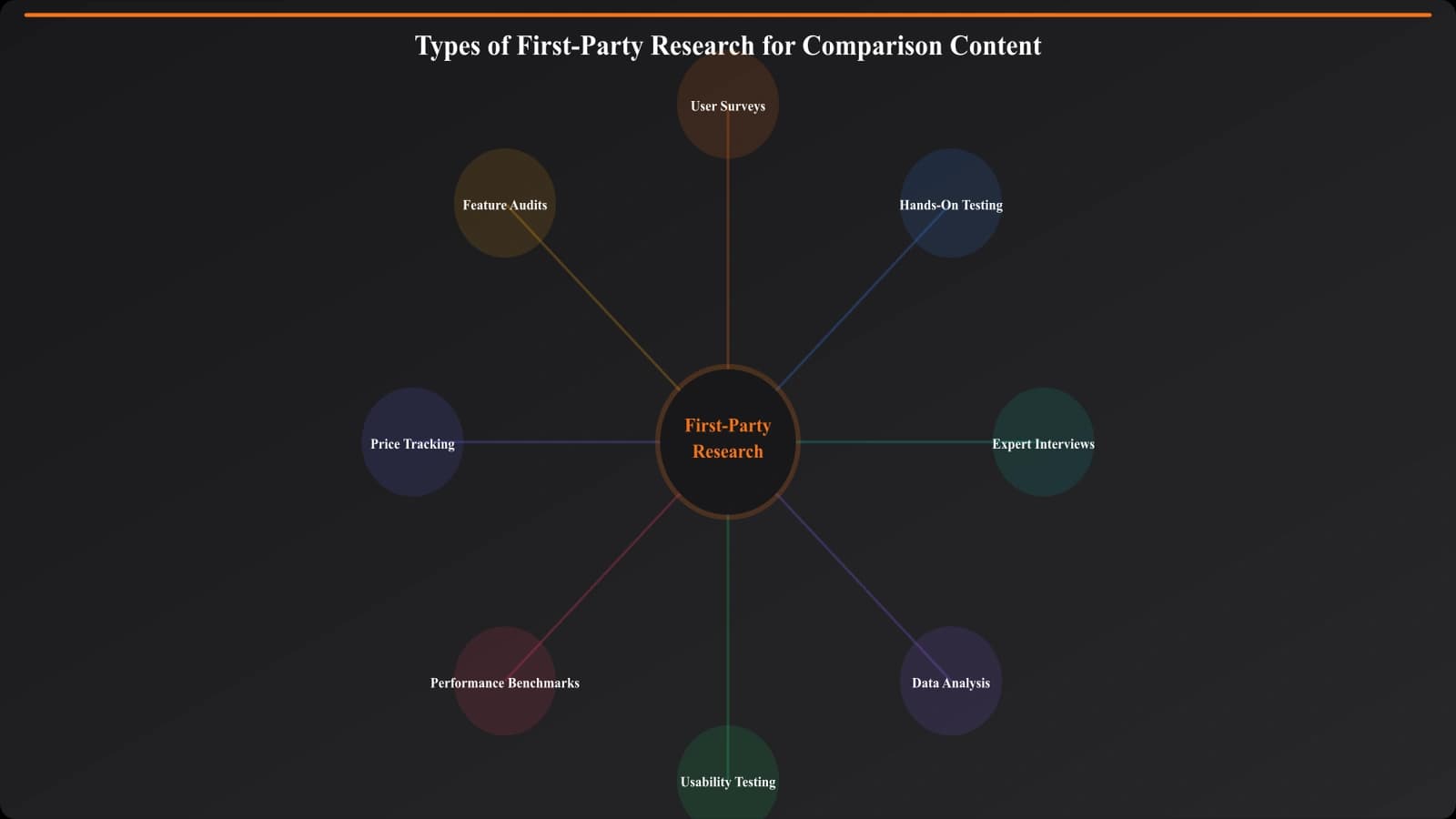
Survey-Based Research
Original surveys create unique data about user experiences and preferences.
Survey Design Principles
Effective surveys for comparison content follow specific design principles:
- Specific focus: Target questions that inform buying decisions
- User experience focus: Ask about real-world usage, not hypothetical preferences
- Quantifiable responses: Enable statistical analysis with structured answers
- Open-ended components: Capture insights beyond predetermined options
- Sample qualification: Ensure respondents actually use the products
- Comparative framing: Ask about comparisons when respondents have multi-product experience
Effective survey questions for comparisons:
• “Which features do you use most frequently?” (reveals core vs peripheral features)
• “What frustrated you most in the first month?” (surfaces onboarding issues)
• “Would you recommend this product? Why or why not?” (captures NPS-style sentiment)
• “What would make you switch to a competitor?” (identifies decision factors)
• “How does this compare to products you've used previously?” (direct comparison)
Survey design directly affects data quality. Invest in thoughtful question design before distributing.
Distribution and Sample
Reaching qualified respondents is often the hardest part:
- Your audience: Survey existing readers, newsletter subscribers, or community members
- Social distribution: LinkedIn groups, Reddit communities, Twitter polls
- Panel services: Paid survey panels (Prolific, UserTesting) for broader reach
- Product communities: User forums and communities for specific products
- Partnership distribution: Partner with industry publications for co-branded research
Sample size affects credibility. Document your sample size and acknowledge limitations from smaller samples.
Hands-On Testing
Direct product testing generates observations unavailable from public sources.
Testing Methodology
Structured testing ensures consistent, comparable evaluation:
- Standardized tasks: Complete the same workflow in each product
- Measurable metrics: Time to completion, error rates, steps required
- Multiple testers: Reduce individual bias through multiple evaluators
- Realistic scenarios: Test workflows users actually perform
- Edge cases: Test unusual situations that reveal product limitations
- Documentation: Record observations systematically for reproducibility
Testing generates unique insights about actual user experience that feature lists can't capture.
What to Test
Focus testing on areas where public information is insufficient:
High-value testing focus areas:
• Onboarding experience: How long to get started? What help is available?
• Core workflow efficiency: How many steps for primary tasks?
• Integration quality: Do integrations actually work as advertised?
• Performance under load: How does it handle larger datasets?
• Support responsiveness: How quickly do support requests get resolved?
• Mobile experience: Does the mobile app match desktop capability?
Testing reveals gaps between marketing claims and actual experience that users need to understand.
Proprietary Data Analysis
Original analysis of available data can surface unique insights.
Public Data, Original Analysis
Public data sources can yield unique insights through original analysis:
- Review sentiment analysis: Analyze patterns across thousands of reviews
- Pricing trend analysis: Track pricing changes over time across competitors
- Feature evolution tracking: Document how products evolve feature sets
- Market share estimation: Analyze job postings, social mentions, or other proxies
- Competitive positioning: Map products on relevant dimensions
The same public data everyone has access to becomes unique content through novel analysis approaches.
Proprietary Data Sources
Some data sources are unique to your operation:
Proprietary data sources:
• Your analytics: What do your users search for, click on, engage with?
• Support inquiries: What questions do users ask about products?
• User feedback: What do users tell you about their experiences?
• Conversion data: Which products do users actually choose?
• Return/satisfaction data: How satisfied are users with recommendations?
Aggregated and anonymized, this proprietary data creates insights no competitor can replicate.
Create Research-Backed Comparisons
Generate listicles structured to integrate and present original research effectively.
Try for Free
Integrating Research into Content
Research only creates value when effectively integrated into comparison content.
Presentation Approaches
Present research findings to maximize impact:
- Lead with findings: Put unique insights prominently rather than buried
- Visualize data: Charts and graphics make data digestible
- Contextualize numbers: Explain what statistics mean for users
- Compare to expectations: Highlight surprising findings
- Link to methodology: Show how you arrived at findings
Research findings should enhance rather than replace practical recommendations.
Building Credibility
Establish research credibility through transparency:
- Sample disclosure: Report sample sizes and composition
- Methodology documentation: Explain how research was conducted
- Limitation acknowledgment: Note what the research can and cannot show
- Data availability: Consider making raw data available
- Replication potential: Document methods well enough for reproduction
Credible research becomes a citation-worthy asset that attracts backlinks and reinforces authority.
Research ROI Considerations
Balance research investment against expected returns.
Investment Levels
Match research investment to content importance:
- Light research: Informal testing, small surveys for supporting content
- Medium research: Structured testing, meaningful survey samples for key comparisons
- Heavy research: Comprehensive studies for flagship content and authority building
Not every comparison needs extensive original research. Focus deep research on high-value content while using lighter approaches for supporting pages.
Research Reuse
Maximize research ROI through strategic reuse:
Research reuse approaches:
• Use survey data across multiple comparison articles
• Create standalone research reports for link building
• Update comparisons with new data from ongoing research
• Publish partial findings as social content
• Pitch unique findings to journalists for coverage
One research project can fuel content across multiple pages and channels when planned strategically.
Conclusion: Research as Moat
In saturated comparison markets, first-party research creates sustainable differentiation. Competitors can copy your format, match your word count, and target your keywords—but they cannot replicate your original data. Research becomes a moat that protects content value over time.
Start with approaches matching your resources. Small surveys, basic testing, and simple analysis build research capability. Expand investment as content proves valuable. Over time, accumulated research creates an increasingly defensible content asset.
The future of comparison content belongs to publishers who generate unique insights rather than just aggregating public information. First-party research is how you get there.
For methodology presentation, see Evaluation Criteria Transparency. For bias prevention, see Bias Prevention.

Product Manager at BestPage. Pioneer in AEO research since 2024, exploring the convergence of SEO and GEO (Generative Engine Optimization). Led multiple AI-powered content optimization projects that achieved 300%+ citation increases in ChatGPT and Perplexity.