
“Best project management software” rankings are everywhere. What differentiates valuable rankings from arbitrary lists? Methodology. When users understand how rankings were determined—what criteria were evaluated, how data was collected, who conducted the evaluation—they can trust the results. When methodology is hidden, users must take rankings on faith.
Google's quality raters explicitly evaluate whether content demonstrates expertise and trustworthiness. For comparison content, transparent methodology is a primary signal of both. Hiding how rankings work suggests either incompetence (no methodology exists) or bias (methodology would reveal conflicts). Neither interpretation helps rankings.
This guide covers how to build and present evaluation methodology that serves both users and search engines. We'll cover what criteria to define, how to present methodology accessibly, where to place methodology content, and how to maintain methodology over time. The goal is transparency that builds genuine trust—not theater that appears transparent while obscuring actual methods.
Effective methodology disclosure requires balancing comprehensiveness with accessibility. Users need enough detail to evaluate your approach but not so much that the methodology obscures the actual recommendations. We'll explore that balance throughout this guide.
Defining Evaluation Criteria
Start with clear, specific criteria that can be consistently applied.
Types of Evaluation Criteria
Comparison criteria typically fall into categories:
- Feature criteria: Does the product have specific capabilities?
- Performance criteria: How well does it perform on measurable dimensions?
- Usability criteria: How easy is it to learn and use?
- Value criteria: What's the price-to-capability ratio?
- Support criteria: What help is available when needed?
- Reliability criteria: How dependable is the product over time?
Define specific criteria within each category relevant to your comparison. “Usability” is too vague; “time to complete core workflow” is measurable.
Example criteria set for project management tools:
• Task management: Subtasks, dependencies, recurring tasks, templates
• Collaboration: Real-time editing, comments, @mentions, guest access
• Reporting: Built-in reports, custom dashboards, export options
• Integrations: Native integrations, API quality, Zapier support
• Mobile experience: App availability, feature parity, offline access
• Pricing: Per-user cost, feature tiers, enterprise options
Specific criteria enable consistent evaluation across products and make your methodology verifiable.
Criteria Weighting
Not all criteria matter equally. Define how different factors contribute to overall ranking:
- Which criteria are must-haves versus nice-to-haves?
- How are criteria weighted in overall scoring?
- Are there category-specific weights (e.g., different weights for enterprise vs SMB)?
- How are trade-offs resolved when products excel in different areas?
Transparent weighting shows users how you balance competing factors and allows them to adjust recommendations based on their own priorities.
Data Collection Methods
Explain how you gather information used in evaluations.
Data Collection Approaches
Different data sources provide different types of insight. Document which you use:
- Hands-on testing: Direct product use by your team
- User surveys: Input from actual product users
- Expert interviews: Insights from industry specialists
- Public data: Pricing, feature lists, documentation
- Third-party reviews: Aggregated ratings from other platforms
- Vendor-provided: Information supplied by product companies
Each source has strengths and limitations. Disclose which sources inform which parts of your evaluation.
Source Quality Considerations
Address how you evaluate source quality:
Source quality factors:
• Recency: When was the information gathered?
• Independence: Are sources independent from vendors?
• Verification: How do you verify claimed information?
• Sample size: For user data, how many users contribute?
• Expertise: What qualifications do evaluators have?
Users can better trust your conclusions when they understand the quality of underlying data.
| Data Source | Strengths | Limitations | Best For |
|---|---|---|---|
| Hands-on testing | Direct experience, current data | Limited scale, single perspective | UX evaluation, feature verification |
| User surveys | Real-world experience at scale | Selection bias, varying expertise | Long-term satisfaction, reliability |
| Expert interviews | Deep domain knowledge | Limited sample, potential bias | Complex technical evaluation |
| Public data | Objective, verifiable | May be outdated, incomplete | Pricing, basic features |
| Third-party reviews | Aggregated perspectives | Quality varies, gaming possible | Sentiment, broad patterns |
| Vendor-provided | Detailed, current | Self-serving, verification needed | Feature specifications |
Presenting Methodology Clearly
Methodology disclosure must be accessible to non-expert users.
Methodology Placement
Options for where to present methodology:
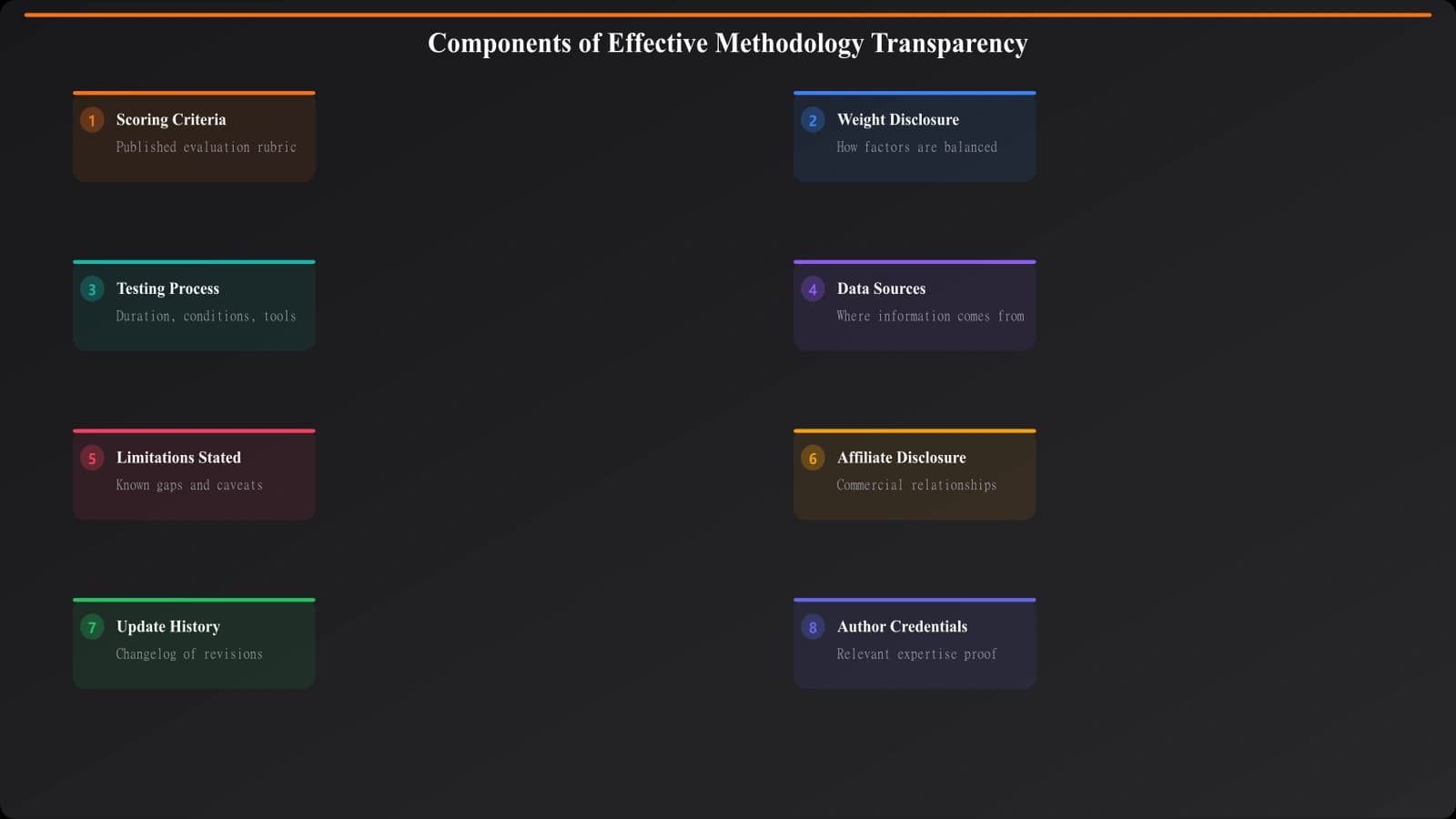
- Dedicated methodology page: Comprehensive documentation linked from all comparisons
- Inline summary: Brief methodology overview within each comparison
- Expandable sections: Detailed methodology available on-demand
- Hybrid approach: Summary inline with link to full documentation
The hybrid approach often works best: users get context without leaving the comparison, with detailed documentation available for those who want it.
Accessibility for Non-Experts
Methodology disclosure should be understandable to target users:
Accessibility principles:
• Use plain language, not jargon
• Explain why each criterion matters
• Provide examples of how criteria are applied
• Offer summary versions for quick scanning
• Make detailed versions available without requiring them
The goal is users understanding your approach well enough to evaluate whether your methodology aligns with their decision criteria.
Build Transparent Comparison Content
Generate listicles with clear methodology that builds E-E-A-T signals.
Try for Free
E-E-A-T Signal Value
Transparent methodology directly supports E-E-A-T evaluation.
Demonstrating Expertise
Methodology sections demonstrate expertise through:
- Domain knowledge evident in criteria selection
- Understanding of what users actually need to evaluate
- Technical depth in evaluation approaches
- Awareness of edge cases and limitations
- Evolution of methodology based on learning
Quality raters can observe expertise through the sophistication and relevance of your evaluation approach.
Building Trust
Transparency builds trust by:
- Showing you have nothing to hide
- Enabling users to verify your claims
- Creating accountability for ranking decisions
- Distinguishing you from hidden-methodology competitors
- Demonstrating respect for users' intelligence
Trust signals compound over time as users observe that your disclosed methodology produces reliable recommendations.
Methodology Maintenance
Methodology evolves as products and markets change.
Versioning Methodology
Track methodology changes over time. Document when criteria change and why, what prompted the evolution, and how changes affect historical comparisons. Methodology versioning shows that your approach improves based on learning rather than arbitrary changes.
Changelog for Methodology
Consider maintaining a public methodology changelog that documents major methodology updates, criteria additions or changes, weighting adjustments, and process improvements. This meta-transparency reinforces your commitment to continuous improvement.
Conclusion: Transparency as Differentiator
In a landscape of opaque “best of” lists, transparent methodology differentiates valuable comparison content. Users seeking reliable guidance gravitate toward content that shows its work. Search engines seeking to surface trustworthy content reward demonstrated expertise and transparency.
Building and presenting clear evaluation criteria requires investment, but the returns compound. Trust built through transparency creates sustainable competitive advantage. Users who understand your methodology become repeat visitors and recommenders.
Start with clear criteria. Document how you gather and evaluate data. Present methodology accessibly. Maintain and evolve your approach over time. The result is comparison content that genuinely serves users—and earns the rankings that service deserves.
For bias prevention approaches, see Bias Prevention. For first-party research methods, see First-Party Research.

Product Manager at BestPage. Pioneer in AEO research since 2024, exploring the convergence of SEO and GEO (Generative Engine Optimization). Led multiple AI-powered content optimization projects that achieved 300%+ citation increases in ChatGPT and Perplexity.