
Creating a comparison page without analyzing competitors is like entering a race without knowing the course. You might produce good content, but you won't know whether it's better than what already exists—or why it should rank above established results.
Competitor analysis for comparison content differs from general SEO competitive research. You're not just measuring authority metrics; you're evaluating content quality, comprehensiveness, methodology rigor, and trust signals. The goal is finding exploitable gaps that your content can fill better.
This guide covers systematic competitor analysis for listicle and comparison content: what to analyze, how to identify gaps, and how to translate findings into content strategy.
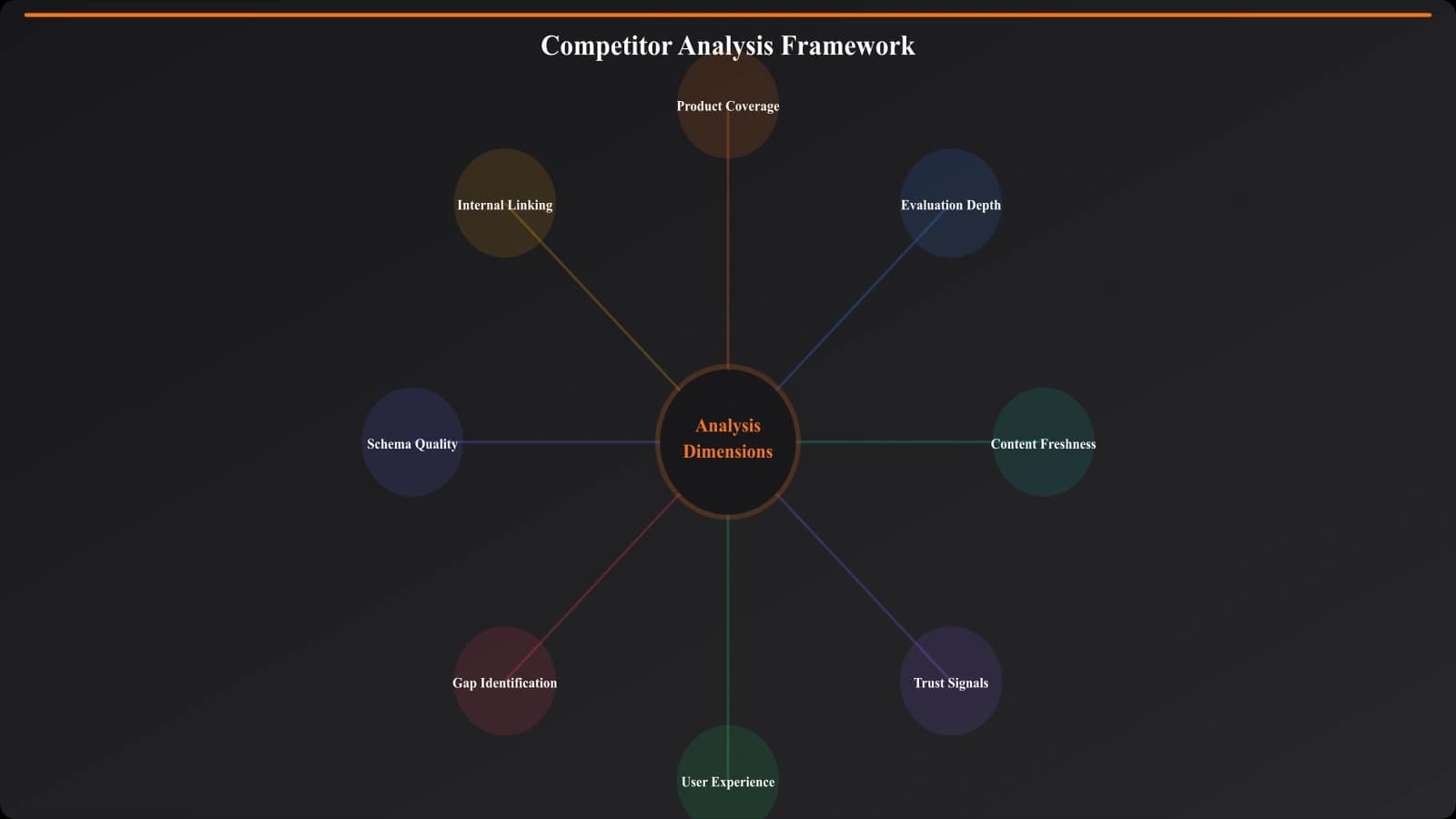
Collecting and Organizing Competitors
Start by identifying which content actually ranks for your target query. The current SERP is your competitive landscape.
SERP Analysis
Search your target query and document the top 10 organic results. Note the content type for each: is it a dedicated comparison page, a product roundup embedded in a larger article, a buying guide with recommendations, or user-generated content like Reddit threads?
Pay attention to SERP features present. Are there Featured Snippets from comparison content? People Also Ask questions? Image packs? These indicate what Google values for this query and suggest content opportunities.
Building a Competitor Inventory
For each ranking competitor, document key characteristics:
- Publication type: Major media, affiliate site, brand blog, community forum
- Content format: Listicle structure, detailed reviews, brief recommendations
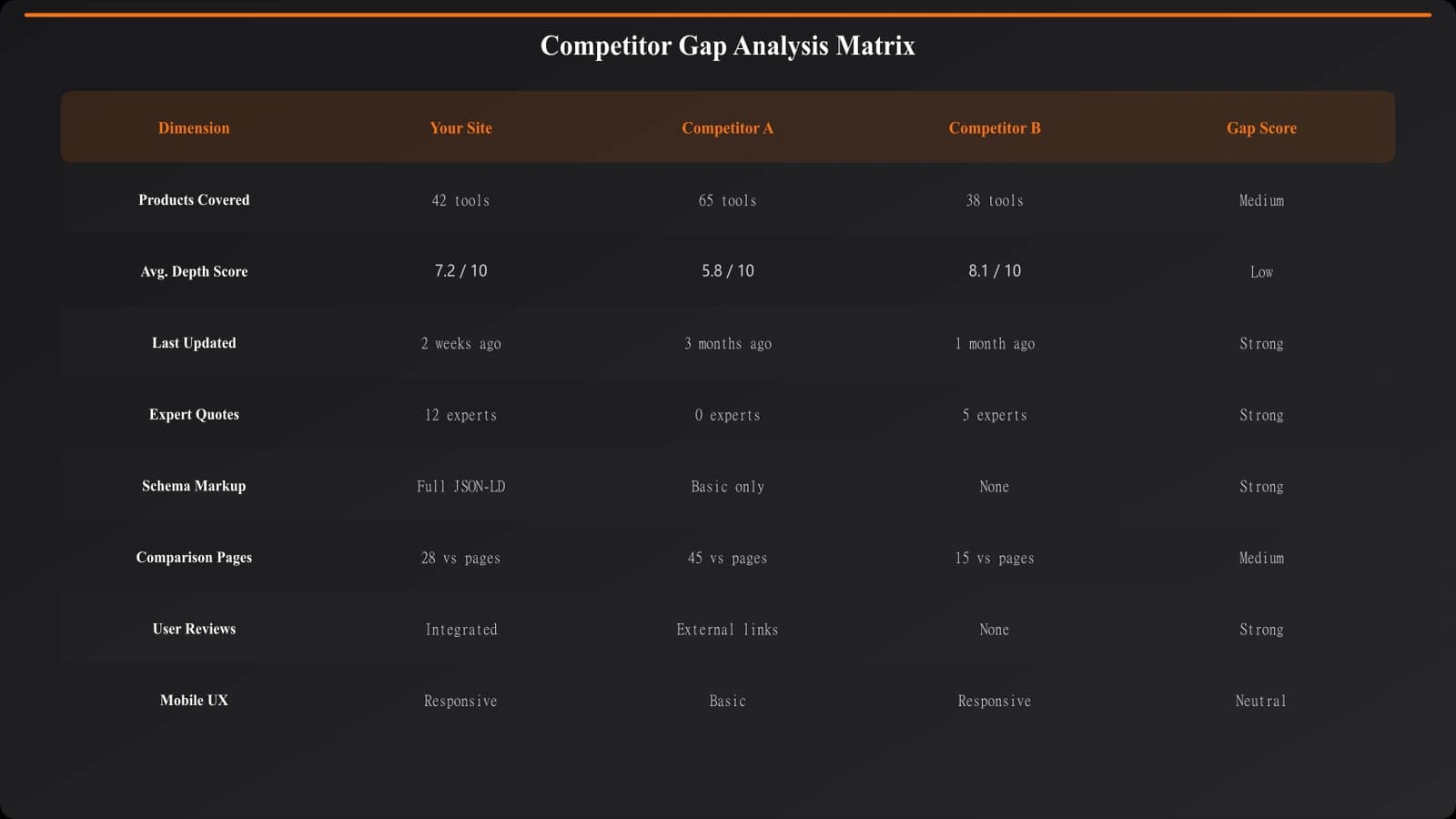
- Products covered: How many items? Which specific products?
- Publish date: When originally published? Last updated?
- Author credentials: Named expert, staff writer, no attribution?
- Word count: Rough estimate of content depth
This inventory becomes your reference throughout content creation. You'll return to it repeatedly when making strategic decisions.
Identifying Content Gaps
With competitors documented, systematically analyze for exploitable weaknesses.
Product Coverage Gaps
Compare which products each competitor covers. You'll often find patterns: everyone mentions the top 3-4 products, but coverage of #5-10 varies. Some competitors may entirely miss newer products that have launched since their publish date.
Example gap analysis: For “best project management tools,” top 5 competitors all covered Asana, Monday, Trello, and Notion. But only 2/5 mentioned Linear (growing fast in engineering teams), and none covered Height (launched 2024, strong reviews). Including these emerging tools provides differentiation.
Product gaps are especially valuable when the missing products serve specific audience segments. If no competitor addresses tools for nonprofit organizations, and there's search volume for that segment, you've found an opportunity.
Depth and Evaluation Gaps
Analyze how thoroughly competitors evaluate each product. Common depth gaps include surface-level descriptions (feature lists without evaluation), missing pricing analysis (especially for complex pricing tiers), no methodology disclosure (rankings without explanation), and absent use case guidance (who is each tool best for?).
Example depth gap: Competitor A's comparison lists 15 email marketing tools with 2-3 sentences each. Competitor B covers only 8 tools but with detailed pros/cons, pricing tables, and integration analysis. Neither includes hands-on testing evidence. You could differentiate by covering 10 tools with testing-backed evaluations.
Freshness and Accuracy Gaps
Dated content is vulnerable. Check for outdated pricing (SaaS tools change prices frequently), discontinued products still listed, features described that have since changed, and missing recently-launched products.
If the top-ranking competitor was last updated 18 months ago and the category has changed significantly, freshness becomes your primary differentiation angle.
Trust and Credibility Gaps
Beyond content comprehensiveness, analyze credibility signals—or their absence.
Expertise and Experience Signals
Does the content demonstrate actual product use? Many comparison pages aggregate specifications without firsthand experience. Look for original screenshots (vs. marketing images), specific workflow observations, non-obvious feature insights, and documented testing methodology.
| Trust Signal | Present In Competitors? | Gap Opportunity |
|---|---|---|
| Named author with credentials | 3 of 5 competitors | Medium—match or exceed |
| Original product screenshots | 1 of 5 competitors | High—differentiate with visual proof |
| Testing methodology explained | 0 of 5 competitors | Very high—unique credibility advantage |
| Update history documented | 2 of 5 competitors | Medium—signal ongoing maintenance |
| Affiliate disclosure prominent | 4 of 5 competitors (buried) | Low—but transparent placement builds trust |
Bias and Objectivity Signals
Examine competitors for bias indicators: do they mention limitations of recommended products? Is the #1 pick suspiciously aligned with highest affiliate payout? Do they recommend alternatives for different use cases, or push one product for everyone?
Example bias pattern: Competitor site ranks Product X #1 across eight different “best tools for [use case]” articles. Either Product X is genuinely best for every use case (unlikely), or affiliate incentives are influencing rankings. Your balanced, use-case-specific recommendations will appear more credible.
Outrank Competitors with Better Comparisons
Generate listicles designed to fill gaps your competitors miss—comprehensive, credible, fresh.
Try for Free
Translating Gaps to Content Strategy
Analysis is only valuable if it shapes your content. Translate identified gaps into strategic decisions.
Prioritizing Gap Opportunities
Not all gaps are equally exploitable. Prioritize based on gap significance (does this gap affect user decisions?), differentiation potential (can you credibly fill this gap better than others?), effort required (what resources does filling this gap require?), and competitive moat (will competitors easily copy your improvement?).
Focus on gaps where you have genuine advantages. If you have product testing capability competitors lack, lean into methodology and hands-on evaluation. If you have industry expertise, emphasize nuanced use-case recommendations.
Building a Gap-Informed Content Brief
Your content brief should explicitly address identified gaps:
- Product list: Include products competitors miss, especially newer entrants
- Depth targets: For each product, exceed competitor evaluation depth
- Unique angles: Address use cases no competitor covers well
- Trust elements: Include signals competitors lack (methodology, screenshots, credentials)
- Freshness signals: Plan for update cadence that maintains advantage
Monitoring Competitive Evolution
Competitors will update their content. Top-ranking positions attract attention and inspire improvements. Monitor key competitors monthly for significant updates. If they close gaps you exploited, you'll need new differentiation angles.
Systematic Competitive Advantage
Competitor analysis transforms content creation from guesswork to strategy. Instead of hoping your comparison is good enough, you know exactly where competitors fall short and how your content addresses those weaknesses.
The analysis process—inventorying competitors, identifying gaps, prioritizing opportunities, translating to strategy—becomes a repeatable methodology. Each new comparison builds on refined competitive instincts and proven gap-identification patterns.
Most importantly, competitor analysis prevents the common mistake of creating content that's slightly better than nothing but not better than what already ranks. Understanding the competitive landscape ensures your content investment goes toward genuine differentiation.
For the evaluation framework to apply once you've identified gaps, see Tool Evaluation Framework. For data verification to support your competitive claims, see Data Sourcing Best Practices.

Product Manager at BestPage. Pioneer in AEO research since 2024, exploring the convergence of SEO and GEO (Generative Engine Optimization). Led multiple AI-powered content optimization projects that achieved 300%+ citation increases in ChatGPT and Perplexity.