
Every comparison table you publish contains claims. Product X has feature Y. Tool A costs $Z per month. Service B has 4.5 stars from 1,000 reviews. Each claim is either verifiable or not, accurate or not, current or not. Your credibility depends on getting these details right.
Inaccurate data creates multiple problems. Readers who discover errors lose trust in your entire evaluation. Vendors whose products are misrepresented will contact you—either requesting corrections or, worse, publicly highlighting your mistakes. And AI systems increasingly fact-check content, potentially affecting how your pages are cited or surfaced.
This guide covers the data sourcing workflow: where to find reliable information, how to verify competing claims, what to do when sources conflict, and how to document your sources for transparency and maintenance.
Source Hierarchy: Where to Find Data
Not all sources are equally reliable. Establish a hierarchy that prioritizes authoritative information over convenient information.
| Source Tier | Examples | Reliability | Best For |
|---|---|---|---|
| Primary (official) | Product website, pricing page, official documentation | High for current state; may be marketing-inflected | Features, pricing, specifications |
| Primary (firsthand) | Your own testing, direct product access | High for experience; limited scope | Usability, performance, workflow evaluation |
| Secondary (verified) | Industry reports, research publications | Medium-high; verify methodology | Market data, trends, benchmarks |
| Secondary (editorial) | Other reviews, comparison sites | Variable; verify against primary sources | Perspective, starting point only |
| Tertiary (aggregated) | Wikipedia, general directories | Low; always verify elsewhere | Background context only |
The hierarchy isn't absolute. Official product pages may lag behind actual product changes. Third-party testing may reveal things vendors don't disclose. Use the hierarchy as guidance, not rigid rule.
Working with Primary Sources
Primary sources—official product information—should anchor your data. But navigate them carefully. Vendor pricing pages reflect current pricing; archived versions may be needed for historical accuracy. Feature pages often highlight strengths while downplaying limitations. Marketing language may imply capabilities that don't exist (or require enterprise tiers).
When extracting data from primary sources:
- Document the exact URL where you found the information
- Record the date you accessed the page
- Screenshot or archive important pages (they change)
- Note which pricing tier or plan the information applies to
- Flag marketing language that requires verification
Verification with Secondary Sources
Cross-reference primary source claims when possible. Third-party testing, user reviews, and independent evaluations can confirm or contradict vendor claims. When sources agree, confidence increases. When they conflict, investigation is needed.
Quality secondary sources for product data include G2 and Capterra (user reviews with specific criteria ratings), industry analyst reports (Gartner, Forrester for enterprise tech), benchmark publications (for performance claims), and established review publications with transparent methodology.
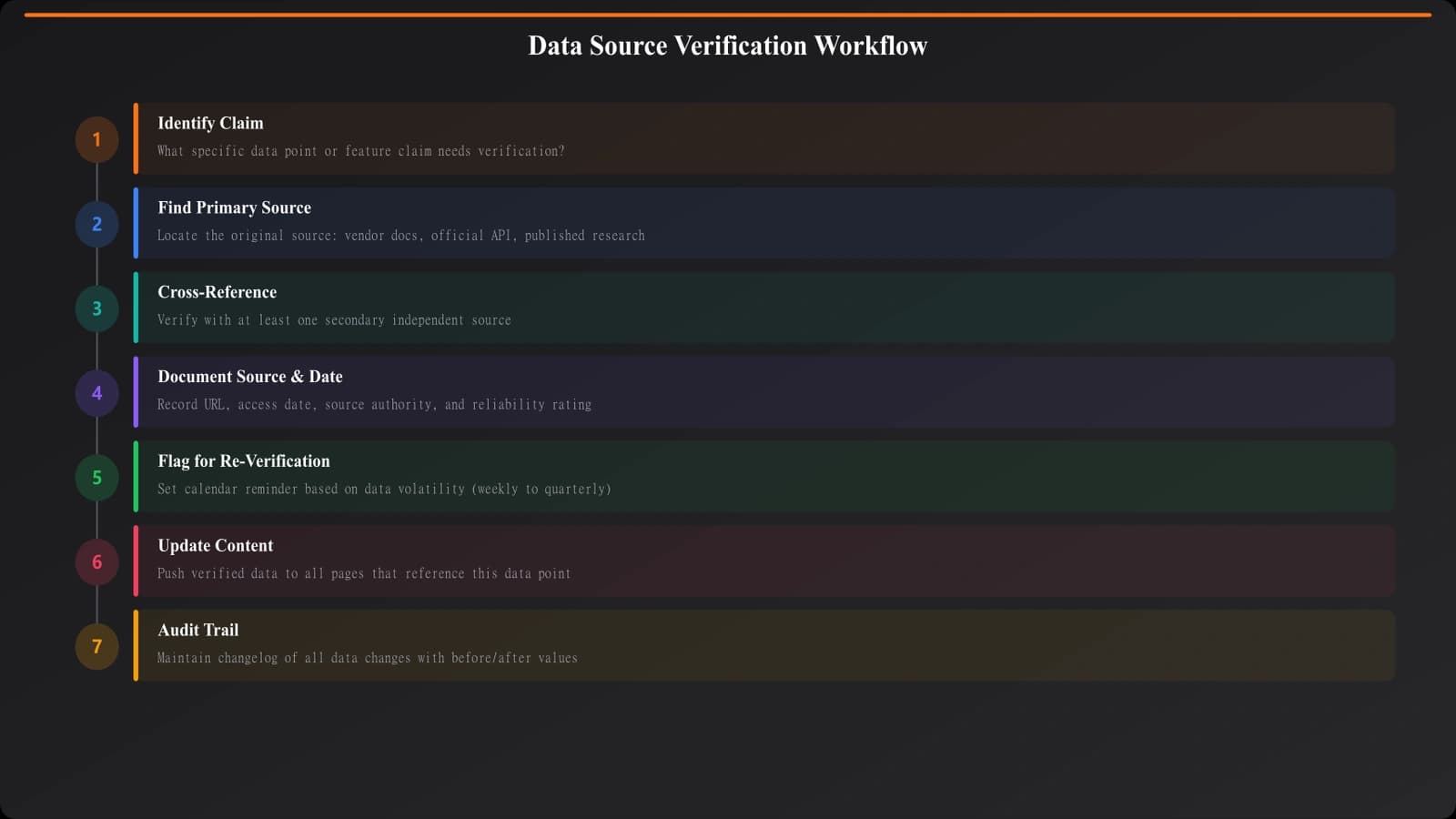
Verification Workflow
Systematic verification catches errors before publication. Build verification into your content creation process.
Claim Extraction and Categorization
Before verifying, identify what needs verification. Review your draft content and extract every factual claim. Categorize by type:
- Specifications: Features, limits, technical capabilities
- Pricing: Costs, tier structures, hidden fees
- Performance: Speed, uptime, reliability claims
- Ratings: Review scores, award claims, certifications
- Comparisons: “More than X” or “only one to offer Y”
Different claim types require different verification approaches. Pricing can be checked directly on vendor sites. Performance claims may require third-party benchmarks. Comparison claims need verification of both the claim and the competitive context.
Per-Claim Verification Checklist
For each significant claim:
- Locate primary source: Find the authoritative origin of this information
- Confirm currency: Is this information current? Check page dates, changelog
- Cross-reference: Does at least one secondary source corroborate?
- Check scope: Does this apply to all plans/versions, or specific tiers?
- Document source: Record URL, date, and any relevant notes
- Flag uncertainty: If verification incomplete, mark for follow-up
Handling Conflicting Information
Sources often disagree. Pricing pages may show different numbers than checkout flows. Marketing pages may claim features documentation says are “coming soon.” Reviews may describe experiences contradicting official specifications.
When conflicts arise, prefer recency (newer information usually more accurate), specificity (detailed sources over general claims), primary over secondary (vendors know their products), and multiple corroboration over single source.
When resolution is impossible, acknowledge the uncertainty. “Pricing reported as $X on the main pricing page, though some users report different rates during checkout” is more honest than stating incorrect certainty.
Source Documentation
Proper source documentation serves multiple purposes: it enables updates, defends against challenges, and signals credibility to readers.
Internal Source Tracking
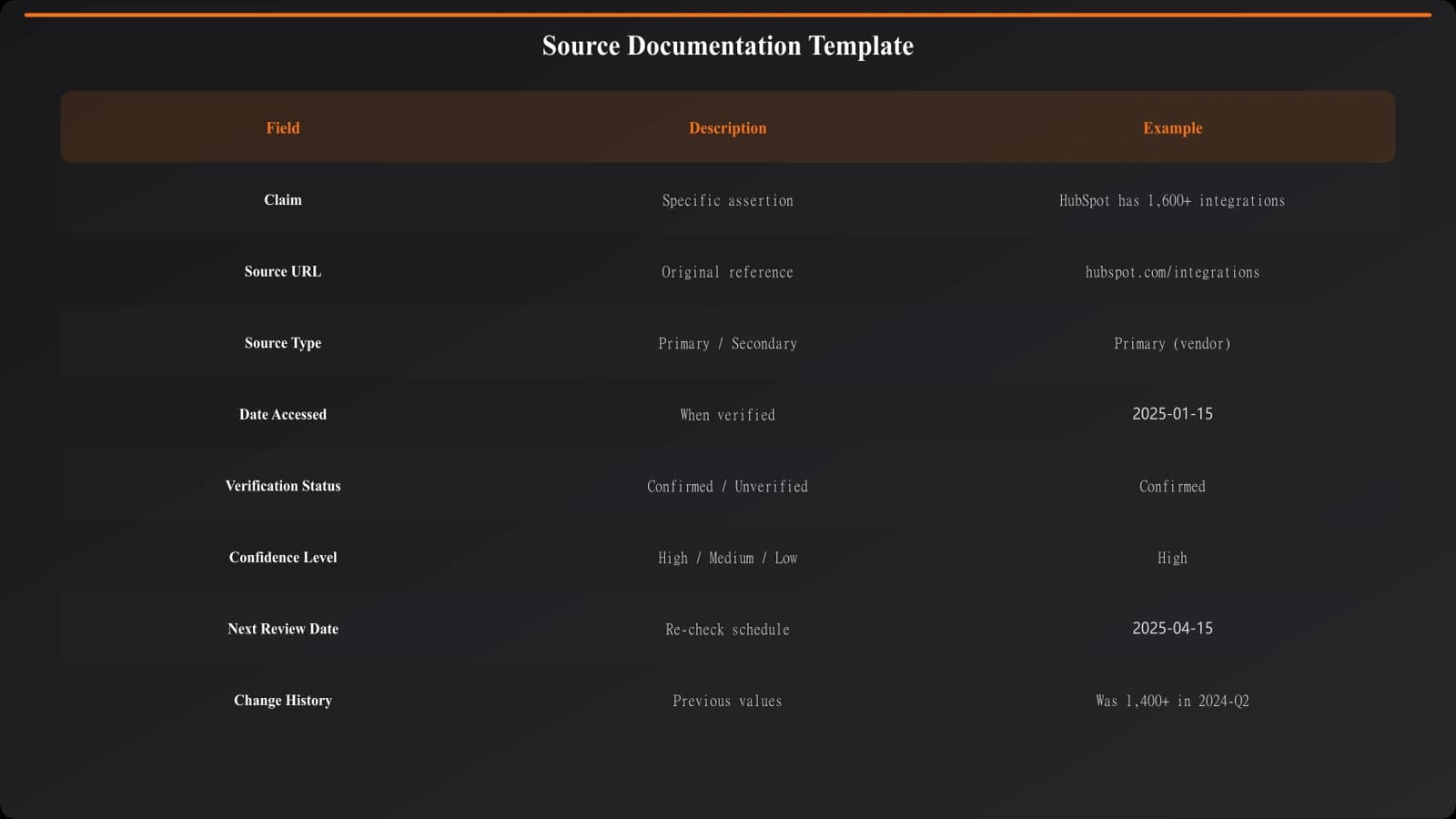
Maintain a source document for each comparison you publish. This internal record should include every significant claim in your published content, the primary source URL for each claim, date accessed (critical for volatile data like pricing), any secondary sources consulted, and notes on verification challenges or uncertainties.
This documentation enables efficient updates. When refreshing content, you can quickly re-check each source rather than re-researching from scratch. It also provides defense if vendors challenge your claims—you can point to exactly where you found information.
Reader-Facing Source Transparency
Decide how much source information to expose publicly. Options range from no visible sourcing (common but increasingly criticized) to inline citations (academic style, can be cluttered) to linked source section (organized references at end) to methodology page linking (explains approach without cluttering content).
For comparison content, a methodology note explaining data sources generally builds trust without cluttering individual claims. “Pricing and feature data sourced from official product pages as of [date]. See our methodology for details.”
Setting Update Triggers
Source documentation should include update triggers—conditions that require re-verification:
- Time-based: Re-verify pricing quarterly; features every 6 months
- Event-based: Product launches, major updates, pricing changes
- Feedback-based: User reports of inaccuracy trigger verification
- Competitive: When competitors update similar content
Generate Accurate, Well-Sourced Comparisons
Create listicles with verified data and proper source documentation built in.
Try for Free
Special Sourcing Challenges
Some data types present particular verification challenges.
Complex Pricing Verification
SaaS pricing is notoriously difficult to verify accurately. Published pricing may not reflect actual costs. Enterprise tiers often require “contact sales.” Usage-based pricing defies simple comparison. Promotional rates differ from standard rates.
Best practices for pricing data include noting the specific tier or plan referenced, indicating whether prices are monthly or annual billing, flagging “starting at” prices that may scale, documenting any required add-ons or hidden costs, and stating the date of pricing verification prominently.
Review and Rating Aggregation
When citing review scores or ratings, precision matters. “4.5 stars on G2” requires noting when you checked (scores change) and how many reviews (20 reviews vs 2,000 matters). Quote the specific rating type if platforms have multiple (overall, ease of use, support quality).
Aggregate ratings from multiple platforms cautiously. Different platforms attract different user populations. Averaging G2 (enterprise-heavy) with Capterra (SMB-heavy) may obscure meaningful differences.
Performance and Benchmark Claims
Vendors love performance claims, but benchmarks are easily manipulated. “Fastest in category” claims require verification of the benchmark methodology, whether it represents real-world usage, and recency (products improve; competitors catch up).
Prefer citing independent benchmarks from recognized testing organizations over vendor-provided performance claims. If using vendor benchmarks, note the source clearly.
Building a Verification Culture
Data accuracy isn't a one-time task—it's an ongoing practice. Build verification into your content creation workflow rather than treating it as an optional final step. Train contributors on source hierarchy and verification standards. Create templates that prompt for source documentation.
The investment pays off in credibility, reduced correction requests, and content that readers trust. In a landscape of quickly-produced, poorly-verified comparison content, accuracy becomes a competitive advantage.
For the complete evaluation methodology that data sourcing supports, see Tool Evaluation Framework. For hands-on verification through product testing, see Product Testing Methodology.

Product Manager at BestPage. Pioneer in AEO research since 2024, exploring the convergence of SEO and GEO (Generative Engine Optimization). Led multiple AI-powered content optimization projects that achieved 300%+ citation increases in ChatGPT and Perplexity.