
Keyword research from scratch is exhausting. You generate thousands of ideas, filter for comparison intent, check volumes and difficulty, assess SERPs—and at the end you're still not sure if you've found the best opportunities.
There's a faster path: reverse-engineering your competitors. Your category's successful sites have already identified and validated comparison opportunities through their content investments. By analyzing their keyword portfolios, you can find both proven opportunities (queries they rank for that you should target) and gaps (valuable queries they've missed that you can claim).
This guide walks through a systematic process for competitor gap analysis focused on listicle and comparison content. For the broader keyword framework, see our Keyword to Page Type Framework.
Identifying the Right Competitors to Analyze
Not all competitors matter equally for keyword gap analysis. Choose strategically.
Competitor Types for Analysis
- Direct category competitors: Sites in your exact space (similar products, similar audience)
- Content competitors: Sites that rank for queries you want, regardless of business model
- Adjacent category players: Sites in related categories that overlap with your topics
- Publishers and affiliates: Content sites monetizing your category
Selection Criteria
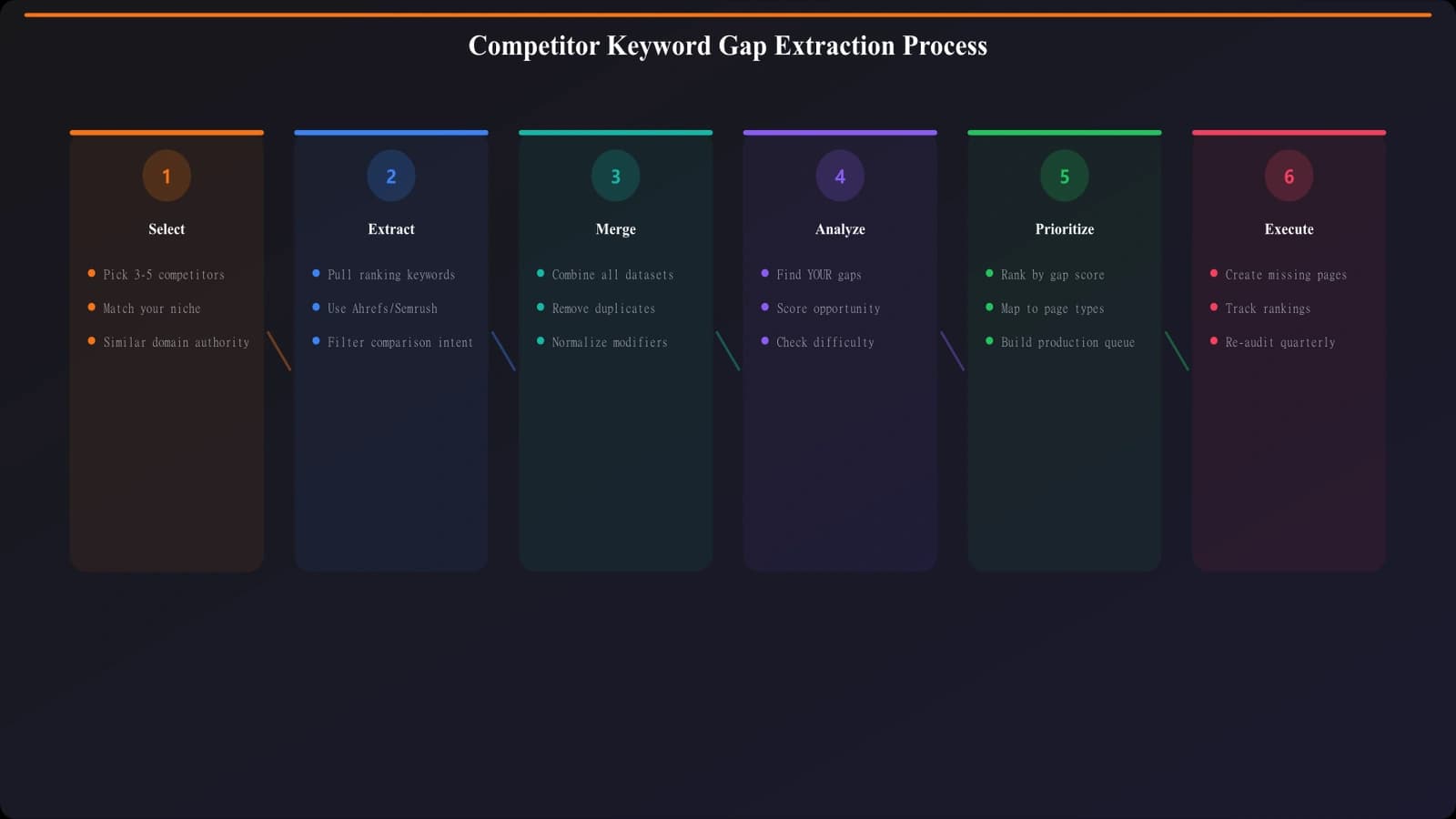
Choose 3-5 competitors that meet these criteria:
- Rank for comparison/listicle queries in your category
- Have meaningful organic traffic (validate with tools)
- Have been active for 2+ years (established keyword portfolios)
- Cover similar or broader topic scope than you
Extracting Competitor Keyword Data
Use SEO tools to pull comprehensive keyword data from competitors.
Data Extraction Process
- Pull ranking keywords: Export all keywords each competitor ranks for (positions 1-50)
- Filter for comparison intent: Include terms containing “best,” “top,” “vs,” “alternatives,” “compare,” “review”
- Include metrics: Search volume, keyword difficulty, current rank, ranking URL
- Merge datasets: Combine data from all competitors into single analysis
Tool Options
| Tool | Strengths | Best For |
|---|---|---|
| Ahrefs | Large keyword database, content gap feature | Comprehensive analysis |
| Semrush | Keyword gap tool, competitive positioning | Multi-competitor comparison |
| Moz | DA/PA metrics, SERP analysis | Authority assessment |
Running the Gap Analysis
With data extracted, identify the actual gaps.
Types of Gaps to Find
- Absolute gaps: Keywords competitors rank for that you don't target at all
- Performance gaps: Keywords where competitors outrank you significantly
- Coverage gaps: Topics competitors cover deeply that you touch lightly
- Format gaps: Query types competitors address with content you lack
Step-by-Step Analysis
- List all unique comparison keywords across competitor set
- Map your current rankings against each keyword
- Identify keywords where:
- 1+ competitors rank in top 20, you don't rank at all
- 1+ competitors rank in top 10, you rank 20+
- Multiple competitors cover the topic, you have nothing
- Score opportunities by volume, difficulty, and relevance
Creating a Gap Matrix
| Keyword | Volume | Comp A Rank | Comp B Rank | Your Rank | Gap Type |
|---|---|---|---|---|---|
| best crm for agencies | 720 | 3 | 7 | — | Absolute |
| hubspot alternatives | 4,400 | 5 | 12 | 34 | Performance |
| crm with email marketing | 390 | 2 | — | — | Absolute |
Fill Your Content Gaps
Generate comparison pages for keywords your competitors rank for—and ones they've missed.
Try for Free
Prioritizing Gap Opportunities
Not all gaps deserve content investment. Prioritize strategically.
Prioritization Factors
- Business value: Does this keyword align with your target customer?
- Traffic potential: Volume × realistic rank potential × CTR
- Ranking feasibility: Given your authority, can you compete?
- Content efficiency: How much effort to create quality content?
- Strategic fit: Does this fill a portfolio gap or extend a cluster?
Identifying Quick Wins
Quick wins share these characteristics:
- Competitors rank but with mediocre content
- No major authority sites in top 5
- You have relevant expertise or data
- The keyword fits your existing content structure
- You can produce quality content quickly
Strategic Plays
Some gaps require longer investment:
- High-volume keywords dominated by authority sites
- Topics requiring significant research or expertise building
- Category hubs that need spoke content first
- Queries where you need product development to compete
Finding Opportunities Competitors Missed
The most valuable gaps are often ones no competitor has targeted—truly uncontested opportunities.
Identifying Competitor Blind Spots
- New product entries: Products that launched after competitors built content
- Emerging use cases: New ways customers use the category
- Niche modifiers: Specific industries or requirements competitors ignored
- Question queries: “How to choose...” queries no one addresses well
- Comparison pairs: Product vs product combinations not covered
Validating Missed Opportunities
Just because competitors missed it doesn't mean it's valuable:
- Check search volume—does the query have traffic potential?
- Check SERP—what currently ranks? Is it low quality?
- Check intent—does this query actually need listicle/comparison content?
- Check feasibility—can you create authoritative content here?
Executing on Gap Opportunities
With priorities set, move to execution.
Content Planning
- Group related gaps: Cluster opportunities that can share research or structure
- Define content specs: For each target, outline format, depth, unique angle
- Identify differentiation: How will your content beat what's ranking?
- Set timeline: Quick wins first, strategic plays parallel
Beating Competitor Content
Don't just match—exceed:
- Depth: Cover more products, more criteria, more use cases
- Freshness: Include latest products and current pricing
- Expertise: Add insights competitors lack (your data, testing, experience)
- Structure: Better organization, faster answers, clearer comparisons
- Visuals: Original images, better tables, clearer comparisons
Ongoing Competitor Monitoring
Gap analysis isn't one-time—competitors evolve, and so should your monitoring.
Monitoring Schedule
- Monthly: Check for new competitor content in your category
- Quarterly: Full gap analysis refresh
- Event-driven: Re-analyze after competitor site updates or product launches
Tracking System
- Set alerts for new competitor pages (via Ahrefs/Semrush)
- Track competitor ranking changes for your target keywords
- Monitor new SERP entrants in your category
- Log your gap-filling progress and results
Building Competitive Advantage Through Gaps
Competitor gap analysis accelerates your content strategy by leveraging others' research and revealing opportunities they've missed.
Key takeaways:
- Choose competitors strategically: Include both aspirational and accessible targets
- Extract comprehensive data: All ranking keywords filtered for comparison intent
- Find multiple gap types: Absolute, performance, coverage, and format gaps
- Prioritize ruthlessly: Not all gaps deserve investment
- Look for blind spots: Opportunities competitors missed entirely
- Execute to win: Don't just match—beat competitor content
- Monitor continuously: Gaps evolve as competitors move
Start with one competitor. Pull their comparison keywords. Find 5 gaps you can fill. Execute. Then expand the analysis to additional competitors and more opportunities.
For the complete keyword strategy, see our Keyword to Page Type Framework. For long-tail opportunities specifically, explore our guide on long-tail comparison strategy.

Product Manager at BestPage. Pioneer in AEO research since 2024, exploring the convergence of SEO and GEO (Generative Engine Optimization). Led multiple AI-powered content optimization projects that achieved 300%+ citation increases in ChatGPT and Perplexity.