
The most competitive comparison keywords are fought over by Forbes, Wirecutter, G2, and every major player in the category. Breaking into “best project management software” requires years of authority building and often still fails. Meanwhile, “best project management for architecture firms” has a fraction of the competition and visitors who match that query are much more likely to convert.
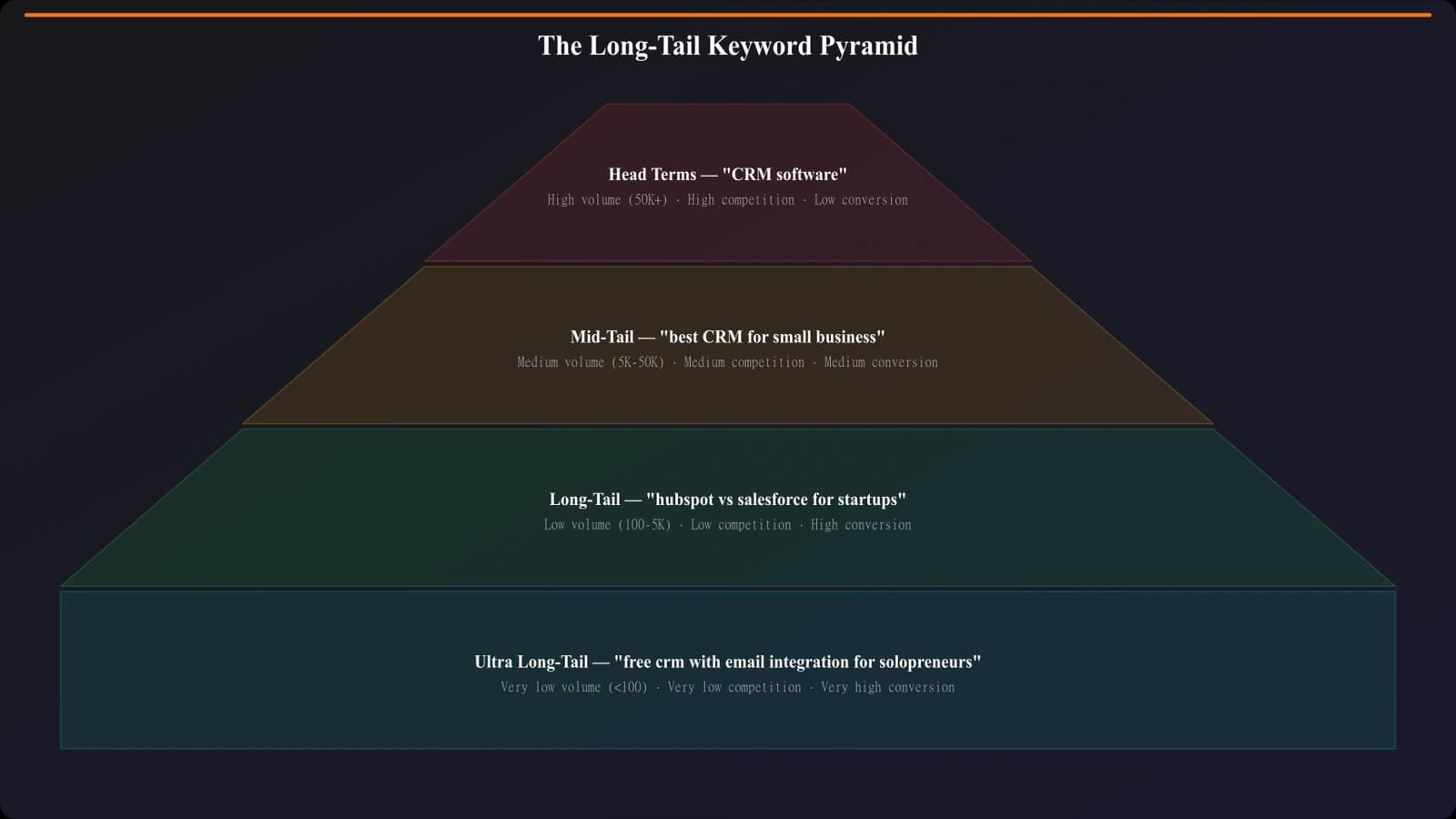
Long-tail comparison keywords are the underexploited opportunity in most content strategies. They're overlooked because individual query volumes seem small—maybe 100-500 searches per month. But aggregate hundreds of these, and you're building substantial traffic from highly qualified visitors.
This guide covers how to systematically find, prioritize, and execute on long-tail comparison opportunities. For the broader framework on keyword-to-content decisions, see our Keyword to Page Type Framework.
What Makes a Comparison Keyword “Long-Tail”
Long-tail comparison keywords share specific characteristics that make them valuable for content strategy.
Key Characteristics
- Specificity: Include modifiers that narrow the audience (industry, company size, use case)
- Lower volume: Typically 50-500 monthly searches (but highly qualified)
- Lower competition: Major publishers often don't target these specifically
- Higher intent: Searchers know exactly what they need
- Better conversion: Content can directly address specific requirements
Long-Tail Examples by Category
| Head Term | Long-Tail Variant | Modifier Type |
|---|---|---|
| Best CRM software | Best CRM for real estate agents | Industry |
| Project management tools | Project management for remote teams under 10 | Team size + work style |
| Email marketing platforms | Email marketing for Shopify stores | Integration/platform |
| Accounting software | Accounting software for freelance designers | Profession |
| Slack alternatives | Slack alternatives for HIPAA compliance | Requirement |
Finding Long-Tail Comparison Opportunities
Systematic discovery beats random keyword hunting. Here are the methods that surface valuable opportunities.
Modifier Expansion Method
Start with your head terms and systematically add modifiers:
- List your category head terms: “best CRM,” “project management tools,” etc.
- Build modifier lists:
- Industries: SaaS, healthcare, real estate, law firms, agencies...
- Company sizes: startups, small business, enterprise, solopreneurs...
- Use cases: sales, marketing, customer support, operations...
- Requirements: HIPAA, GDPR, integrations, pricing tiers...
- Create combinations: [head term] + [modifier]
- Validate with keyword tools: Check volume and competition
Competitor Content Analysis
Your competitors have already done research—leverage it:
- Pull competitor sitemaps for all comparison URLs
- Identify patterns in their targeting (what modifiers do they use?)
- Check Ahrefs or Semrush for their ranking keywords
- Find gaps—modifiers they haven't covered
Customer Language Mining
Your customers describe their needs in specific ways:
- Sales call recordings: How do prospects describe their requirements?
- Support tickets: What specific use cases do customers mention?
- Review sites: What industries/roles mention your product?
- Internal search: What do visitors search on your site?
SERP-Based Discovery
Google itself reveals related queries:
- People Also Ask: Expand these for related angles
- Related Searches: Bottom of SERP shows adjacent queries
- Auto-complete: Start typing and capture suggestions
- Google Keyword Planner: Ideas tab for related terms
Prioritizing Long-Tail Opportunities
You'll find more opportunities than you can pursue. Prioritize ruthlessly.
Scoring Framework
| Factor | Weight | How to Assess |
|---|---|---|
| Volume | 20% | Monthly search volume (even 100/mo can be valuable) |
| Competition | 25% | SERP quality—are top results weak? |
| Relevance | 25% | Does this audience match your ICP? |
| Intent match | 15% | Would your product genuinely fit? |
| Content efficiency | 15% | Can you create quality content efficiently? |
Assessing Competition Quality
Low difficulty scores don't tell the whole story. Check the actual SERP:
- Are top results generic? Category pages ranking for specific query = opportunity
- Are top results thin? Short posts with little depth = opportunity
- Are top results old? 2021 content in 2026 = opportunity
- Missing intent match? Results don't quite fit the query = opportunity
Build Long-Tail Content at Scale
Generate targeted comparison pages for niche audiences without sacrificing quality.
Try for Free
Creating Long-Tail Comparison Content
Long-tail content needs specificity—generic advice doesn't work. Here's how to create content that matches narrow intent.
Deep Audience Understanding
Before writing “Best CRM for Real Estate Agents,” understand:
- What's unique about real estate workflows?
- What integrations do agents need (MLS, property databases)?
- What are common pain points with generic CRMs?
- What features matter most (mobile access, lead capture, showing scheduling)?
Content Specificity Requirements
Long-tail content must prove it's written for the specific audience:
- Intro: Immediately acknowledge the specific context
- Criteria: Evaluation factors specific to that audience
- Product coverage: How each option addresses their specific needs
- Comparisons: Features that matter to them, not generic feature lists
- Verdict: Recommendation considering their specific constraints
Adapting Your Template
You can use a consistent structure but customize sections:
- Keep consistent format for scalability
- Customize intro, criteria, and verdict for each audience
- Include audience-specific screenshots or examples when possible
- Reference industry-specific use cases in product descriptions
Scaling Long-Tail Content
Individual long-tail pages drive modest traffic. The power comes from scale.
Programmatic-ish Approach
Scale without sacrificing quality:
- Template structure: Consistent format across all long-tail pages
- Variable content: Customize intro, criteria, verdict per audience
- Modular product descriptions: Core info reusable, audience-specific notes added
- Quality gates: Review each page before publishing
Hub-Spoke Model
Connect long-tail pages to head terms:
- Hub: Broad category page (“Best CRM Software”)
- Spokes: Long-tail pages (“Best CRM for Real Estate,” “Best CRM for Law Firms”)
- Cross-links: Related spokes link to each other
- Authority flow: Hub builds authority, spokes inherit and contribute
For detailed clustering methodology, see our guide on keyword clustering for programmatic SEO.
Measuring Long-Tail Success
Standard metrics don't always capture long-tail value. Here's what to track.
Aggregate Performance
- Total long-tail traffic: Sum across all long-tail pages
- Average rank by category: Are you consistently winning?
- Traffic trend: Growing as you add pages?
- Content velocity: How many pages can you produce per month?
Quality Indicators
- Conversion rate by page: Long-tail should convert higher than head terms
- Engagement: Time on page, scroll depth
- Query expansion: Are you ranking for related terms you didn't target?
- Link acquisition: Are long-tail pages earning natural links?
ROI Calculation
Compare effort to results:
- Cost per long-tail page (creation + maintenance)
- Revenue attributed to long-tail traffic
- Compare to cost of competing for head terms
- Factor in cumulative effect over time
Building Long-Tail Dominance
Long-tail comparison keywords won't make headlines like ranking #1 for “best CRM software.” But they're often the more practical path to meaningful traffic and conversions.
Key takeaways:
- Volume adds up: 100 pages × 200 visits/month = 20,000 qualified visitors
- Conversion is higher: Specific intent = specific solutions = better conversion
- Competition is lower: Publishers can't cover every niche
- Expertise shows: Long-tail forces you to demonstrate real knowledge
- Authority builds: Coverage breadth signals topical expertise to Google
Start by finding 10 long-tail opportunities in your core category. Create genuinely helpful content for each. Measure results. Scale what works.
For the broader keyword framework, see our Keyword to Page Type Framework. And for finding gaps in competitor coverage, explore our guide on competitor keyword gap analysis.

Product Manager at BestPage. Pioneer in AEO research since 2024, exploring the convergence of SEO and GEO (Generative Engine Optimization). Led multiple AI-powered content optimization projects that achieved 300%+ citation increases in ChatGPT and Perplexity.