
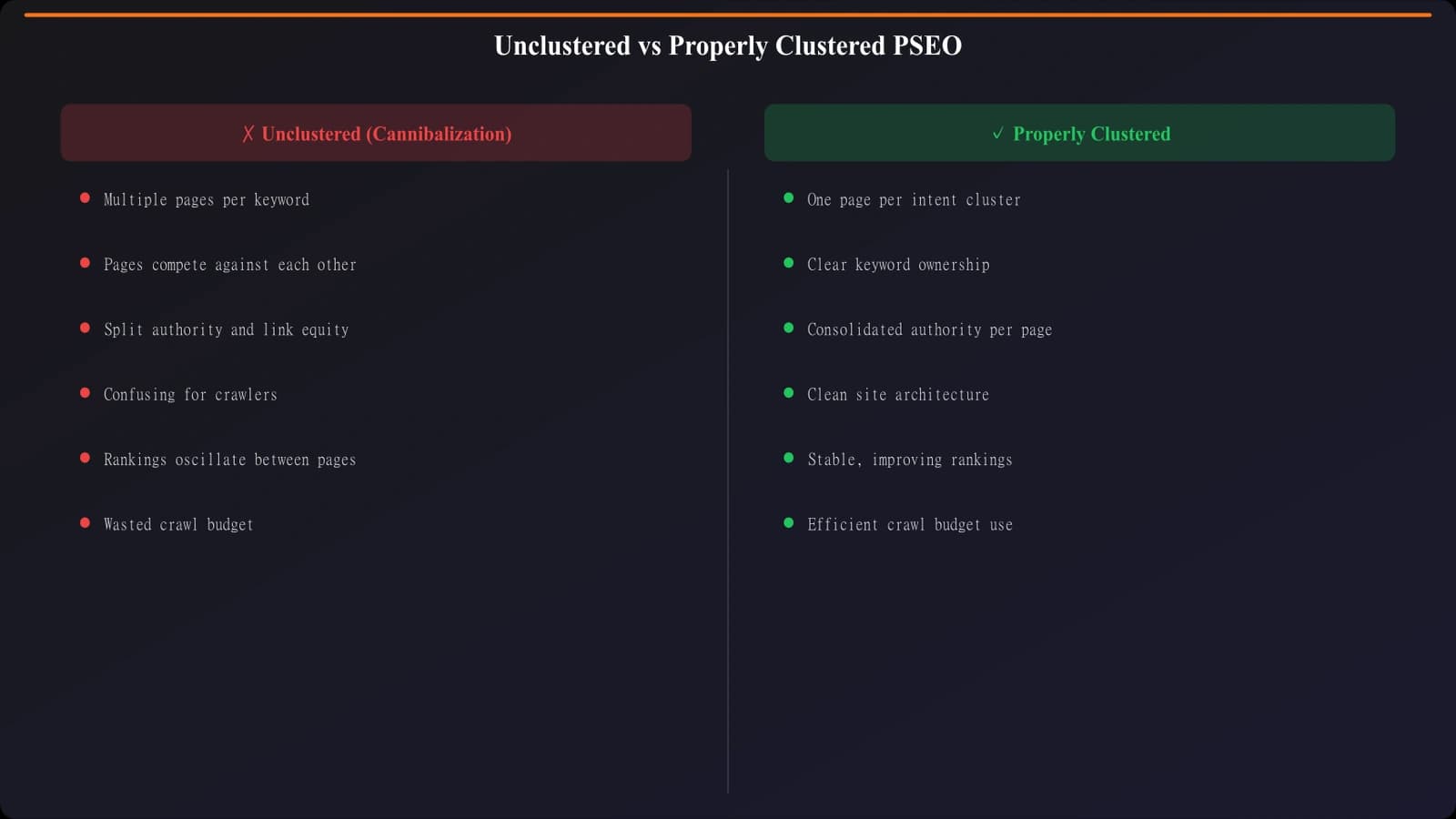
Programmatic SEO sounds simple: build a template, fill it with data, generate hundreds or thousands of pages, collect traffic. In reality, the biggest PSEO failure mode isn't thin content or poor templates—it's cannibalization. When you create pages at scale without proper clustering, you end up with pages competing against each other, none ranking well.
The challenge intensifies with comparison content. “Best CRM for small business” and “Top CRM for SMB” might look like different keywords, but Google treats them as identical intent. Build pages for both, and you've split your own ranking signals.
This guide covers keyword clustering methodology specifically for programmatic SEO at scale. We'll cover SERP-based clustering, hierarchical intent structures, and the validation processes that prevent cannibalization before it happens. For the foundational keyword framework, see our Keyword to Page Type Framework.
The PSEO Clustering Challenge
Clustering for programmatic SEO differs from manual content planning in scale and complexity.
Scale Creates Different Problems
| Factor | Manual Content | Programmatic SEO |
|---|---|---|
| Page count | 10-100 pages | 100-10,000+ pages |
| Keywords per page | Carefully selected | Programmatically assigned |
| Overlap risk | Visible during planning | Hidden in data volume |
| Validation | Manual SERP checks | Automated processes required |
| Error impact | Fix a few pages | Systemic across hundreds |
Common PSEO Clustering Failures
- Synonym explosion: Creating separate pages for “software,” “tools,” “platforms,” “solutions”
- Modifier overlap: “Best X for small business” vs “Best X for SMB” vs “Best X for startups”
- Geographic duplication: Same intent across city/region variations without distinct need
- Format confusion: Listicle, comparison, and alternatives pages all targeting same query
SERP-Based Clustering Methodology
The most reliable clustering method for PSEO: let Google tell you which keywords share intent.
The SERP Overlap Principle
If two keywords produce largely the same SERP results, Google considers them the same intent. This is the foundation of SERP-based clustering:
- High overlap (7+ same URLs in top 10): Same intent cluster, one page
- Moderate overlap (4-6 same URLs): Related but potentially distinct, investigate
- Low overlap (<4 same URLs): Different intent, can have separate pages
SERP Clustering Process
- Collect candidate keywords: All potential targets for your PSEO project
- Pull SERP data: Top 10-20 results for each keyword (use API or tool)
- Calculate overlap: Jaccard similarity or simple URL overlap percentage
- Cluster algorithmically: Group keywords with >70% overlap
- Validate clusters: Manual spot-check of clustered groups
- Assign one page per cluster: Select primary keyword, merge secondaries
Automation Options
- Keyword clustering tools: Keyword Insights, Cluster AI, SERPstat
- Custom scripts: Python + SERP API for complete control
- SEO platforms: Ahrefs, Semrush clustering features
Hierarchical Intent Structures
Beyond flat clustering, PSEO benefits from hierarchical intent mapping.
Intent Hierarchy Levels
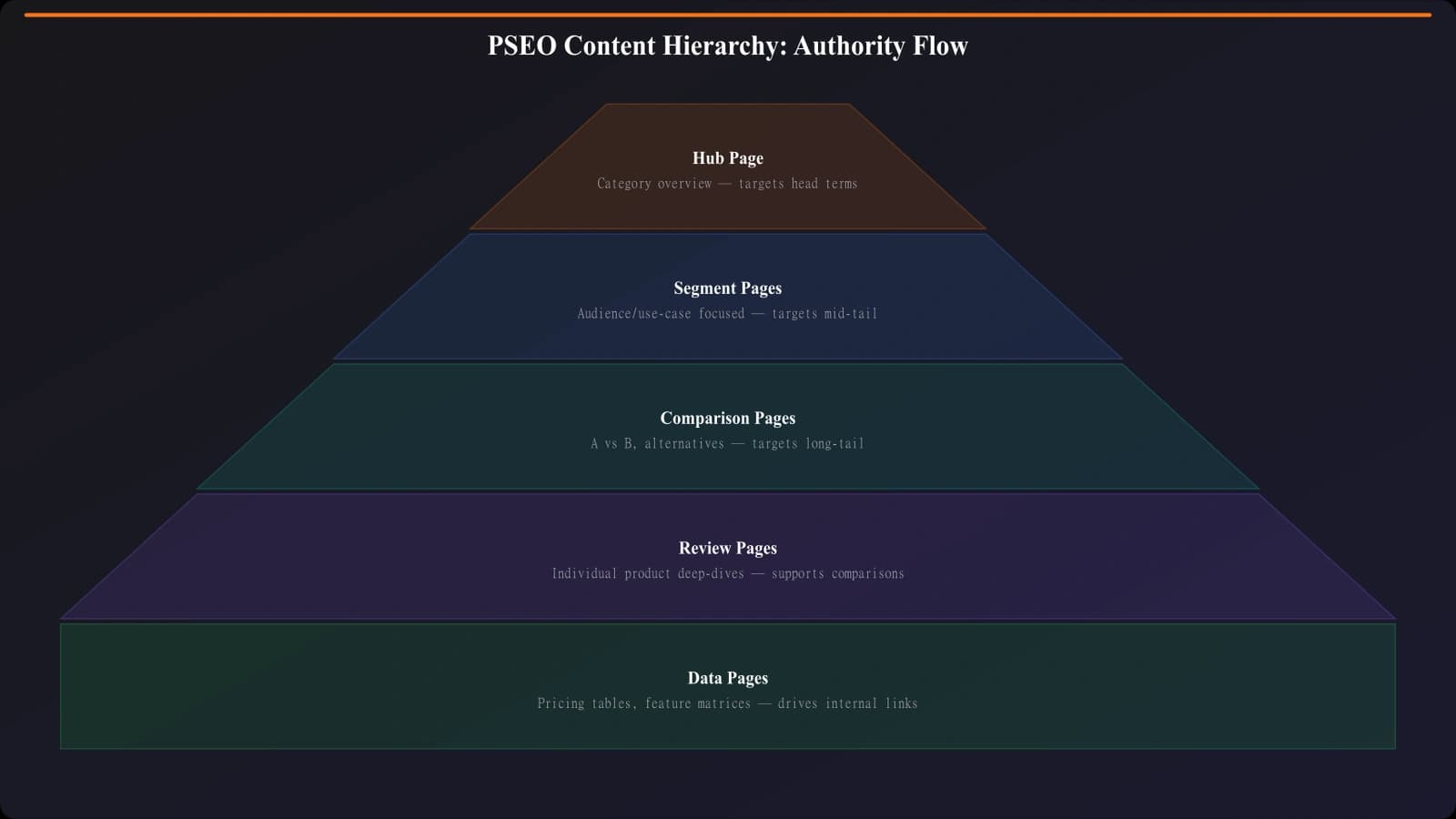
- Category (Hub): Broad category page — “Best CRM Software”
- Segment (Spoke): Audience-specific — “Best CRM for [Industry]”
- Sub-segment (Deep Spoke): Narrow focus — “Best CRM for [Industry] + [Size]”
Hierarchy Rules for PSEO
- Only create sub-levels if SERP differs: Don't create industry pages if generic page ranks for industry queries
- Establish clear parent-child relationships: Sub-pages link to parent, inherit authority
- Avoid orphan pages: Every page fits in the hierarchy
- Define differentiation criteria: What makes each level distinct?
Example PSEO Hierarchy
| Level | Page | Target Cluster |
|---|---|---|
| Hub | /best-crm-software | best crm, top crm tools, crm software |
| Segment | /best-crm-for-real-estate | crm for real estate, realtor crm |
| Segment | /best-crm-for-small-business | small business crm, smb crm |
| Sub-segment | /best-crm-for-real-estate-teams | real estate team crm (if distinct SERP) |
Build PSEO at Scale
Generate properly clustered comparison pages without cannibalization risk.
Try for Free
Pre-Launch Validation Processes
Before launching PSEO pages at scale, validate that your clustering prevents cannibalization.
Pre-Launch Validation Checklist
- Cluster uniqueness test: No two pages target the same cluster
- SERP distinctness test: Spot-check that target SERPs differ between pages
- Internal search test: site:yourdomain.com “[keyword]” returns only one relevant page
- URL structure test: URLs clearly indicate distinct topics
- Content differentiation test: Pages targeting similar areas have distinct content angles
Sample-Based Validation
For large PSEO launches, validate samples:
- Select 5-10% of pages randomly
- Run full validation checklist on sample
- If issues found, investigate root cause in clustering logic
- Fix systemically, not just sample pages
Automated Checks
- Duplicate title detection: No pages with identical or near-identical titles
- Keyword assignment audit: Each primary keyword assigned to exactly one page
- Internal link validation: Hub-spoke links correctly implemented
- Index status monitoring: Track which pages get indexed post-launch
Post-Launch Monitoring
Even with careful clustering, monitor for cannibalization after launch.
Cannibalization Signals to Monitor
- Multiple pages ranking: Same query shows 2+ pages from your site
- Rank fluctuations: Pages swap positions frequently
- Underperformance: Expected traffic not materializing despite indexing
- Click distribution: Clicks split across multiple pages for same query
Search Console Monitoring Process
- Export all queries with impressions for PSEO pages
- Identify queries where multiple PSEO pages appear
- Calculate click distribution—is one page dominant?
- If split, investigate whether pages truly serve different intent
Remediation When Issues Found
- Consolidate: Merge competing pages into one stronger page
- Differentiate: Adjust weaker page to target distinct intent
- Redirect: 301 redundant pages to the primary
- Update clustering logic: Prevent future recurrence
For detailed remediation strategies, see our guide on intent overlap detection.
Tools and Techniques for Scale
Managing clustering for thousands of pages requires appropriate tooling.
Keyword Clustering Tools
| Tool | Approach | Best For |
|---|---|---|
| Keyword Insights | SERP-based clustering | Large keyword sets |
| Cluster AI | NLP + SERP hybrid | Semantic understanding |
| SE Ranking | Built-in clustering | Platform integration |
| Custom Python | Full control | Advanced requirements |
Spreadsheet-Based Approach
For smaller PSEO projects (100-500 pages):
- List all candidate keywords in column A
- Add cluster assignment column
- Use SERP similarity to assign clusters
- Create pivot to validate one page per cluster
- Generate page specifications from clustered data
Database Approach
For large PSEO projects (1,000+ pages):
- Store keywords, clusters, and page assignments in database
- Build validation queries to check for conflicts
- Generate page templates from structured data
- Monitor cannibalization via GSC data integration
Building Cannibalization-Proof PSEO
Keyword clustering is the foundation of successful programmatic SEO. Without it, you're building pages that compete against themselves—negating the scale advantage PSEO should provide.
Key takeaways:
- SERP-based clustering is most reliable: Let Google define intent clusters
- Build hierarchical structures: Hub-spoke models prevent overlap
- Validate before launch: Sample-based checking catches systemic issues
- Monitor post-launch: GSC reveals cannibalization patterns
- Remediate quickly: Consolidate or differentiate competing pages
- Use appropriate tools: Scale requires automation
Start any PSEO project with clustering. Before you build templates, before you generate content, cluster your keywords into distinct intent groups. Then build one page per cluster—no more.
For the complete keyword strategy, see our Keyword to Page Type Framework. For detecting issues in existing content, explore our guide on intent overlap detection.

Product Manager at BestPage. Pioneer in AEO research since 2024, exploring the convergence of SEO and GEO (Generative Engine Optimization). Led multiple AI-powered content optimization projects that achieved 300%+ citation increases in ChatGPT and Perplexity.