
You've published 15 comparison articles targeting different keywords, but traffic is stagnant. You check Search Console and find the same three pages competing for overlapping queries, none of them ranking well. Welcome to keyword cannibalization—the silent killer of content strategies.
The frustrating part? Cannibalization is almost always preventable. It happens when content planning focuses on keywords in isolation rather than the intent clusters those keywords represent. Two pages targeting “best CRM software” and “top CRM tools” aren't targeting different keywords—they're targeting the same user need.
This guide provides a systematic approach to detecting intent overlap before you publish new content and resolving cannibalization when it's already occurred. For the broader context on content type decisions, see our Keyword to Page Type Framework.
Understanding Intent Overlap vs. Healthy Content Clusters
First, let's clarify what cannibalization actually is—and isn't. Not every situation where multiple pages rank for similar keywords is a problem.
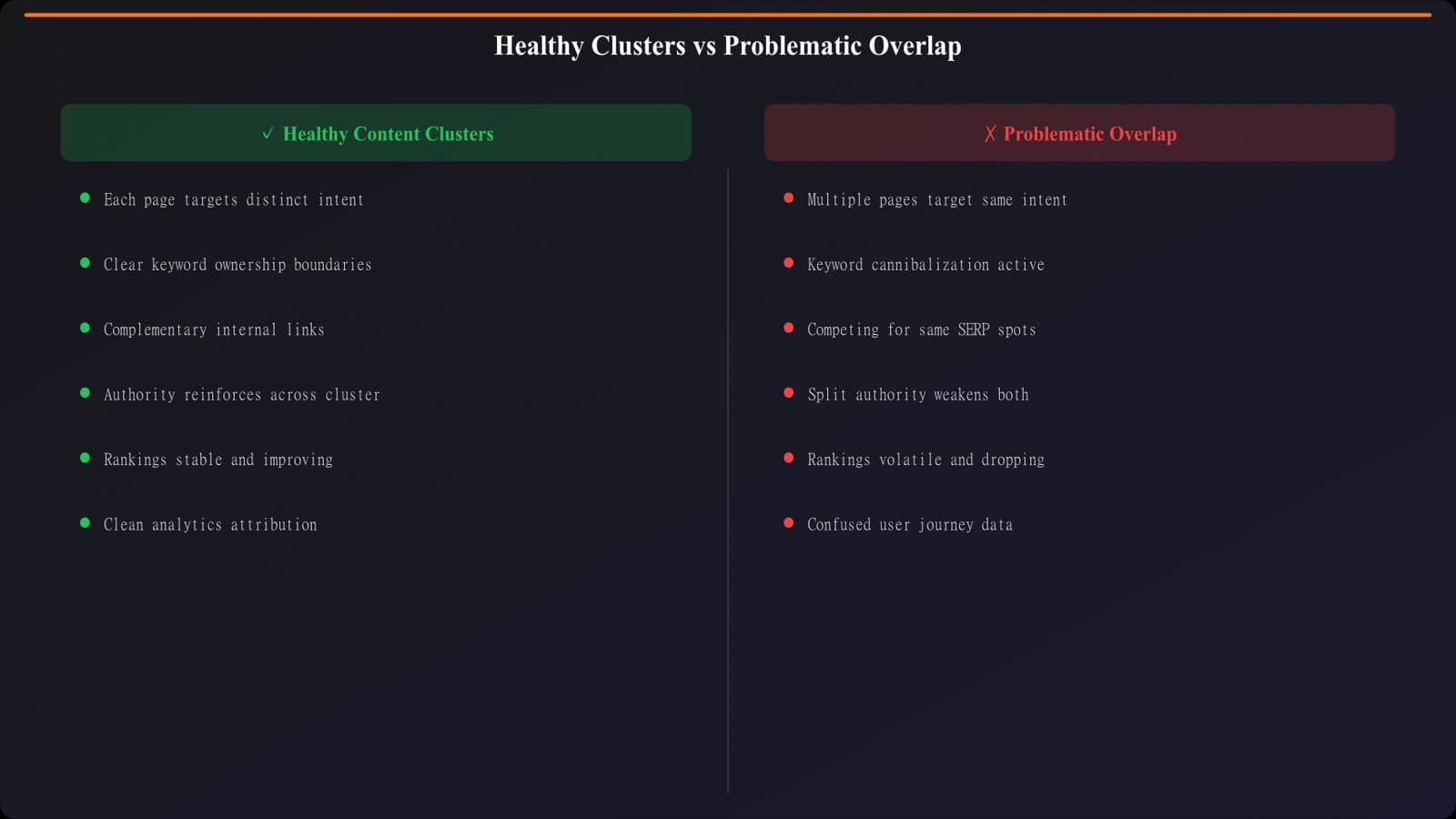
Healthy Content Clusters
When multiple pages rank for related queries and each serves a distinct purpose, that's not cannibalization—it's a healthy content cluster:
- “Best CRM software” — Category listicle page
- “HubSpot vs Salesforce” — Head-to-head comparison
- “Salesforce alternatives” — Alternatives page
- “CRM for small business” — Segment-specific listicle
Each page serves different user intent. Google understands this and shows different pages for different queries. Internal linking reinforces the relationships.
Problematic Intent Overlap
Cannibalization occurs when pages compete for the same intent:
- “Best CRM software 2026” AND “Top CRM tools 2026” — Same intent
- “Slack alternatives” AND “Apps like Slack” — Same intent
- “Best project management for teams” AND “Top team project management” — Same intent
When this happens, Google receives mixed signals: which page should rank? The result is usually that neither performs as well as a single, consolidated page would.
The Pre-Publication Detection Process
The best time to catch cannibalization is before you publish. Here's a systematic process to run before greenlighting any new comparison content.
Step 1: Audit Existing Coverage
Before writing anything new, know what you already have:
- Export all existing comparison/listicle URLs
- List primary and secondary keywords for each
- Note the specific intent each page serves
- Identify any pages that might overlap with your planned content
Step 2: SERP Similarity Check
The most reliable overlap test: do the SERPs look similar?
- Search your planned target keyword in incognito
- Record the top 10 results
- Search related keywords from existing pages
- Compare results—if 7+ URLs are the same, intent overlaps
Step 3: Query Clustering Analysis
Group your target keywords by intent before creating content:
| Intent Cluster | Keywords | Target Page |
|---|---|---|
| CRM Discovery | best crm, top crm software, crm tools 2026 | /best-crm-software |
| CRM for SMB | crm for small business, small team crm | /best-crm-small-business |
| Salesforce Switching | salesforce alternatives, switch from salesforce | /salesforce-alternatives |
For a deep dive on clustering methodology, see our guide on keyword clustering for programmatic SEO.
Detecting Existing Cannibalization
Already published content that might be cannibalizing? Here's how to identify it.
Search Console Signals
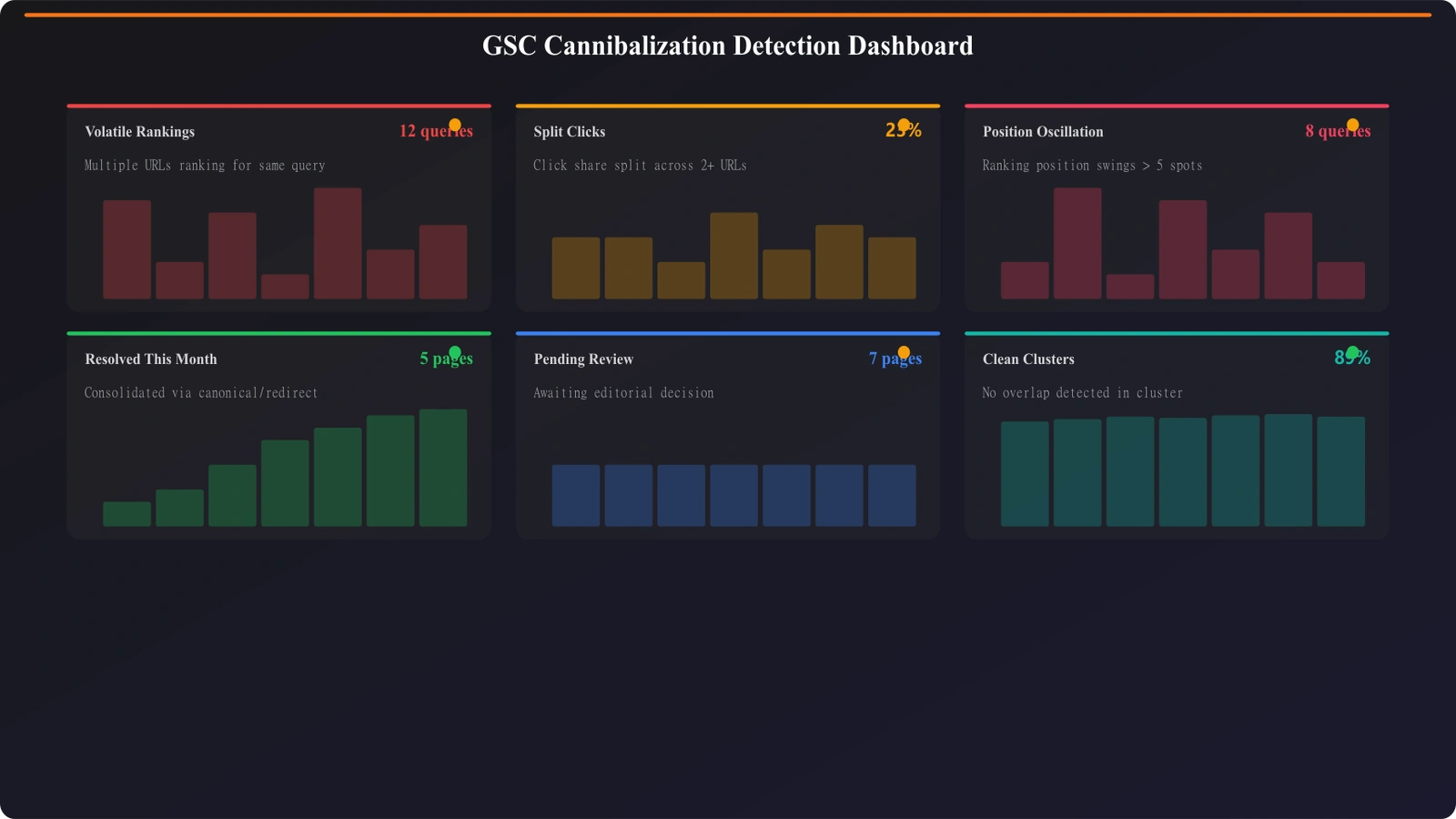
Google Search Console reveals cannibalization through specific patterns:
- Multiple pages ranking: Same query shows 2+ URLs from your site
- Ranking volatility: Positions fluctuate wildly as pages swap
- Click distribution: Clicks split between multiple pages for same query
- Declining performance: Once a single page ranked, now neither does well
GSC Query Analysis Process
- Export all queries with impressions > 100/month
- For each query, identify all pages that appeared in results
- Flag queries where 2+ pages received impressions
- Prioritize by query volume and business value
The Site:Search Test
A quick manual check for any keyword:
- Search:
site:yourdomain.com “target keyword” - If multiple relevant pages appear, potential overlap exists
- Evaluate whether pages serve distinct intents
Build Cannibalization-Free Content
Generate listicles with built-in intent clustering to prevent overlap from the start.
Try for Free
Resolution Strategies
When you've identified cannibalization, you have several remediation options. The right choice depends on content quality, traffic, and strategic value.
Option 1: Consolidate
Merge competing pages into a single, stronger piece:
- When to use: Both pages are mediocre, combined would be comprehensive
- Process: Create new consolidated page, 301 redirect old URLs
- Risk: Low—usually improves overall performance
Option 2: Differentiate
Adjust one page to target a distinct intent:
- When to use: Both pages have value, can serve different audiences
- Process: Reframe one page for specific use case/audience
- Example: Generic “Best CRM” → “Best CRM for Sales Teams”
Option 3: Canonicalize
Point search engines to the preferred page:
- When to use: Pages are intentionally similar (variants, versions)
- Process: Add canonical tag on secondary page pointing to primary
- Caveat: Not a fix for true cannibalization—just consolidates signals
Option 4: Delete
Remove the weaker page entirely:
- When to use: One page is clearly superior, other adds no value
- Process: 301 redirect deleted page to the keeper
- Risk: Low if redirected properly
| Scenario | Recommended Action |
|---|---|
| Both pages weak | Consolidate into one strong page |
| One strong, one weak | Delete weak, redirect to strong |
| Both valuable but overlapping | Differentiate one for specific segment |
| Intentional variants | Canonicalize to primary |
Building a Prevention System
Detecting and fixing cannibalization is reactive. Building systems to prevent it is proactive. Here's how.
Maintain a Content Inventory
A living document that tracks:
- Every comparison/listicle URL
- Primary keyword target
- Secondary keywords
- Intent cluster assignment
- Related/linked pages
Before creating new content, check this inventory. If an intent cluster is already covered, either update the existing page or differentiate the new angle.
Approval Workflow Gate
Add a cannibalization check to your content approval process:
- Keyword proposal: Writer proposes target keywords
- Inventory check: Compare against existing content
- SERP check: Verify intent is distinct from existing pages
- Approval or differentiation: Greenlight or require angle change
Regular Cannibalization Audits
Schedule periodic reviews:
- Monthly: Quick GSC check for new overlapping queries
- Quarterly: Full inventory review and SERP analysis
- After major content pushes: Verify new content isn't competing
Proactive Intent Management
Keyword cannibalization is one of the most common and most preventable SEO problems. The key insights:
- Intent clusters, not keywords: Plan around user needs, not individual keywords
- SERP similarity is the test: 70%+ SERP overlap = same intent
- Prevention beats remediation: Build systems to catch overlap before publishing
- Consolidation usually wins: One strong page beats two weak ones
- Regular audits catch drift: Intent relationships change over time
Before your next piece of comparison content, run through the detection process. The 15 minutes you spend checking for overlap can save months of competing against yourself.
For the complete keyword strategy framework, see our Keyword to Page Type Framework. And for implementation at scale, explore our guide on keyword clustering for programmatic SEO.

Product Manager at BestPage. Pioneer in AEO research since 2024, exploring the convergence of SEO and GEO (Generative Engine Optimization). Led multiple AI-powered content optimization projects that achieved 300%+ citation increases in ChatGPT and Perplexity.