
You know that feeling when you find a 5,000-volume keyword with “best” in it and think you've struck gold? Yeah, I've been there. Built the listicle, published it, waited for traffic... and watched it sit at position 25 while product pages dominated the SERP.
Turns out, not every “best X” keyword wants a listicle. Some want product pages. Some want guides. Some want comparison tables. The volume means nothing if you're building the wrong format.
This process is specifically for finding validated listicle opportunities—keywords where you know Google rewards best-of pages before you invest time building them. It's part of the broader Keyword to Page Type Mapping Framework, focused specifically on the listicle discovery workflow.
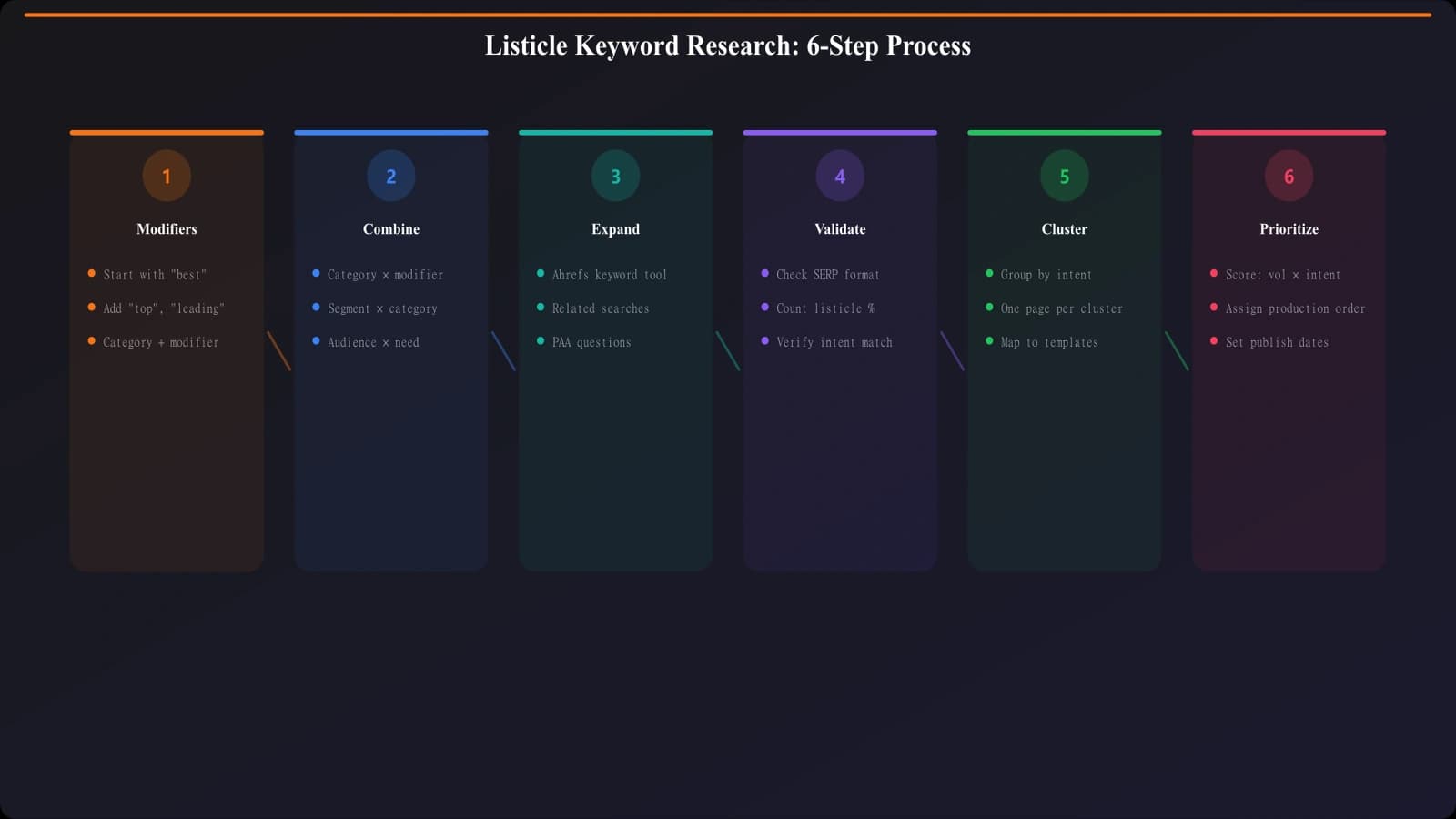
Step 1: Start With Listicle Modifiers
Here's where most people go wrong: they start with topic brainstorming. “What categories should we cover?” That's backwards for listicle research.
Instead, start with modifiers—the words that signal listicle intent. These are your building blocks:
Primary Modifiers (Highest Volume)
- best →the gold standard, highest search volume
- top →often followed by a number (top 10, top 5)
- leading →more professional/enterprise contexts
- popular →social proof angle
- [year] →“best CRM 2026”
Secondary Modifiers (Audience/Use Case)
- for small business, for startups, for enterprise
- for beginners, for developers, for marketers
- free, affordable, open source
The magic formula: [Primary Modifier] + [Category] + [Optional: Year/Audience]
So “best” + “CRM software” + “for startups” = “best CRM software for startups.” That's your seed keyword.
Step 2: Generate Seed Term Combinations
Now combine your modifiers with category terms. Where do you find category terms? A few reliable sources:
- G2 and Capterra categories →they've already done the taxonomy work
- Competitor listicles →what categories are they covering?
- Your product's competitive set →what category do you compete in?
- Industry publications →how do they categorize software?
For each category, generate combinations:
- “best [category]”
- “best [category] software”
- “best [category] tools”
- “best [category] 2026”
- “best [category] for [audience]”
- “best free [category]”
Start with 10-20 seed combinations. You'll expand from there.
Step 3: Expand With Keyword Tools
Take your seeds and run them through keyword research tools. The goal here is finding variations you didn't think of and getting volume/difficulty data.
| Tool | Best For | Key Tip |
|---|---|---|
| Ahrefs Keywords Explorer | Comprehensive data | Use “Matching terms” report |
| Semrush Keyword Magic | Large keyword lists | Filter by modifiers |
| Google Keyword Planner | Free option | Good for volume estimates |
| AlsoAsked | Question patterns | Find “best X for Y” patterns |
Filter aggressively: Only keep keywords containing your listicle modifiers (best, top, leading, etc.). Everything else goes in a different bucket.
Turn Keywords Into Listicles Automatically
Generate complete best-of pages from your validated keywords in minutes.
Try for Free
Step 4: SERP Validation (Don't Skip This)
This is where most people cut corners. Don't.
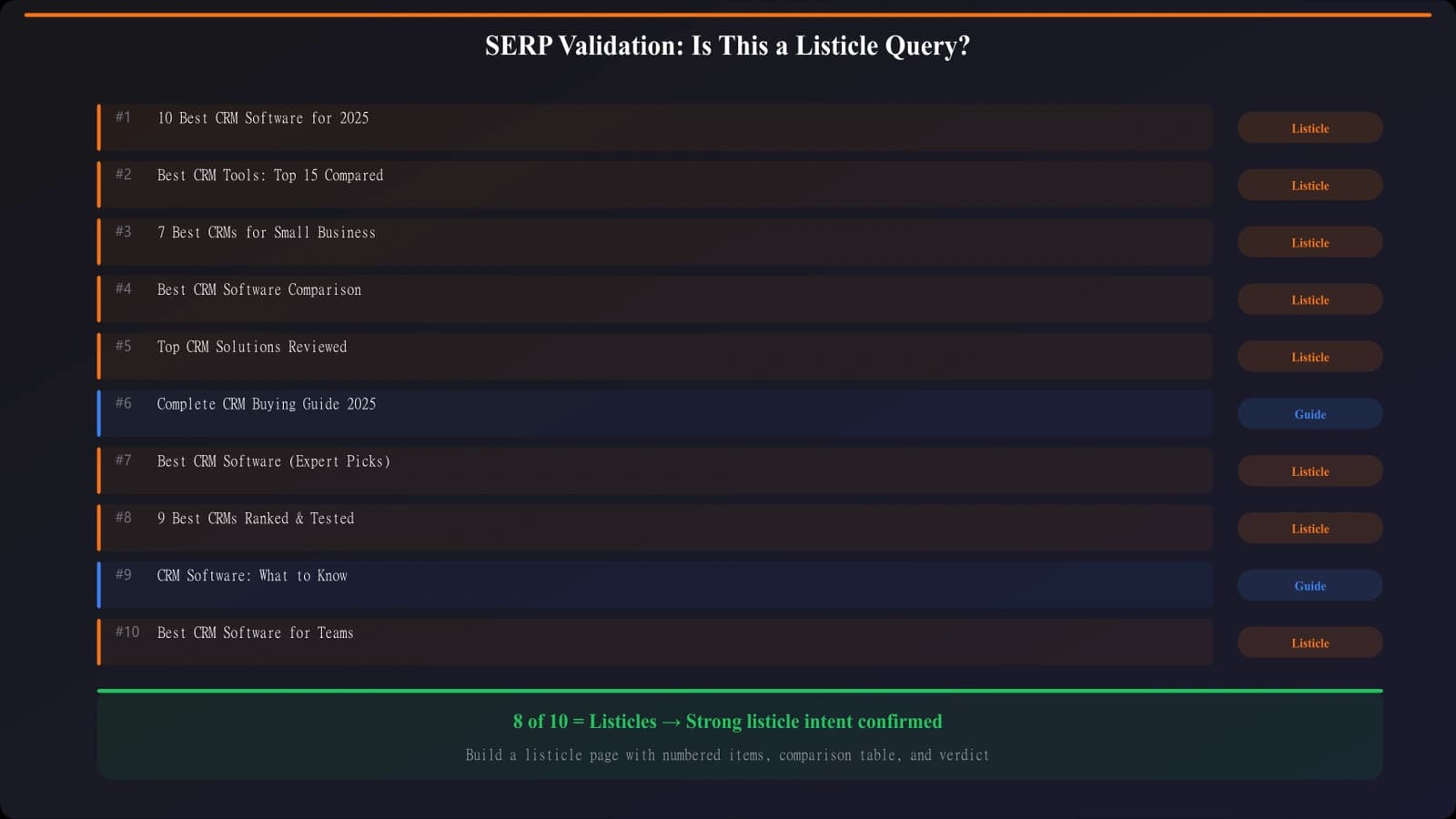
Not every “best X” keyword shows listicle results. Some show product pages (transactional intent). Some show guides (informational intent). Some show a mix. You need to check.
The Validation Process
- Open an incognito/private window (your history affects results)
- Search the exact keyword
- Count how many of the top 10 organic results are listicles
- Score it: 8-10 listicles = strong intent, 5-7 = moderate, 0-4 = weak or no listicle intent
If fewer than 5 of the top 10 are listicles, seriously reconsider. Either find a different angle or accept that this keyword might not be a listicle opportunity at all.
Step 5: Cluster Related Keywords
Here's a time-saver: multiple keywords can often be served by a single page. “Best CRM software,” “best CRM tools,” and “top CRM platforms” probably all want the same listicle.
Clustering Rules
Same page cluster:
- Same core topic, different modifiers
- Year variants of the same keyword
- Singular vs. plural forms
- Tool vs. software vs. platform variations
Different page cluster:
- Different audience segments (“for enterprise” vs. “for startups”)
- Different price points (“free” vs. premium)
- Significantly different SERP results
The quick test: Do the top 3 results overlap for both keywords? If yes, cluster them. If no, separate pages.
Step 6: Prioritize Your Keyword List
Not all validated keywords are equal. Use this scoring framework to prioritize:
| Factor | Weight | What to Look For |
|---|---|---|
| Search Volume | 25% | Higher = more traffic potential |
| Competition | 25% | Lower difficulty = faster wins |
| Business Relevance | 30% | Does it bring target customers? |
| Monetization | 20% | Affiliate potential, lead value |
A 500-volume keyword with low competition and high relevance often beats a 5,000-volume keyword where you'll be stuck on page 3.
Making This Repeatable
The best part about this process? It's systematic. You can run through it every quarter, every time you enter a new category, every time you want to expand your content footprint.
Quick recap:
- Start with modifiers →best, top, leading, plus audience qualifiers
- Combine with categories →generate comprehensive seed lists
- Expand with tools →find variations, get volume data
- Validate SERPs →confirm listicles actually rank (don't skip this!)
- Cluster keywords →group what can be served by single pages
- Prioritize →balance volume, competition, relevance, and monetization
With this workflow, you'll never waste time building listicles for keywords that won't rank. Every page targets a validated opportunity.
For the complete page type decision framework, see our guide: Keyword to Page Type Mapping: Complete Framework. And for a comprehensive list of modifiers to use, check out 56 Comparison Keyword Modifiers You're Missing.

Product Manager at BestPage. Pioneer in AEO research since 2024, exploring the convergence of SEO and GEO (Generative Engine Optimization). Led multiple AI-powered content optimization projects that achieved 300%+ citation increases in ChatGPT and Perplexity.