
You've probably been there. You find a keyword with 15,000 monthly searches, get excited, spend two weeks building content around it, and then... the traffic comes but nobody converts. Not a single demo request. Not one signup. Just a bunch of visitors who bounce after scanning the page.
Meanwhile, your competitor is crushing it with a keyword that gets maybe 800 searches a month. But their conversion rate? Through the roof. What's the difference? It's not the content quality. It's not their design. It's the intent behind the keyword they chose.
Here's the thing most content teams get wrong: they treat search volume as the primary filter for keyword prioritization. It feels logical—more searches equals more potential traffic, right? But when you're building comparison content, listicles, or best-of pages, that math doesn't hold up. Intent quality matters way more than volume, and understanding the difference will completely change how you prioritize your content roadmap.
The Volume Trap: Why Big Numbers Mislead
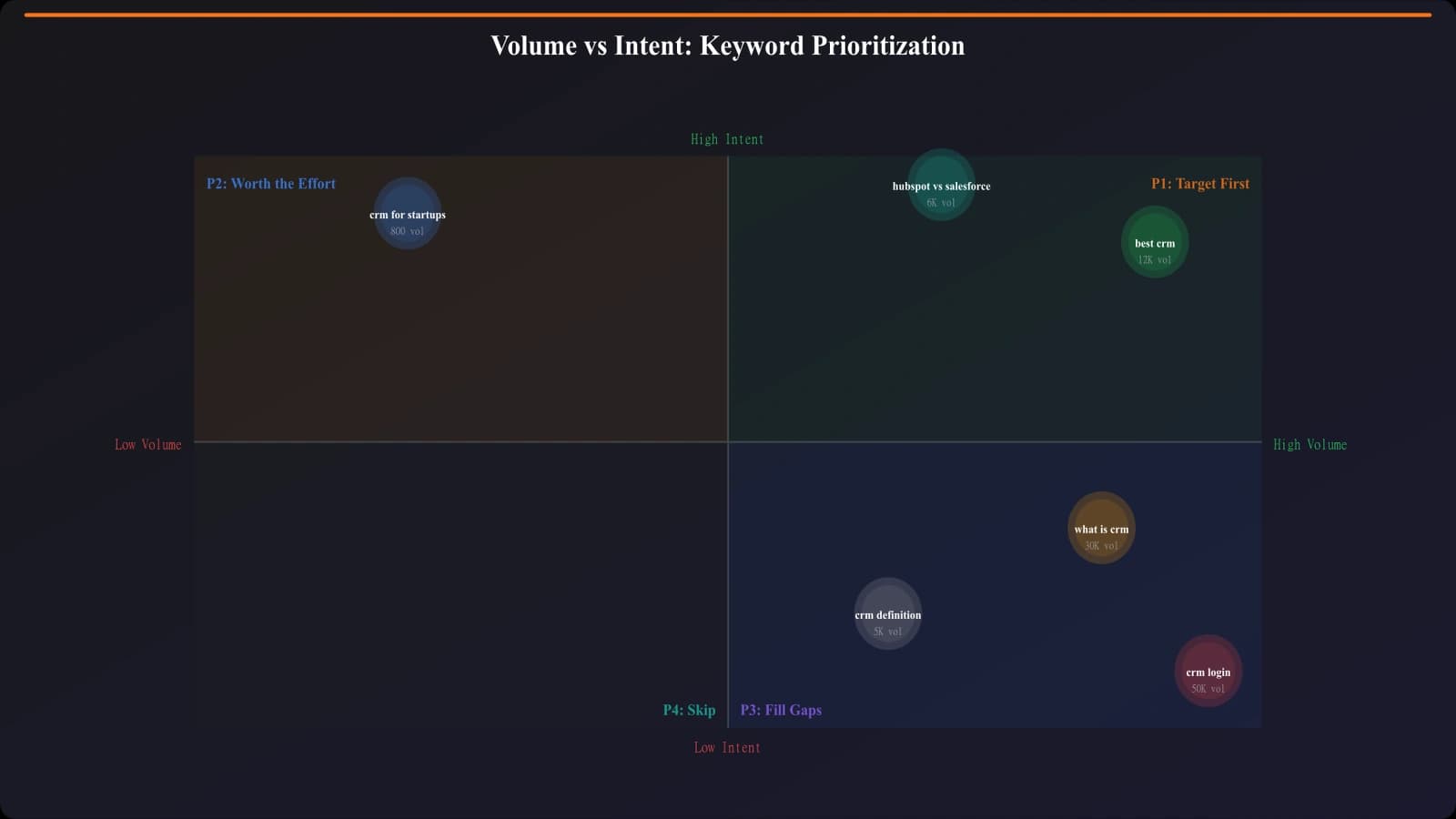
Let's talk about why high-volume keywords can be such a trap. When you see a keyword like “project management software” with 25,000 monthly searches, it's tempting to prioritize it. All that traffic potential! But here's what the volume number doesn't tell you.
First, high-volume keywords are almost always more competitive. You're not just fighting for rankings—you're fighting against Forbes, G2, Capterra, and every other major publisher with massive domain authority. Even if you rank, you're probably landing somewhere on page two where clicks are scarce.
Second, and this is the bigger issue, high-volume keywords often attract mixed or early-stage intent. Someone searching “project management software” might be a student researching for a paper. They might be someone who already uses Monday.com just checking what else is out there. They might be a decision-maker, sure—but they're probably months away from actually buying anything.
Compare that to someone searching “best project management tool for remote agencies.” Way fewer searches. But think about who's typing that query. They know exactly what they need. They're ready to evaluate options. They're probably making a decision this quarter.
That's the difference between traffic and qualified traffic. And honestly, I'd take 200 qualified visitors over 5,000 tire-kickers any day of the week.
Reading Intent Signals in Keywords
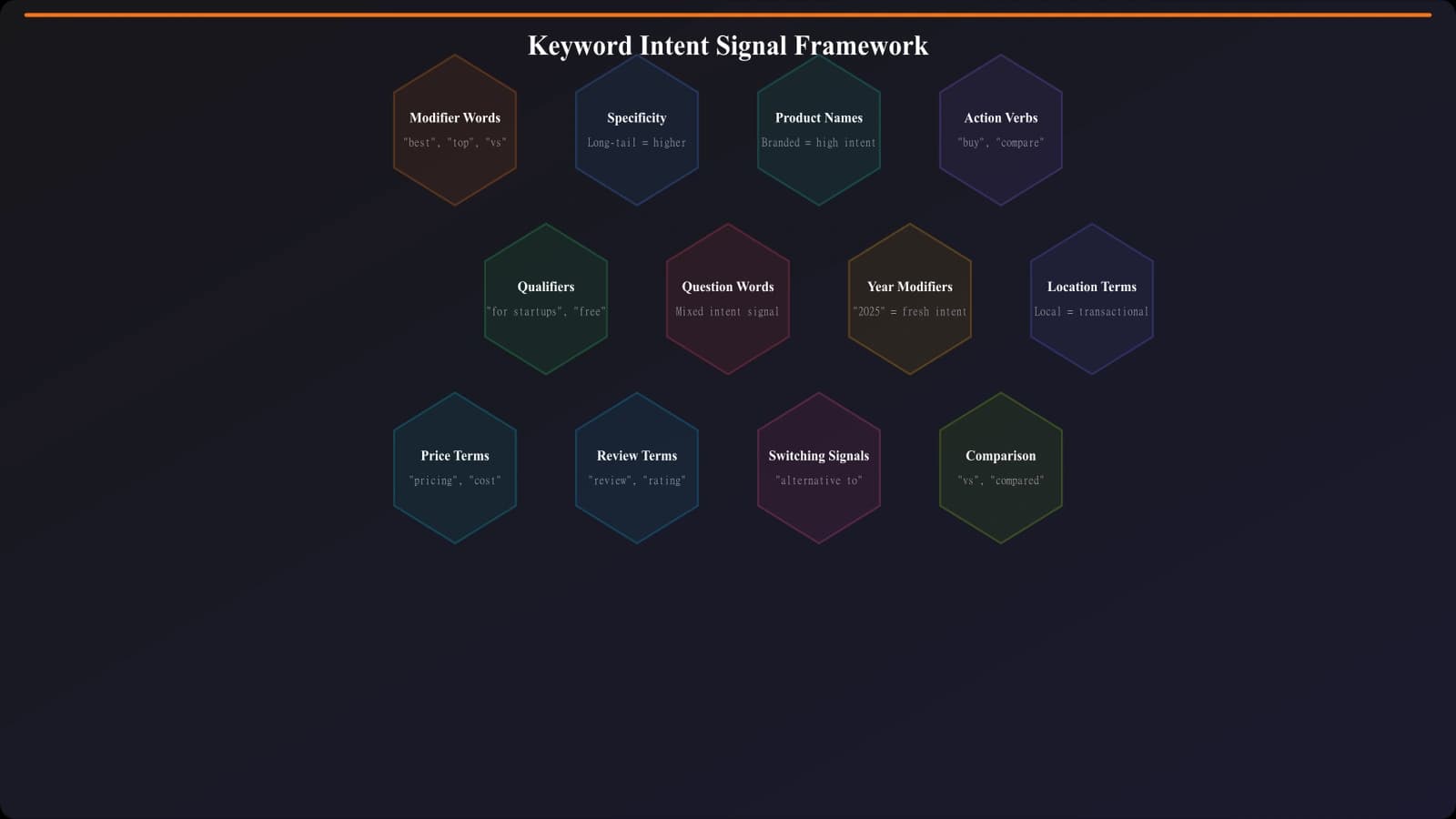
So how do you actually tell which keywords have strong buying intent? It's not as mysterious as it might seem. Keywords contain embedded signals that reveal where someone is in their decision journey. You just need to know what to look for.
The most obvious signals are modifier words. When you see words like “best,” “top,” “vs,” “alternative,” or “for [specific use case],” you're looking at someone actively comparing options. They've moved past the “what is X” stage and into the “which X should I choose” stage.
Specificity is another huge indicator. “CRM software” is vague. “CRM for real estate teams under 10 people” is incredibly specific. The more specific the query, the more likely the searcher knows what they need—and the closer they typically are to making a decision.
Then there's what I call “switching intent.” Keywords like “Salesforce alternatives” or “tools like HubSpot but cheaper” indicate someone who already uses a product and is actively looking to replace it. These people aren't casually browsing. They're motivated to make a change, which means they're much more likely to convert.
A Practical Prioritization Framework
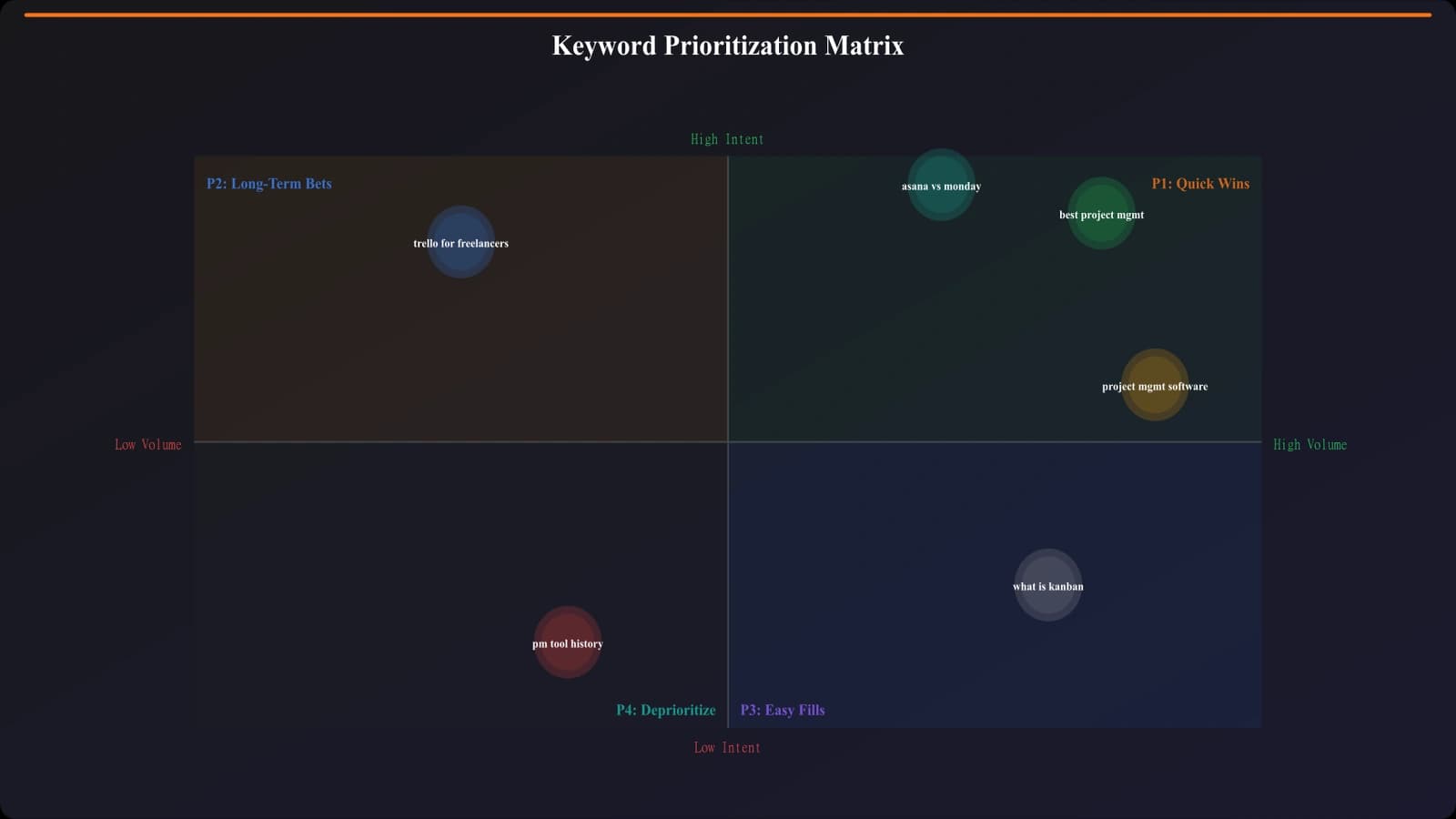
Alright, let's get practical. Here's the framework I use when prioritizing comparison keywords. It's not complicated, but it shifts the emphasis from volume to actual business value.
Start by scoring each keyword on three dimensions. First, intent strength—how close is this searcher to a decision? Give it a 1-5 score based on the signals we just discussed. Second, relevance—how well does this keyword match what you actually offer? A perfect-match keyword is worth more than something tangentially related. Third, competition reality—can you actually rank for this within 6 months?
Only after scoring those three factors should you look at volume. And when you do, treat it as a tiebreaker, not the primary filter. If two keywords score equally on intent, relevance, and competition, pick the one with higher volume. But don't let a high-volume keyword jump ahead just because the numbers look impressive.
What this usually means in practice: you end up prioritizing longer-tail, more specific keywords over broad head terms. “Best email marketing software for Shopify stores” beats “email marketing software” even though it has a fraction of the volume. The former converts. The latter just generates traffic that bounces.
For a deeper dive on how to match keywords to the right content format, check out our Keyword to Page Type Mapping Framework. Getting the format right is just as important as picking the right keyword in the first place.
Target High-Intent Keywords at Scale
Generate comparison pages that target buyer-intent keywords—not just high-volume terms that don't convert.
Try for Free
Real Examples: Volume vs Intent in Action
Let me walk you through a few real scenarios to make this concrete. These are patterns I've seen play out repeatedly across different industries.
Scenario 1: The SaaS trap. A B2B company targeting “CRM software” (22,000 monthly searches) versus “best CRM for consulting firms” (450 monthly searches). The broad keyword attracted tons of traffic—students, job seekers, people clicking from “what is CRM” queries. Conversion rate: 0.3%. The specific keyword brought in consulting firm owners actively looking for solutions. Conversion rate: 4.2%. Despite having 50x less traffic, the specific keyword generated more leads.
Scenario 2: The alternatives goldmine. “Time tracking software” (8,000 searches) versus “Toggl alternatives for agencies” (280 searches). The alternatives keyword indicated someone already using Toggl, probably frustrated with it, ready to switch. They weren't researching whether they needed time tracking—they knew they did. They just wanted something better. These visitors converted at nearly 6x the rate of the generic keyword.
Scenario 3: The comparison sweet spot. “Project management tools” (18,000 searches) versus “Asana vs Monday for marketing teams” (320 searches). The comparison keyword caught people at the decision stage. They'd already narrowed down to two options and needed help choosing. These visitors often converted in the same session because they were ready to act.
See the pattern? Lower volume, higher intent, better business results. Almost every time.
When Volume Actually Does Matter
Now, I don't want to give you the impression that volume is completely irrelevant. There are situations where it genuinely matters, and you should factor it into your prioritization.
If you're building topical authority, sometimes you need to cover the broad head terms even if they don't convert directly. Having a strong piece on “project management software” helps establish your site as an authority in the space, which can indirectly boost your rankings for all the more specific keywords. Think of it as foundational content.
Volume also matters when you're monetizing through ads rather than conversions. If your business model is pageviews and ad impressions, then yeah, more traffic is genuinely better. But if you're trying to drive signups, demos, or purchases, this doesn't apply to you.
And sometimes high-volume keywords do have strong intent. “Best CRM software 2026” might get substantial volume AND indicate someone actively comparing options. Don't dismiss high-volume keywords automatically—just make sure you're evaluating intent alongside the numbers.
Measuring Intent Quality After Launch
Here's something most guides skip: how do you actually measure whether your intent hypothesis was correct? Because you can estimate all you want upfront, but the real proof comes after you publish.
The metrics that matter aren't pageviews or even time on page. They're conversion-focused signals. Look at your click-through rate on CTAs within the content. Track how many visitors from that keyword move deeper into your funnel—signing up for newsletters, requesting demos, starting trials. Compare these rates across keywords to validate your prioritization.
You might be surprised. Sometimes a keyword you thought had strong intent actually attracts tire-kickers. Other times, a keyword you almost dismissed turns out to be a conversion machine. Let the data refine your framework over time.
The key metrics I track for each keyword:
- Conversion rate (keyword-level, not page-level)
- Bounce rate compared to site average
- Scroll depth and engagement time
- CTA click-through rate
- Lead quality score (if your sales team grades leads)
If you're serious about understanding what triggers conversions on comparison pages, our piece on SERP Analysis for Page Type Decisions covers how to read competitive signals that correlate with strong buyer intent.
Putting Intent First in Your Workflow
Let me leave you with this: the next time you're staring at a keyword research spreadsheet sorted by volume, pause before you start from the top. That 20,000-search keyword at the top might look appealing, but it's probably not your best opportunity.
Instead, add an intent column. Score each keyword based on the signals we discussed—modifiers, specificity, switching indicators. Then sort by intent score first, volume second. You'll likely end up with a completely different priority list. And more importantly, you'll end up with content that actually moves your business forward.
The companies winning at comparison content right now aren't the ones chasing the biggest keywords. They're the ones who understand that 500 ready-to-buy visitors are worth more than 50,000 people just killing time. They build for intent, and the conversions follow.
So go ahead—prioritize that 400-search keyword with incredible intent over the 10,000-search keyword with vague browsing behavior. Your conversion rates will thank you.

Product Manager at BestPage. Pioneer in AEO research since 2024, exploring the convergence of SEO and GEO (Generative Engine Optimization). Led multiple AI-powered content optimization projects that achieved 300%+ citation increases in ChatGPT and Perplexity.