

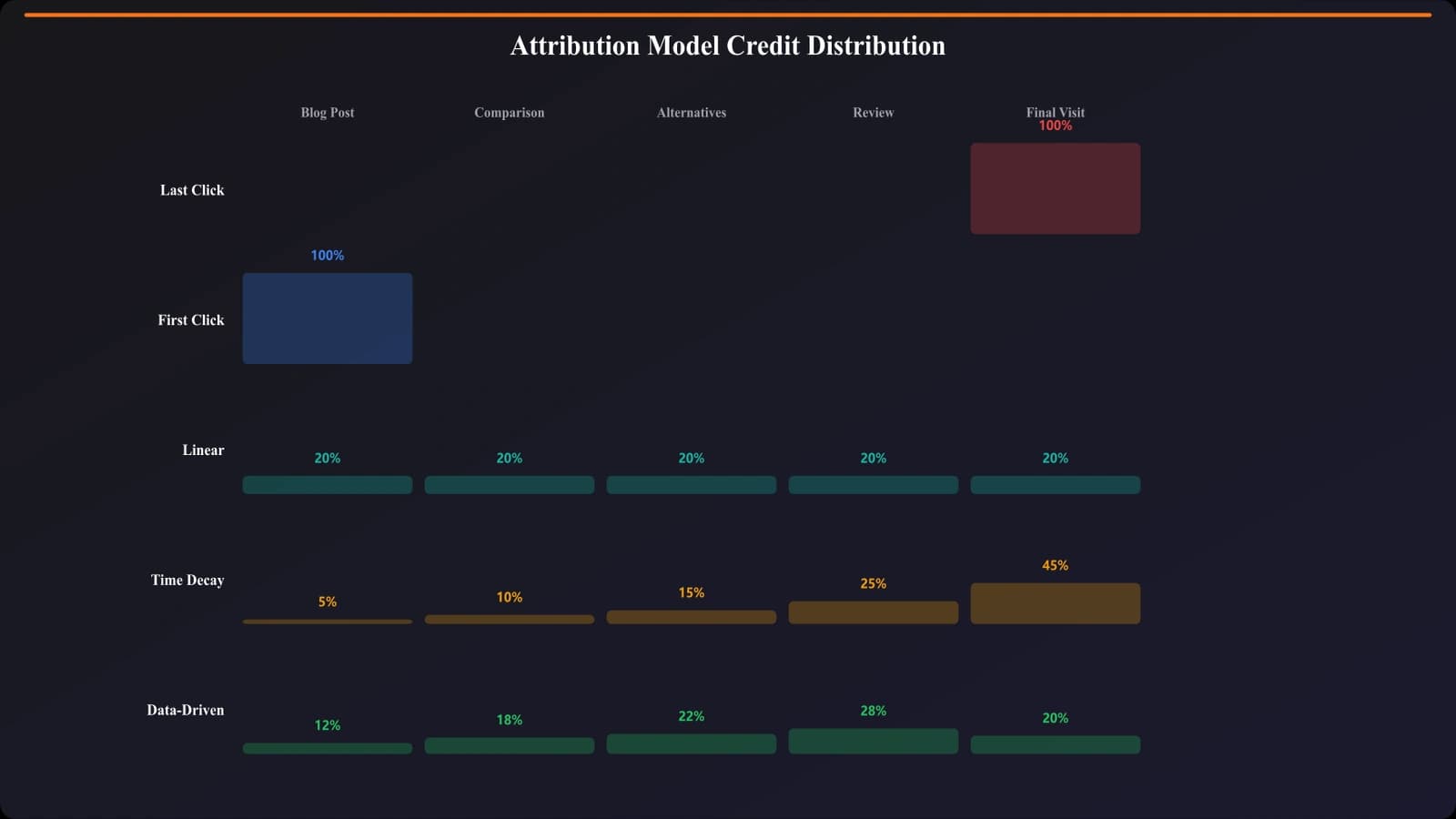
A user searches “best CRM software,” lands on your listicle, spends 8 minutes reading, then leaves. Three days later, they search “Salesforce pricing,” visit Salesforce directly, and sign up. Did your listicle contribute to that conversion? Under last-click attribution, it receives zero credit. Under first-click, it gets full credit. Under data-driven attribution, it might get partial credit based on observed patterns.
Attribution matters because it determines which content appears valuable. If listicles consistently assist conversions but don't close them, last-click attribution will undervalue your comparison content. You might cut investment in high-performing content because the attribution model obscures its contribution. Conversely, understanding listicle's true funnel role enables appropriate investment.
This guide covers attribution models relevant to comparison content, how to choose appropriate models, how to interpret attribution data for listicles, and how to use attribution insights for content strategy. The goal is measuring listicle value accurately so you can invest wisely.
| Attribution Model | How It Works | Listicle Treatment | Best For |
|---|---|---|---|
| Last-click | 100% credit to final touchpoint | Often undervalued (mid-funnel role) | Short purchase cycles |
| First-click | 100% credit to first touchpoint | Overvalued if listicle starts journey | Understanding discovery |
| Linear | Equal credit across all touchpoints | Fair share regardless of position | Simple multi-touch view |
| Position-based | 40% first, 40% last, 20% middle | Some credit if mid-funnel | Valuing both ends |
| Time-decay | More credit to recent touchpoints | Depends on timing in journey | Long purchase cycles |
| Data-driven | ML-based on actual patterns | Credit based on observed contribution | Sufficient conversion volume |
Understanding Listicle Funnel Position
Attribution interpretation requires understanding where listicles typically appear in customer journeys.
Typical Listicle Journey Patterns
Listicles commonly appear in these journey positions:
- Research initiation: User starts with broad search, lands on listicle first
- Mid-funnel evaluation: User knows category, uses listicle to narrow options
- Pre-purchase validation: User has preference, uses listicle to confirm choice
- Comparison shopping: User visits multiple listicles across sites during research
- Return research: User returns to same listicle multiple times before deciding
Different listicle types and categories have different typical positions. “Best CRM for small business” is often mid-funnel; “What is CRM” is early-funnel.
Analyzing Your Journey Data
Use GA4 path analysis to understand your listicles' actual funnel position:
Journey analysis questions:
• What percentage of converters visited listicles at some point?
• Where do listicles typically appear in multi-touchpoint journeys?
• How many touchpoints typically follow listicle visits before conversion?
• Do users who visit listicles convert at higher rates than average?
• How long after listicle visit does conversion typically occur?
Journey data reveals whether your listicles are introducers, assisters, or closers—crucial context for attribution interpretation.
Choosing Attribution Models
Select models that reflect your actual customer journey and business needs.
Data-Driven as Default
GA4 uses data-driven attribution by default, which is appropriate for most listicle publishers:
- Uses machine learning to assign credit based on observed patterns
- Adapts to your specific journey data rather than applying fixed rules
- Generally more accurate than rule-based models for complex journeys
- Requires sufficient conversion volume for accuracy (typically 300+ conversions/month)
If you have sufficient conversion volume, data-driven attribution provides the most realistic view of listicle contribution.
Models for Lower Volume
If conversion volume is insufficient for data-driven attribution, consider:
Low-volume attribution approaches:
• Linear: Fair starting point; gives listicles appropriate credit
• Position-based: Good if you believe introduction and closing matter most
• Compare models: Run same analysis under multiple models; significant differences indicate sensitivity
• Assisted conversions: Use assisted conversion reports rather than attributed conversions
No model is perfect at low volume. Use multiple perspectives rather than trusting any single model completely.
Interpreting Attribution Data
Raw attribution data needs contextual interpretation.
Direct vs Assisted Conversions
Understand the difference between these metrics:
- Direct (last-touch) conversions: Conversions where listicle was final touchpoint
- Assisted conversions: Conversions where listicle appeared in journey but wasn't last
- Total contribution: Direct + assisted shows full listicle impact
- Assist ratio: Assisted/direct indicates funnel position (high ratio = early/mid funnel)
For many listicles, assisted conversions significantly outnumber direct conversions. Ignoring assists undervalues content.
Valuing Assists
Calculate the value of listicle assists:
Assist value calculation:
• Count assisted conversions attributed to listicle pages
• Apply fractional credit (varies by model; e.g., 0.2-0.3 for linear with 3-5 touchpoints)
• Multiply by conversion value
• Sum assisted value with direct conversion value for total contribution
This total contribution figure provides a more complete view of listicle ROI than direct conversions alone.
Measure True Listicle Value
Generate comparison content structured for accurate conversion attribution.
Try for Free
Cross-Device and Cross-Platform Challenges
User journeys often span multiple devices and platforms, complicating attribution.
Cross-Device Tracking
Users may research on phone and convert on desktop:
- Logged-in users: GA4 User-ID feature can track cross-device for logged-in users
- Google Signals: Enable for cross-device tracking of signed-in Google users
- Probabilistic matching: Some platforms use probabilistic methods (less reliable)
- Limitations: Much cross-device activity remains unmeasurable
Accept that measured attribution understates true contribution when cross-device journeys are common.
Attribution Gaps
Several factors create attribution blind spots:
- Cookie blocking: Safari ITP and similar limit tracking duration
- Ad blockers: Block analytics and prevent touchpoint tracking
- Private browsing: Sessions not connected to persistent identity
- Long cycles: Conversions outside attribution windows receive no touchpoint credit
Attribution data represents a sample, not complete reality. Use it directionally rather than absolutely.
Strategic Implications
Use attribution insights to inform content strategy.
Content Investment Decisions
Attribution data should inform where to invest:
- High direct + assist: Valuable content; maintain and expand
- High assist, low direct: Important for pipeline; don't cut despite low direct attribution
- Low assist, high direct: Closing content; optimize for conversion
- Low across both: Question value; consider revision or retirement
Attribution-informed decisions prevent cutting content that appears low-value under last-click but drives significant assists.
Reporting Best Practices
Report listicle value accurately:
Attribution reporting best practices:
• Report both direct and assisted metrics
• Calculate and report total attributed value
• Include assist ratio to show funnel position
• Note attribution model used
• Acknowledge limitations and gaps
• Compare across time periods consistently
Transparent reporting builds understanding of listicle contribution among stakeholders.
Conclusion: Measuring True Contribution
Attribution models significantly affect how listicle value is perceived. Last-click attribution systematically undervalues mid-funnel content like comparison pages. Understanding and applying appropriate attribution models reveals the true contribution of listicle content to business outcomes.
Use data-driven attribution when volume supports it. Report both direct and assisted conversions. Calculate total attributed value rather than relying on incomplete metrics. Accept that attribution is imperfect but directionally useful.
Most importantly, use attribution insights to make better content decisions. Invest in content that drives conversions—even when those conversions happen after users leave your site through other channels.
For full tracking setup, see Conversion Tracking Guide. For GA4 specifics, see GA4 Setup.

Product Manager at BestPage. Pioneer in AEO research since 2024, exploring the convergence of SEO and GEO (Generative Engine Optimization). Led multiple AI-powered content optimization projects that achieved 300%+ citation increases in ChatGPT and Perplexity.