
Here's a hard truth that digital marketers often miss: journalists don't care about your listicle. They receive hundreds of pitches daily, and “we published a best-of guide” doesn't clear the bar. It's not news. It's content marketing—and they can smell it.
But some comparison sites consistently land media coverage. You've seen their data cited in Forbes, their insights quoted in industry publications, their research referenced in mainstream news. What's their secret?
The difference is understanding what journalists need: stories, not self-promotion. Original data, not recycled rankings. Insights that serve their readers, not content that serves your traffic goals. When you reframe your listicle as a source of newsworthy information rather than an article to promote, everything changes.
This guide shows you how to extract newsworthy angles from comparison content, package them for media consumption, and build relationships that turn one-time coverage into ongoing press opportunities.
Finding Newsworthy Angles in Your Data
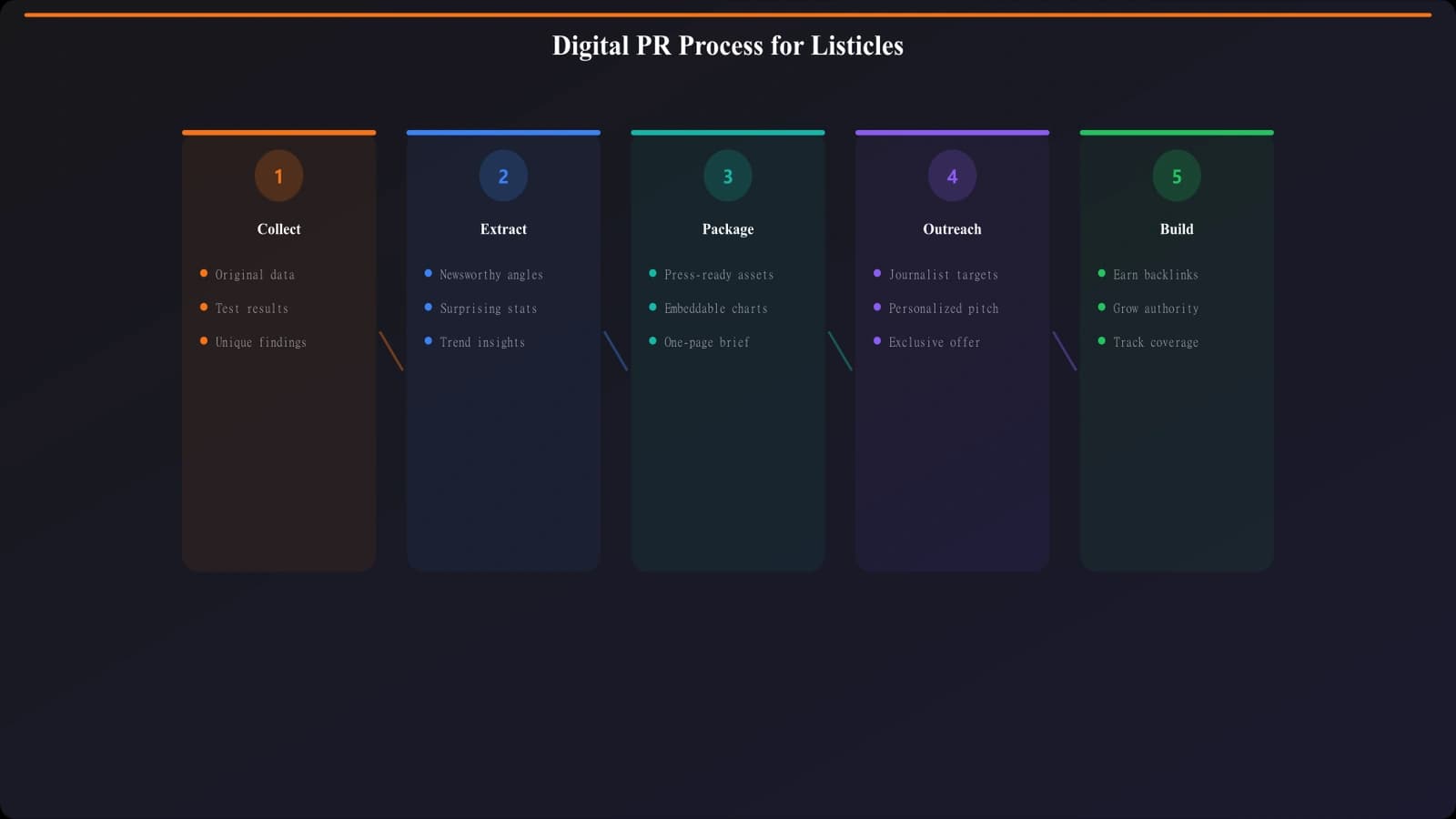
Every comparison contains potential stories—you just need to know how to find them. The data you collect for product rankings often reveals trends, surprises, and insights that genuinely interest journalists.
Types of Angles That Get Coverage
| Angle Type | Example | Why It Works |
|---|---|---|
| Trend spotting | “AI features now standard in 78% of email tools, up from 12% last year” | Shows industry movement journalists can report |
| Surprising findings | “Most expensive CRM ranks lowest in user satisfaction” | Counterintuitive data sparks curiosity |
| Consumer impact | “Average SaaS subscription cost jumped 23% this year” | Affects readers directly, creates urgency |
| Market shifts | “Startups now outperform enterprise tools in 6 of 10 categories” | Industry dynamics interest trade press |
| Behavior insights | “67% of teams switch tools within 18 months of first purchase” | Reveals patterns readers can relate to |
How to Extract Stories From Comparisons
Go through your comparison data asking these questions:
What's changed? If you've tracked data over time, any significant shifts become stories. Pricing changes, feature additions, rating movements—these show industry evolution.
What's surprising? Look for data that contradicts assumptions. When expensive doesn't mean better, when the industry leader underperforms, when the underdog wins—these surprises catch attention.
What affects people's wallets? Price stories always interest general audiences. If you can show costs rising, hidden fees, or money-saving alternatives, you've got consumer angle that works beyond trade press.
What does the data predict? Use current trends to project forward. “At current rate, the average marketing stack will cost $X by 2027” turns present data into future-focused stories.
Packaging Research for Media Consumption
Finding a story is only half the battle. Journalists need materials they can use quickly. Your job is to make their job easy.
Essential Press Materials
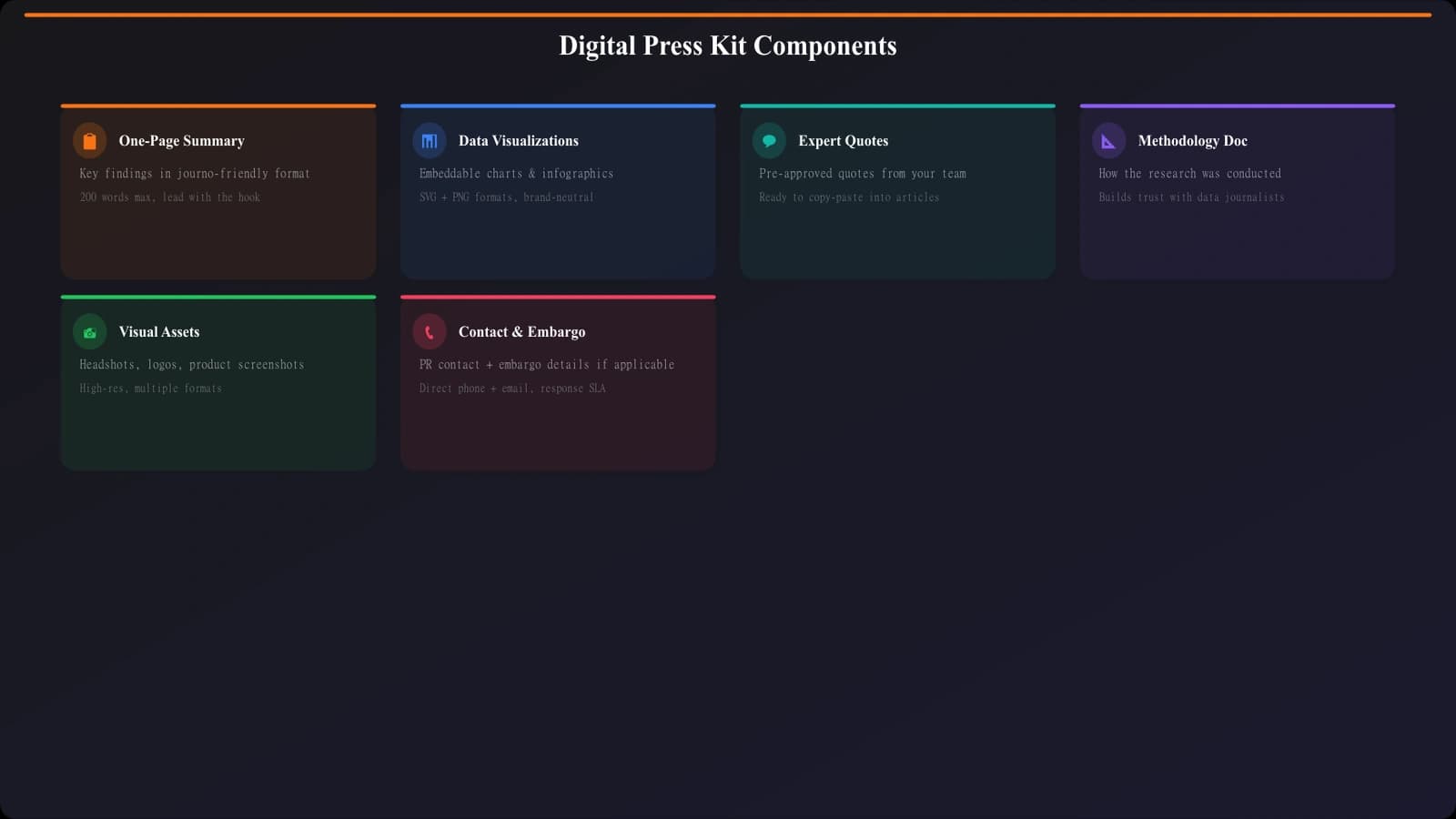
The One-Pager Summary: Create a single-page document with your key findings, methodology overview, and quotable statistics. Journalists should understand the story in 30 seconds of scanning.
Data Visualizations: Charts and graphs that clearly illustrate your findings. Make them publication-ready—professional design, clear labels, appropriate for both digital and print. Offer in multiple formats (PNG, SVG, high-res PDF).
Quotable Expert Commentary: Prepare 3-4 quotes from your team interpreting what the data means. Journalists often quote directly from press materials when deadline pressure hits. Make your quotes insightful and quotable.
Methodology Documentation: Journalists will ask how you collected data. Have a clear, honest methodology document ready. Sample size, collection methods, timeframe, limitations—all documented and ready to share.
Framing for Different Outlets
The same data supports different stories for different audiences:
- Trade publications: Focus on industry implications, competitive dynamics, market trends
- Business press: Focus on business impact, executive decisions, company strategy
- Consumer press: Focus on how it affects everyday users, money implications, practical advice
- Tech press: Focus on innovation, technology shifts, feature evolution
Prepare slightly different pitches for each type of outlet, emphasizing the angle most relevant to their readers.
Strategic Journalist Outreach
With story angles identified and materials prepared, it's time for outreach. But digital PR outreach differs fundamentally from link building outreach—you're pitching stories, not asking for favors.
Finding the Right Journalists
Target journalists who actually cover your space. Generic pitching wastes everyone's time. Here's how to find the right contacts:
- Search past coverage: Google “[your category] + site:forbes.com” (or other target publications) to find journalists who've covered similar topics
- Use Twitter/X: Journalists often share their beats and interests in their bios
- Check bylines: When you see relevant coverage, note the author and add them to your media list
- Use HARO and similar: Respond to journalist queries in your area to build relationships before you need coverage
The Pitch Structure That Works
Journalist inboxes are brutal. Your pitch needs to communicate value in seconds. Here's the structure:
Subject line: Lead with the most surprising or newsworthy stat. “New data: SaaS pricing up 23% YoY” not “Sharing our new research report.”
First sentence: One sentence summary of the story with key data point. No preamble, no throat-clearing.
The context: 2-3 sentences on why this matters now and who it affects. Connect to current events or ongoing industry narratives if possible.
The offer: What you're providing—exclusive data, expert quotes, visualizations. Make it clear you're offering value, not asking for promotion.
The ask: Would they like the full data set? An interview with your expert? Keep it low-friction.
Build PR-Ready Comparison Pages
Create listicles with original data and insights that journalists want to cover. Make your comparison content newsworthy.
Try for Free
Timing and Newsjacking
When you pitch matters almost as much as what you pitch. Strategic timing dramatically increases coverage odds.
Reactive Newsjacking
When something newsworthy happens in your category—an acquisition, a major product launch, a security breach—journalists scramble for context. If your comparison data provides that context, reach out immediately.
Example scenario: Major CRM company announces significant price increase. You have comparative pricing data across the category. Pitch within 24 hours: “Following [Company]'s price hike—our data shows average CRM pricing trends and alternatives.”
Speed matters in newsjacking. Have template pitches ready that you can customize quickly when opportunities arise.
Calendar-Based Timing
Some timing opportunities are predictable:
- January: “State of [Category] 2026” reports, year-over-year comparisons
- Budget season (Q4): Price comparisons, ROI data, cost optimization angles
- Trade show weeks: Industry trends, competitive analysis, innovation tracking
- Slow news weeks: Holidays and summer often see lower news volume—features and data stories get more consideration
Embargo and Exclusive Strategies
For major research findings, consider offering exclusives. Give one journalist first access to your data in exchange for guaranteed coverage. Once they publish, you can pitch other outlets with the “as reported in [Publication]” credibility boost.
Alternatively, embargo your findings—share with multiple journalists under agreement not to publish before a specific date. This creates synchronized coverage and momentum.
Building Long-Term Media Relationships
One-time pitches generate one-time coverage. Sustained media presence comes from relationships. Here's how to build them:
Becoming a Go-To Source
Position yourself as a helpful resource, not a self-promoter. When journalists need quick context on your category, you want to be their first call.
Tactics that work:
- Share relevant data proactively, even when it doesn't promote your latest content
- Respond quickly and helpfully when journalists ask questions
- Connect them with other sources when you're not the right expert
- Engage thoughtfully with their work on social media
- Never complain publicly about coverage you didn't like
Creating Recurring Touchpoints
Annual or quarterly research creates natural reasons to reconnect. “Thought you'd want to see our updated data” is a genuine value-add, not a pitch.
Keep a calendar of journalist relationships and schedule periodic check-ins—sharing relevant industry news, congratulating on new roles, or simply staying visible in their world.
For the full framework on building links to comparison pages through various channels, see our companion guide on Link Building for Comparisons: What Actually Works.
Measuring PR Success
Digital PR success looks different from traditional metrics. Here's what to track:
Direct Coverage Metrics
- Placements: Number of articles featuring your data or quotes
- Publication tier: Quality matters—one Forbes mention beats ten no-name blogs
- Link acquisition: How many placements include followed backlinks
- Message pickup: Are publications using your framing and key points
Indirect Impact Metrics
- Branded search lift: Does coverage drive more people to search your brand
- Referral traffic: Visitors from coverage to your comparison pages
- Social amplification: Shares and engagement on coverage pieces
- Follow-on requests: Do journalists come back for future stories
Long-Term Authority Building
The biggest wins from digital PR are often indirect. Consistent media presence builds domain authority, brand recognition, and industry credibility that compounds over time. Track these longer-term indicators:
- Inbound journalist requests (they come to you)
- Speaking and interview invitations
- Citation in industry reports and analyst coverage
- Partner and collaboration inquiries
Your Digital PR Action Plan
Transforming your comparison content into press-worthy material requires a shift in thinking. You're not promoting content—you're providing valuable data to journalists who need it.
Start with these steps:
- Audit your data: What original data do you have that could tell a story? Look for trends, surprises, and consumer-impact angles.
- Package one story: Pick your strongest angle and create a complete press kit—summary, visuals, quotes, methodology.
- Build a media list: Identify 20-30 journalists who cover your category. Research their recent work and interests.
- Pitch strategically: Time your outreach for maximum relevance. Lead with value, not asks.
- Follow up and nurture: After coverage, thank journalists and stay in touch. Build relationships for future opportunities.
Digital PR for comparison content isn't about getting press mentions for your listicle. It's about positioning yourself as the authoritative source of data and insights in your category. When you achieve that positioning, coverage follows naturally—and it brings the kind of high-authority links that transform your site's competitive position.
For a comprehensive approach to scaling your comparison content operation, see our pillar guide on Scaling Listicles: More Output Without Quality Loss.

Product Manager at BestPage. Pioneer in AEO research since 2024, exploring the convergence of SEO and GEO (Generative Engine Optimization). Led multiple AI-powered content optimization projects that achieved 300%+ citation increases in ChatGPT and Perplexity.