
Let's be honest about something: most comparison pages and listicles are terrible link building targets. Think about it from a blogger's perspective. Why would they link to your “Best CRM Software 2026” page? What's in it for them? The answer, usually, is nothing—which is why standard outreach campaigns fall flat for this content type.
But here's the thing: some comparison sites absolutely dominate their niches with impressive link profiles. G2, Capterra, Wirecutter, The Points Guy—these sites attract links naturally and consistently. What are they doing differently?
After analyzing hundreds of successful comparison pages and the link profiles behind them, patterns emerge. The teams that build links to listicles aren't playing the same game as everyone else. They're not sending cold emails saying “please link to my comparison.” They're creating genuine value that makes linking inevitable.
This framework covers the specific tactics that work for comparison content—and just as importantly, explains why the standard playbook fails.
Why Standard Link Building Fails for Listicles
Before we talk about what works, let's understand why the usual tactics fail. This isn't just academic—understanding the objections helps you overcome them.
The Commercial Content Problem
When someone receives an outreach email asking them to link to a “Best X for Y” page, their immediate assumption is commercial intent. And they're usually right—most listicles exist to generate affiliate revenue or leads. This creates an immediate credibility hurdle.
Even if your page is genuinely helpful and unbiased, the format itself triggers skepticism. Bloggers and journalists have been burned before. They've linked to “helpful” comparisons that turned out to be thinly disguised sales pages. So they default to declining.
The Missing Incentive
Good link building works because both parties benefit. You get a link; they get value. But what value does a comparison page offer to a potential linker?
- Not information they can't find elsewhere—Product features are on product websites
- Not original research—Most comparisons compile existing information
- Not tools or resources—It's just an article ranking products
- Not prestige—Being cited as source for a buying guide isn't prestigious
This is the fundamental challenge. Standard listicles offer nothing unique that justifies a link. Which means you need to add something unique—and that's exactly what the rest of this framework addresses.
The Outreach Signal Problem
Mass outreach for comparison pages sends a clear signal: “I'm trying to manipulate rankings.” Recipients know this. They receive dozens of similar requests. Even personalized outreach for commercial content gets filtered into spam by many recipients.
The teams that succeed with comparison link building rarely do cold outreach for direct links. Instead, they build relationships, create genuinely linkable assets, and let links come naturally through value creation.
Original Data: The Ultimate Linkable Asset
The most reliable way to earn links to comparison content is to include original data that can't be found anywhere else. When you're the primary source for interesting statistics, links follow naturally.
Types of Original Data That Work
| Data Type | Example | Link Potential | Effort Level |
|---|---|---|---|
| Survey data | “87% of marketers switched CRMs in the last 2 years” | Very High | Medium |
| Testing benchmarks | “We tested load times across 15 page builders” | High | High |
| Pricing analysis | “Average project management tool costs $12.50/user/month” | Medium | Low |
| Feature tracking | “42% of email tools now include AI writing assistance” | Medium | Low |
| Market trends | “Year-over-year pricing increased 18% in the CRM category” | High | Medium |
Implementing Data Collection
You don't need a massive research budget to create original data. Here are practical approaches:
Survey Your Audience: If you have any email list or social following, you have a survey panel. Ask 5-10 questions relevant to your comparison topic. Even 100-200 responses create citable statistics. Tools like Typeform or Google Forms make this free.
Aggregate Public Data: Often the data exists but hasn't been compiled. Collect pricing across all products in a category. Track feature releases over time. Compile review ratings from multiple sources. The aggregation itself is original research.
Run Actual Tests: For technical products, run your own benchmarks. Test page speed, uptime, accuracy, or whatever metrics matter in your category. Document your methodology and publish the results.
For a deeper dive on leveraging original research for link building and credibility, see First-Party Research: Differentiate Your Listicles.
Leveraging Brand Relationships
Here's an often-overlooked opportunity: the products you feature in your comparisons have marketing teams. Many of them actively look for positive coverage to share and link to. This creates a natural partnership opportunity.
The Featured Product Outreach
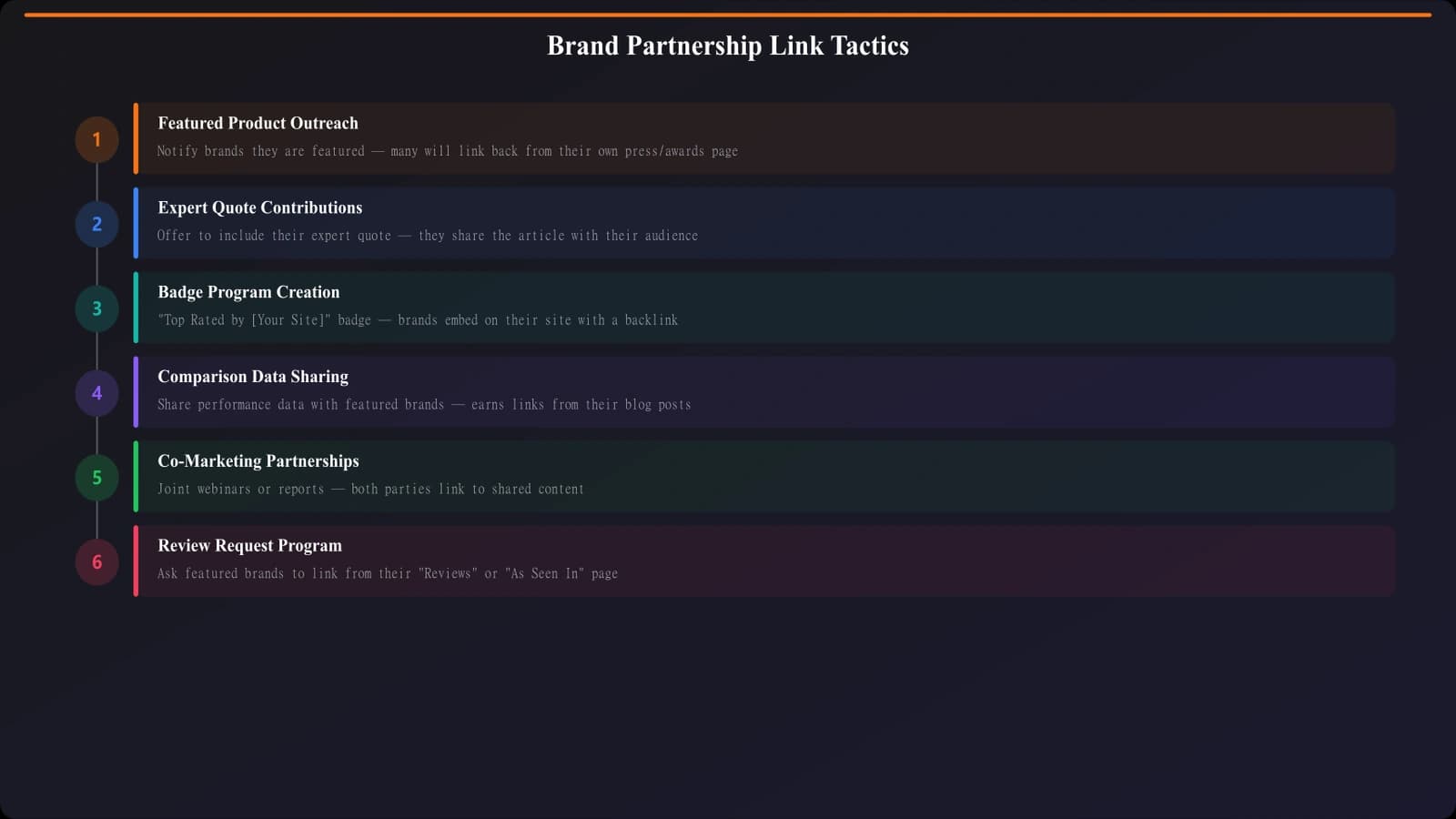
When you feature a product positively in a listicle, you've created value for that brand. Let them know about it—not with a link request, but as a notification of coverage.
The approach that works:
- Publish your listicle with genuinely positive (and accurate) coverage of products
- Email marketing contacts at featured brands: “Hey, thought you'd want to know we featured [Product] in our [Category] roundup”
- Include a quote or screenshot of how you covered them
- Don't ask for a link—just share the coverage
Many brands will share this coverage on social media, include it in their press sections, or link to it from their “reviews” or “as seen in” pages. You're not asking for a link; you're giving them content to share.
Expert Quote Contributions
An even stronger approach: involve brand representatives in your content creation. Reach out before publishing and ask for a quote or insight.
“We're writing a guide on [Category]. Would someone from your team be willing to provide a quote on [relevant topic]?”
When published, you've created content that the brand has a personal stake in promoting. Their quote, their name, their expertise—all featured in your piece. They're far more likely to share and link to content they contributed to.
Creating Award and Badge Programs
Some comparison sites create “winner” badges that featured products can display. G2 does this masterfully with their seasonal award badges. Products want to show they're recognized as leaders, and the badge links back to your comparison.
This works best when your comparison has credibility and methodology. Random blogs can't create meaningful badges. But established comparison sites can create genuine prestige that brands want to display.
Create Link-Worthy Comparison Pages
Build listicles with embedded data, expert quotes, and linkable assets that attract backlinks naturally.
Start Building Free
Embeddable Resources and Tools
Another powerful tactic: create assets within your comparison that others want to embed or reference. These become passive link generators over time.
Embeddable Comparison Charts
A well-designed comparison chart or infographic can travel far beyond your original page. Create visual comparisons that are genuinely useful, then make them easy to embed with attribution.
What makes comparison charts embeddable:
- Clean, professional design that looks good on other sites
- Accurate, current data that others trust
- Clear attribution and embed code
- Responsive sizing that works across contexts
Calculators and Interactive Tools
If your comparison involves pricing or ROI considerations, a calculator tool can become a major link magnet. “CRM Cost Calculator” or “Marketing Automation ROI Calculator” provides utility that pure articles can't match.
These tools get linked because they're genuinely useful. A blogger writing about CRM selection might link to your calculator as a resource for their readers—something they'd never do for a static comparison.
Templates and Downloadable Resources
Create resources that complement your comparison. If you're comparing project management tools, offer a “Project Management Tool Evaluation Checklist” as a downloadable PDF. If you're comparing email tools, offer email templates.
These resources get shared and linked independently, but they live on your comparison page, driving links and traffic back to your listicle.
Content That Transcends the Comparison
The most successful comparison pages include content that goes beyond the comparison itself—educational content that stands on its own and attracts links for its inherent value.
Deep Methodology Sections
A transparent, detailed methodology section can become linkable in its own right. “How we test CRM software” might get cited by others writing about software evaluation best practices.
Make your methodology genuinely valuable: explain your criteria, describe your testing process, discuss the tradeoffs you considered. This isn't just disclosure—it's content that demonstrates expertise.
Buyer's Guide Content
Include substantial “how to choose” content before your actual rankings. This educational component often attracts links from people who aren't interested in your specific product recommendations but value your category expertise.
Sections that work:
- “Key features to consider when choosing [category]”
- “Common mistakes when evaluating [category]”
- “Questions to ask vendors before purchasing”
- “Red flags that indicate a product isn't right for you”
Glossary and Educational Sections
Define industry terms. Explain concepts. Create reference material that helps readers understand the category, not just the products. This content becomes a resource that others link to when explaining the same concepts.
Promotion and Distribution
Even with great linkable assets, you need initial distribution to get content in front of potential linkers. Here's what works for comparison content:
Community and Forum Sharing
Share your comparison in relevant communities—not as self-promotion, but as a genuine resource when people ask comparison questions. Reddit threads, Quora questions, Facebook groups, Slack communities. When someone asks “What's the best CRM for small teams?” your comparison is genuinely helpful.
This builds visibility among the people most likely to link: active community members who also create content.
Journalist Outreach on Trends
When news breaks in your category—funding announcements, acquisitions, product launches—journalists need context. If your comparison is the go-to resource for understanding the category landscape, reach out with a helpful angle.
“I saw you're covering the Salesforce acquisition. We track all major CRM players—happy to provide context on competitive dynamics if helpful.”
Social Media Amplification
Regularly share insights from your comparison on social platforms. Not “check out our listicle!” but specific, interesting data points or observations. This builds awareness and attracts followers who may link to you later.
For the complete framework on scaling your content production while maintaining link-worthy quality, see our pillar guide on Scaling Listicles: More Output Without Quality Loss.
Putting It All Together
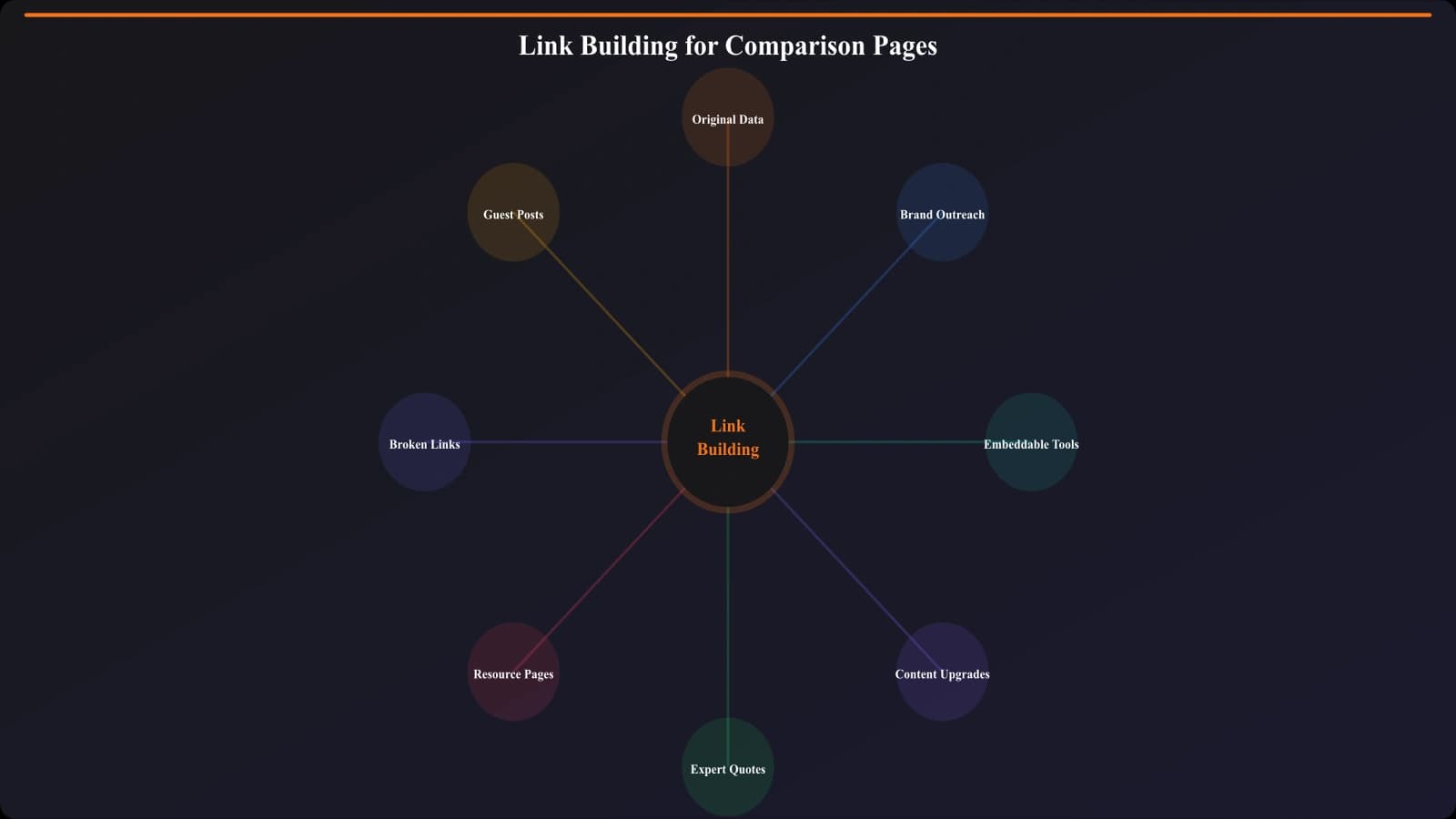
Link building for comparison pages requires a fundamentally different approach than link building for other content types. You're working against the commercial perception of listicles and the missing incentive for linkers. Standard outreach fails because standard listicles offer nothing worth linking to.
The solution is to make your comparison genuinely linkable by adding unique value:
- Original data that makes you the primary source for industry statistics
- Brand partnerships that turn featured products into promotional allies
- Embeddable assets that others want to share and reference
- Educational content that transcends the comparison and demonstrates expertise
Start with one approach. If you can run a simple survey and publish original data, that alone can transform your link profile. Add brand outreach for featured products. Create one embeddable calculator or chart. Each layer compounds the others.
The goal isn't to trick people into linking. It's to create comparison content so genuinely valuable that linking becomes the natural response. When your comparison is the best resource in its category—not just for product rankings, but for understanding the category itself—links follow.
Build content worth linking to, and you'll spend a lot less time asking for links.

Product Manager at BestPage. Pioneer in AEO research since 2024, exploring the convergence of SEO and GEO (Generative Engine Optimization). Led multiple AI-powered content optimization projects that achieved 300%+ citation increases in ChatGPT and Perplexity.