
You've driven traffic to your comparison page. A visitor has read through your recommendations, scrolled past your top picks, and is now moving their cursor toward the browser tab to leave. Should you hit them with an exit intent popup?
The answer is: it depends. Exit intent can recover visitors who were about to bounce without taking action. But poorly executed exit intent damages trust, increases bounce rate, and creates a spammy experience that undermines your content's credibility.
This guide covers when exit intent makes sense for comparison pages, what offers actually work for this context, and how to implement without destroying user experience. For the broader conversion framework, see our CRO for Listicles guide.
Exit Intent on Comparison Pages: The Context
Before deciding whether to use exit intent, understand what makes comparison pages different.
Comparison Page Visitor Intent
Visitors on comparison pages are typically:
- Research phase: Actively evaluating options, not yet ready to buy
- Information-seeking: Want content, not interruptions
- Multi-session: Often return multiple times before converting
- Comparison-focused: Want to compare, not get sidetracked
Why Comparison Visitors Leave
| Reason | Exit Intent Appropriate? |
|---|---|
| Found what they needed, clicking CTA | No—don't interrupt conversion |
| Need more time, will return later | Maybe—offer to save/email the list |
| Content didn't match their needs | Maybe—offer related content |
| Overwhelmed by options | Yes—offer help choosing |
| Price concerns | Yes—offer discount or budget options |
When Exit Intent Works
Exit intent earns its place when it offers genuine value to the departing visitor.
Scenarios Where Exit Intent Helps
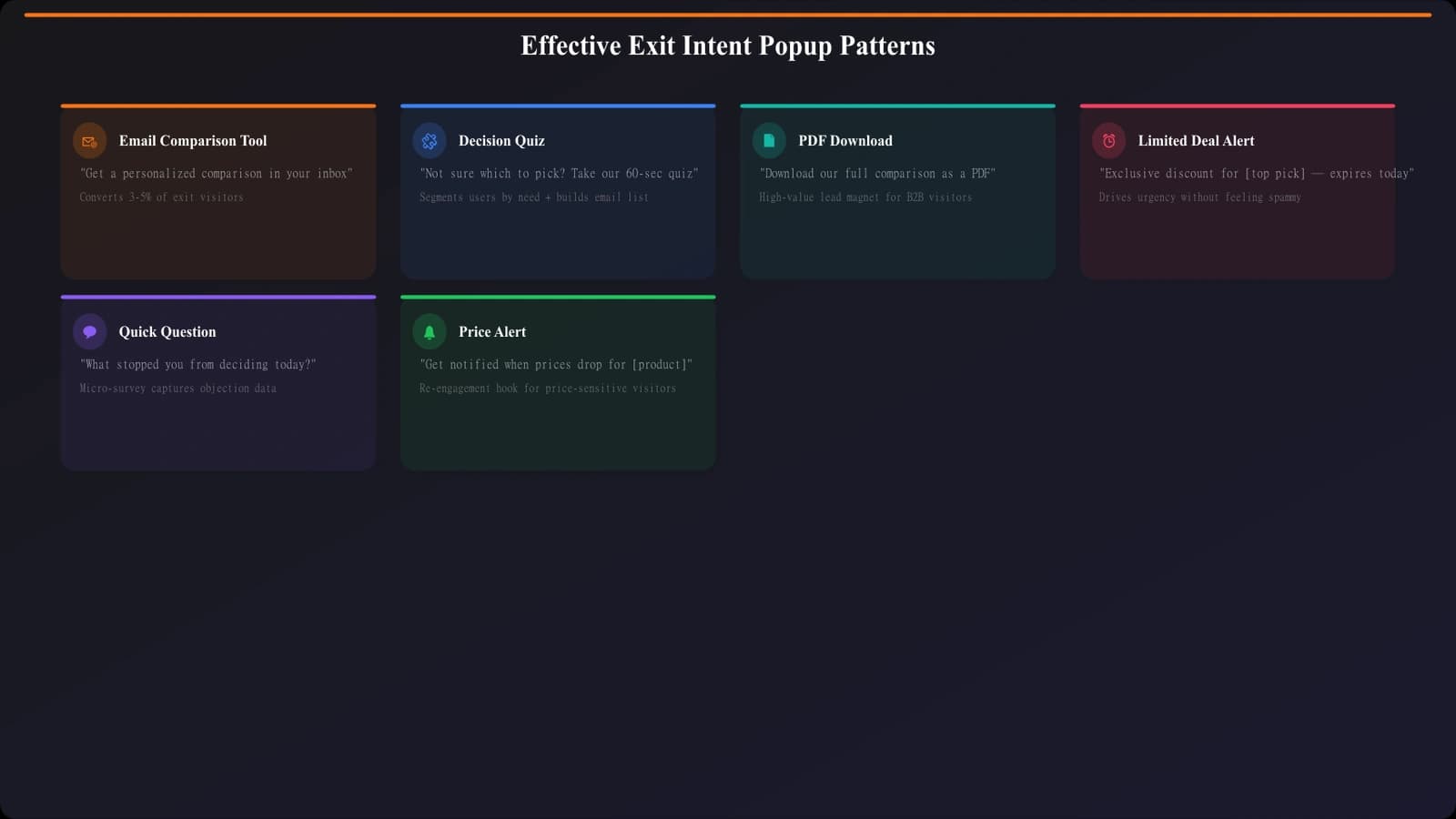
- Save for later: “Email yourself this comparison”—helps multi-session researchers
- Decision support: “Not sure which to choose? Take our quiz”—helps overwhelmed users
- Download comparison: “Get this as a PDF”—useful for enterprise buyers
- Specific discount: “Still deciding? Here's 10% off”—price-sensitive leads
- Related content: “Looking for something different? Try our [related] guide”
Aligning Value with Intent
The offer must match why they came:
- They came to compare → Offer more comparison help
- They came to decide → Offer decision tools
- They came to save money → Offer discounts or budget options
- They came for research → Offer deeper research content
When Exit Intent Hurts
Many exit intent implementations actively damage conversion and trust.
Patterns That Hurt
- Generic newsletter: “Subscribe to our newsletter!”—irrelevant to comparison intent
- Aggressive sales: “Wait! Talk to sales NOW!”—mismatched stage
- Guilt-tripping: “No thanks, I don't want to save money”—manipulative
- Repeated popups: Showing again after dismiss—annoying
- Blocking content: Popup that obscures the comparison—frustrating
- Mobile popups: Exit intent is unreliable on mobile and often intrusive
Trust Damage Assessment
| Behavior | Trust Impact |
|---|---|
| One helpful popup, easy dismiss | Neutral to slightly positive |
| Aggressive or irrelevant offer | Negative—spammy impression |
| Repeated popups | Very negative—annoyance |
| Guilt-trip copy | Severely negative—manipulation |
| Blocking content access | Extremely negative—hostile UX |
Implementation Best Practices
If you decide exit intent is appropriate, implement thoughtfully.
Timing Rules
- Minimum time on page: Don't trigger until 30+ seconds (they should have read something)
- Scroll depth: Consider requiring 50%+ scroll before enabling
- Session frequency: Once per session maximum
- Return visitors: Don't show to returning visitors who dismissed before
Design Guidelines
- Easy dismiss: Large, obvious X button and click-outside-to-close
- Non-blocking: Don't cover the entire viewport
- Fast load: Pre-load popup so it appears instantly
- Mobile consideration: Different approach for mobile (slide-up often better)
Copy Guidelines
- Acknowledge exit: “Before you go...” or “One quick thing...”
- Offer value: Clearly state what they get
- Respect decline: Simple “No thanks” or “Maybe later”—no guilt
- Keep it short: 2-3 sentences maximum
Build High-Converting Listicles
Generate comparison pages with conversion optimization built in—no annoying popups required.
Try for Free
Exit Intent Offers That Work for Comparisons
Here are specific offers proven to work on comparison pages.
1. Email the Comparison
The offer: “Want us to email you this comparison so you can review it later?”
- Why it works: Addresses real need (multi-session research)
- What you get: Email for remarketing
- Low friction: Just email address required
2. Decision Quiz
The offer: “Not sure which is right for you? Take our 2-minute quiz.”
- Why it works: Helps overwhelmed users
- What you get: Qualification data + email
- Higher value: Personalized recommendation
3. PDF Comparison Download
The offer: “Download this comparison as a PDF to share with your team.”
- Why it works: B2B buyers need to share with stakeholders
- What you get: Email + work context signal
- Perceived value: Tangible asset
4. Specific Discount
The offer: “Still comparing? Here's 10% off [your product] to help you decide.”
- Why it works: Addresses price hesitation
- Appropriate when: You sell one of the compared products
- Caution: Don't use if you're an affiliate-only site
5. Related Comparison
The offer: “Looking for something different? Check out our [adjacent category] comparison.”
- Why it works: Helps users who came to wrong page
- What you get: Pageview, possibly better match
- Low friction: Just a link
Measuring Exit Intent Impact
Don't assume exit intent works. Measure carefully.
Metrics to Track
- Popup impression rate: How often does it trigger?
- Conversion rate: What % complete the offer?
- Dismiss rate: What % actively close?
- Post-popup behavior: Do they bounce or continue engaging?
- Email quality: Do captured emails engage/convert?
A/B Testing Approach
- Test popup vs. no popup (is it worth having?)
- Test different offers (which resonates?)
- Test timing (30s vs. 60s minimum)
- Test design variations (modal vs. slide-in)
Warning Signs
- Bounce rate increase: Popup may be annoying rather than helping
- Low email engagement: Captured emails never open—wrong audience
- High dismiss rate: 90%+ dismiss suggests poor offer-match
- Negative feedback: Users complaining about popups
Alternatives to Exit Intent
Exit intent isn't the only way to capture abandoning visitors.
In-Content CTAs
- Strategic placement throughout the page
- Less intrusive than popups
- Always visible, don't require exit trigger
Sticky Email Bar
- Non-intrusive bar at top or bottom
- “Get updates on [category]”
- Visible throughout without interrupting
Retargeting Ads
- Capture via pixel, reach later via ads
- No on-page interruption
- Multiple touchpoints opportunity
Exit Intent Done Right
Exit intent on comparison pages is a tool—not inherently good or bad. Used thoughtfully, it recovers value from abandoning visitors. Used poorly, it damages your brand and drives users away.
Key principles:
- Match offer to intent: Comparison visitors want comparison help
- Respect the user: Easy dismiss, no guilt trips, once per session
- Add genuine value: Email comparison, quiz, PDF—not generic newsletter
- Time appropriately: Minimum time and scroll before triggering
- Measure impact: Test whether it's helping or hurting
- Consider alternatives: In-content CTAs may work better
If you can't clearly articulate the value your exit popup provides to departing visitors, don't use one. The damage from annoying users outweighs marginal lead capture.
For the complete conversion optimization framework, see our CRO for Listicles guide. For other trust-building approaches, explore our guide on social proof in listicles.

Product Manager at BestPage. Pioneer in AEO research since 2024, exploring the convergence of SEO and GEO (Generative Engine Optimization). Led multiple AI-powered content optimization projects that achieved 300%+ citation increases in ChatGPT and Perplexity.