
International SEO is complex enough for individual pages. Now multiply that by thousands or tens of thousands of programmatic pages, each potentially needing variants across multiple languages and regions. A 10,000-page PSEO site with 5 language variants means managing 50,000 URLs and their inter-relationships—a scale where manual hreflang management is impossible.
The good news: PSEO's template-based nature makes systematic hreflang implementation practical. If your templates generate consistent URL patterns, you can generate correct hreflang annotations programmatically. The challenge is getting the logic right once, then validating at scale.
This guide covers hreflang implementation for programmatic comparison sites: architecture decisions, common mistakes at scale, and validation approaches that work for large page counts.
Hreflang Fundamentals for PSEO
Before tackling scale-specific challenges, ensure fundamental hreflang concepts are clear.
What Hreflang Actually Does
Hreflang tells search engines about language and regional variants of a page. It's not a redirect mechanism—it helps Google show the right version to users in different locations or languages. Key points:
- Signals, not directives: Google treats hreflang as a signal, not a command. Other factors also influence which version appears.
- Requires reciprocity: Every page must link to all variants, including itself. A pointing to B without B pointing back creates errors.
- Language vs region: “en” means English generally; “en-US” means English for United States users specifically.
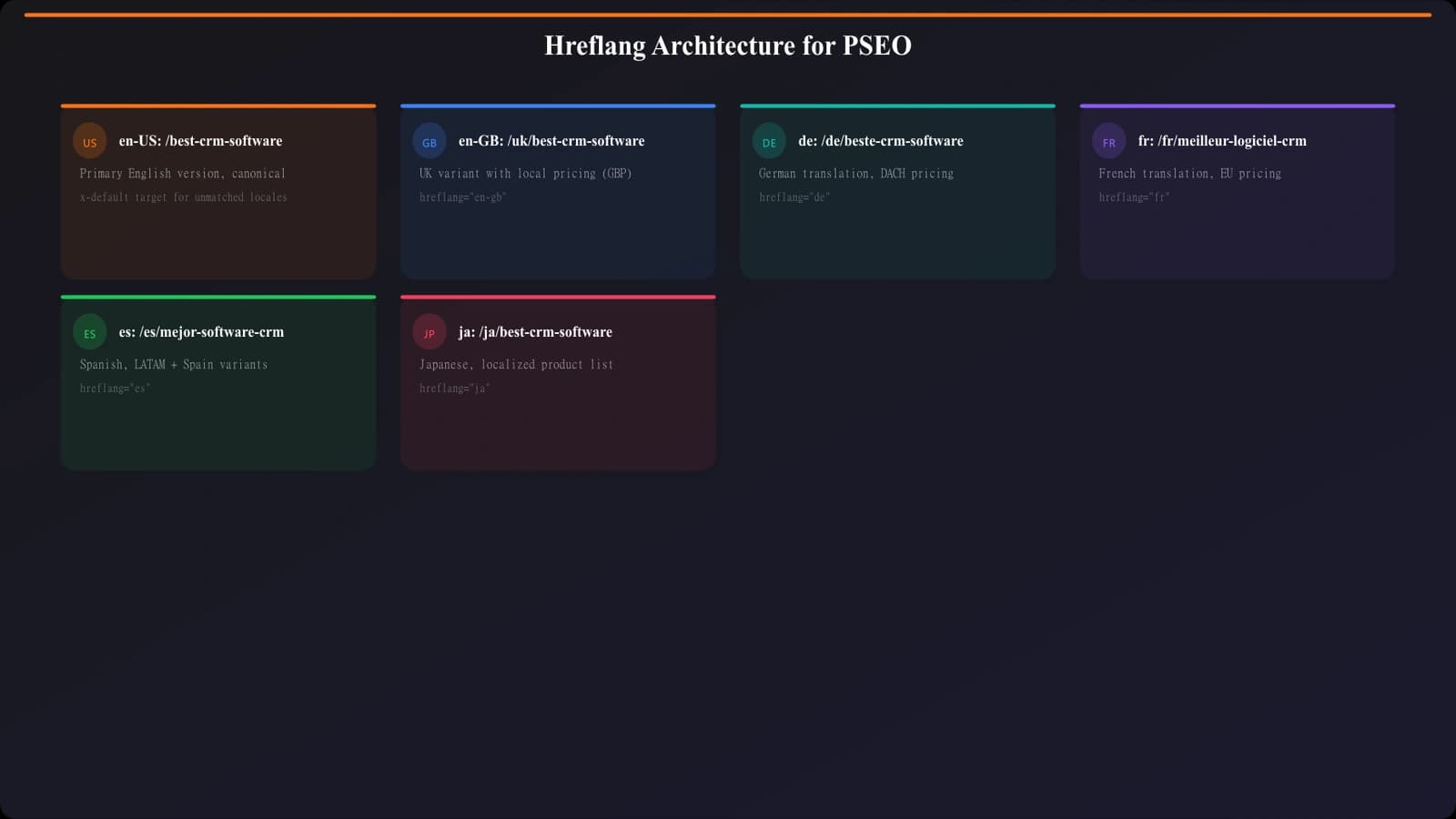
- x-default: The fallback version for users not matching any specified variant.
PSEO-Specific Challenges
Programmatic sites face unique hreflang challenges:
- Partial translations: Not every page exists in every language. Product X might have English and Spanish pages but not German.
- Data availability: Some products only available in certain regions—no reason to create regional pages.
- URL structure consistency: Ensuring URL patterns are predictable across languages for systematic annotation.
- Scale validation: Can't manually check 50,000 pages for hreflang errors.
- Dynamic changes: Adding new pages or languages must automatically update hreflang throughout.
Implementation Approaches
Three main methods for implementing hreflang at scale, each with trade-offs.
HTML Link Tags
Adding hreflang via link tags in the page head:
HTML implementation:
• Include in page head section
• Each page lists all its variants (including itself)
• Generated dynamically from your PSEO data layer
• Advantage: crawled with every page visit
• Disadvantage: adds to HTML size; requires page generation for updates
For PSEO sites, HTML link tags work well when you're already dynamically generating pages. The hreflang becomes part of your template logic.
XML Sitemap Hreflang
Declaring hreflang relationships in XML sitemaps instead of (or in addition to) page HTML:
Sitemap implementation:
• Use xhtml:link elements within url entries
• Can update hreflang without regenerating pages
• Easier bulk management for large sites
• Must still include self-referencing links
• Sitemap file size limits (50MB/50,000 URLs) may require splitting
Sitemap-based hreflang is often preferred for PSEO because it centralizes the logic and can be updated independently of page content.
HTTP Headers
Setting hreflang via HTTP headers (primarily for non-HTML content like PDFs):
Less common for HTML pages but useful if you have programmatic PDF comparisons or other non-HTML content that needs language variants.
Common PSEO Hreflang Patterns
Different international structures require different hreflang approaches.
| URL Structure | Example | Hreflang Pattern | Considerations |
|---|---|---|---|
| Subdirectory | /en/tool-x, /es/tool-x | Replace language prefix | Most common; easy to map |
| Subdomain | en.site.com, es.site.com | Replace subdomain | Each subdomain crawled separately |
| ccTLD | site.com, site.es | Replace TLD | Strongest regional signal; complex management |
| Parameter | site.com?lang=en | Change parameter value | Not recommended; harder to crawl |
| Hybrid | /en-us/, /en-gb/, /es-mx/ | Language-region combinations | Most complex; careful planning needed |
For most PSEO sites, subdirectory structure offers the best balance of simplicity and control. The hreflang logic becomes a straightforward string replacement in URL generation.
Generate International Comparisons at Scale
Build multilingual listicles with proper hreflang implementation built in.
Try for Free
Validation at Scale
With thousands of pages, you need automated validation to catch hreflang errors.
Automated Validation Approaches
Build validation into your PSEO pipeline:
- Reciprocity check: For every hreflang link A→B, verify B→A exists
- Self-reference check: Every page should include hreflang to itself
- URL validity: Every referenced URL should return 200 status
- Language code validity: All language-region codes follow ISO standards
- x-default presence: Verify x-default is specified for each cluster
Run these validations on every deployment, not just occasionally. Errors compound quickly at scale—one broken template creates thousands of hreflang errors.
Search Console Monitoring
Google Search Console reports hreflang issues. For PSEO sites:
Search Console hreflang monitoring:
• Check International Targeting report regularly
• Look for “no return tag” errors indicating reciprocity failures
• Monitor for unknown language codes
• Track which pages are being indexed in which country versions
• Set up alerts for sudden spikes in hreflang errors
A sudden increase in hreflang errors after a deployment signals template-level problems that affect many pages simultaneously.
Scaling International SEO
Hreflang at PSEO scale is fundamentally an automation and validation problem. The concepts are the same as for any site—you just can't implement or validate manually. Build hreflang generation into your templates, validate systematically on every deployment, and monitor Search Console for issues that slip through.
Start with simple structures: subdirectory-based language variants with consistent URL patterns. Add complexity (regional variants, partial translations) only when necessary, and extend your validation to cover each new complexity.
For general PSEO crawl debugging, see Log File Analysis for PSEO. For technical audit processes, see Technical Audit Checklist.

Product Manager at BestPage. Pioneer in AEO research since 2024, exploring the convergence of SEO and GEO (Generative Engine Optimization). Led multiple AI-powered content optimization projects that achieved 300%+ citation increases in ChatGPT and Perplexity.