10 Best Enterprise Marketing Automation Platforms in 2026
Enterprise marketing automation goes far beyond email drips. These platforms handle complex multi-channel orchestration, account-based marketing, predictive analytics, and governance for global teams. We evaluated 14+ platforms to find the best for sophisticated marketing operations.
Marketo Engage remains the gold standard for B2B marketing automation. Its strength lies in sophisticated lead management—scoring, nurturing, and routing based on behavioral and demographic data. Account-Based Marketing features target buying committees at named accounts. Revenue attribution connects marketing activities to pipeline and closed-won revenue. The platform excels at complex, multi-touch B2B journeys.
Strengths
Industry-leading B2B lead management
Advanced revenue attribution modeling
Account-Based Marketing capabilities
Deep Salesforce and CRM integrations
Robust program and campaign structure
Limitations
Steep learning curve
Expensive implementation costs
UI feels dated in places
Complex reporting requires expertise
Who it's for: Best for B2B enterprises with complex sales cycles, multiple products, and large marketing operations. Ideal when revenue attribution and sales alignment are critical.
Salesforce Marketing Cloud offers the most powerful journey orchestration in the industry. Journey Builder creates sophisticated customer journeys spanning email, SMS, mobile push, advertising, and more. Einstein AI provides predictive insights and optimization. Data Cloud (CDP) unifies customer data across touchpoints. The platform shines for B2C and complex B2B2C scenarios.
Strengths
Most powerful journey orchestration
Native Salesforce CRM integration
Einstein AI for predictions and optimization
Data Cloud (CDP) for unified customer profiles
Advertising Studio for paid media
Limitations
Very complex to implement fully
Modular pricing adds up quickly
Requires certified specialists
Long implementation timelines
Who it's for: Ideal for large enterprises already on Salesforce who need sophisticated multi-channel journey orchestration. Best when budget allows for proper implementation.
HubSpot Enterprise brings enterprise capabilities with HubSpot's signature ease of use. ABM tools, advanced reporting, hierarchical teams, and custom objects handle complex requirements. The unified CRM means marketing, sales, and service share one customer view. Adoption is faster than traditional enterprise platforms.
Strengths
Easiest enterprise platform to learn
Marketing, sales, service unified
ABM tools and target accounts
Custom objects for data flexibility
Strong content management
Limitations
Less depth than specialized tools
Revenue attribution is good but not best-in-class
Some features require multiple Hub purchases
Can be limiting for very complex orgs
Who it's for: Best for growing enterprises that value ease of use and unified marketing-sales operations. Ideal when fast adoption matters more than maximum feature depth.
Oracle Eloqua is built for global B2B enterprises with complex requirements. Its Campaign Canvas enables sophisticated multi-step campaigns with advanced logic. Lead scoring and profiling handle intricate qualification criteria. Global teams benefit from multi-language support, workspaces, and governance controls.
Starting priceCustom
Strengths
Enterprise-grade scalability
Sophisticated Campaign Canvas
Global compliance and governance
Deep Oracle ecosystem integration
Advanced lead profiling
Limitations
Significant implementation investment
Steeper learning curve
Best with Oracle CRM/stack
Premium pricing
Who it's for: Ideal for large global B2B enterprises with complex compliance requirements. Best when Oracle CRM or ecosystem is already in place.
Pardot (now Salesforce Account Engagement) provides B2B marketing automation native to Salesforce. Engagement Studio builds sophisticated nurture tracks. Lead scoring syncs with Salesforce opportunities. Einstein AI adds predictive scoring and behavior insights. It's the natural choice for Salesforce B2B customers.
Strengths
Native Salesforce integration
Engagement Studio for nurturing
Einstein AI for B2B
Strong lead scoring
Salesforce reporting
Limitations
B2B focused (less suited for B2C)
Some features need higher tiers
Less flexible than Marketo
Marketing Cloud overlap confuses
Who it's for: Perfect for B2B companies on Salesforce CRM who want native integration without third-party connectors. Best for lead nurturing and sales alignment.
Adobe Campaign enables true omnichannel orchestration including email, SMS, direct mail, and connected devices. Integration with Adobe Experience Cloud (Analytics, Target, Real-Time CDP) creates a unified experience platform. Workflow automation handles complex campaign logic. It's designed for brands that need consistency across digital and physical channels.
Starting priceCustom
Strengths
True omnichannel including direct mail
Adobe Experience Cloud integration
Real-Time CDP connection
Workflow automation power
Personalization at scale
Limitations
Complex implementation
Best value in Adobe stack
Expensive standalone
Requires technical resources
Who it's for: Best for enterprises already invested in Adobe Experience Cloud who need omnichannel coordination across digital and physical touchpoints.
Dynamics 365 Marketing brings marketing automation to Microsoft ecosystem companies. Customer journey orchestration, event management, and lead scoring integrate natively with Dynamics CRM. Customer Insights (CDP) unifies data across sources. The platform works seamlessly with Teams, Outlook, and Power Platform.
Strengths
Native Dynamics CRM integration
Built-in event management
Customer Insights (CDP)
Power Platform extensibility
Microsoft ecosystem synergy
Limitations
Best in Microsoft stack
Less mature than leaders
B2B focused
Feature gaps vs. Marketo/SFMC
Who it's for: Ideal for enterprises on Microsoft Dynamics 365 CRM and the Microsoft ecosystem. Best when unified Microsoft stack is a priority.
SAP Emarsys specializes in e-commerce marketing automation with deep personalization. Pre-built tactics for e-commerce scenarios (cart abandonment, replenishment, loyalty) accelerate time-to-value. AI-powered personalization optimizes content and timing. Integration with SAP Commerce Cloud enables unified commerce experiences.
Starting priceCustom
Strengths
E-commerce specialization
Pre-built retail tactics
AI-driven personalization
SAP Commerce integration
Omnichannel engagement
Limitations
Best for e-commerce/retail
SAP ecosystem focus
Less suited for pure B2B
Complex for non-SAP shops
Who it's for: Best for large e-commerce and retail enterprises, especially those on SAP Commerce Cloud. Ideal when pre-built e-commerce tactics provide value.
Braze leads in mobile-first customer engagement. Push notifications, in-app messages, and Content Cards work alongside email and SMS. Real-time data streaming enables instant personalization. The platform is built for consumer apps, media, and digital-first brands that prioritize mobile experience.
Starting priceCustom
Strengths
Best-in-class mobile engagement
Real-time personalization
Cross-channel orchestration
Modern API-first architecture
Strong for consumer apps
Limitations
Mobile-first focus
Less B2B-oriented
Pricing for enterprise only
Requires technical implementation
Who it's for: Perfect for consumer brands, media companies, and apps where mobile engagement is critical. Best when real-time messaging drives the experience.
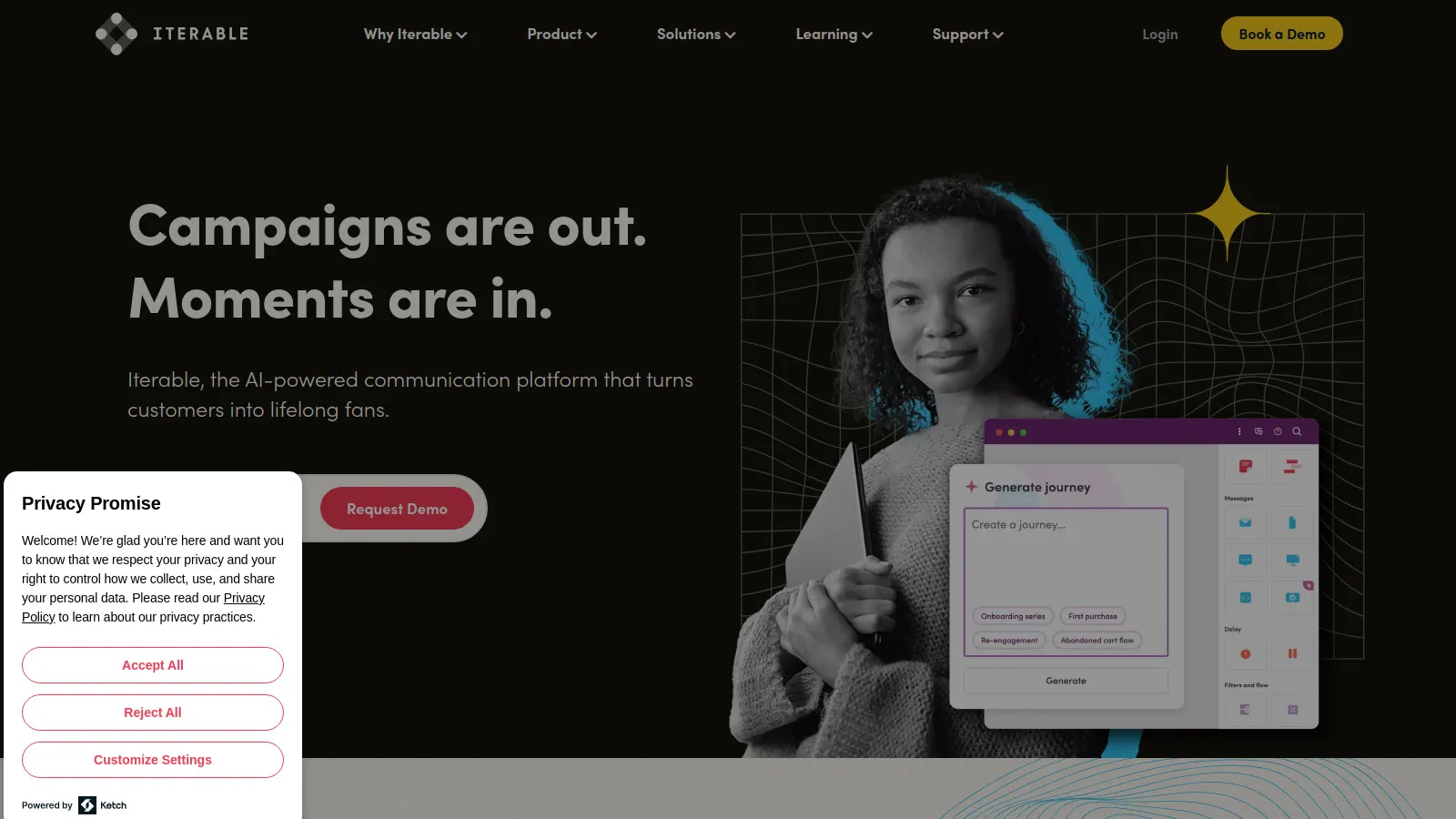
Iterable provides modern marketing automation with flexible data architecture and AI optimization. The platform handles email, push, SMS, and in-app from one place. AI-powered Send Time Optimization and content recommendations improve performance automatically. Its modern stack appeals to technical marketing teams.
Starting priceCustom
Strengths
Modern flexible architecture
AI-powered optimization
Cross-channel from one platform
Flexible data model
Developer-friendly APIs
Limitations
Less brand recognition
B2C focused
Smaller ecosystem than leaders
Growing feature parity
Who it's for: Best for modern B2C and digital-native enterprises that want a fresh platform without legacy constraints. Ideal for technical marketing teams.
We assessed enterprise platforms based on capabilities needed for complex marketing operations:
Orchestration Power (25%) — Multi-channel campaign orchestration, journey building, and cross-channel coordination.
Scalability & Performance (20%) — Ability to handle millions of contacts, high email volumes, and global operations.
Integration Ecosystem (20%) — CRM integration depth, API capabilities, and ecosystem connectivity.
Analytics & Attribution (20%) — Revenue attribution, ROI reporting, and predictive analytics capabilities.
Governance & Security (15%) — Role-based access, audit trails, compliance features, and data governance.
How to Choose
Choose Marketo Engage if you need Complex B2B marketing.
Choose Salesforce Marketing Cloud if you need Salesforce CRM (multi-channel).
Choose Pardot if you need Salesforce CRM (B2B focus).
Choose HubSpot Enterprise if you need Fast enterprise adoption.
Choose Oracle Eloqua if you need Global B2B operations.
Choose Adobe Campaign if you need Adobe Experience Cloud.
Choose Dynamics 365 Marketing if you need Microsoft Dynamics.
Choose SAP Emarsys if you need E-commerce enterprise.
Choose Braze if you need Mobile-first brand.
Choose Iterable if you need Modern B2C company.
Common Questions
Typical enterprise implementations take 3-6 months for basic functionality, 6-12 months for full deployment with integrations. Simpler platforms like HubSpot can be faster. Plan for change management and training time.
Platform licensing is just part of the cost. Budget for implementation (often 1-2x license cost), integrations, training, and ongoing administration. Total first-year investment often ranges from $100K to $500K+ for enterprises.
It depends on data complexity. If customer data lives in many systems and you need unified profiles for personalization, a CDP helps. Some platforms (Salesforce, Dynamics) include CDP capabilities. Others integrate with standalone CDPs.
Marketo excels at B2B lead management and revenue attribution. Marketing Cloud shines at B2C journey orchestration and omnichannel. Your CRM choice matters—Salesforce MC integrates best with Salesforce, while Marketo works well with any CRM.