
FAQ schema has become one of the most abused structured data types on the web. Somewhere along the way, SEOs discovered that FAQ rich results could dramatically expand their SERP real estate—and the race to the bottom began.
The result? Google has become increasingly skeptical of FAQ markup. In 2023, they significantly reduced FAQ rich result visibility. And their algorithms have gotten much better at detecting when FAQ schema is being used manipulatively versus legitimately.
For comparison pages, this creates a dilemma. Genuine FAQs are actually common on this content type—people really do have questions about how to choose, what the differences are, who should pick what. But if you implement FAQ schema poorly, you risk looking spammy rather than helpful.
This guide covers when FAQ schema genuinely helps comparison pages, when it hurts, and how to implement it correctly when you do use it.
When FAQ Schema Actually Helps
Let's start with the legitimate use cases. FAQ schema genuinely benefits your comparison pages in these scenarios.
Genuine User Questions
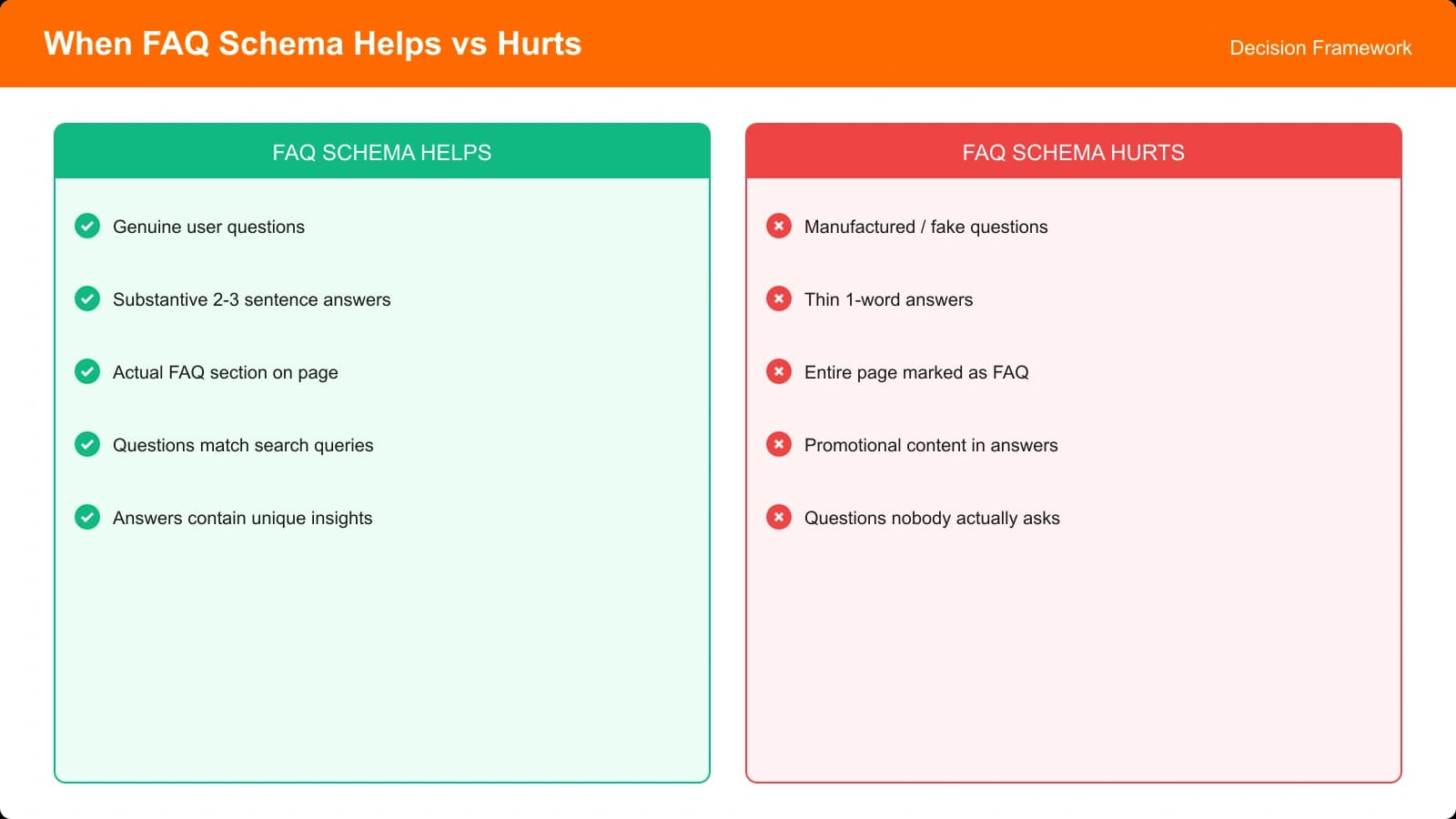
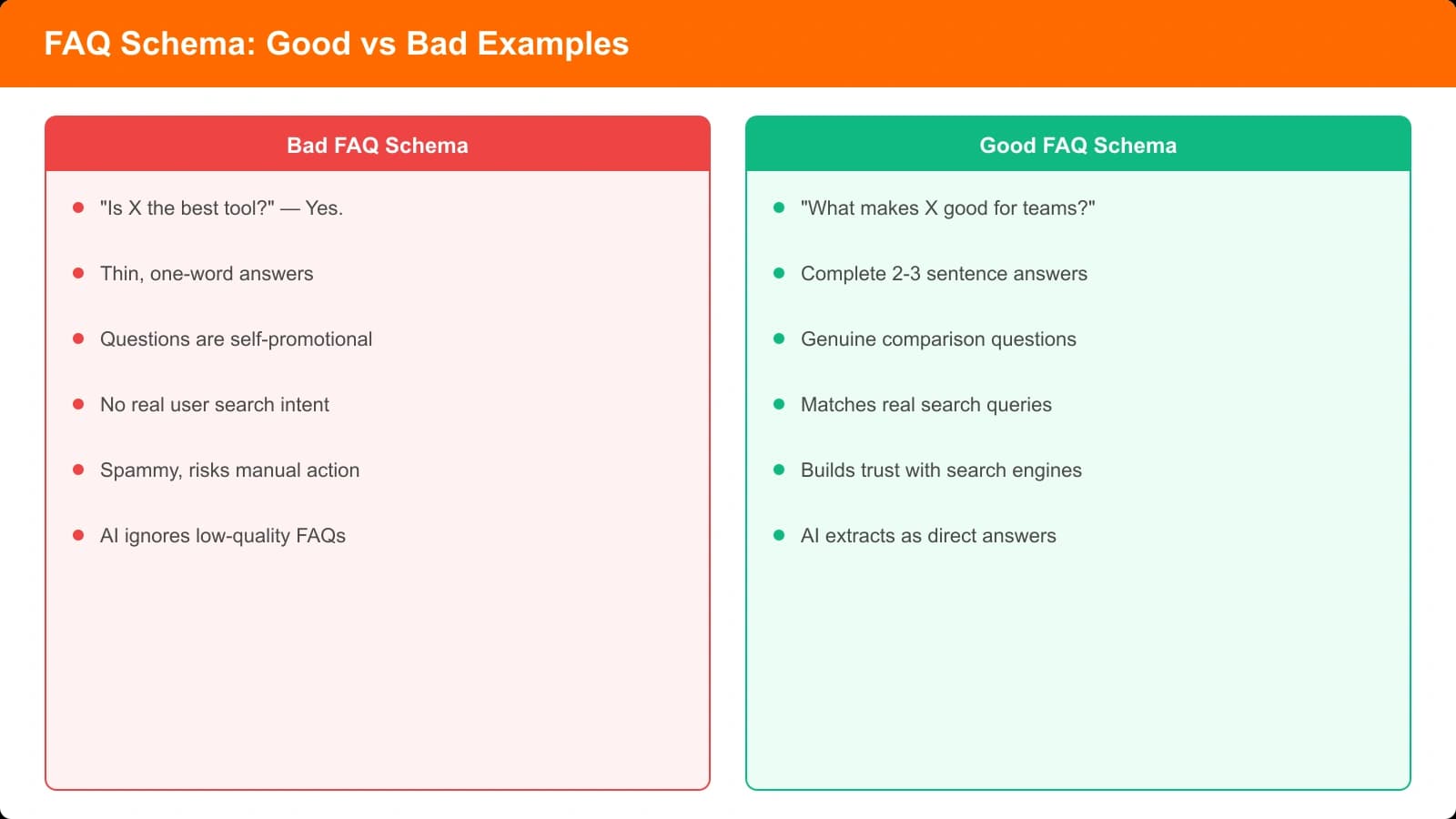
The most obvious case: you have a dedicated FAQ section answering questions users actually ask. Not questions you invented for SEO purposes—questions that appear in your customer support tickets, your site search logs, your “People Also Ask” research.
Examples of genuine questions for a CRM comparison page:
- “What's the difference between CRM and marketing automation?”
- “How long does CRM implementation typically take?”
- “Do I need a CRM if I'm a solo entrepreneur?”
- “What happens to my data if I switch CRMs?”
These are questions someone researching CRMs would genuinely have. The answers add value beyond what's in your main comparison content. That's the test: does this FAQ section serve users who read the whole page, or is it just reformatted content?
Substantive Answers
FAQ schema only helps when the answers are actually helpful. Google's documentation explicitly states that FAQ answers should be complete—not teasers that require clicking through to learn more.
Good FAQ answers are typically 2-4 sentences. Long enough to actually answer the question, short enough to be digestible. If your answer requires a paragraph of context before even addressing the question, it might be better as a regular content section.
AI Search Citation Benefits
Beyond traditional SERP visibility, FAQ schema helps AI systems understand your content structure. When Perplexity, ChatGPT, or Google SGE encounters a well-structured FAQ, they can extract and cite specific Q&A pairs more accurately.
This matters for comparison content because AI responses often synthesize information from multiple sources. A clearly marked FAQ gives AI systems confidence about what your page definitively states—increasing the likelihood of accurate citation.
When FAQ Schema Hurts
Now the cautionary tales. These patterns will either get your FAQ markup ignored or actively hurt your site's quality perception.
Manufactured Questions
The biggest red flag: questions that aren't really questions. “What are the features of [Product]?” isn't a question users ask—it's your features section reformatted as a question. “Why should I read this comparison?” is obviously self-serving.
Google's systems are good at detecting this pattern. When your “questions” are really just headings rephrased with question marks, you're signaling that you're gaming the system rather than serving users.
Marking Your Entire Page as FAQ
Some sites mark their entire comparison content as FAQ—every section becomes a question-answer pair. This is almost always inappropriate.
FAQ schema is for frequently asked questions, not for all content that could theoretically be phrased as Q&A. A comparison page is primarily an Article or ItemList, with potentially a small FAQ section embedded. Making the whole thing FAQ misrepresents your content type.
| Content Type | Appropriate Schema | FAQ Schema? |
|---|---|---|
| Main comparison content | Article + ItemList | No |
| Product descriptions | Product schema | No |
| Actual FAQ section | FAQPage schema | Yes |
| Methodology explanation | Part of Article | No |
Thin or Promotional Answers
Answers that don't actually answer the question—either because they're too brief or because they pivot to promotion—undermine trust. “Q: How do I choose the right CRM? A: Check out our comparison above!” adds no value.
Similarly, answers that are just calls-to-action in disguise hurt more than help. Users (and AI systems) can tell when your “FAQ” is really just a sales funnel.
Generate Schema-Ready Comparison Pages
Create listicles with proper structured data—FAQ, ItemList, and Product schema implemented correctly.
Try for Free
Implementing FAQ Schema Correctly
When you do have legitimate FAQ content, here's how to implement the schema properly.
Proper Structure
FAQ schema uses the FAQPage type with nested Question and Answer entities. The structure matters—improperly nested schema gets ignored or misinterpreted.
Key requirements:
- Use FAQPage as the containing type
- Each question needs both “name” (the question) and “acceptedAnswer” (the answer object)
- Answer text goes in the “text” property of the Answer object
- HTML is allowed in answers but keep it simple—basic formatting only
Where to Place FAQ Schema
For comparison pages, FAQ schema should correspond to a visible FAQ section on the page. Don't add FAQ schema for content that isn't visually presented as Q&A.
Common placement pattern: a dedicated “Frequently Asked Questions” section near the bottom of your comparison, after the main product content but before the conclusion. This section gets FAQ schema; the rest of the page uses Article/ItemList schema.
Validation
Always validate your FAQ schema using Google's Rich Results Test before publishing. Common errors include:
- Missing required properties (usually the answer text)
- Improper nesting of Question/Answer objects
- Invalid HTML in answer text
- Duplicate questions
After publishing, monitor Search Console's Enhancements report for FAQ. Any errors or warnings will appear there. Address issues promptly—schema errors can affect how Google perceives your overall technical quality.
Alternatives to FAQ Schema
If your content doesn't genuinely fit the FAQ format, consider other structured data options that might be more appropriate.
HowTo schema works well for procedural content—“How to choose the right CRM” can be structured as steps rather than Q&A.
ItemList schema is specifically designed for listicles and rankings—often more appropriate than FAQ for comparison content.
Review/AggregateRating captures the evaluative aspect of comparisons without forcing Q&A structure.
For comprehensive guidance on structured data options for comparison pages, see our guides on Rating Schema for Listicles and JSON-LD Templates for Best-Of Pages.
The Strategic Approach
FAQ schema isn't inherently good or bad for comparison pages—it depends entirely on whether you have genuine FAQ content worth marking up.
Ask yourself: if you removed the schema entirely, would users still find value in your FAQ section? If yes, the schema just helps search engines understand what you already have. If no—if the FAQ section only exists for schema benefits—you're on thin ice.
The safest approach is to build your FAQ section based on actual user questions first, then add schema to what you've created. Never start with “how can I use FAQ schema?” and work backward to content. That approach almost always produces the kind of manufactured Q&A that hurts rather than helps.
For the broader picture of how structured data helps AI systems understand your comparison content, see our guide on Structured Data for Listicles.

Product Manager at BestPage. Pioneer in AEO research since 2024, exploring the convergence of SEO and GEO (Generative Engine Optimization). Led multiple AI-powered content optimization projects that achieved 300%+ citation increases in ChatGPT and Perplexity.