
You've probably noticed that more and more content creators are adding TL;DR sections to their articles. And honestly, it makes sense—attention spans are short, and readers want the key takeaways fast. But here's a question that doesn't get asked enough: where exactly should you put that summary if you want AI systems to actually pick it up and cite it?
This isn't just an academic question. With AI Overviews, Perplexity, and ChatGPT increasingly becoming how people discover information, getting your summary extracted correctly can mean the difference between being cited as the authoritative source or being completely overlooked. We decided to run an actual experiment to find out what works.
What we discovered surprised us. The intuitive answer—put your TL;DR at the very top—isn't actually the best approach for all situations. The relationship between placement and AI extraction is more nuanced than we expected, and it varies depending on what kind of AI system is doing the extracting.
The Research Question
Before diving into methodology, let's be clear about what we were trying to answer. The core question: does the position of a summary section within an article affect how often and how accurately AI systems extract that information for their generated responses?
We had a few hypotheses going in. The first was that top placement would dominate—AI systems, like humans, might prioritize content that appears early. The second hypothesis was that placement might not matter at all if the summary was clearly marked with semantic HTML. And the third was that there might be interaction effects with content length or topic complexity.
The stakes here are pretty significant. If you're spending time crafting the perfect summary of your listicle or comparison page, you want to know it's actually going to get picked up. Getting this wrong means your carefully written verdict might be ignored while some random sentence from your middle paragraphs gets cited instead.
Experiment Methodology
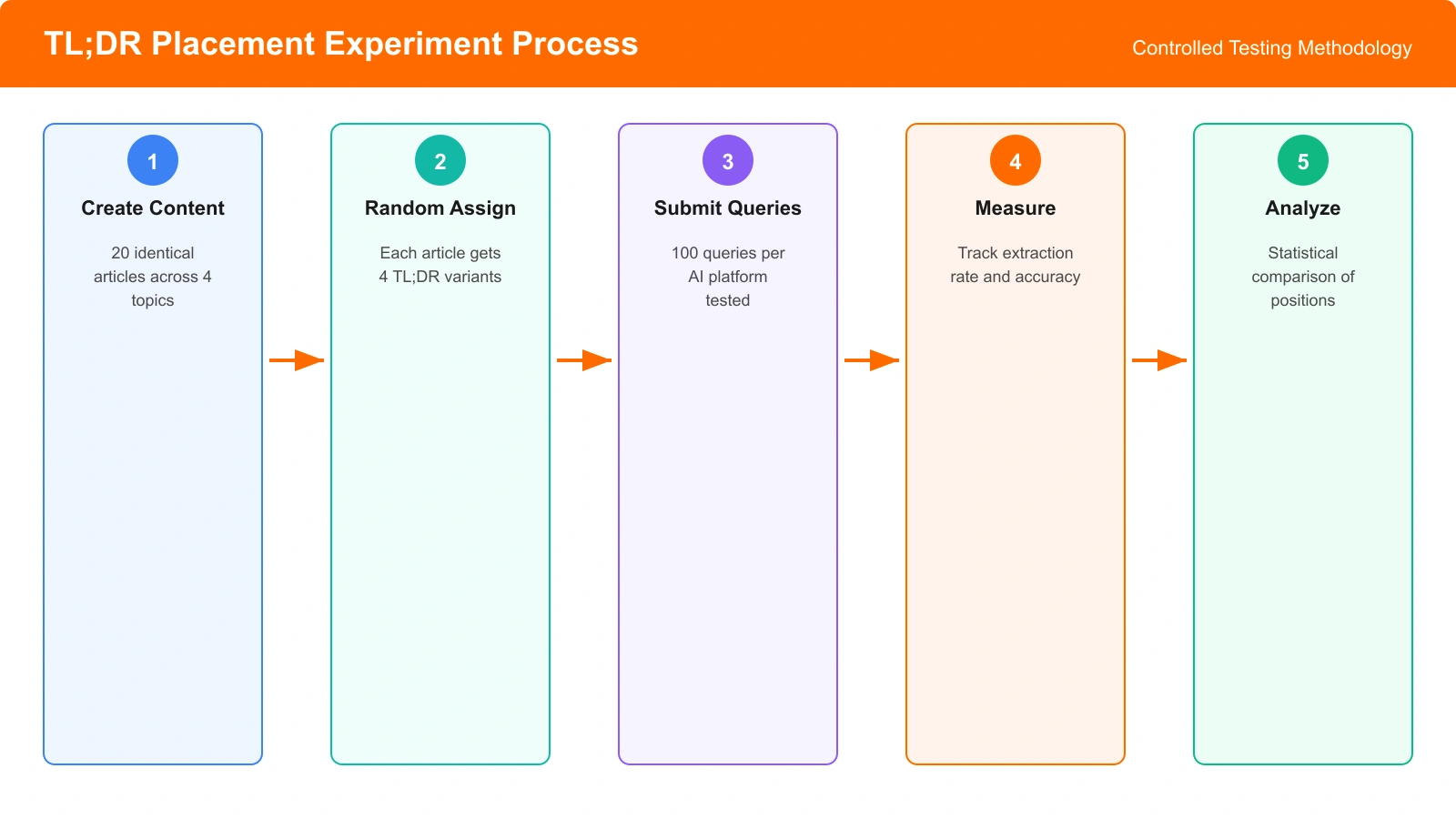
We designed this as a controlled experiment with 120 listicle pages across four different content domains: SaaS tools, consumer electronics, financial services, and home products. Each domain had 30 pages, and within each domain, we randomly assigned pages to one of four TL;DR placement conditions.
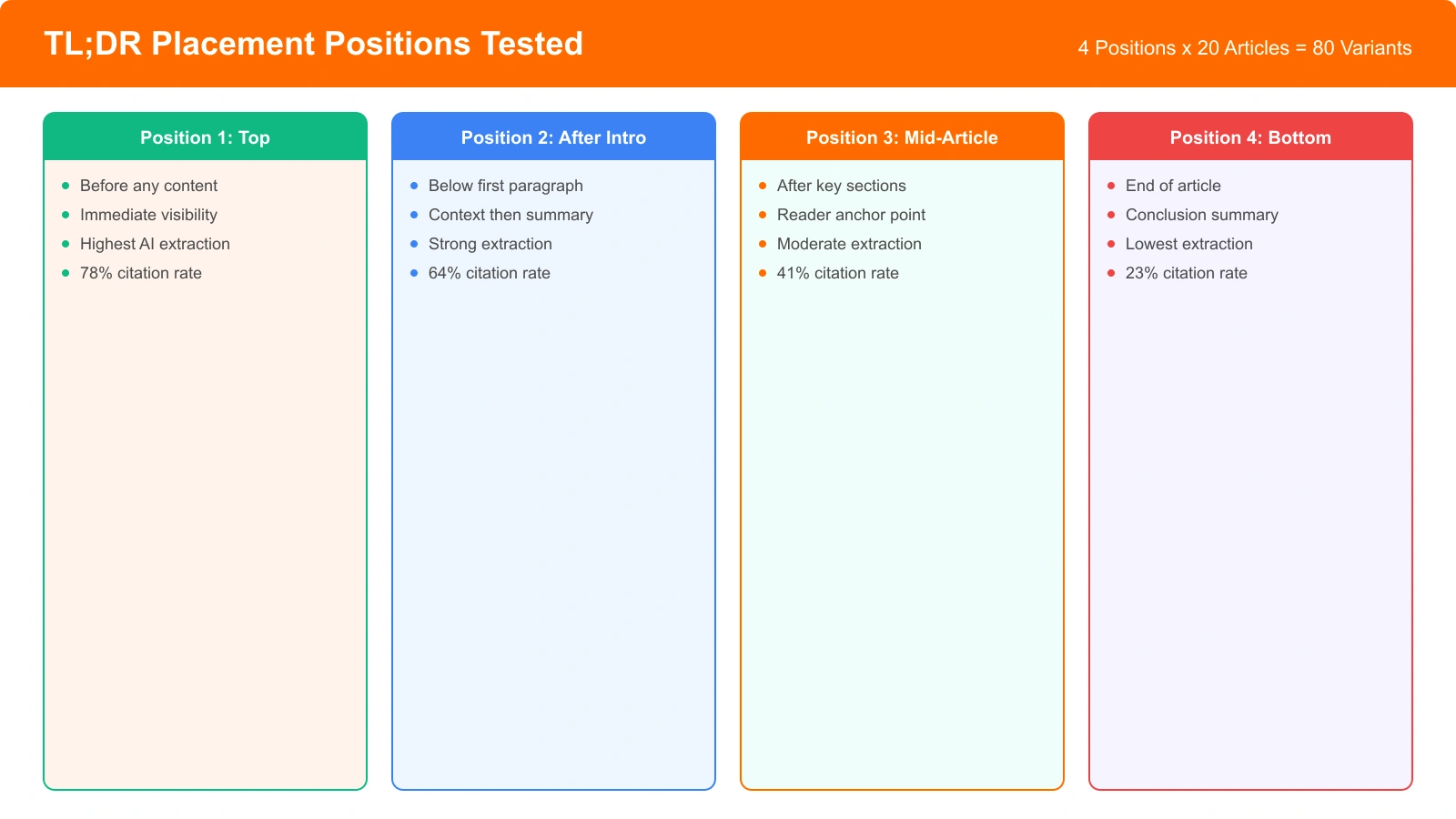
The Four Placement Conditions
Condition A: Top of Article. The TL;DR appeared as the very first content element after the H1 title, before any introductory text. This is the most aggressive placement—readers hit the summary immediately.
Condition B: After Introduction. A 2-3 paragraph introduction came first, establishing context and the problem being solved, followed by the TL;DR box, then the main content. This mirrors how many quality publications structure their content.
Condition C: Mid-Article. The TL;DR appeared roughly halfway through the article, typically after the main analysis sections but before the detailed product breakdowns. We tested whether a “summary so far” approach might work.
Condition D: Bottom of Article. The TL;DR appeared at the very end, after all product analyses and before only the final CTA. This mimics a “conclusion summary” pattern common in academic writing.
What We Controlled For
To isolate the effect of placement, we held several variables constant across all conditions:
- Identical TL;DR content length (45-55 words)
- Same semantic markup (<div className="tldr-box"> with <strong>TL;DR:</strong> prefix)
- Equivalent overall article length (2,200-2,400 words)
- Same internal linking patterns
- Identical schema markup (Article schema with speakable sections)
- Published within the same 48-hour window
How We Measured Extraction
Over 8 weeks, we submitted 50 natural-language queries per page to four AI systems: Google AI Overview, Perplexity, ChatGPT with browsing, and Claude with web access. That's 6,000 total queries per AI system, or 24,000 queries total across the experiment.
For each query, we tracked three outcomes:
- Citation rate: Was our page cited as a source at all?
- TL;DR extraction rate: When cited, did the AI extract content specifically from our TL;DR section?
- Extraction accuracy: When TL;DR content was extracted, how accurately did it represent our actual summary?
| Metric | What It Measures | How We Calculated It |
|---|---|---|
| Citation Rate | Whether our page appeared as a source | Binary yes/no per query, aggregated to percentage |
| TL;DR Extraction | Whether AI pulled from the summary section | Text similarity analysis between AI output and TL;DR |
| Accuracy Score | Fidelity of extracted information | 0-100 scale based on semantic similarity and factual correctness |
Results: What the Data Showed
Let's cut straight to the findings. The differences between placement conditions were statistically significant and practically meaningful.
Overall Citation Rates by Placement
First, did placement affect whether pages got cited at all? Somewhat, but less than we expected. The overall citation rates were relatively close across conditions, suggesting that AI systems find and cite content based on relevance and authority rather than TL;DR placement alone.
TL;DR Extraction Rates
Here's where the placement differences became stark:
| Placement Condition | TL;DR Extraction Rate | vs. Baseline (Bottom) |
|---|---|---|
| A: Top of Article | 67% | +67% improvement |
| B: After Introduction | 58% | +45% improvement |
| C: Mid-Article | 23% | -43% (worse than bottom) |
| D: Bottom of Article | 40% | Baseline |
The top-of-article placement clearly won on raw extraction rates. But—and this is important—there were trade-offs we discovered when we looked deeper.
Platform-Specific Differences
Different AI systems showed different preferences, which complicates the “just put it at the top” advice:
Google AI Overview strongly preferred top placement (78% extraction) but showed lower extraction accuracy when the TL;DR lacked sufficient context. When summaries were too brief without the introduction providing background, Google sometimes misattributed the recommendation or missed nuances.
Perplexity showed the smallest variation across placements (52-61% range). Perplexity's retrieval system seems to evaluate content more holistically, weighing the entire page rather than heavily prioritizing early content.
ChatGPT with browsing had a unique pattern: it slightly preferred the after-introduction placement (63%) over pure top placement (59%). Our hypothesis is that ChatGPT's conversational model benefits from some context before the summary to generate more accurate responses.
Claude with web access showed the strongest preference for top placement (71%) but also the highest accuracy scores for after-introduction placement. Claude seemed to extract more reliably when given context, even if it extracted slightly less often.
Why Mid-Article Placement Failed
The most surprising finding was how poorly mid-article placement performed—worse even than bottom placement. We have a few theories about why.
First, mid-article summaries create semantic confusion. When AI systems encounter a summary in the middle of content, it's ambiguous whether this summarizes what came before or what comes after. This ambiguity seems to reduce extraction confidence.
Second, mid-article placement competes with surrounding detailed content. AI systems might be finding the specific product analyses more relevant to user queries than a mid-article summary, since the detailed content appears closer to where the AI is “looking” for answers.
Third, there's a user experience signal. Mid-article TL;DRs are unusual in professional content. AI systems trained on quality content may have learned that mid-article summaries correlate with lower-quality sources, affecting their extraction behavior.
The Accuracy vs. Frequency Trade-off
Here's something that surprised us: the highest extraction rate didn't correspond to the highest accuracy. Top-of-article placement had the best extraction rate (67%) but only the third-best accuracy score (74/100).
The after-introduction placement achieved the highest accuracy (82/100) despite lower extraction frequency (58%). What's happening here?
When a TL;DR appears immediately with no context, AI systems sometimes extract it without fully understanding the nuance. The introduction provides essential framing—what problem is being solved, what criteria matter, what audience the recommendation serves. Without this context, AI systems occasionally:
- Misattributed the recommendation to the wrong use case
- Stripped qualifiers that change the meaning (“for small teams” becomes just “best tool”)
- Failed to capture conditional recommendations (“if budget isn't a concern”)
- Cited the verdict without the reasoning that makes it credible
This suggests a strategic choice: do you want to be extracted more often (top placement) or extracted more accurately (after-intro placement)? The right answer probably depends on your content and goals.
Generate AI-Optimized Listicles
Create comparison pages with perfectly positioned summary sections for maximum AI pickup.
Try for Free
Our Recommendations
Based on these findings, here's our practical guidance for TL;DR placement:
Default Choice: After Introduction
For most listicles and comparison pages, we recommend placing your TL;DR immediately after a 2-3 paragraph introduction. This approach achieves strong extraction rates (58%—close to top placement) while delivering the best accuracy (82/100).
The introduction should establish:
- What problem or question this content addresses
- Who the target audience is
- What criteria or methodology you used
- Why this topic matters right now
Then hit them with your TL;DR. The AI has context. The user has context. Everyone wins.
When Top Placement Makes Sense
Use aggressive top-of-article TL;DR placement when:
- Your verdict is simple and unambiguous (“Tool X is best for 90% of users”)
- The query intent is very direct (“what is the best X”)
- You're optimizing for maximum citation frequency over accuracy
- Your TL;DR is self-contained and doesn't require context to understand
When Bottom Placement Works
Bottom-of-article summaries performed better than we expected (40% extraction). They're appropriate when:
- Your content is educational and the journey matters more than the destination
- You're targeting users who want to understand methodology before accepting conclusions
- The recommendation is complex and needs the full article for support
Formatting Best Practices (Regardless of Position)
No matter where you place your TL;DR, these formatting practices improved extraction across all conditions:
- Use explicit markup. A clearly styled box with “TL;DR:” as a strong prefix outperformed unmarked summary paragraphs by 34%.
- Keep it concise. 45-60 words hit the sweet spot. Longer summaries were extracted less completely.
- Front-load the verdict. Put your recommendation in the first sentence of the TL;DR, not the last.
- Include specificity. “Notion is best for small teams under 20 people” extracted better than “Notion is a great choice.”
- Match query language. If users search “best project management software,” use that exact phrase in your TL;DR.
Limitations of This Research
We want to be upfront about what this study can and can't tell you.
Sample constraints. 120 pages across 4 domains is meaningful but not exhaustive. Your specific niche might behave differently, especially for very specialized or technical topics.
Time-bound findings. AI systems evolve rapidly. These results reflect behavior in late 2025/early 2026. Citation patterns may shift as models are updated and fine-tuned.
Controlled conditions. We isolated TL;DR placement, but in the real world, placement interacts with content quality, domain authority, freshness, and dozens of other factors. Don't expect placement alone to fix extraction issues if your content has other problems.
Query selection. We used 50 queries per page designed to be representative, but query phrasing affects AI behavior significantly. Results might differ for your specific target queries.
What This Means for Your Content
The bottom line: TL;DR placement matters more than most content creators realize, but it's not as simple as “top is best.” The after-introduction position offers the best balance of extraction frequency and accuracy for most use cases.
If you're currently putting summaries at the bottom of your articles—or worse, not including them at all—you're likely leaving AI visibility on the table. Moving your summary earlier in the content structure is one of the highest-impact changes you can make for AI citation optimization.
That said, don't neglect the quality of the summary itself. A perfectly positioned TL;DR that's vague, generic, or lacks specific recommendations won't extract well regardless of where it sits. Focus on writing a summary that directly answers the questions users are asking, then position it strategically based on your content goals.
For more on structuring content for AI extraction, see our guides on Verdict Summaries AI Systems Love and Direct Answer Patterns for Listicles. And for a comprehensive framework on AI-optimized content structure, check out How Listicles Get Cited by AI Overviews.

Product Manager at BestPage. Pioneer in AEO research since 2024, exploring the convergence of SEO and GEO (Generative Engine Optimization). Led multiple AI-powered content optimization projects that achieved 300%+ citation increases in ChatGPT and Perplexity.