
Not all comparison keywords are created equal. Someone searching “best CRM software” is in a different mental state than someone searching “Salesforce alternatives”—even though both might end up on a comparison page.
The first query (unbranded) represents discovery: the user doesn't have strong product awareness and wants to explore the landscape. The second (branded) represents evaluation: the user knows Salesforce, probably uses it or considered it, and is specifically looking for alternatives to that product.
Understanding this distinction changes how you prioritize keywords, structure content, and position your products. This guide breaks down the different playbooks for each keyword type and when to use them. For the foundational framework, see our Keyword to Page Type Framework.
Defining Branded vs. Unbranded Comparison Keywords
Let's establish clear definitions before diving into strategy.
Branded Comparison Keywords
Keywords that include specific product or company names:
- “Salesforce alternatives” — Contains competitor brand
- “HubSpot vs Pipedrive” — Contains two brands
- “Apps like Notion” — References specific product
- “Slack competitors” — Contains competitor brand
Unbranded Comparison Keywords
Category-level keywords without specific product names:
- “Best CRM software” — Category only
- “Top project management tools” — Category only
- “Email marketing platforms 2026” — Category + modifier
- “Team chat apps for remote work” — Category + use case
Hybrid Keywords
Some keywords blend both:
- “Best Salesforce alternatives” — Branded + best modifier
- “CRM software like HubSpot” — Category + brand reference
These typically behave more like branded keywords—the brand presence anchors the search intent.
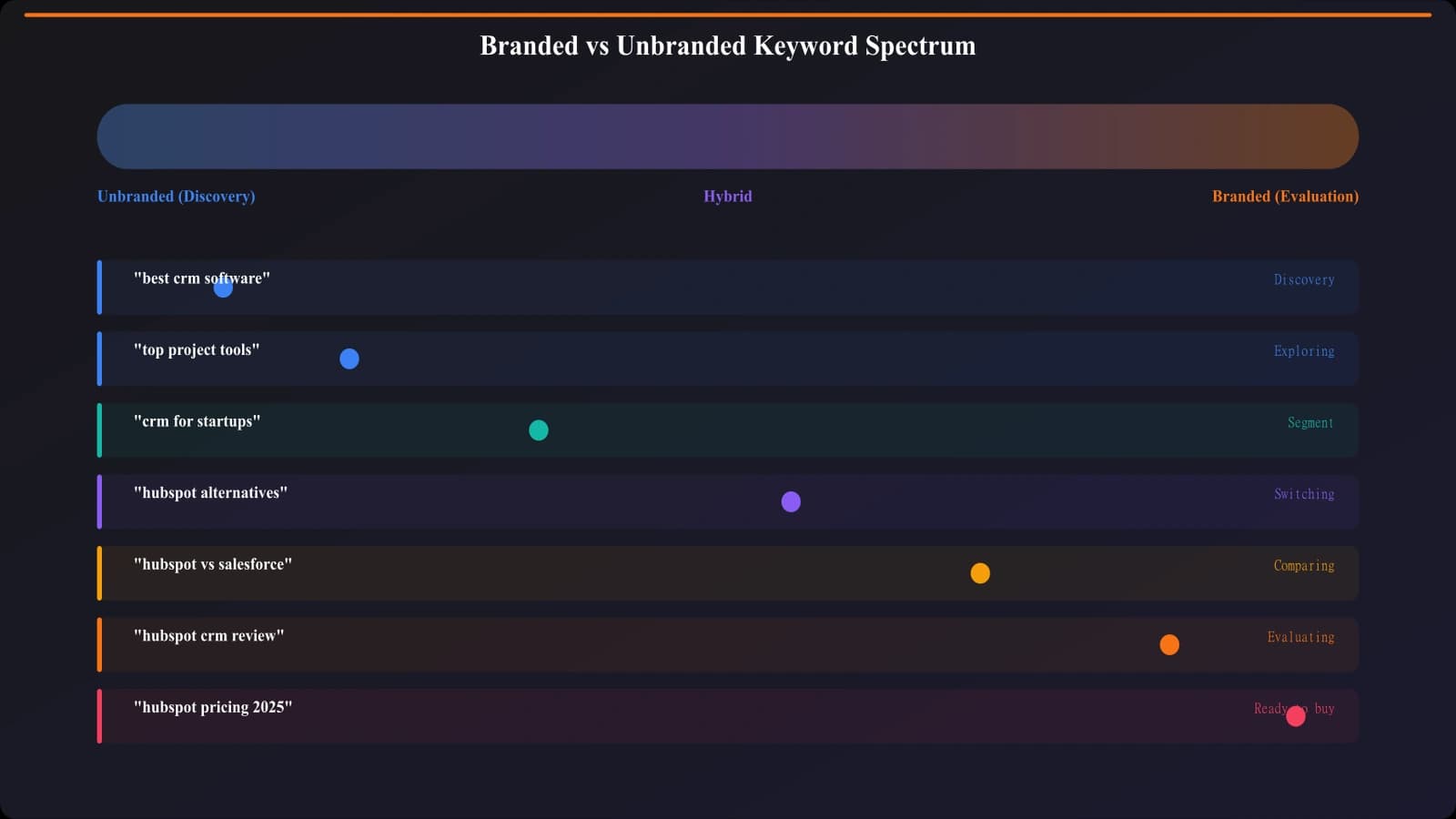
Intent Differences and What They Mean
The branded/unbranded distinction maps to different user mindsets. Understanding these differences shapes content strategy.
Unbranded Intent: Discovery Mode
Users searching unbranded queries are typically:
- Earlier in the buying journey
- Less informed about specific options
- Open to learning about the category
- Looking for expert guidance on what to consider
- Willing to read comprehensive content
Content implication: These users need education. Your content should explain the category, define evaluation criteria, and introduce them to the landscape before recommending specific products.
Branded Intent: Evaluation Mode
Users searching branded queries are typically:
- Further in the buying journey
- Already familiar with at least one product
- Looking for specific alternatives or comparisons
- Ready for detailed feature/pricing comparisons
- Closer to a purchase decision
Content implication: These users need comparison, not education. Get to the point quickly with specific alternatives and direct feature comparisons.
| Factor | Unbranded | Branded |
|---|---|---|
| Buying stage | Early/Mid | Mid/Late |
| Product awareness | Low | High |
| Content expectations | Educational + recommendations | Direct comparisons |
| Conversion timeline | Longer | Shorter |
| Competition type | Category publishers | Named competitors |
Content Structure Differences
The intent differences demand different content approaches.
Unbranded Content Structure
For “best [category]” pages:
- Quick picks: Top 3 for common use cases
- Category overview: What this software type does
- Evaluation criteria: What to look for
- Ranked listicle: 7-15 products with detailed coverage
- Buying guide: How to make the final decision
- FAQ: Common category questions
Branded Content Structure
For “[brand] alternatives” pages:
- Quick answer: Top 3 alternatives with one-line reasons
- Why switch: Common reasons people leave [brand]
- Alternatives list: 5-10 alternatives with comparison to [brand]
- Feature comparison: Table comparing all vs. [brand]
- Migration guide: How to switch from [brand]
Notice the difference: unbranded educates broadly, branded assumes knowledge and focuses on direct comparison.
Generate Both Content Types
Build branded and unbranded comparison pages with the right structure for each intent type.
Try for Free
Competitive Dynamics
Who you're competing against differs significantly between keyword types.
Unbranded Competition
Category-level keywords are dominated by:
- Major publishers: Wirecutter, CNET, Forbes
- Review platforms: G2, Capterra, TrustRadius
- Niche authority sites: Category-specific publications
- Established affiliate sites: Long-standing comparison sites
Ranking difficulty: High. These sites have massive domain authority and established topical expertise. Breaking in requires exceptional content and patience.
Branded Competition
Brand-specific keywords have different competitors:
- The named brand: Their own site often ranks
- Direct competitors: Companies actively targeting the brand's customers
- Review platforms: G2, Capterra with comparison pages
- Affiliate sites: Targeting high-intent switching queries
Ranking opportunity: Often better than unbranded. If you're a competitor to the named brand, you have inherent relevance that publishers lack.
Prioritization Framework
When building your comparison content strategy, how should you allocate resources between branded and unbranded keywords?
Prioritize Branded When:
- You're a direct competitor to well-known products
- You have unique positioning against specific competitors
- Your domain authority is limited (easier wins)
- You want shorter path to conversion
- Your sales team hears “we're comparing you to X” frequently
Prioritize Unbranded When:
- You have strong domain authority
- You want to capture early-stage buyers
- You're building category authority for long-term positioning
- You have resources for comprehensive, expert-level content
- You can differentiate through unique data or methodology
The Balanced Approach
Most mature content strategies include both:
- Foundation: Unbranded category hub pages
- Spokes: Branded alternatives/comparison pages
- Internal linking: Branded pages link to unbranded hubs
- Authority building: Unbranded establishes expertise, branded captures ready buyers
Your Product Positioning by Keyword Type
How you position your own product changes based on keyword type.
On Unbranded Pages
You're one option among many:
- Include yourself where genuinely appropriate
- Don't always rank yourself #1 (hurts credibility)
- Be clear about who you're best for
- Acknowledge competitors' strengths honestly
On Branded Pages
You're directly challenging a specific competitor:
- Lead with your differentiation against that specific product
- Address known pain points of the named product
- Highlight specific features where you win
- Include migration/switching guidance
Using Both Playbooks Together
Branded and unbranded keywords serve different purposes in your content strategy—neither is inherently better, but each requires its own approach.
Key takeaways:
- Intent differs: Unbranded = discovery, Branded = evaluation
- Structure differs: Unbranded educates broadly, Branded compares directly
- Competition differs: Unbranded faces publishers, Branded faces competitors
- Prioritize by situation: New sites often win faster with branded
- Build both: Mature strategies need both for full funnel coverage
When planning your next piece of comparison content, first identify whether you're targeting branded or unbranded intent—then structure accordingly.
For the complete keyword strategy framework, see our Keyword to Page Type Framework. For finding specific opportunities, check our guides on long-tail comparison strategy and competitor keyword gap analysis.

Product Manager at BestPage. Pioneer in AEO research since 2024, exploring the convergence of SEO and GEO (Generative Engine Optimization). Led multiple AI-powered content optimization projects that achieved 300%+ citation increases in ChatGPT and Perplexity.