

Search engines increasingly reward topical authority over individual page optimization. A single well-optimized “best project management software” page competes against hundreds of similar pages. But a comprehensive hub page surrounded by deep spoke content on specific aspects—enterprise features, team collaboration, pricing comparisons, integration guides—signals authoritative coverage that merits ranking preference.
Hub and spoke architecture isn't a secret—it's fundamental content strategy. The challenge is implementation: identifying appropriate hub topics, designing spokes that complement rather than cannibalize, creating internal linking structures that flow authority effectively, and maintaining the architecture as content grows. This guide addresses each challenge comprehensively.
For comparison sites specifically, hub-spoke architecture solves common problems. It prevents keyword cannibalization between similar comparisons. It creates clear paths for users exploring related topics. It concentrates link equity efficiently rather than dispersing it across disconnected pages. It provides a scalable framework for content growth. The benefits compound as your content library expands.
We'll cover the conceptual foundation of hub-spoke architecture, practical implementation for comparison content, internal linking strategies, technical SEO considerations, content planning frameworks, and ongoing maintenance requirements. By the end, you'll have a complete framework for structuring comparison content that maximizes topical authority and ranking potential.
Understanding Hub and Spoke Architecture
Before implementation, understand what hub-spoke architecture is and why it works for SEO.
What is Hub and Spoke Architecture?
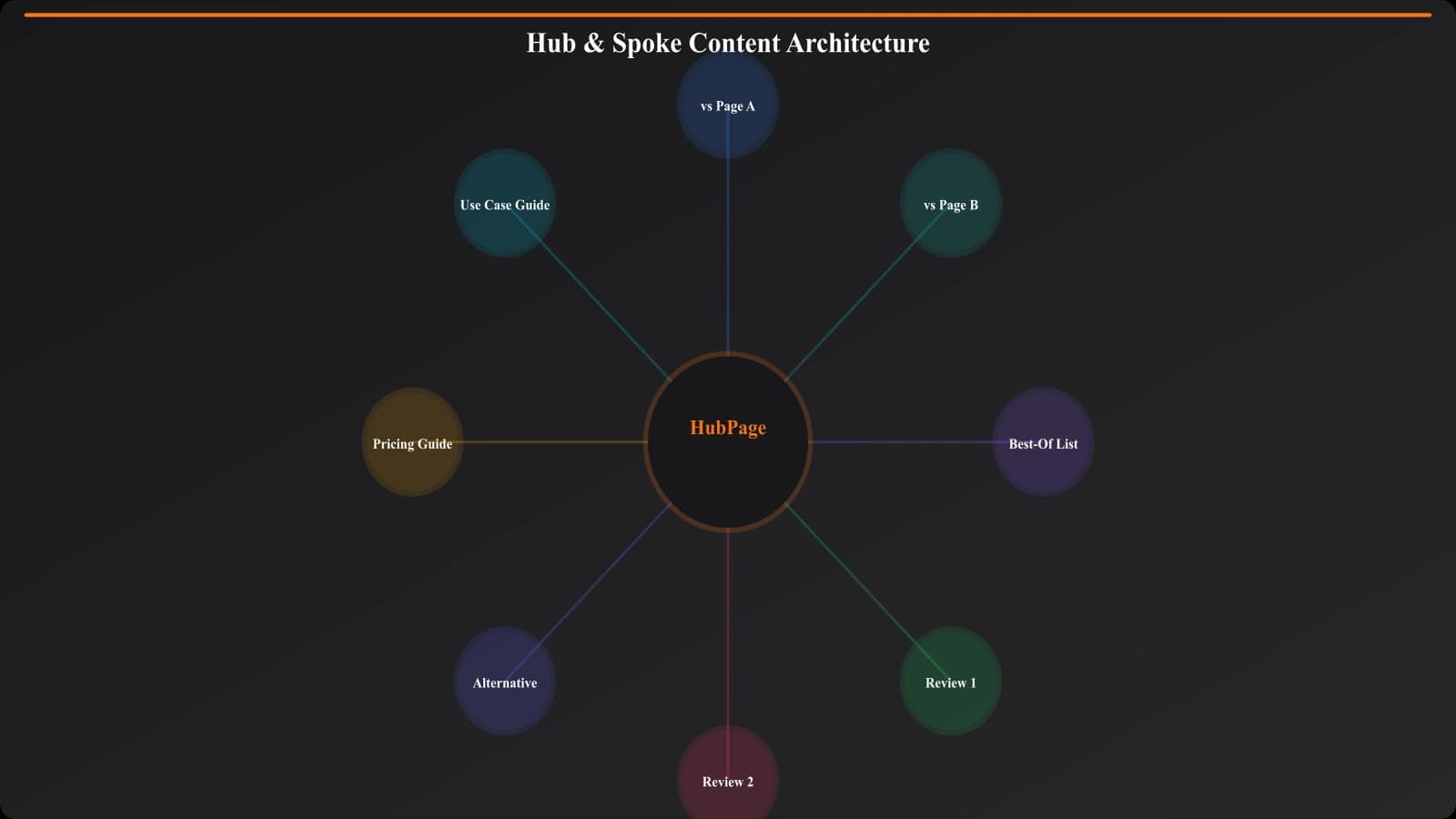
Hub and spoke architecture organizes content into hierarchical clusters:
- Hub pages: Comprehensive pages covering a broad topic, linking to all related spoke content
- Spoke pages: Focused pages addressing specific aspects of the hub topic, linking back to the hub
- Internal links: Systematic connections between hub, spokes, and related content
- Topic clusters: The combined hub-spoke structure treating a topic comprehensively
The hub provides breadth; spokes provide depth. Together, they demonstrate comprehensive topical coverage that search engines recognize and reward.
Why Hub-Spoke Works for SEO
Hub-spoke architecture aligns with how search engines evaluate content:
SEO benefits of hub-spoke:
• Topical authority signals: Comprehensive coverage demonstrates expertise
• Link equity concentration: Internal links focus authority on key pages
• Crawl efficiency: Clear structure helps search engines understand relationships
• Reduced cannibalization: Hierarchical structure clarifies which page targets which query
• User engagement: Related content paths increase time on site
• Content scalability: Framework accommodates growth without reorganization
Search engines explicitly state they evaluate topical authority and content depth. Hub-spoke architecture makes these qualities structurally evident.
Hub-Spoke for Comparison Sites
Comparison sites face specific structural challenges that hub-spoke addresses:
- Many similar pages: “Best X for Y” variants can cannibalize each other without clear hierarchy
- Category overlap: Products span categories, creating linking ambiguity
- Depth vs breadth trade-offs: Can't cover everything deeply on one page
- User journey complexity: Users research across multiple dimensions
- Scale requirements: Successful comparison sites need many pages
Hub-spoke architecture provides the organizational framework to address each challenge systematically.
Designing Hub Pages
Hub pages are the architectural foundation. Design them carefully.
Identifying Hub Topics
Not every topic deserves a hub. Identify topics with these characteristics:
- Significant search volume: The broad topic has meaningful search demand
- Multiple sub-topics: The topic naturally breaks into distinct aspects
- User journey relevance: Users explore from broad to specific
- Content depth potential: Each sub-topic can support substantial content
- Competitive landscape: Competitors haven't comprehensively covered the territory
For comparison sites, natural hubs include broad category comparisons (“Best Project Management Software”), industry-specific guides (“Marketing Tools for Agencies”), and comprehensive buyer's guides for major purchase categories.
| Hub Type | Example | Typical Spoke Topics | Content Characteristics |
|---|---|---|---|
| Category hub | Best CRM Software | By business size, by industry, by feature focus, vs alternatives | Comprehensive overview, top picks, category explanation |
| Use case hub | Sales Team Tools | Prospecting, pipeline, forecasting, commission tracking | Workflow-focused, cross-category, implementation guidance |
| Industry hub | SaaS Marketing Stack | By function, by company stage, by budget level | Industry context, integration focus, case examples |
| Buyer's guide hub | Choosing HR Software | Evaluation criteria, vendor comparisons, implementation guides | Decision-focused, comprehensive, neutral positioning |
| Technology hub | No-Code Platforms | By use case, by skill level, vs traditional development | Educational, comparative, future-oriented |
Hub Content Structure
Hub pages need specific structural elements:
Essential hub page components:
• Comprehensive overview: Introduction covering the entire topic space
• Quick navigation: Jump links to major sections and spoke content
• Top-level recommendations: Best options for common use cases
• Category/sub-topic breakdown: Organization of the topic space
• Spoke content links: Prominent links to all related spoke pages
• Methodology summary: How recommendations are determined
• Update information: When the hub was last comprehensively updated
Hub pages should be genuinely comprehensive—not thin category pages with links, but substantial content that provides value even without visiting spokes.
Hub Page Length and Depth
Hub pages typically require substantial length to achieve comprehensiveness:
- Minimum viable hub: 2,000-3,000 words covering core topic elements
- Competitive hub: 4,000-6,000 words with depth across all sub-topics
- Comprehensive hub: 6,000+ words with extensive detail and examples
The appropriate length depends on topic complexity and competitive landscape. Analyze ranking competitors to calibrate expectations.
Designing Spoke Pages
Spoke pages provide the depth that makes hub-spoke architecture effective.
Identifying Spoke Topics
Spokes address specific aspects of the hub topic:
- Sub-category comparisons: “Best CRM for Small Business” as spoke to “Best CRM Software”
- Feature-focused comparisons: “CRMs with Best Email Integration”
- Use case comparisons: “CRM for Real Estate Agents”
- Head-to-head comparisons: “Salesforce vs HubSpot”
- Methodology/educational: “How to Evaluate CRM Software”
- Implementation guides: “CRM Implementation Checklist”
Each spoke should have distinct search intent and provide value that the hub doesn't fully address.
Spoke Keyword Mapping
Map spokes to specific keywords to prevent cannibalization:
Spoke keyword mapping example (CRM hub):
• Hub: “best CRM software” (highest volume, broadest intent)
• Spoke 1: “best CRM for small business” (size-specific)
• Spoke 2: “best free CRM” (price-specific)
• Spoke 3: “Salesforce vs HubSpot CRM” (comparison-specific)
• Spoke 4: “best CRM for real estate” (industry-specific)
• Spoke 5: “CRM with best mobile app” (feature-specific)
Clear keyword mapping ensures each page has a distinct primary target and reduces internal competition.
Spoke Content Depth
Spokes should provide definitive coverage of their specific topic:
- Deep rather than broad: Focus intensely on the spoke's specific angle
- Comprehensive for intent: Fully address what users with this query need
- Connected to hub: Reference and link to the hub for broader context
- Cross-linked to siblings: Connect to related spokes where relevant
A spoke about “best CRM for small business” should be the definitive resource for that specific query, going deeper than the hub could on small business considerations.
Build Hub-Spoke Content Architecture
Generate interconnected comparison content that signals topical authority.
Try for Free
Internal Linking Strategy
Internal linking is the mechanism that makes hub-spoke architecture work. Without proper linking, the structure provides no SEO benefit.
Hub to Spoke Linking
Every hub should prominently link to all its spokes:
- Contextual links: Links within hub content where spokes are naturally relevant
- Navigation sections: Dedicated sections listing spoke content
- Related content blocks: Sidebar or footer listings of spoke pages
- Table of contents: Links to on-page sections that reference spokes
Hub pages should make spoke content discoverable and easy to access. Users exploring the hub topic should naturally encounter paths to relevant spokes.
Spoke to Hub Linking
Every spoke should link back to its parent hub:
Spoke-to-hub linking patterns:
• Breadcrumb navigation showing hierarchy
• Early-content contextual link (“For our complete guide to CRMs, see...”)
• Related content sections
• Closing content references (“Explore more in our comprehensive CRM guide”)
Spoke-to-hub links flow authority upward, strengthening the hub for competitive broad queries.
Spoke to Spoke Linking
Spokes should also link to sibling spokes where contextually relevant:
- Related alternatives: “If small business CRM isn't right, see our enterprise CRM guide”
- Complementary content: “After choosing your CRM, review our implementation checklist”
- Comparative references: Link to head-to-head comparisons of mentioned products
Cross-linking between spokes strengthens the entire cluster and keeps users engaged within your content ecosystem.
Anchor Text Strategy
Use descriptive, keyword-relevant anchor text for internal links:
| Link Type | Good Anchor Text | Poor Anchor Text | Why It Matters |
|---|---|---|---|
| Hub to spoke | “best CRM for small business” | “click here” or “learn more” | Signals spoke topic to search engines |
| Spoke to hub | “comprehensive CRM software guide” | “main page” | Reinforces hub topical focus |
| Spoke to spoke | “enterprise CRM comparison” | “this article” | Clarifies sibling relationship |
| Cross-cluster | “marketing automation tools” | “related topic” | Connects related but distinct clusters |
Anchor text communicates page relationships to search engines. Make it descriptive and relevant.
Technical SEO Implementation
Technical elements reinforce hub-spoke relationships for search engines.
URL Structure
URL structure should reflect content hierarchy:
Hub-spoke URL patterns:
• Hub: /best-crm-software/
• Spoke: /best-crm-software/small-business/
• Spoke: /best-crm-software/vs-hubspot-salesforce/
• Spoke: /best-crm-software/real-estate/
Hierarchical URLs signal content relationships through structure. Spokes as subdirectories of hubs make relationships explicit.
Breadcrumb Navigation
Implement breadcrumbs that reflect hub-spoke hierarchy:
- Home > Software Comparisons > Best CRM Software (hub)
- Home > Software Comparisons > Best CRM Software > Small Business (spoke)
Breadcrumbs with structured data help search engines understand page relationships and can appear in search results.
Schema Markup
Use schema to communicate content relationships:
- BreadcrumbList: Structured breadcrumb data showing hierarchy
- WebPage with mainEntity: Connect pages to their primary topic
- Article with about: Reference hub topics from spoke articles
- ItemList: Structure listicle content on both hub and spoke pages
Schema doesn't directly affect rankings but helps search engines understand your content structure accurately.
XML Sitemap Organization
Organize sitemaps to reflect content clusters:
Sitemap organization options:
• Group hub and spokes together in sitemap sequence
• Use sitemap index with separate sitemaps per major hub cluster
• Include priority hints favoring hubs over spokes
• Ensure all hub and spoke pages are included and accessible
Clear sitemap organization supports efficient crawling of your hub-spoke structure.
Content Planning Framework
Plan hub-spoke content systematically for coherent architecture.
Hub-Spoke Planning Process
Follow this process when planning new hub-spoke clusters:
- Identify hub opportunity: Validate topic with search volume and competitor analysis
- Map potential spokes: List all sub-topics that warrant separate pages
- Keyword research per spoke: Verify search demand for each spoke topic
- Content gap analysis: Identify what competitors cover and what they miss
- Prioritize spokes: Sequence creation based on value and difficulty
- Plan internal linking: Map relationships before content creation
- Create hub first: Establish foundation before spokes
- Build spokes systematically: Add spokes and link back to hub
- Update hub as spokes complete: Add links to new spoke content
Systematic planning prevents ad-hoc content creation that leads to structural problems.
Spoke Prioritization
Not all spokes are equally valuable. Prioritize based on:
- Search volume: Higher-demand spokes provide more traffic opportunity
- Competitive difficulty: Lower-competition spokes may rank faster
- Hub support: Some spokes strengthen hub rankings more than others
- User journey importance: Critical decision-stage spokes deserve priority
- Content creation efficiency: Some spokes share research or testing
Balance these factors to sequence spoke creation for maximum cumulative impact.
Ongoing Maintenance
Hub-spoke architecture requires ongoing maintenance to remain effective.
Content Freshness
Keep hub and spoke content current:
- Hub updates: Regularly refresh hub overview and recommendations
- Spoke updates: Update spokes when products or market changes affect them
- New spokes: Add spokes as new sub-topics emerge
- Spoke retirement: Remove or consolidate spokes that become irrelevant
- Link maintenance: Ensure internal links remain functional as content changes
Stale content undermines hub-spoke effectiveness. Build maintenance into content operations.
Internal Link Audits
Regularly audit internal linking:
Internal link audit checklist:
• Verify all hub-to-spoke links function
• Check that all spokes link back to hub
• Identify orphan spokes lacking proper linking
• Review anchor text for optimization opportunities
• Look for new cross-linking opportunities
• Remove links to deleted or redirected content
Link rot and missing connections weaken architecture over time. Regular audits maintain structural integrity.
Cluster Expansion
As content grows, expand hub-spoke architecture thoughtfully:
- New clusters: Add new hub-spoke clusters for additional topic areas
- Cluster connections: Link between related clusters appropriately
- Sub-hubs: For large topics, create sub-hubs with their own spokes
- Hub consolidation: Merge overlapping hubs if cannibalization emerges
Architecture should evolve with content, not constrain it. Adapt structure as needs change.
Common Mistakes to Avoid
Learn from common hub-spoke implementation errors.
Mistake: Thin Hub Pages
Hubs that are merely link directories fail to establish authority. They provide no standalone value and don't demonstrate expertise. Build hubs with substantial content that provides value even without visiting spokes.
Mistake: Inconsistent Internal Linking
Incomplete linking undermines architecture. When some spokes don't link to the hub, or the hub doesn't link to all spokes, the structure breaks down. Implement systematic linking and audit regularly.
Mistake: Hub-Spoke Cannibalization
When hubs and spokes target too-similar keywords, they compete. Clear keyword differentiation with distinct primary targets for each page prevents internal competition. Map keywords before creating content.
Mistake: Neglecting Maintenance
Hub-spoke architecture requires ongoing investment. Content that was accurate becomes outdated. Links break. New sub-topics emerge. Build maintenance into content operations rather than treating architecture as set-and-forget.
Conclusion: Architecture as Competitive Advantage
Hub-spoke architecture isn't just organizational convenience—it's strategic SEO infrastructure. Properly implemented, it signals topical authority, concentrates link equity, prevents cannibalization, and supports sustainable content growth. These benefits compound over time, creating increasing advantage against competitors with less structured approaches.
The investment is substantial: careful planning, comprehensive hub content, deep spoke content, systematic linking, and ongoing maintenance. But the returns justify the investment. In competitive comparison markets, structured content architecture often determines who ranks and who struggles.
Start with your most important topic cluster. Build a comprehensive hub. Create focused spokes systematically. Link thoroughly. Maintain diligently. Let the structure prove its value, then expand to additional clusters. Over time, hub-spoke architecture becomes the foundation of sustainable comparison content success.
For methodology transparency approaches, see Evaluation Criteria Transparency. For first-party research integration, see First-Party Research. For bias prevention in content, see Bias Prevention.

Product Manager at BestPage. Pioneer in AEO research since 2024, exploring the convergence of SEO and GEO (Generative Engine Optimization). Led multiple AI-powered content optimization projects that achieved 300%+ citation increases in ChatGPT and Perplexity.