
So you've optimized your listicles using the patterns from our AI citation framework. You've implemented entity signals and citable content blocks. Great. But now what? How do you actually know if it's working?
Here's the frustrating reality: unlike traditional SEO—where Google Search Console gives you clear data on rankings, impressions, and clicks—AI visibility tracking is fragmented and incomplete. There's no central dashboard showing when ChatGPT cited your page or how often you appear in Perplexity answers.
This gap is a problem because you can't improve what you can't measure. So we built a framework. It's not perfect—the space is still maturing—but it gives you actionable visibility into your AI search performance using tools that actually exist today.
The Four-Layer AI Visibility Framework
Effective AI visibility measurement requires monitoring at four distinct layers. Each layer tells you something different—and you need all four to get the complete picture.
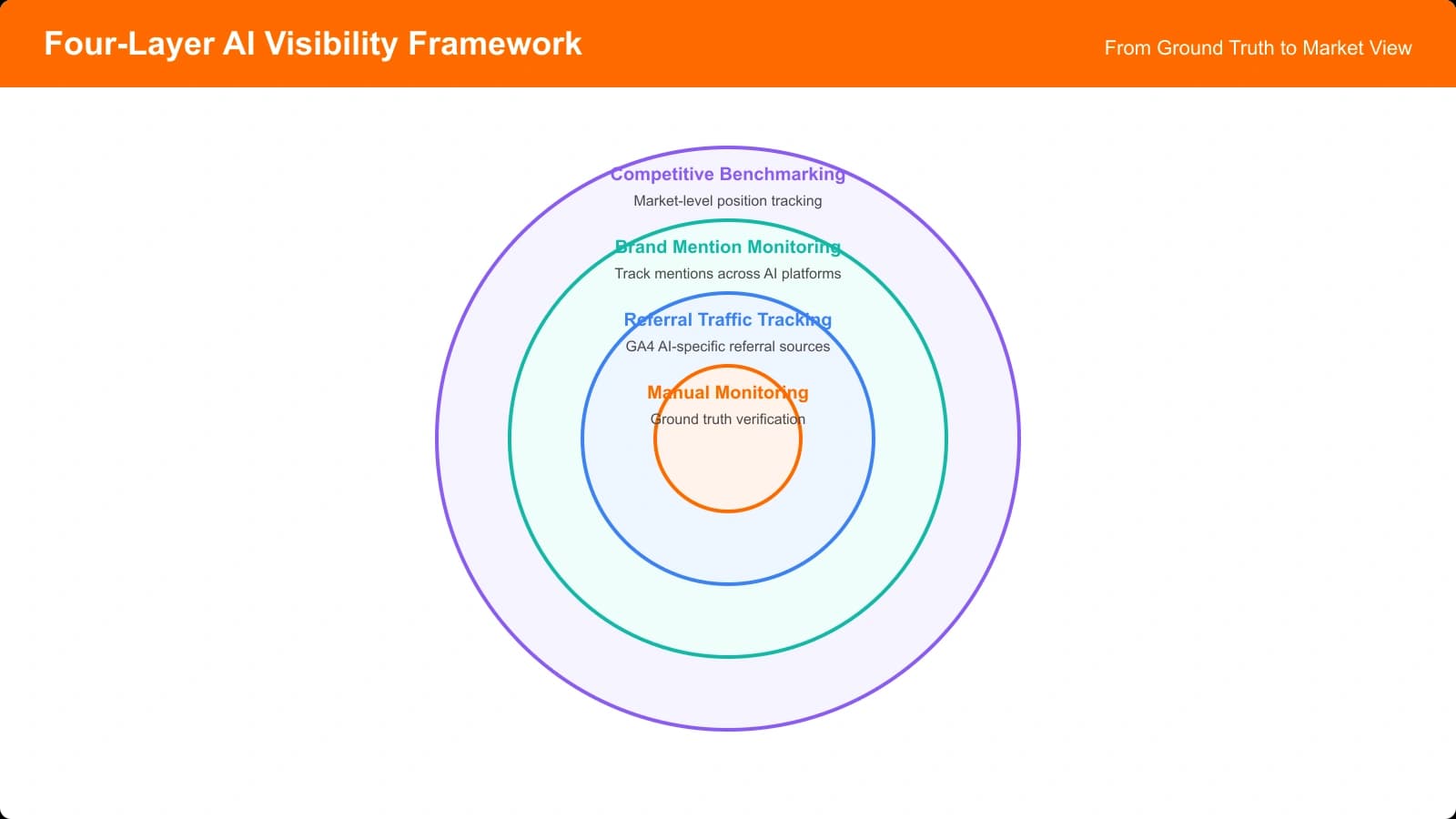
| Layer | What It Measures | Effort Level |
|---|---|---|
| Manual Monitoring | Direct citation presence in AI responses | High (but most accurate) |
| Referral Tracking | Traffic from AI platforms to your site | Low (automated via GA4) |
| Brand Mention Monitoring | When your content is referenced | Medium |
| Competitive Benchmarking | Your visibility vs competitors | Medium-High |
Let's break down each layer—what it involves, which tools to use, and how to actually do it.
Layer 1: Manual Monitoring (Ground Truth)
This is the most time-intensive method, but it's also the most accurate. You're literally checking AI responses yourself to see if your content appears. Tedious? Yes. Essential? Also yes—especially when you're first establishing baselines.
What to Check
Create a list of 20-50 target queries where you want your listicles to appear. These should include:
- Brand queries: Your site name plus topic (e.g., “[Your Site] best CRM tools”)
- Category queries: Topics where you have content (e.g., “best project management software”)
- Comparison queries: Head-to-head matchups you've covered (e.g., “Notion vs Coda”)
- Question queries: Questions your content answers (e.g., “what is the best free CRM?”)
Platforms to Monitor
Different AI platforms cite sources differently. Here's where to check:
- Google AI Overviews: Check in incognito mode to avoid personalization effects
- Perplexity: Shows source links directly in responses—easiest to track
- ChatGPT with Browse: Cites sources when using the web browsing feature
- Bing Copilot: Lists sources in conversational responses
- Claude: Citations appear when given web access
The Tracking Spreadsheet
Set up a simple spreadsheet with these columns. Run through your query list weekly at first, then monthly once you have baselines:
| Query | Platform | Date Checked | Cited? | Position | Competitors Cited |
|---|---|---|---|---|---|
| best crm for startups | Google AI | 2026-01-29 | Yes | 2nd source | G2, Capterra |
| notion vs coda | Perplexity | 2026-01-29 | No | — | Zapier, PCMag |
Layer 2: Referral Tracking (Traffic Impact)
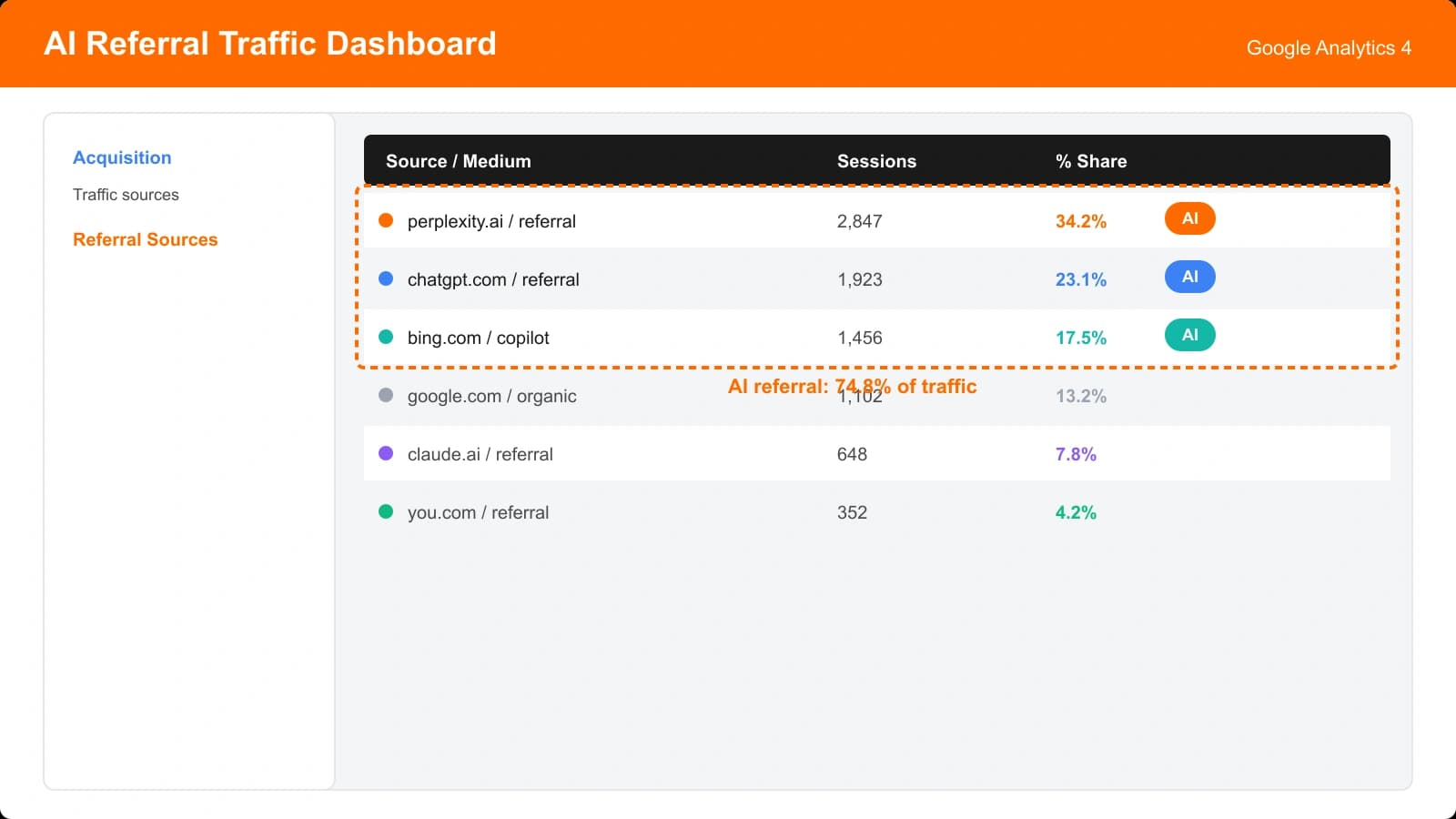
When AI platforms cite your content with clickable links, you'll see referral traffic. This is the closest thing to “measurable impact” for AI visibility—actual visits you can attribute to AI citations.
Google Analytics 4 Setup
In GA4, navigate to Reports → Acquisition → Traffic Acquisition. Look for these referral sources:
perplexity.ai— Direct Perplexity referrals (most reliable)chat.openai.com— ChatGPT with Browse enabledbing.com/chat— Bing Copilot referralsgoogle.com— Includes AI Overview clicks, but mixed with regular search
Identifying AI Overview Traffic
Google AI Overview traffic is tricky because it still shows up as google.com referral—you can't separate it directly. But you can identify likely AI traffic by looking at patterns:
- Engagement patterns: AI Overview visitors often have higher engagement—they've already seen a summary and clicked for depth
- Query correlation: Cross-reference with queries you know trigger AI Overviews
- Time on page: AI referrals typically show higher average engagement time than regular organic
Track AI Visibility Automatically
Generate listicles with built-in citation optimization. See what's working without the manual effort.
Try for Free
Layer 3: Brand Mention Monitoring
Beyond direct citations with links, you want to track when your brand or content is mentioned in AI contexts—even without attribution. This gives you broader awareness signals.
Tools to Consider
- Mention: Tracks brand mentions across web, social, and some AI-generated content. Solid mid-tier option.
- Brandwatch: Enterprise-grade monitoring with AI content detection. Expensive but comprehensive.
- Brand24: Good web monitoring at a reasonable price point.
- Google Alerts: Free but limited. Set up alerts for your brand + key content titles. Better than nothing.
What to Set Alerts For
- Your brand name + “best” or “top” keywords
- Your specific article titles or unique phrases
- Your domain name in comparison contexts
- Key competitors (for benchmarking)
Layer 4: Competitive Benchmarking
Understanding your AI visibility relative to competitors provides essential context. Being cited in 30% of target queries means nothing if competitors are at 80%.
The Benchmarking Process
- Identify competitors: List 5-10 sites that rank for your target queries
- Run the same queries: Check who gets cited when you don't
- Analyze their structure: What do cited competitors have that you don't?
- Track over time: Are you gaining or losing share of citations?
Key Metrics to Track
| Metric | How to Calculate |
|---|---|
| Citation Share | Your citations ÷ Total citations across competitors |
| Query Coverage | Queries where you're cited ÷ Total target queries |
| Platform Presence | Platforms where you appear ÷ Total platforms monitored |
| Citation Position | Average position when cited (1st source, 2nd, 3rd...) |
AI Visibility Tools Compared
The tooling landscape for AI visibility is evolving fast. Here's how the current options stack up:
| Tool | Price | Best For | Limitations |
|---|---|---|---|
| Otterly.ai | $49/mo+ | AI Overview specific tracking | Google-focused only |
| Nightwatch | $39/mo+ | SGE + traditional rank tracking | Limited AI platform coverage |
| Semrush | $129/mo+ | Comprehensive SEO + AI insights | AI features still developing |
| Manual tracking | Free (time cost) | Ground truth accuracy | Time-intensive, doesn't scale |
The Monthly AI Visibility Report
Combine all four layers into a monthly report. Here's a template structure:
- Executive Summary: Citation count change vs last month, top-performing content, key wins
- Query Coverage: Percentage of target queries where you're cited
- Platform Breakdown: Citations by platform (Google AI, Perplexity, ChatGPT, etc.)
- Traffic Impact: AI referral traffic trends and engagement metrics
- Competitive Position: Citation share vs key competitors
- Action Items: Content to optimize, new queries to target, structural fixes needed
The goal isn't perfect data—it's directional insights that help you improve over time. Even imperfect measurement beats flying blind.
Start Measuring Today
AI visibility tracking is messy right now. There's no Search Console equivalent, no unified dashboard, no perfect solution. But that doesn't mean you can't measure it. The four-layer framework gives you coverage:
- Manual monitoring for ground truth on what's actually being cited
- Referral tracking for measurable traffic impact
- Brand monitoring for broader mention awareness
- Competitive benchmarking for context and prioritization
Start simple. Set up a tracking spreadsheet with your 20 most important queries. Configure GA4 to catch AI referrals. Check your queries weekly. Build from there as the measurement ecosystem matures.
The teams that figure out AI visibility measurement now will have a massive advantage as this channel grows. The data may be imperfect, but having some data beats having none.
What's next? For the complete optimization framework, see our guide on how listicles get cited by AI. If your measurements show you're not getting cited despite ranking well, check our troubleshooting guide on why AI skips your listicle.

Product Manager at BestPage. Pioneer in AEO research since 2024, exploring the convergence of SEO and GEO (Generative Engine Optimization). Led multiple AI-powered content optimization projects that achieved 300%+ citation increases in ChatGPT and Perplexity.