
Here's a scenario that drives content teams crazy: you've got a “Best CRM Tools for Small Business” listicle sitting pretty at position #3 for your target keyword. Organic traffic is solid. Engagement metrics look good. By traditional SEO standards, it's winning.
Then you check Google's AI Overview for that same query—and a competitor's article is being cited instead. Not yours. Theirs. Even though you outrank them. What gives?
This isn't random bad luck. AI systems like Google's AI Overviews, ChatGPT, and Perplexity have specific requirements for what makes content “citable.” Your page can rank well by traditional SEO standards while completely missing the signals AI systems look for. If you want to understand the full picture, check out our guide on how listicles get cited by AI. But right now, let's diagnose your specific problem.
I've audited dozens of listicles with exactly this issue. In almost every case, the problem comes down to one—or a few—of these seven fixable reasons.
Quick Diagnosis: Which Issue Is Yours?
Before we dive into each problem, here's a quick checklist to help you identify what's likely wrong with your listicle. Go through these in order—they're ranked by how commonly they cause citation failures.
| Check | Pass Criteria | Severity |
|---|---|---|
| Verdict statements | Each tool has explicit “Best for X” statement | Critical |
| Specific positioning | No vague terms like “affordable” or “popular” | Critical |
| Recommendation placement | First recommendation within 400 words | High |
| Consistent formatting | All tools follow same template structure | High |
| Entity signals | Canonical names used consistently throughout | Medium |
| Schema markup | ItemList + Product schema validates without errors | Medium |
| Information freshness | Updated within last 3 months, pricing verified | Medium |
Found your weak spots? Let's fix them one by one.
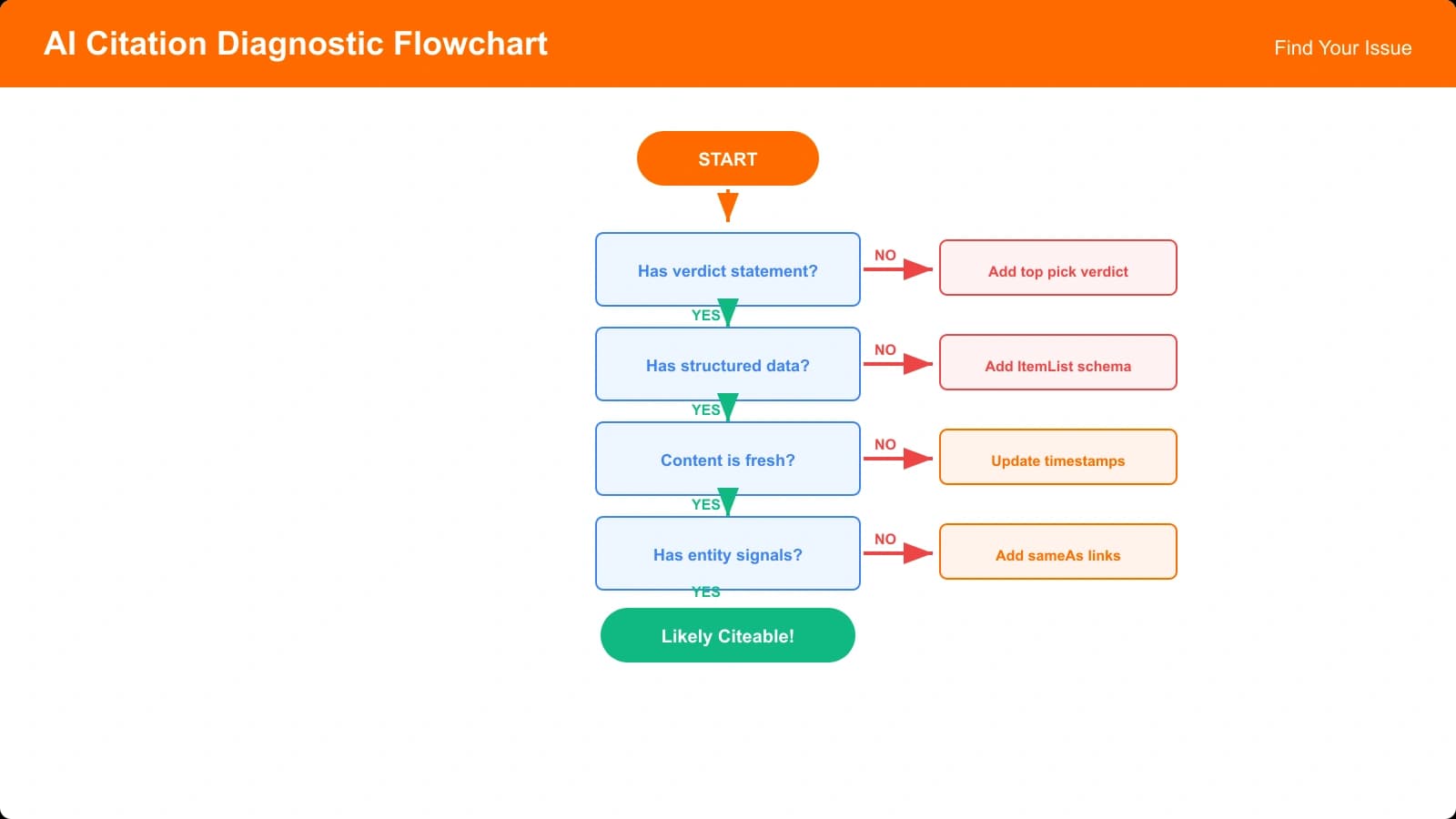
The 7 Fixable Issues (And How to Fix Them)
Issue #1: Missing Verdict Statements
The Problem: Your listicle describes tools but never actually says which is best for what. You're presenting information, but not making recommendations. AI systems need explicit, extractable answers—not implied preferences that require inference.
How to Diagnose: Search your page (Ctrl+F) for phrases like:
- “Best for”
- “Our top pick”
- “We recommend”
- “The winner is”
- “Choose this if”
If you find none, you've got a verdict problem. Your content is informative but not decisional.
The Fix: Add explicit verdict statements using this template:
[Tool Name] is best for [specific audience/use case] because [primary reason]. [Supporting evidence]. [Caveat if relevant].
After: “HubSpot is best for small marketing teams because it offers free CRM with built-in email marketing and automation. Most competitors charge separately for these features. However, advanced reporting requires paid plans starting at $50/month.”
Issue #2: Vague Positioning
The Problem: Every tool in your list is described as “great,” “powerful,” “popular,” or “affordable.” These generic descriptors give AI systems nothing to work with when matching content to specific queries. If everything is great, nothing is useful.
How to Diagnose: Look at your “Best for” statements and tool descriptions. Are they actually specific? Do they include:
- Specific team sizes? (“teams of 5-20” vs “small teams”)
- Specific use cases? (“sales pipeline management” vs “sales”)
- Specific constraints? (“under $50/month” vs “affordable”)
The Fix: Replace every vague descriptor with a specific one:
| Vague (Kill These) | Specific (Use These) |
|---|---|
| “Great for small businesses” | “Best for teams of 5-20 with limited IT support” |
| “Affordable pricing” | “Free tier available, paid plans from $12/user/month” |
| “Easy to use” | “No training required, average onboarding under 30 minutes” |
| “Popular choice” | “Used by 50,000+ companies including Airbnb and Spotify” |
Issue #3: Buried Recommendations
The Problem: Your actual recommendations are hidden under 1,500 words of context, methodology explanations, and disclaimers. By the time you get to the list, AI systems may have already stopped extracting.
How to Diagnose: Count the words before your first actual tool recommendation. If it's more than 300-400 words of preamble, your recommendations are too buried.
The Fix:
- Add a TL;DR at the top with your top 3 picks and why
- Create a quick-reference table before detailed reviews
- Move methodology sections to the end or make them collapsible
- Lead with value—context and caveats can come after recommendations
Generate Properly-Structured Listicles
Create best-of pages with the right structure from the start. No retrofitting needed.
Try for Free
Issue #4: Inconsistent Formatting
The Problem: Your first three tools follow a clear template, but then the format breaks down. Tools 4-10 might have different sections, different structures, varying levels of detail. This inconsistency makes it hard for AI to reliably extract structured information.
How to Diagnose: Compare any three tools in your list. Do they all have:
- The same heading structure?
- The same sections (pros, cons, best for, pricing)?
- Similar content depth and detail level?
The Fix: Create a strict template and apply it to every single entry. As we outline in our citable content blocks guide, each tool should have:
- Name + positioning label: “Notion — Best for All-in-One Workspaces”
- One-sentence summary
- Key strengths (3-5 consistent bullets)
- Limitations (2-3 bullets—yes, limitations)
- Best for statement
- Pricing with actual numbers
No exceptions. Every tool, same structure.
Issue #5: Weak Entity Signals
The Problem: You're using inconsistent naming, abbreviations, or variations that make it hard for AI to confidently identify which products you're discussing. “Hubspot” vs “HubSpot” vs “the platform” creates ambiguity.
How to Diagnose: Search for any product name in your article. Do you find:
- Multiple spellings? (“Hubspot” vs “HubSpot”)
- Abbreviations mixed with full names? (“SFDC” vs “Salesforce”)
- Generic references replacing product names? (“the platform,” “the tool,” “it”)
The Fix: Follow our complete guide on entity signals for best-of pages. The quick version:
- Use the exact canonical name from the product's official website
- Never switch between spelling variations
- Repeat the entity name rather than using pronouns
- Include the full entity name in headings
Issue #6: Missing Schema Markup
The Problem: Your page has no structured data, or the schema doesn't accurately represent your rankings. AI systems use schema as both a trust signal and an extraction guide.
How to Diagnose: Run your page through Google's Rich Results Test. Check for:
- ItemList schema wrapping your rankings
- Product or SoftwareApplication schema for each tool
- FAQ schema if you have an FAQ section
- Any validation errors or warnings
The Fix: Implement at minimum:
- ItemList schema wrapping your ranked items in order
- Product/SoftwareApplication schema for each tool (name, description, URL)
- sameAs properties linking to official websites
Issue #7: Outdated Information
The Problem: Your listicle references 2024 pricing, discontinued features, or products that have significantly changed. AI systems can detect staleness and deprioritize outdated content.
How to Diagnose: Check your article for:
- Pricing that doesn't match current product websites
- Features that have been added or removed
- Products that have been acquired, renamed, or discontinued
- Publication or “last updated” date more than 6 months old
The Fix:
- Update pricing quarterly at minimum—set calendar reminders
- Verify features against current product marketing pages
- Add a prominent “Last Updated” date and actually update it
- Update dateModified in your schema when you make changes
- Remove discontinued products or clearly mark them as such
What to Fix First
You probably found multiple issues. Don't try to fix everything at once. Here's how to prioritize:
- High priority (fix immediately): Missing verdicts and vague positioning. These are deal-breakers. Without explicit recommendations and specific positioning, your content fundamentally isn't citable.
- Medium priority (fix this week): Buried recommendations and inconsistent formatting. These are extraction blockers—AI might want to cite you but can't find what it needs.
- Lower priority (fix this month): Schema, entity signals, and freshness refinements. These are optimization layers on top of a solid foundation.
After each fix, give it 2-4 weeks, then check your AI visibility using the methods in our AI visibility measurement guide. Systematic troubleshooting beats random changes every time.
Most Listicles Have 2-3 of These Issues
Here's some good news: when we audit listicles that rank but don't get cited, most have 2-3 of these problems—not all seven. That means focused fixes can make a real difference relatively quickly.
The most common combo we see? Missing verdicts + vague positioning + inconsistent formatting. Fix those three and you've addressed the most critical citation blockers. Everything else is optimization.
Teams that apply these fixes systematically typically see noticeable citation improvements within 30 days—often appearing in AI answers for the first time. The gap between ranking and getting cited is real, but it's bridgeable.
Start with the quick diagnosis table above. Identify your specific issues. Fix the critical ones first. Measure. Iterate. That's the formula.
Need the full picture? For the complete framework on what makes listicles citable, see how listicles get cited by AI. And if you want to understand the difference between being mentioned and properly cited, read brand mentions vs citations.

Product Manager at BestPage. Pioneer in AEO research since 2024, exploring the convergence of SEO and GEO (Generative Engine Optimization). Led multiple AI-powered content optimization projects that achieved 300%+ citation increases in ChatGPT and Perplexity.