

“We're getting mentioned in ChatGPT responses!” Your marketing team is excited. The CEO is excited. Everyone's excited. Then someone asks the obvious question: “So... how much traffic is that driving?”
Awkward silence. Because those “mentions” aren't actually citations. There's no link. No attribution. No way for users to click through to your site. You're getting awareness, sure—but awareness without action is just a vanity metric.
This distinction matters more than most people realize. As AI search becomes a significant channel—with tools like Google's AI Overviews, Perplexity, and ChatGPT with browsing reshaping how people find information—understanding what “visibility” actually means is critical for your strategy.
The Core Definitions
Let's get precise about what we're talking about. These terms get thrown around loosely, and that imprecision leads to bad strategy.
Brand Mention
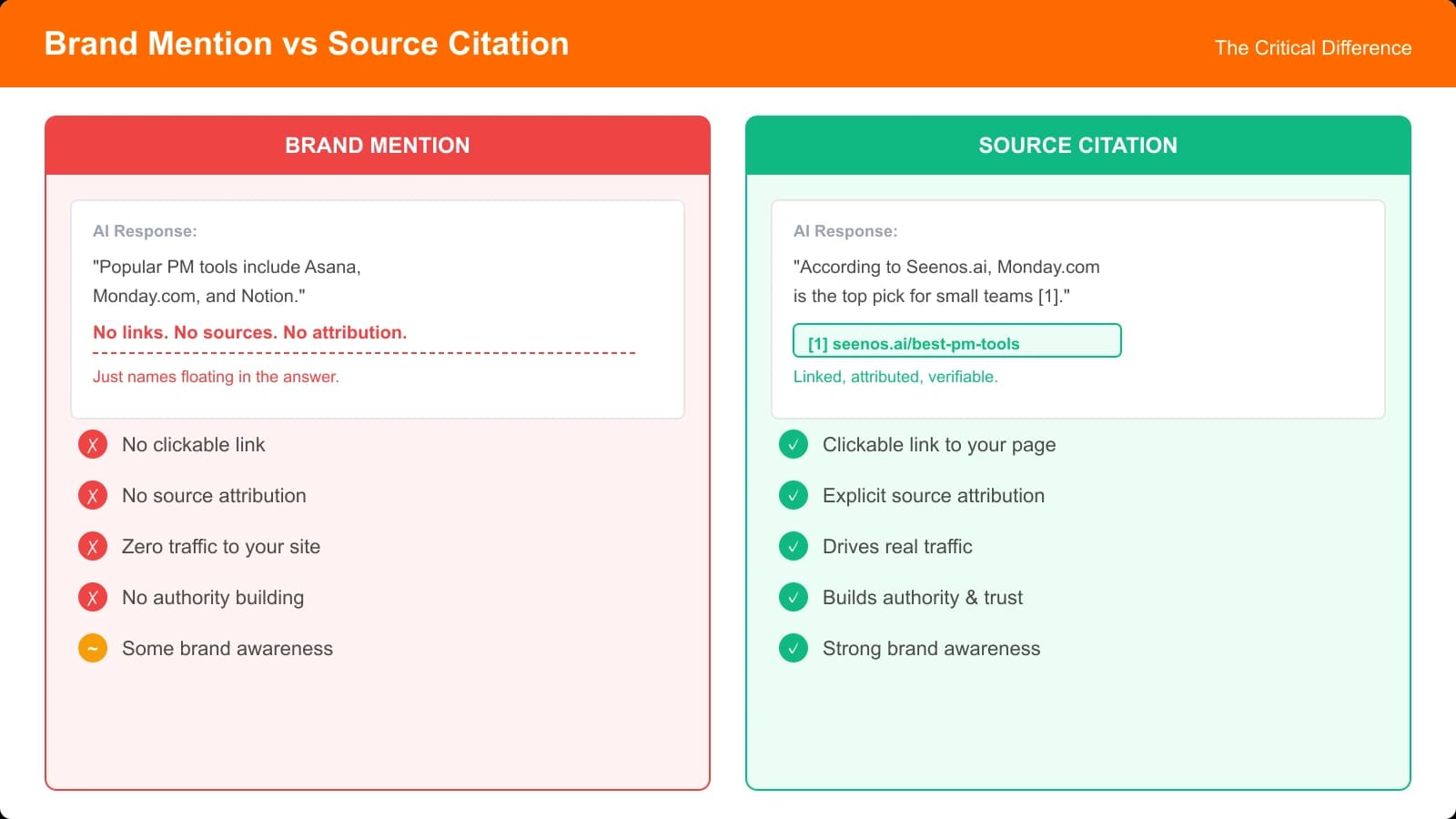
A brand mention occurs when an AI system includes your brand, product, or company name in its response without attributing information to your website or providing a link to your content.
What it looks like:
“Popular project management tools include Asana, Monday.com, and Notion.”
In this example, all three brands are mentioned, but the AI isn't citing any specific source. The information comes from the AI's training data or synthesized general knowledge. There's no link to click. No source to verify. Just... names.
Citation (Source Citation)
A citation occurs when an AI system references your content as a source, typically with a clickable link, footnote number, or explicit source attribution.
What it looks like:
“According to TechCrunch, Notion has grown to over 30 million users worldwide [1].”
Here, TechCrunch is cited as the source. Users can verify the information. They can click through to the original article. The source gets credit, traffic, and authority building.
Related Terms You Should Know
| Term | Definition |
|---|---|
| AI Overview | Google's AI-generated summary appearing above traditional search results |
| Source attribution | Credit given to the original source of information |
| Linked citation | A citation that includes a clickable URL to the source |
| Implicit mention | When information from your content is used without naming your brand at all |
| GEO | Generative Engine Optimization—the practice of optimizing content to appear in AI-generated responses |
Why This Distinction Matters (A Lot)
Understanding mentions vs citations isn't academic hairsplitting. It has direct, measurable implications for your content strategy and business outcomes.
Traffic Impact
Citations drive clicks. Mentions don't. When Perplexity or Google AI Overview cites your page with a link, users can click through. When ChatGPT mentions your brand without a source, there's no path back to your site. Your brand awareness goes up, maybe. Your traffic? Zero.
According to data from Search Engine Land, AI Overview citations receive 2-3x higher click-through rates than traditional organic results for the same query—*when links are provided*. But that only applies to citations, not mentions.
Authority Building
Citations build credibility. Mentions provide awareness. When you're cited as a source, you're positioned as an authority—the AI is essentially vouching for your expertise. When you're merely mentioned alongside competitors (“tools like Notion, Asana, and Monday”), you're just in a category. There's no differentiation.
Verifiability
Citations allow verification. Mentions don't. Users increasingly want to verify AI-generated claims. Citations provide that verification path. Mentions leave claims unsubstantiated—which may actually hurt trust if users wonder where the AI got its information.
How Different AI Platforms Handle Citations
Not all AI platforms cite sources the same way. Understanding these differences helps you prioritize which platforms to optimize for.
| Platform | Citation Style | Click-Through? |
|---|---|---|
| Google AI Overviews | Linked source cards with favicon and title | Yes, prominent links |
| Perplexity | Numbered footnotes with full URLs | Yes, all sources linked |
| ChatGPT (Browse mode) | Inline citations with clickable links | Yes, when browse active |
| ChatGPT (No browse) | May mention brands, no citations | No—training data only |
| Bing Copilot | Superscript numbers with source list | Yes, numbered sources |
| Claude | Varies; often mentions without links | Depends on context |
The platforms with reliable citation behavior—Perplexity, Google AI Overviews, Bing Copilot—are the ones worth optimizing for first. ChatGPT without browse mode is a mentions-only environment where your optimization efforts won't translate to traffic.
Get Cited, Not Just Mentioned
Create listicles structured for proper source citations—with the patterns AI systems actually extract.
Try for Free
How to Move from Mentions to Citations
So your brand is getting mentioned but not cited. How do you upgrade that visibility? Here's the playbook.
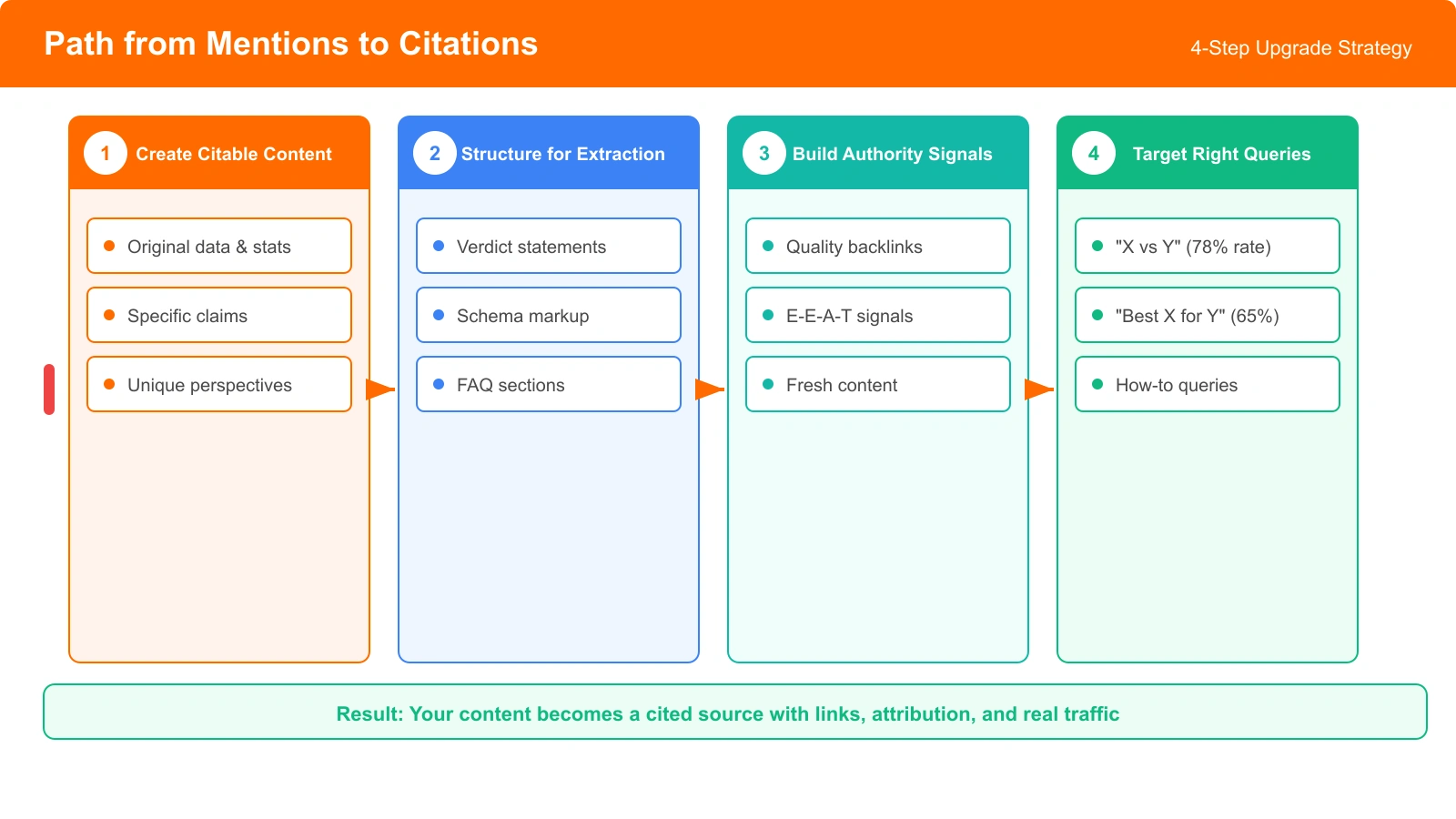
1. Create Actually Citable Content
AI systems cite content that provides verifiable, specific information. They don't cite generic marketing copy. To get cited:
- Add original data—statistics, research, or findings that can't be found elsewhere
- Include specific claims that require source attribution
- Provide unique perspectives that can't be synthesized from training data
See our guide on citable content blocks for specific templates that consistently get cited.
2. Structure for Extraction
Even great content won't get cited if AI can't easily extract it. Optimize your structure:
- Explicit verdict statements that directly answer specific questions
- Structured data (schema markup) confirming your content's topic and claims
- FAQ sections matching how users phrase questions in AI tools
3. Build Authority Signals
AI systems prefer citing authoritative sources. Strengthen your site's perceived authority:
- Build backlinks from credible sources in your industry
- Ensure E-E-A-T signals—Experience, Expertise, Authoritativeness, Trust
- Maintain fresh, accurate content—outdated information signals lower reliability
4. Target Citation-Friendly Query Types
Some queries naturally generate more citations than others. Focus your efforts:
- “X vs Y” comparisons—78% citation rate in our research
- “Best X for Y” queries—65% citation rate
- How-to and explanatory queries—variable but often high
For more on which queries generate citations, see our research on what triggers AI Overviews.
When Brand Mentions Are Actually Enough
I've been emphasizing citations, but let me be fair: mentions aren't worthless. In some contexts, they provide real value.
For Pure Brand Awareness Goals
If your primary objective is awareness—getting your name in front of people, staying top of mind—mentions accomplish that. When someone asks “what are some project management tools?” and the AI responds “Notion, Asana, Monday.com, and ClickUp are popular options,” you're in the consideration set even without a citation.
For Category Association
Being consistently mentioned alongside category leaders reinforces your position in that category. If AI systems reliably include your brand when discussing your space, that's a signal of relevance even without direct links.
For Product Recommendations
When AI recommends your product directly—“For that use case, try [Your Product]”—the mention itself has value. The user now has a clear next step even if they have to search separately to find you.
How to Track Mentions vs Citations
You need to monitor both types of visibility, but track them separately with different methods.
Tracking Citations
- Referral traffic in GA4: Monitor traffic from AI platforms (perplexity.ai, chat.openai.com, etc.)
- Manual monitoring: Check AI responses for your target queries regularly
- Backlink tools: Some AI citations show up in backlink monitoring tools
Tracking Mentions
- Brand monitoring tools: Mention, Brand24, or Brandwatch
- Manual sampling: Query AI platforms regularly for brand-related terms
- Social listening: People often share interesting AI responses on social media
For the complete measurement framework, see our guide on measuring AI visibility.
The Distinction That Drives Strategy
Let's recap the core distinction:
- Brand mentions = Your name appears in AI responses without attribution or links
- Citations = Your content is used as a source with explicit attribution and clickable links
Citations drive measurable outcomes: traffic, authority, verification. Mentions provide softer benefits: awareness, category association, consideration.
For most businesses, citations should be the primary optimization target. They're harder to earn, but they deliver real, trackable value. Mentions are nice to have—but if you're only tracking mentions and calling it “AI visibility,” you're celebrating the wrong metric.
The good news? The same structural improvements that earn citations often increase mentions too. Focus on creating genuinely citable content, and both will follow.
Ready to get cited? For the complete guide to earning citations, see how listicles get cited by AI. If you're getting mentions but not citations, our troubleshooting guide on why AI skips your listicle can help diagnose the issue.

Product Manager at BestPage. Pioneer in AEO research since 2024, exploring the convergence of SEO and GEO (Generative Engine Optimization). Led multiple AI-powered content optimization projects that achieved 300%+ citation increases in ChatGPT and Perplexity.